
Tathata
It is what it is

Today’s New York Times Spelling Bee letters:
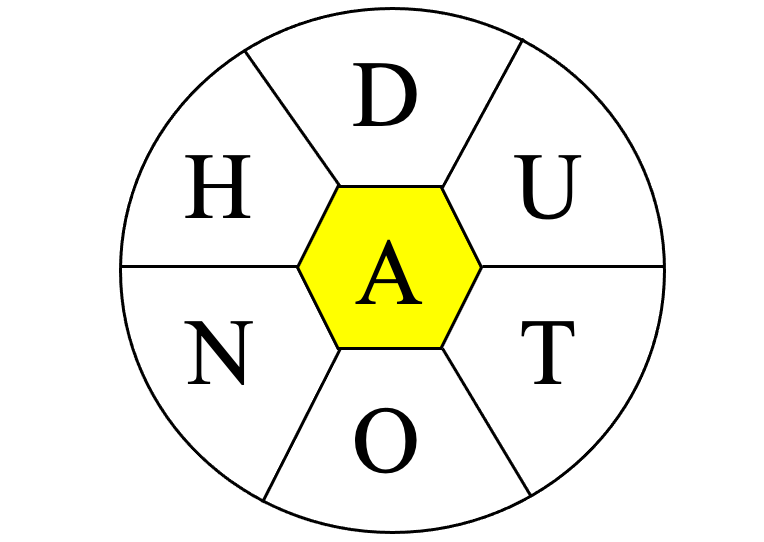
D, H, N, O, T, U, and center A (all words must include A)
Merriam-Webster says…
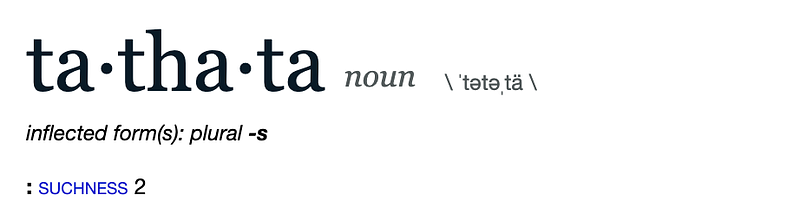
Silly little dictionary! Don’t you know that tathata can’t possibly be a word if The New York Times says it ain’t?
For a complete list of rejected words, check out the Spelling Bee Master.
What’s your favorite dord* from today’s puzzle?
My Two Cents
Being of Jewish heritage, I tread carefully when it comes to discussing other religions. On Tuesday I wrote about ambo, a “a large pulpit or reading desk in early churches and in contemporary Greek and Balkan churches”. But I don’t consider writing about a piece of church furniture to be as complicated as addressing theological concepts. When it comes to that, I admit I don’t even master those of my own religion. So there’s no way I’ll come close to being able to delve into the intricacies of other faiths.
With that in mind, I submit to my readers that my intention here (and in future articles such as this one) is to cover the basics relating to whatever word it is I’m writing about. I preemptively apologize for any misunderstandings and say outright that I am trying my best not to offend. Still if anyone thinks anything needs correcting, please let me know in the comments section.
Moving on to our daily dord*…
The definition of tathata as “suchness (2)” does not help if you don’t know what the second entry of suchness is. But we here at Silly Little Dictionary! have incredible resources and were able to click on the link blue word for you, revealing this:
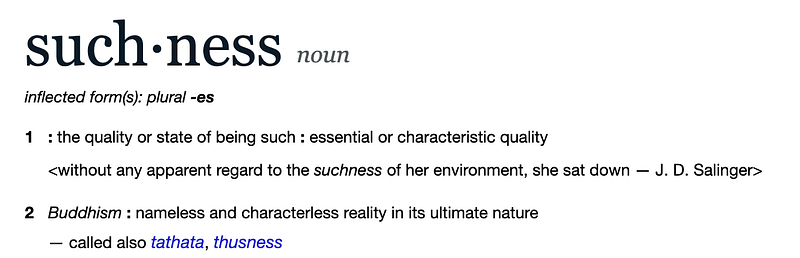
“Nameless and characterless reality in its ultimate nature.” We should probably discuss a few basic concepts related to Buddhism. And then we’ll talk about tathata in… golf?!?
In Buddhism
The term Buddhism refers to both the original spiritual teachings of Siddhārtha Gautama Buddha (who lived during the 6th or 5th century BC) and the religious and philosophical movement that developed from said teachings and has now become the fourth largest religion in the world, behind Christianity, Islam, and Hinduism.
In Buddha’s first sermon, given after achieving enlightenment, he mentioned a doctrine known in English as Four Noble Truths, a misleading translation of the Sanskrit term Chatvari-arya-satyani because arya (noble) refers not to the truths themselves but to those who understand them. (As an interesting aside, arya is the linguistic root of the word Aryan.)
These four truths, or realities, for the “spiritually worthy ones” are:
- dukkha, or suffering, an innate feature of our world and its cyclical nature
- samudaya, the origin or cause of suffering, which the Buddha explained in his sermon was associated with human cravings and attachments (collectively called tanha).
- nirodha, better known to Westerners as nirvana, literally means “ending” or “confinement”, and refers to letting go or containing the dukkha by renouncing the tanha in our lives.
- marga, is the path to achieving nirvana.
The online Britannica summarizes the development of the religion after the Buddha passed away.
In the centuries following the founder’s death, Buddhism developed in two directions represented by two different groups. One was called the Hinayana (Sanskrit: “Lesser Vehicle”), a term given to it by its Buddhist opponents. This more conservative group, which included what is now called the Theravada (Pali: “Way of the Elders”) community, compiled versions of the Buddha’s teachings that had been preserved in collections called the Sutta Pitaka and the Vinaya Pitaka and retained them as normative. The other major group, which calls itself the Mahayana (Sanskrit: “Greater Vehicle”), recognized the authority of other teachings that, from the group’s point of view, made salvation available to a greater number of people.
I mention the two main branches of Buddhism because they have different conceptions of tathata.
▹ Theravada Buddhism considers the term as bhava, or the nature of existence, the truth that applies to all things. Wikipedia cites the explanation given by Buddhadasa Bhikkhu, an influential Thai ascetic and philosopher of the 20th century: “When tathātā is seen, the three characteristics of anicca [impermanence], dukkha [suffering], and anatta [not-self] are seen, sunnata [emptiness] is seen, and idappaccayata [specific conditionality] is seen. Tathātā is the summary of them all — merely thus, only thus, not-otherness.”
▹ On the other hand, Mahayana Buddhism sees tathata as simply representing the base reality we live. A fifth-century Chinese Mahayana scripture, Awakening of Faith in the Mahayana, is cited to describe the concept more fully: “In its very origin tathata is of itself endowed with sublime attributes. It manifests the highest wisdom which shines throughout the world, it has true knowledge and a mind resting simply in its own being. It is eternal, blissful, its own self-being and the purest simplicity; it is invigorating, immutable, free.”
In summary, tathata can be understood as “the nature of reality free from conceptualization elaborations and the subject–object distinction”. Which makes one curious about how this idea ended up…
In Golf
Founded in 2010 and headquartered in Arizona, United States, Tathata Golf has become a global golf instruction and education brand. The company provides a curriculum that combines the fundamentals of the game of golf and the arts of martial. (Or is it martial arts?)
The company’s website explains this in their About Us page (words in all caps are theirs, not mine):
At Tathata Golf, we are driven by an unwavering passion to spark and support the sustained growth of the beautiful game of golf. With an aging demographic and entire generations of future golfers potentially being missed, we set out to provide the masses with a radically easier way to LEARN and EXCEL at the sport. It is our fundamental belief that people of all ages, body types and ability levels can play and experience the game at a RADICALLY HIGHER LEVEL than what we see today. Through better golf, participation and enjoyment in the game can skyrocket providing a foundation for the industry to thrive for years to come.
The founder’s name is Bryan Hepler, and on that same page there is a timeline of his training in golf, Shambhala meditation, more golf, satori (the experience of the true nature of reality), and even more golf.
The only golfing I’ve ever done is of the miniature nature, so I’m not one to judge whether or not what Hepler offers is heplful. (Bad pun intended.) To be honest, it actually sounds interesting if you’re a regular player, whether amateur or pro. Tathata Golf launched an online membership that gives you access to their videos and certified movement specialists.
What can I say about buddhism in golf? Only that it is what it is.
Now you know. Next time you’re with a friend at a golf tournament, you can tell them that this game has something in common with Buddhism: tathata. Don’t be surprised if they tell you to be quiet. Not because it’s rude to talk while a golfer is about to take a swing… but because the editors of the Spelling Bee decided that tathata is a dord*.
You can check out my previous entry on another dord* here:
*What the heck is a dord, you ask? Here’s the answer:


