
Ambo
Let us pray
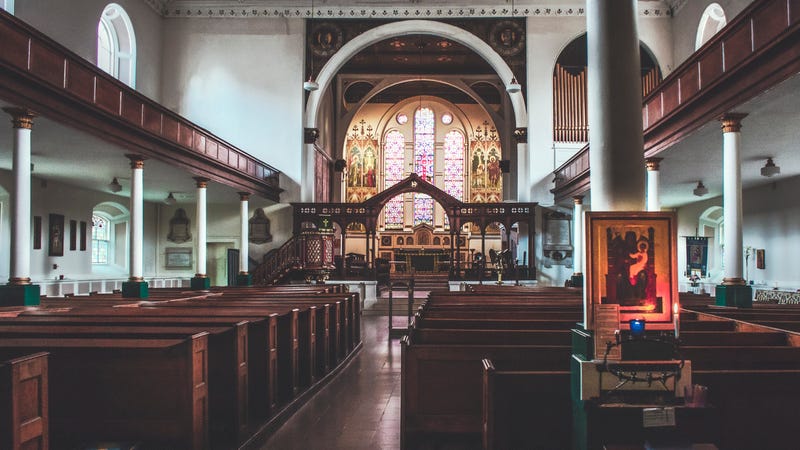
Today’s New York Times Spelling Bee letters:
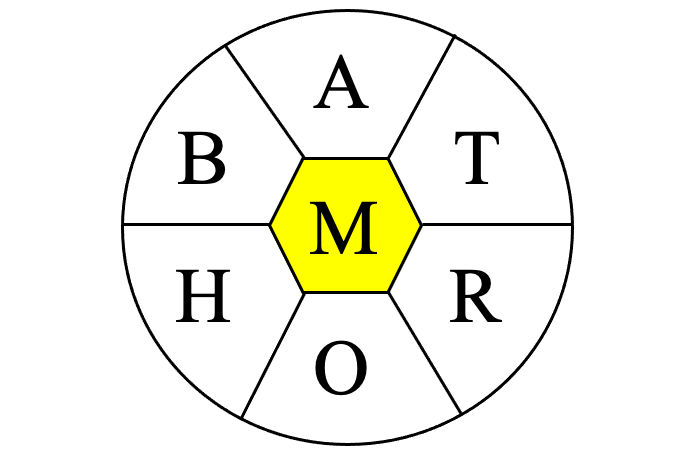
A, B, H, O, R, T, and center M (all words must include M)
Merriam-Webster says…
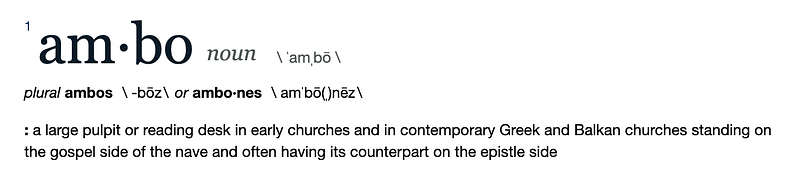
Silly little dictionary! Don’t you know that ambo can’t possibly be a word if The New York Times says it ain’t?
For a complete list of rejected words, check out the Spelling Bee Master.
What’s your favorite dord* from today’s puzzle?
My Two Cents
More often than not, Unsplash –the stock photo feature associated with this platform– is quite helpful when it comes to finding pictures for my column. This despite the fact that I often pick words that are not easily photographed.
Today was not one of those cases, however. This is one of the pages I got when I typed in “ambo”:
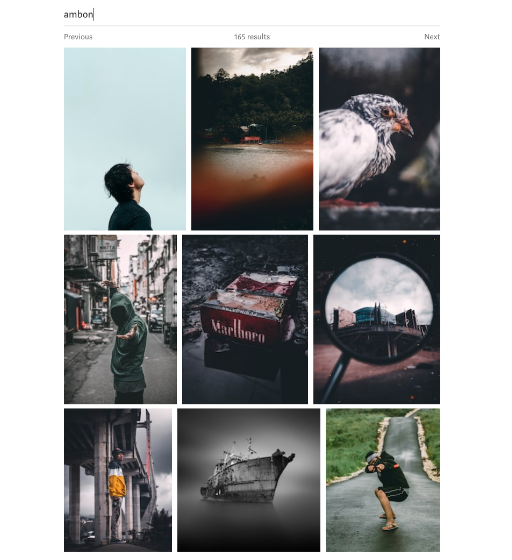
That is quite an eclectic collection of images for one word… none of which has anything to do (as far as a I can tell) with the meaning given by the dictionary. Speaking of which, you may have noticed that Merriam-Webster’s entry has a superscript 1 to the left of the word. Here’s ambo number 2, if you’re curious:
Obviously that’s not very helpful if you don’t know what an ambon is. So here you go: “a fibrocartilaginous ring around an articular cavity”. It wasn’t easy to get a lot of information about the usage of this word, but from what I was able to find out, ambon is now considered an obsolete anatomical term. Instead, it is now considered to be a synonym of ambo. Some people make the distinction between ambo and ambon and say the former refers to the elevated area where the pulpit can be placed, while the latter is the pulpit itself. I’m not Catholic or even Christian, so I’ll leave it up to the experts to debate.
lowercase a
Our friends at Merriam-Webster tell us that ambo comes from the Medieval Latin ambon-, ambo, from the Late Greek ambōn, itself from the ancient Greek word meaning “edge” or “rim”.
In Eastern Orthodox, Oriental Orthodox, and Eastern Catholic churches, an ambo is is a projection coming out from the soleas, which is the walkway in front of the iconostasis, or wall of icons and religious paintings that separates the nave from the sanctuary in a church building. To clarify, the nave is the main body of the church, where most of the worshippers stand or sit, while the sanctuary is the area around the altar. The illustration below is not ideal, but it has no copyright claim and it can help you get a better idea of the church geography I’ve mentioned so far. (The sanctuary would be the area surrounding number 7, to the right.)
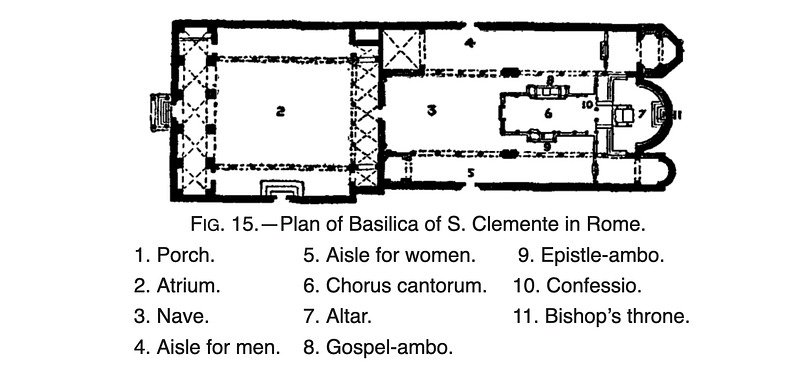
Because the above church is a Roman Catholic one, there are two ambos, one to each side of the choir (number 6, above). The Gospel ambo (number 8) was used for, well, reading or chanting the Gospel, while the Epistle ambo was where the reading of the epistles, or letters from the Apostles to Christian communities, took place.
In early Western churches the ambo was known also as the gradus, lectorium, or lectricium, from which the terms lectern and pulpit developed. In Eastern churches the term used is ambon, with the -n at the end. Those usually have only one, rounded or square in shape, and sometimes with steps leading up to it, like this one from a church in the village of Beloiannisz, Hungary.
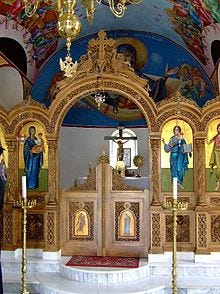
You can see the iconostatis (wall of icons) behind it.
According to the online Britannica, “Originally, the ambo took the form of a portable lectern. By the 6th century it had evolved into a stationary church furnishing… By the Byzantine and early Romanesque periods, it had become an essential part of the church plan. In the 12th century, the ambo was gradually superseded by the pulpit, and it passed out of liturgical use.”
Here is a more modern ambo, from a church in Greece, which as you can see has quite some height.
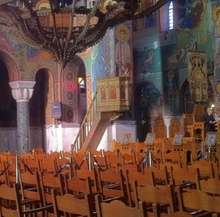
It’s likely that the ambo developed from the bimah in Jewish synagogues; meanwhile the term bimah appears to have been borrowed from the greek bema, a platform used in ancient Athens to address citizens and courts of law.
Uppercase A
There are quite a few Ambos with a capital A, among them a neighborhood in South Tarawa, the capital of the island nation of Kiribati; a province in Peru; the name of five tropical cyclones; a planned oil pipeline to be built and operated by the US-registered Albanian Macedonian Bulgarian Oil Corporation; and a variety of potato.
Oh, and also the name of a naturally-carbonated bottled mineral water, sourced from springs near the town of Ambo in central Ethiopia.
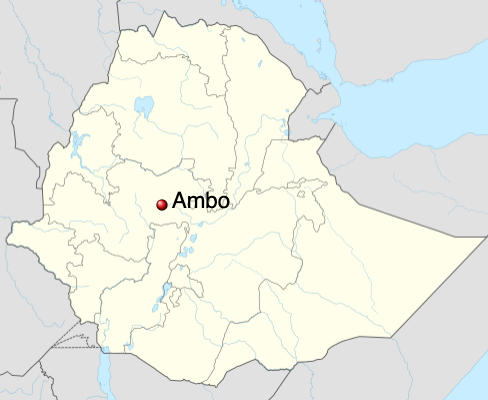
Ambo is considered to be one of the oldest modern mineral waters and has been bottled and sold since 1930. The original company was purchased in 2009 by SABMiller (a UK-based South African brewing and beverage company), which proceeded to invest millions modernizing the bottling plant and operations. In 2017, Ambo was bought by Coca-Cola’s African division. According to a 2014 article by Yonas Abiye in The Reporter, “The source of Ambo Mineral Water is a thermo-mineral spring, which is rich in natural calcium, magnesium, potassium, bicarbonates and carbon dioxide. The water originates in a volcanic fissure which then percolates through mountainous terrain, eventually being tapped at the springs in Ambo Senkele, 130 km from Addis Ababa.”
What’s weird is that despite its popularity and ownership by a major conglomerate, Ambo Mineral Water’s website stopped operating several years ago. Currently, ambomineralwater.com is for sale on GoDaddy (in case you’re interested), but I did manage to find the waybackmachine version here.
They also have a more-or-less active Facebook page:
That lion logo is for their energy drink, called Predator.
Anyway, I’m not sure if I can post pictures of their bottled water or their other beverages. You can click on the links to check them out for yourself. And if you’re from Ethiopia or have visited, please let us know what you think of Ambo mineral water!
Now you know. Next time you’re in a church in Eastern Europe, you can show off your knowledge by pointing at the raised platform and shouting, “Hey, there’s the ambo!”. Don’t be surprised if you’re escorted outside. Not because you were interrupting the church services… but because the editors of the Spelling Bee decided that ambo is a dord*.
You can check out my previous entry on another dord* here:
*What the heck is a dord, you ask? Here’s the answer:


