
Owling
Covering the night shift
Today’s New York Times Spelling Bee letters:
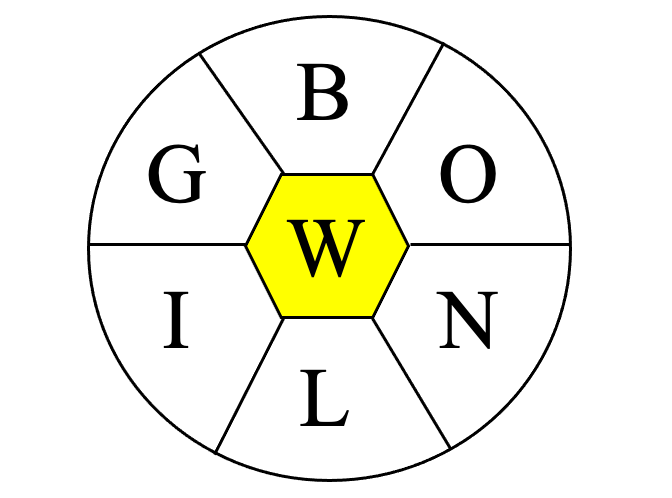
B, G, I, L, N, O, and center W (all words must include W)
Merriam-Webster says…
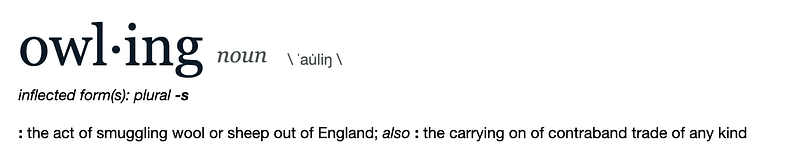
Silly little dictionary! Don’t you know that owling can’t possibly be a word if The New York Times says it ain’t?
For a complete list of rejected words, check out the Spelling Bee Master.
What’s your favorite dord* from today’s puzzle?
My Two Cents
Today we had slim pickens when it came to choosing what word we could write about. As you can see below, the Spelling Bee Master provided only ten options.
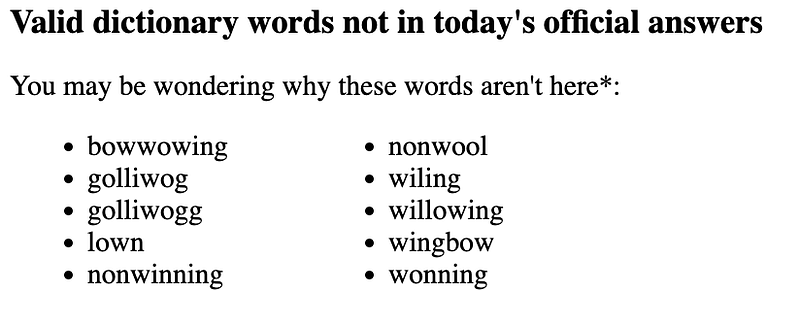
Of those words, two are actually the same word (golliwog and golliwogg), two others (nonwinning and nonwool) don’t show up as entries in the dictionary, one (wingbow) appears as separated words, and one (bowwowing) appears only as a noun.
But lo and behold, I managed to find –all on my own– an eleventh word that was rejected by the Spelling Bee. If you figured out that the word is owling, well, congrats for reading the title of today’s column.
Speaking of Slim Pickens, the late actor with one of the best names in Hollywood was in the picture The Howling. What does a 1981 movie about werewolves have to do with owling? Not much, except if you add na H to the latter, you get the former. And that’s a good enough excuse for me to talk about that cult film.
Stop, thief!
The 1911 Encyclopedia Britannica sums up our word of the day thusly:
OWLING, in English law, the offence of transporting wool or sheep out of the kingdom, to the detriment of the staple manufacture of wool. The name is said to owe its origin to the fact that the offence was usually carried on at night-time, when the owls were abroad. The offence was stringently regulated by a statute of Edward III. (1336–7), while many subsequent statutes also dealt with it. In 1566 the offence was made punishable by the cutting off of the left hand and nailing it in a public place. By a statute of 1660 the ship and cargo were to be forfeited. In the reign of George I. (1717–1718) the penalty was altered to transportation for seven years. The offence was abolished in 1824.
Wikipedia adds the following, citing references: “The law gained particular currency after a 1689 bill outlawing all trade with France. Owlers were able to take advantage of a significant black market, and smuggling increased rapidly during the 1690s. According to G. N. Clark, period sources indicate that by 1689, 480,000 pounds of wool per year were being smuggled to France.”
That’s a lot of wool. Considering this was done by sea, I wonder if at any point some Englishman, seeing how more and more wool was being shipped, uttered the phrase “We’re gonna need a bigger boat.”
I found a couple of interesting things about owling during my usual 15-minute intensive research. One is that thesaurus.com seems to think owl mean “thief”. Look at all the synonyms and references listed:
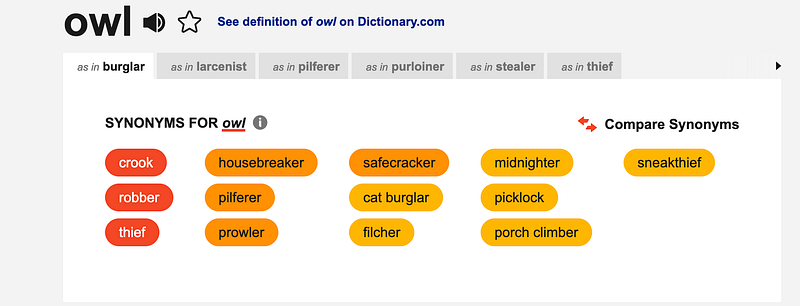
Which is odd considering this is how they claim owl should be used in a sentence:
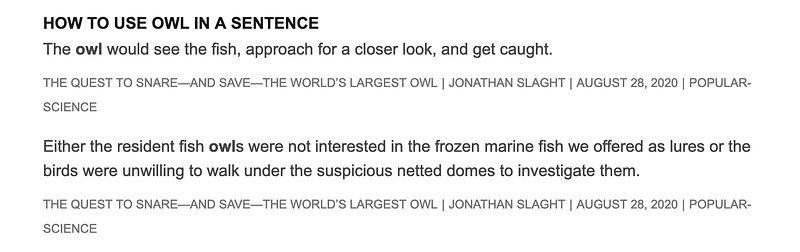
I don’t think author Jonathan Slaght was thinking about burglars, crooks, safecrackers or picklocks when he penned those two sentences.
The other thing that caught my eye was Urban Dictionary’s definitions of owling. Here is one example.
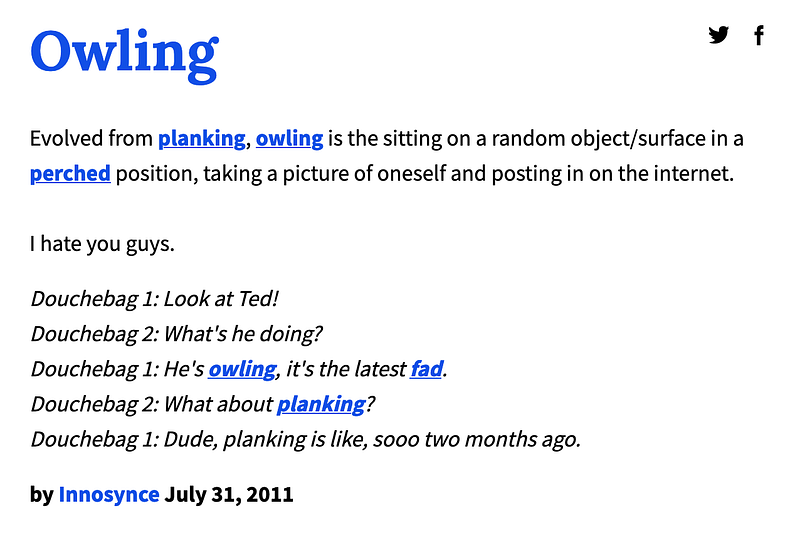
Since this was posted more than a decade ago, we can safely assume it’s no longer trending.
I also found a tune called “The Owling Hour”, composed by Redding Hunter as part of the soundtrack for Long Nights Short Mornings, a 2016 indie film directed by Chadd Harbold. It was screened in that year’s South by Southwest Film Festival.
And speaking of movies…
Owling with an H
The Howling is a 1981 American horror film directed by Joe Dante, perhaps best-known for helming both Gremlins movies. In fact, he was hired as a director for those pictures based on the success of The Howling. The film is based on the 1977 novel of the same name by Gary Brandner, but its plot is not very faithful to the book. The movie stars Dee Wallace (best known for her role as “mom” in E.T, the Extra-Terrestrial), Patrick Macnee (the original secret agent John steed in TV’s The Avengers –no relation to Marvel), Dennis Dugan (who later became a director and helmed Happy Gilmore, Big Daddy, and other Adam Sandler films), Robert Picardo. (of China Beach and Star Trek: Voyager fame), and Slim Pickens, who along with Rip Torn had the best name in Hollywood, in my opinion.
Werewolves were a hit in 1981, as The Howling was one third of a trio of now-cult movies, the other two being An American Werewolf in London and Wolfen. Google them and feel your jaw drop as you read the names of their star-studded casts and famous directors. (Neither movie rhymes with owling, though, so I won’t be discussing them here.)
In it’s plot summary, IMDB takes great pains not to spoil one ounce of The Howling’s plot: “After a bizarre and near deadly encounter with a serial killer, a television newswoman is sent to a remote mountain resort whose residents may not be what they seem.” Those twenty-nine words can probably describe a few dozen Hollywood movies. Take out “with a serial killer” and the list goes into the hundreds.
Well, I’m not going to be the one to spoil things, so I won’t add too much to that synopsis. Except this:
According to Wikipedia, the film cost a million and a half dollars to make and brought in over $17 million. Forty-one years ago that was considered a pretty good result at the box office. The film was even ranked number one or number two (depending on your criteria) during its opening week.
Rogert Ebert and his pal Gene Siskel had widely different opinions about The Howling, with the former giving it two stars (out of four), while the latter countered with three and a half. For the most part, reviews were positive, praising the special effects and offbeat humor. Joe Dante also filled the movie with tributes and inside jokes. A character is seen eating Wolf Brand Chili, a copy of the Allen Ginsberg book Howl appears at one point, and many of the characters are named after horror film directors who directed movies featuring werewolves.
The film’s success spawned a series of seven sequels that covered the next four decades, with the last one, The Howling: Reborn, being released in 2011. There is talk of a remake, with Argentinian director Andrés Muschietti (of It fame) having been picked two years ago to direct it for Netflix.
The original movie is still considered one of the best werewolf movies ever made, so hopefully Muschietti can do it justice with his vision.
Now you know. Next time you see someone smuggling wool from England to France, alert the police and let them know you’re calling to report some owling going on. Don’t be surprised if the cops hang up on you, though. Not because wool smuggling is no longer a thing… but because the editors of the Spelling Bee decided that owling is a dord*.
You can check out my previous entry on another dord* here:
*What the heck is a dord, you ask? Here’s the answer: