
Caitiff
What a wicked word

Today’s New York Times Spelling Bee letters:
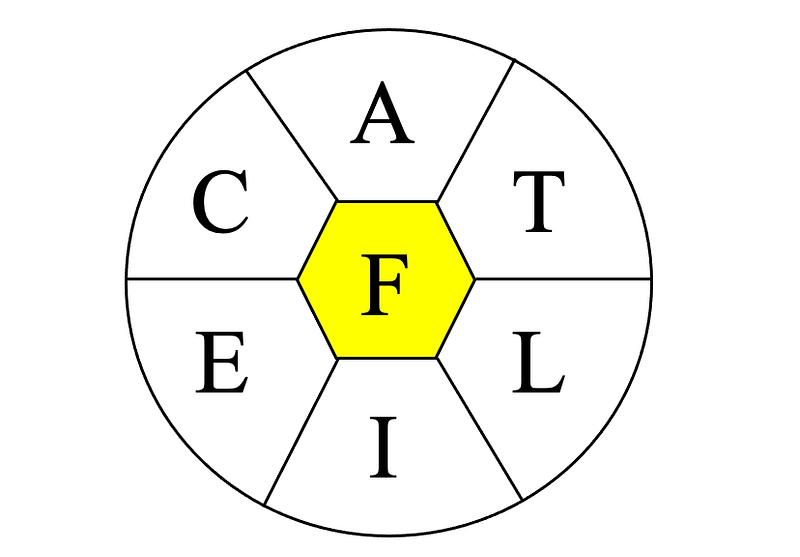
A, C, E, I, L, T, and center F (all words must include F)
Merriam-Webster says…
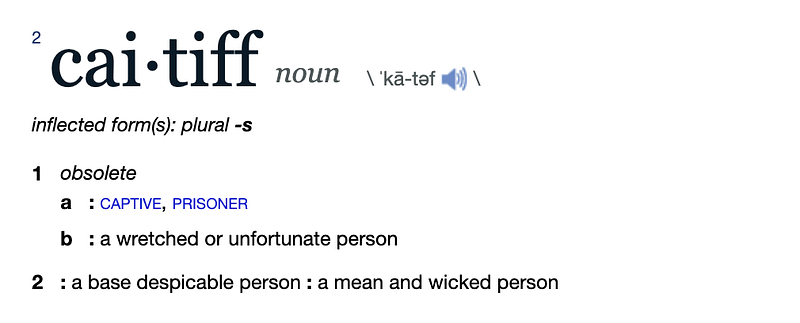
Silly little dictionary! Don’t you know that caitiff can’t possibly be a word if The New York Times says it ain’t?
For a complete list of rejected words, check out the Spelling Bee Master.
What’s your favorite dord* from today’s puzzle?
My Two Cents
Although I am a fan of Heavy Metal –and by Heavy Metal I mean both the music and the legendary graphic novel magazine– my knowledge about its music bands is limited to the “classic” ones, such as Metallica, Iron Maiden, Pantera, Judas Priest, Kiss, AC/DC, etc., etc. (I can see fans of the genre rolling their eyes at the mention of the last two in this category.)
Heavy metal is heavy (bad pun intended) with subgenres, too. You may have heard of a few of them: black metal, thrash, death metal. But had you ever heard about these lesser-known ones: rap metal, glam metal, sludge metal, and pirate metal?
My introduction to both sludge metal and Southern metal came in the early 2000s, when a coworker with a very eclectic taste in music introduced me to Alabama Thunderpussy. I must admit that what piqued my interest was their name, which I still think may be one of the best in the business. Plus, this T-shirt (which my buddy bought, if I remember correctly) didn’t hurt their reputation, either. I think back then, in 2003 or 2004, the band has its own website; now they have the Facebook page I linked to earlier. Which makes sense, considering they had disbanded in 2008. It looks there is a reunion concert in December, if you’re interested.
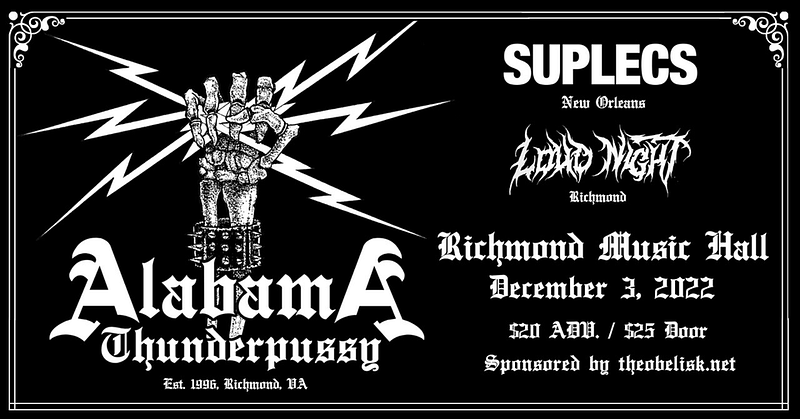
You might be wondering what all this has to do with our dord*, caitiff. And even if you’re not wondering, I’ll tell you. If you read on…
lowercase c
Our friends at Merriam-Webster have an interesting tidbit about our word of the day:
Caitiff is pretty rare in contemporary use, but it has functioned since the 14th century as an adjective and also as a noun meaning “a base, cowardly, or despicable person” (as in Shakespeare’s Measure for Measure: “O thou caitiff! O thou varlet! O thou wicked Hannibal!”). Both the adjective and the noun evolved from the Anglo-French adjective caitif, meaning “wretched, despicable.” The French word in turn derived from the Latin captivus, meaning “captive”-the shift from “captive” to “wretched” being perhaps prompted by the perception of captives as wretched and worthy of scorn.
At one point the term caitiff was used to designate Christians who were used as slaves in galleys, those ships propelled by multiple men oaring them along. If you’ve seen the movie Ben-Hur, you know what I’m talking about. If you haven’t seen the movie, well, here you go:
The illustration below, from 1643, shows the layout of an Italian galley with 16 pairs of oars.
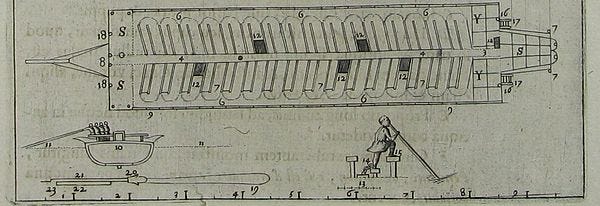
The caitiffs were kept as galley slaves mainly by the Ottoman and Barbary navies of the sixteenth century. And Christian naval powers, such as Spain, frequently used Muslim captives and prisoners of war. In fact, almost all major Mediterranean powers sentenced criminals to galley service, although this was often limited to wartime. However, considering different nations or states were at war with each other almost all the time, the “limited” part was not so… limited.
The Ottoman caitiffs were housed in prisons known as bagnios. The word came from Italy, where it originally means “bath” (from the Latin balneum). But the Livorno prison establishment had been built on an ancient bathroom. The term passed to Turkey, especially in Constantinople where Italian Christian prisoners called the establishment bagno for the same reason.
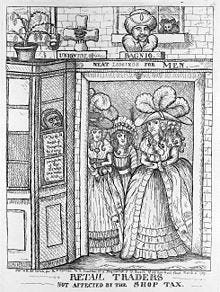
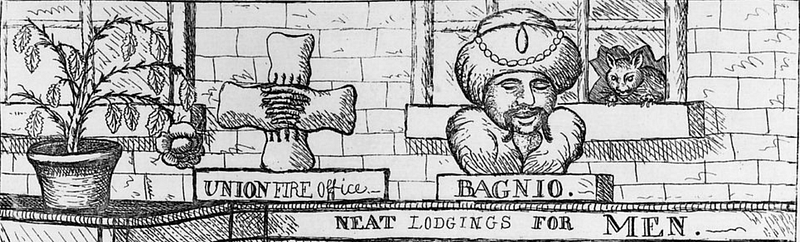
In English the word has come to designate bathhouses and brothels as well. Notice the sign saying BAGNIO in this illustration of a well-known English brothel known as the Turk’s Head.
Here is the detail of the sign:
Perhaps one of the most famous prisons known as bagnios was Devil’s Island in French Guiana, featured in the novel Papillon and the movie adaptation starring Steve McQueen and Dustin Hoffman. And if you haven’t seen that movie… you should!
Uppercase C
Vampire: The Masquerade is a tabletop role-playing game created by Mark Rein-Hagen and released in 1991. Set in a fictionalized “gothic-punk” version of the modern world, game players are asked to assume the role of vampires (known as Kindred) and deal with their night-to-night struggles against their own bestial natures, vampire hunters, and each other.
This RPG became quite successful, spawning an entire franchise that includes sequels, video games, novels, comics, and even TV and web series.
The game has thirteen clans, which are characters’ vampire families. All members of a clan are descendants of the clan’s founder. Clans are not chosen by the characters; rather, characters are Embraced into clans. There are some characters, however, that don’t belong to any clan, and those characters are known as Caitiffs.
The other Caitiff with a capital C forms part of the name of a an album called The Caitiff Choir, the first full-length album released by the band It Dies Today. The band, formed in 2001 and originally consisting of Nicholas Brooks (lead vocals) Chris Cappelli (guitars), and Steve Lemke (guitar and later bass), came out with its first disc in 2002, an EP called Forever Scorned. But it was The Caitiff Choir that gave them some measure of success two years laters, even garnering them a slot in the 2005 edition of Ozzfest.
Two songs from their 2006 album, Sirens, became part of movie soundtracks. However, the band’s lead singer left the year after that, and things sort of went downhill from there. There was a reunion in 2011, and rumors over the next few years that It Dies Today would release a new album, but that never happened.
The band’s genre is defined as metalcore, a fusion of extreme metal and hardcore punk. Metalcore is known for its breakdowns (slow, intense song parts in which various instruments play solo) that are used for moshing, ro slam dancing.
The album The Caitliff Choir features a song in two parts by the same name, and also another song called “A Threnody for Modern Romance”. With a title like that, I couldn’t help but pick it as the sample song to showcase today.
You can check out the lyrics here.
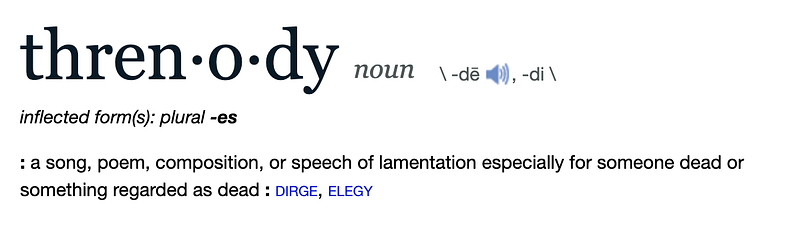
And if you’re wondering what threnody means, I’d love to write an article about that word… but it will never appear in the Spelling Bee because it has eight different letters, with is one more letter than the game uses. But no worries, Merriam-Webster is here to help us:
Now you know. Next time you’re watching Ben-Hur with family or friends and the galley scene comes up, you can show off your knowledge by yelling: “Hey, those are caitiffs rowing!” Don’t be surprised if people ask you to shut up. Not because you’re interrupting the movie… but because the editors of the Spelling Bee decided that caitiff is a dord*.
You can check out my previous entry on another dord* here:
*What the heck is a dord, you ask? Here’s the answer:


