
Take This Map to Reclaim Yourself in a New Culture
Look before you leap

For anyone who moves to another part of the world, you’re exposed to different cultures.
And you don’t know what to do about it. It seems nerve-wracking and tricky. Sometimes, people take decades and still can’t seem to accept.
We often give very little thought to an international move, sometimes even less than we would give to a place for travel. We think we have a job and it’s settled.
I have seen some friends book cabs and buses in advance for local travel but will go in knowing nothing about their future colleagues or the workplace.
It’s courageous to take a leap. However, going in ‘blind’ is risky, whether in poker or in life.
As far as I go, I have taken this leap and gone blind several times before I figured out how to do it better with my fifth move to Canada. I was tired of landing my parachute in people’s faces every time I leaped. And getting screamed at, of course.
Curious to know how it changed?
“Culture is a way of coping with the world by defining it in detail.” — Malcolm Bradbury
My initial struggle with a new culture
Not knowing can lead to feeling ineffective in new environments. The more it befuddles you, the more you want to escape. In reality, what we need is acceptance.
Someone once told me while I was living in Europe to not call them after 4 pm for work, which shocked me as I was coming from India.
I was at the time used to calling people late at night as they preferred it. It felt personal in the moment, and I had several scoops of ice cream to dull the blow.
However, on reflection, I realized my colleague wasn’t being disrespectful, but setting clear boundaries.
It turned out to be an opportunity to learn about others’ preferences.
I wished at the time if there was some resource, which could give me a crash course to avoid such scenarios. I wished my company trained me on culture parameters and not left it completely on me to figure it out.
Figuring it out myself was exciting, but full of many setbacks.
Then the Book Genie granted me a wish. Hehe, not literally. I mean I got saved by my reading habit. I believe books I need in my life find their way to me. They do.
So glad this one did.
‘The Culture Map,’ by Erin Meyer
This book details several cultural parameters you need to grasp the cultural elements in a new place.
It includes many parameters, such as communication, relationship-building, trust, and decision-making. It’s a powerful tool to adapt to different cultures.
First, you must know your cultural baseline. Then, you can compare it to the new culture you’re exposed to.
- It makes you communicate your style better rather than fumbling up.
- It makes it easier to understand and adjust to other’s styles and not take it personally. Because no matter how much the culture shock stings, I can tell you it’s never personal.
A few questions for doing this exercise can be like this.
1) How is my communication style different from what is the preferred style in this new culture?
2) How do I like feedback? How is this different here?
3) Am I used to trusting people based on a task or relationship with them?
A word of ‘caution’
Knowing the baseline and cultural preferences is not enough.
It takes time to internalize and use it. To get the best results, place it where you can see it daily to assess your interactions.
For reference, the picture shows my baseline in 2019 and 2023 against the countries I have lived in. Trust me, it looks harder than it is. Basically, I chose 5 key parameters I wanted to practice. These were :
- Communicating, which can be low-context, i.e. prior knowledge of the topic required, or high-context, i.e., no prior knowledge required.
- Evaluating is the way people give feedback. It can be direct or indirect.
- Persuading, which is how you present your views. Do you talk about its uses/implications first, or do you explain the concept?
- Leading, which can be hierarchical to more egalitarian.
- Trusting, which can be task-based to relationship-based.
I assessed how the preferred style was in Germany, France, India, and Canada. I compared it to my personal style at those times and then got better at explaining to people and understanding their preferences.
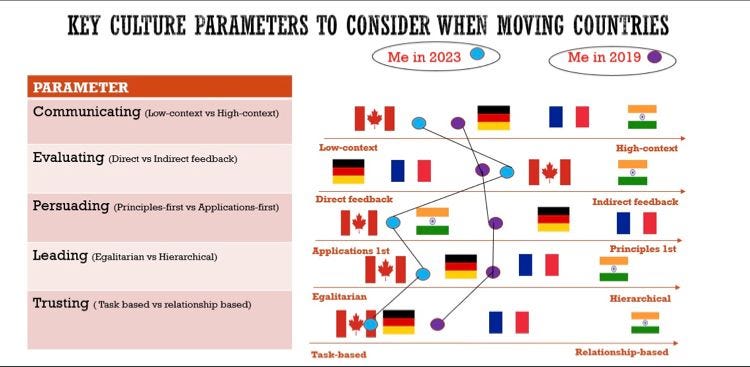
Later, I got better at creating newer maps that didn’t exist. Trust me, this is the one map you shouldn’t forget when trying to work across cultures remotely or otherwise.
My sincere hope is this book will help you avoid the cultural fumbling I had to undergo several times and make your transition smoother.
I’d love to hear which other tools have helped you settle in unknown places.
Or if you have embarrassing stories you want to share, it’s even better so we can laugh it off together. :D
“Culture is the widening of the mind and of the spirit.” — Jawaharlal Nehru
You can also download my free e-book at the link below.
Other Stories by the Author :


