
Health & Fitness
Take It Outdoors — How We Get Back on the Healthy Side of the Door
An Outdoors Manifesto — Part 2
Is it possible humans will reverse their “indoors habit” and become more outdoors-oriented again? I’m happy to say the answer can be a resounding yes.
In part 1, “Life on the Inside Has Major Downside,” I wrote about how humans have increasingly become indoor creatures. I documented how the move indoors has harmed our physical, mental, and spiritual well-being. I speculated whether there’s a plausible view of the future in which our species becomes more outdoors-oriented again.
The trend toward becoming more indoors-oriented has lasted for at least 200 years. Unfortunately, it’s not easy to reverse something that’s lasted so long. Currently, we average less than an hour a day outside in natural environments. It’s not like we’re all going to wake up one sunny morning and go outside and never look back. So what gives reason for optimism? As explained in my piece, “The New Outdoors Movement,” it’s already happening.
More than ever, we understand that spending time outdoors is good for us
Extolling the benefits of the outdoors is not new, but in the last 20 years, we’ve gained the science that backs it up. Study after study documents how time outdoors benefits physical and mental health. Landscape therapy, forest therapy, blue mind, and awe theory are just a few examples of ways our understanding has multiplied.
And there’s so much more. We now know that outdoor workouts result in greater fitness gains. We’ve learned that time in nature helps reduce the risk of obesity, blood pressure, stress, and depression. We understand that outdoor experiences lead to increased connection with others and the natural world, increased feelings of awe, decreased materialism, and increased orientation toward spirituality.
A little nudge can go a long way
Many of us remember being kids and having our parents harangue us to “go play outside.” Many of us also remember being harangued to come back inside later the same day. Turns out, being outdoors is what we wanted all along.
The point is that we sometimes need encouragement to do things — even things we like, even when they are good for us.
This is where nudges come in. A nudge is a gentle push. In the arena of social science, a nudge is “an intervention that gently steers individuals towards a desired action.” Importantly, the action is voluntary and has a benefit. For example, having comfortable and convenient outdoor seating is a simple way to nudge people to eat their lunch outside.
So who’s going to provide these nudges? Well, health companies for one. They are already doing this, and — in light of the research — should be doing much more.
Looking at the preeminence of nature from another perspective: it is at last, and fast becoming the fourth pillar of health and wellbeing, alongside (1) diet, (2) exercise and (3) sleep habits. — Global Wellness Institute
The U.S. currently only spends 3 percent of its healthcare budget on promoting good health. Physical inactivity (as one measure of insufficient outdoor time) costs $117 billion each year in medical bills. Those costs can be reduced — and people can be a lot healthier if a fraction of that $117 billion is spent nudging people to spend more time outdoors.
Change is afoot. The healthcare industry is (finally) moving toward value-based care which incentivizes keeping people well. Spending time outdoors promotes health and wellness, so it’s in the interest of health companies, employers, and the government to provide these nudges.
Health insurance companies in Japan and South Korea already give financial credit for time spent in nature. Health insurance companies in the U.S. already give financial credit for physical activity. It’s only a matter of time before the practice of awarding credits for outdoor time (and especially outdoor time in quality natural environments) becomes widespread. Apps that track time outdoors such as NatureDose and Awe will likely soon be integrated with wellness apps.
Other nudges already being provided by healthcare companies include nature prescriptions and the Walk with a Doc initiative. Nature prescriptions are available in 35 states. You can join a Walk with a Doc in more than 500 communities worldwide.
Hospitals are also beginning to offer horticulture therapy, integrate exposure to nature into treatment plans, and subsidize participation in recreational programs. An Outside Magazine article by Christine Yu states: “the acceptance of nature as a legitimate form of medicine is finally here.”
It’s not just the healthcare industry that stands to benefit by nudging us to spend more time outside. Employers can see gains in worker productivity (and company bottom line) to the extent that their employees are healthy, engaged, and motivated — and nature helps with this. In the same way, schools can see gains in student learning by fostering more access to the outdoors. Healthy nudges that employers and educational institutions can provide include:
- create outdoor spaces that can be easily accessed during the work or school day
- create indoor spaces that include more plants, outdoor light, and other natural features
- hold meetings and events outdoors
- sponsor inclusive, health-promoting outdoor activities
- provide extended more flexible lunch hours and/or work schedules
- use the snow day concept to provide “sun days” in the winter for those in northern climates (and provide “cool days” for those in southern climates).
- provide a more flexible calendar and a 4-day week
- provide more vacation time (more similar to European countries)
- promote the belief that we can’t be the best versions of ourselves unless we spend time outdoors.
The acceptance of nature as a legitimate form of medicine is finally here.
Bring nature to the people
Most people live in cities and don’t have easy access to nature. Part of the solution, then, is to redesign cities to include more greenery and natural spaces. This is happening in many cities around the world as part of the biophilic cities movement.
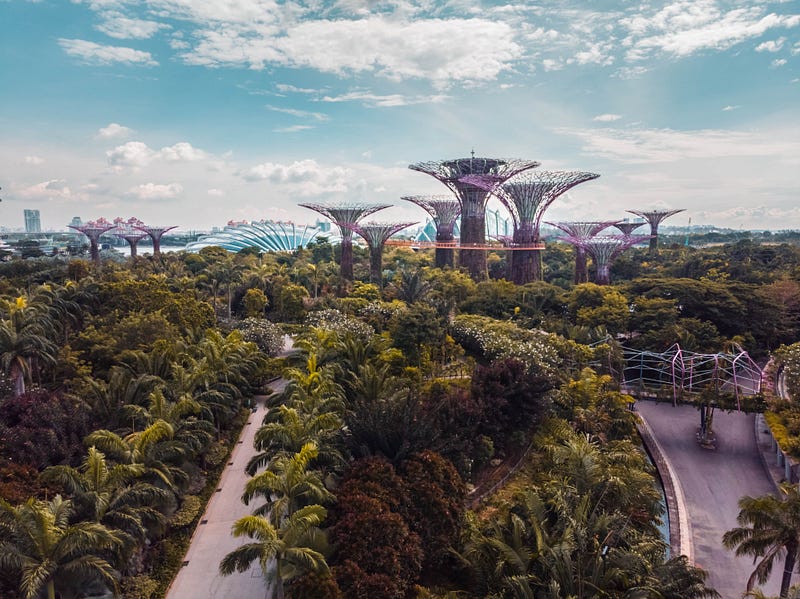
Singapore is often cited as a leading biophilic city. Decades ago, Singapore took on the goal of being a garden city and more recently has upped its vision by seeking to become a “city in a garden.” A measure of Singapore’s success is that while the population has increased by several million people, the percentage of green space within the city increased by 10 percent. Green spaces now make up nearly half of its geographical area. Singapore has an extensive network of trails and pathways that connect parks and green spaces to one another. Additionally, Singapore has worked to integrate greenery in the form of green roofs, vertical green spaces, and hanging gardens.
It’s not just Singapore either. Dozens of cities around the world such as Wellington, New Zealand; Portland, Oregon; and San Francisco are part of the movement. Moving in a similar direction, the 10-Minute Walk Program aims to ensure all Americans have a park or green space within an easy walk of where they live.
On the smaller-than-a-city scale, corporations are resigning offices to be more biophilic, both to entice workers back to the office and to improve employee retention.
Bringing nature closer to where people live is especially important for the economically disadvantaged. In the U.S., people who live in low-income communities are three times more likely to be “nature deprived.” This amounts to a total of 70 percent of low-income people who do not have access to nature. This nature gap becomes even more pronounced when broken down by race: while 23 percent of whites live in nature-deprived communities, 74 percent of non-whites (or three times as many) live in neighborhoods with limited access to nature.
Many cities now offer free park passes and transportation vouchers as a way to mitigate these population-specific nature deficits. Outdoor programs for inner-city youth are also essential. Restoring degraded public lands and creating more green spaces in areas where these less privileged people live is also important.
Historically, the United States has systematically segregated and excluded people of color from public lands and other natural places. — Center for American Progress
The doors of perception
The move indoors and the growth of western civilization have gone hand in hand. On many levels, it’s hard to see how such a long trend can be reversed. A dark view of the future says things will keep going the way they’re going. People will live almost entirely indoors. Outdoor time will all but disappear. Having little contact with the outdoors, people will lose concern for protecting nature. The natural environment will continue to decline, climate change will get worse, and — as a result — people will spend even less time outdoors. It’s hard to see how this trend ends up anywhere good.
But our society is changing, and there is an opportunity within those changes. If the productivity gains brought by artificial intelligence and robotics can be harnessed to benefit all Americans, people will work less and have more leisure. The question then will be, “What will Americans (and others in the developed world) do with this increased leisure?” Will we spend it indoors? Will we spend it hooked to digital devices, living in virtual reality worlds? Or will we spend it outside? Will we invest in volunteerism, neighborhood projects, trail building, planting, gardening, cultivating, exercising, recreating, adventuring, creating outdoor art, and building community?
Say no to the naysayers
We know how to fix it. The way to shift the paradigm, save ourselves, and save the planet is as simple as adding to the critical mass of the new outdoor movement that has already underway.
We can speed up the process by putting pressure on the healthcare industry, employers, schools, and government to bring about the needed changes.
While we work to shift the politics, we can also do things on a personal scale to keep things moving in the right direction. We can call out the myth that we don’t really need to go outdoors — because now we know it’s as important to our health as diet, sleep, and exercise. We can call out the myth that we don’t have time to go outdoors — yet somehow manage to spend several hours a day on social media. We can call out the myths — propagated by alarmist weather reporting — that cold, heat, rain, and snow are bad things to be avoided at all costs.
We can focus on the positives. For example, the numbers indicating participation in outdoor sports such as camping, biking, and hiking saw enormous increases during the pandemic and continue to grow at a rapid rate.
Connection to nature is not a dispensable amenity, but rather is essential to the health, economic prosperity, quality of life, and social well-being of all Americans.
— Nature of Americans report
Take it outside
What we each can do — beginning today — is to be on the lookout for opportunities to spend more quality time outdoors. Bring your partner or your kids with you. Bring your parents. Bring your friends. Bring your boss or co-workers. Make new friends while you’re there. Eat a meal out there. Get your workout while you’re there. Take up a new hobby or begin a new sport that involves being outdoors. Have a phone conversation while in a garden or underneath a tree. Outfit yourself with the clothing you need to be comfortable outdoors regardless of the weather. Add an outside activity to your party or holiday gathering. And, of course, advocate for the benefits of the outdoors while you’re there.
What part of your job can you do outside? What part of your social life can be outside? What part of your political activism can you do outside? Urge your representatives to spend more time outside — they are likely even more nature-deprived than you and me.
Trust the path, and keep the faith. Remember, if more people spend more time outdoors, it means less consumerism and less materialism. It means more spirituality and better health. It means more happiness. It means the more sustainable and peaceful world that we so desperately need.
Hope to see you out there!
If you missed it, you may want to read:


