
Life Inside Has Major Downside — And We’re Down with That.
An Outdoor Manifesto — Part 1

Only recently, given the span of history, have humans in developed countries become indoor creatures.
How recently?
If the 200,000 years of human history were condensed to one year, humans were outdoor creatures for the first 364 days. On Dec. 31, five hours before midnight, humans in the developed world became “homo indoorus.” For the first time, our orientation became toward the indoors.
At a singular moment in the early 20th century, on a day unmarked by ceremony or celebration, the portion of humanity living in the developed world, on average, started spending more than 50 percent of their waking hours indoors.
We have not looked back.
No one asked us, collectively, if that’s what we wanted. Only a few paused to wonder that it might not be good.
The arc of human history has supposedly led toward freedom and self-determination. When it comes to the outdoors, however, this isn’t true. Outdoor time is something we’ve sacrificed in the name of progress. While most people and especially most young people report feeling happier outdoors, people in developed countries ironically spend very little time outdoors — and that amount is diminishing year by year.
Simply put: spending time outdoors is a habit we’ve lost control of. Those of us who live in the developed world spend only an hour a day outdoors, and twenty-five percent of people report no time outdoors at all.
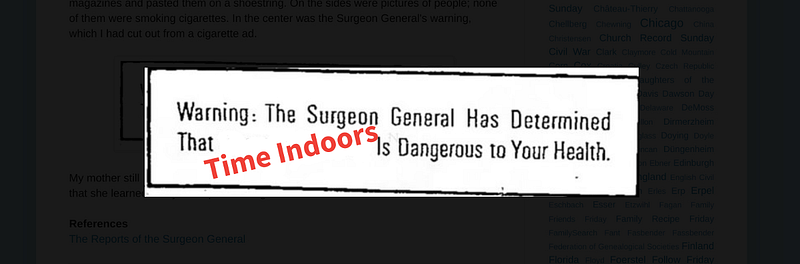
Collectively we’ve become addicted to being indoors. It’s as if we repeatedly read the warning label and then blatantly disregard it.
When you look at recent health findings, it’s not difficult to reach a realization that’s both simple and profound: nearly all of the maladies of the developed world — from poor physical health to depression to materialism and many things in between — can be seen as directly or indirectly tied up to the fact that we spend our lives almost entirely indoors.
How we got here, behind closed doors
Using the same human-history-is-a-year timeline as above, we can see that humans lived out in the world for the first 50.5 weeks. It was not until December 20 that we first came indoors at all. Given the extreme recency of our move to indoor digs, is it any wonder we’re feeling out of sorts?
Let’s look at the same numbers in a different way. For 97 percent of human history, there was no outdoors. There was no indoors. There were, in fact, no doors at all.
Before there were doors, there was the world. When the weather was cold or wet, people huddled under trees, in caves, or under makeshift open-sided shelters. These first dwellings were primitive. The wind and the light came through. People could still easily see, hear, and smell what was outside. They could feel the wind and changes in temperature. These dwellings created little separation from the world.
When humans migrated to colder climates and populations increased, dwellings became more important — and more elaborate. Animal skins were hung over openings to seal out the cold. Shelters were used primarily for sleeping.
As generations passed, shelters became larger and more permanent. People figured out how to cut trees into boards and fasten boards together. Someone made the first wooden door.
It’s hard to overstate the size of this shift. Before, people lived in the world. Now, everything is defined relative to the paradigm of the door. There is the door itself. There is the world inside the door. There is the world beyond the door. The world is divided.
It’s ironic that the great world would forevermore be defined in the context of the door.
The word door comes from an indo-european word “foris” or gate. A gate partially blocks and entrance and restricts a certain amount of access. A door fully blocks it.
Obviously, the door brought important benefits including improved privacy, security, and protection. People slept better and could now devote less energy to protecting themselves and their property. People were warmer, drier, and more comfortable.
We have become a cult of the door. Home is sweet home. Our houses are our castles. 80 percent of us live in cities. We spend 93 percent of our time behind closed doors. 97 percent of us work indoors. Our children spend 80 percent of their waking time inside. Compared to the life of earlier humans, everything has flipped.
Simply put. We have become indoor creatures. We wake up indoors, go to sleep indoors, and are indoors most of the time in between. With every passing year, people have fewer reasons to go outdoors. We can shop, work, exercise, socialize, and access entertainment — all without leaving our homes — all without stepping out the door.
Don’t let the door hit you on the way in
No doubt that being indoors is seductive. But it will serve us well to remain mindful that while doors separate us from undesirable things, they separate us from good things as well.
For one, living behind closed doors reduces our chance of experiencing community. The two years I lived in a West African village was powerful evidence that community is fostered when people spend their waking hours outdoors and have frequent face-to-face interactions. Contrast that with the culture shock I felt on returning to America. How strange and eerie it was to walk through a town and not see any people.
For another, we lose connection with the natural world. No number of hours spent watching The Nature Channel can make up for that.
If you consider that our species evolved in the open air, it’s not surprising that our move indoors has had a huge impact on our physical and mental health. The negatives of our move indoors include:
- lack of sunlight
- lack of exposure to phytoncides (the healthy chemicals emitted by trees)
- lack of exposure to temperature variations
- lack of physical space for movement
- lack of sensory stimulation, especially from nature
- increased exposure to dust, molds, and other airborne contaminants
The effects of the above are subtle at first. But, over time, they lead to health conditions such as vitamin D deficiency weakened immune response, hormonal imbalances, slowed metabolism, sleep disorders, lowered mood, depression, increased anxiety, increased stress levels, addiction, poor posture, obesity, diabetes, loss of bone density, increased allergies, asthma, and respiratory diseases.
The French word for outdoors is en plein air, or in open air. It’s a less door-centric way of talking about the portion of the world that is “out there.”
The harm done by staying indoors doesn’t end with medical conditions either. It also has spiritual implications. A study published in Science Direct shows that materialism is the flip side of connection with nature. If you have more of one, you have less of the other. Another study confirms this, saying:
“These studies suggest that people with high materialistic values have lower levels of empathy and attachment to nature; that is, they have a weaker sense of connection with nature, and may thus further show a lower level of pro-environmental behavior.”
To the extent that materialism has led to environmental destruction, social conflict, and climate change, we can see a direct tie between humanity’s move indoors and the environmental and social problems that now threaten our very survival.
So there we have it! Human biology and psychology make us ill-suited for a life lived indoors. Yet a host of factors — some of them beyond our individual control — conspire to keep us where we are.
Is there hope for us? Is it ridiculous to think the trend toward less and less time outdoors can be reversed? Is there a plausible version of the future in which a majority of people might spend more quality time outdoors? These questions are explored in Part 2 of our outdoor manifesto, also recently published in The New Outdoors.
A door can be a symbol of opportunity or one of imprisonment. –Nici Curtis
- Throughout this piece, the pronouns “we,” “our,” and “us” are used to refer to people in developed countries. People in less developed countries tend to spend more time outdoors. Their relationship with nature will be the subject of a separate article.
Can our addiction to the indoors be reversed? We explore that question and (spoiler alert) offer an ample dose of hope:


