
Sweet Vegan Dumplings — called Ukadiche Modak in India
Steamed modak — a Ganesh Chaturthi sweet recipe.
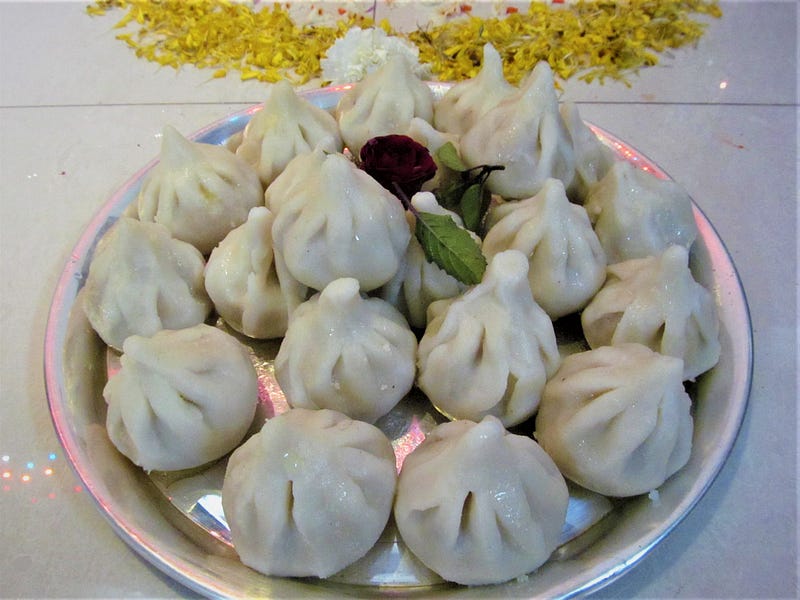
In India, modaks are synonymous with Ganesh Chaturthi — one of the most popular festivals, commemorating the Elephant-God Ganesh. Modaks come in a myriad of varieties and countless flavors. You have milk, saffron, chocolate, pistachio, mango-flavored, fried modaks; the list goes on.
The most popular variety of modaks from the west coast of India — the state of Maharashtra — is ukadiche (steamed) modak. I describe them as sweet dumplings that are absolutely melt-in-your-mouth delectable! They are the healthiest variety of modaks, being —
- Vegan
- Steamed, not fried
- Gluten-free
The recipe I want to share is a legacy handed down to from generation to generation, right from my great-grandmother to grandmother to my mother and now me. So, without further ado, let’s cook.
Ingredients
1 cup rice flour 1 1/4 cup water 1 cup grated coconut (fresh is preferable, frozen will do, desiccated is frowned upon) 1 cup jaggery 1/4 tsp cardamom powder 2 tbsp oil of your choice (I use peanut oil) 1/8 tsp salt or as per taste
Directions
- Mix the coconut, jaggery, and cardamom powder in a pan and cook it till the mixture thickens and turns brown, which usually takes 5–8 minutes. The trick is to let it become gooey but not runny, else it may ooze out of the dumpling. It shouldn’t become too hard either. Over-cooking the jaggery makes the filling a rocky, unchewable mess.
- Also, note that the filling hardens a little more after it cools down.
- Now, bring water to a boil in a pan, and add the salt and oil.
- Once the water boils, lower the heat and slowly add the rice flour while stirring continuously.
- Turn off the heat and keep stirring till the flour and water mix properly and attain a dough-like consistency.
- Knead the dough while it’s still warm using your hands or a stand mixer. Knead till it becomes soft and moist and reaches a consistency fit for rolling.
- Divide the dough into 10–12 smaller balls.
- Kneading the ball with your hands, flatten it into a circle of approximately 8 inches on a butter paper. You may use your own hands or a rolling pin to flatten; I prefer doing it by hand.
- Place a tablespoon of the filling at the center of the circle.
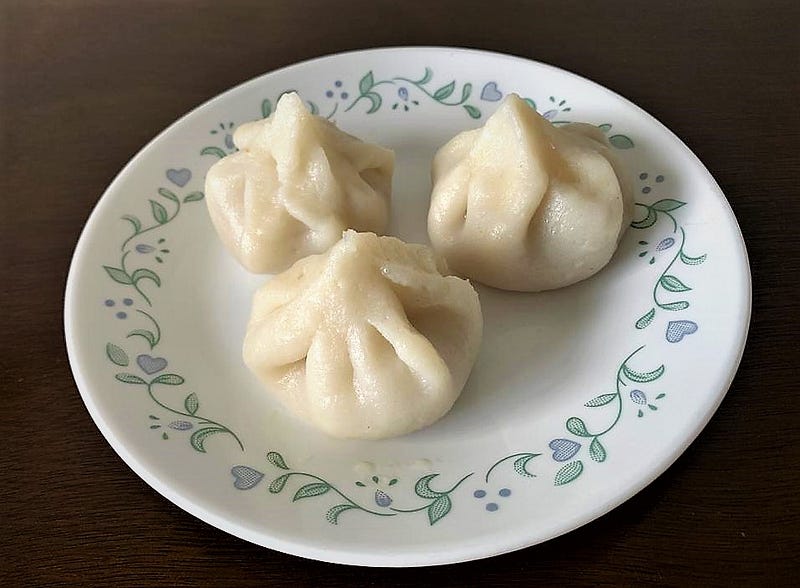
- Now make pleats from the edges of the circle by pinching the dough together and finally bring all the pleats together in the center, and press them together to seal the top. You may remove any extra dough that forms on the top, to make it look dainty, or leave it as is looking like a nubbin if the look is not vital to you.
- Step#10 requires practice. If you found it too mind-boggling (I definitely did, on my first try), ditch it. Instead, simply fold the circle to form a semi-circle and press along the circumference to seal the deal. Then follow steps 12 through 14. The resultant sweet is called karanji in India.
- The ultimate step is to steam all the modaks in a steamer pot for 10 minutes.
- Let them cool for 10 minutes and serve.
- Enjoy the scrumptious, sweet goodness that will melt in your mouth and taste like heaven!
Tips
- Use fine rice flour.
- Using fresh coconut if guaranteed to give the best results. If you can’t find fresh coconut, you may use frozen coconut, but make sure it is grated, not shredded. Desiccated or dry coconut does not do this recipe justice.
- Use salt sparingly but don’t skip, it lends a richness to the sweet.
- Cardamom is an India spice that you can find at any Indian grocery store. Cardamom powder is also available at most US grocery stores and Amazon.
- You can make fold the dumpling using a ready-made modak mold available in Indian grocery stores and Amazon. If you use the mold then replace steps 8 through 10 with these.
- Put the dough ball in the mold and press it gently to the shape of the mold.
- Add 1 tbsp of the filling and then cover the bottom of the mold with some extra dough to seal the dumpling.
Last but not the least, Bon Appetit!
Get all my stories about the Festivals of India.
You will love this vegan delight too.


