
Festivals of India — Ganesh Chaturthi and Anant Chaturdashi
The 11-day festival celebrating the birth anniversary of the Elephant-God Ganesh.
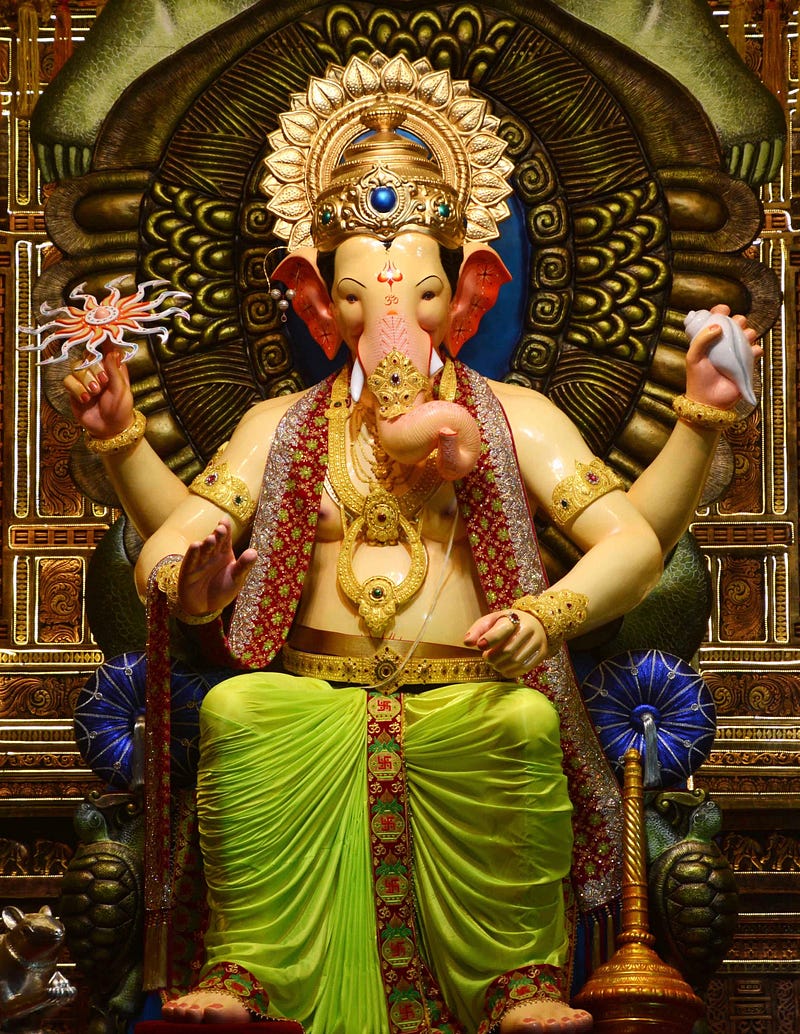

The proud and handsome moon roared with laughter, much to Ganesh’s chagrin as he plummeted into the ground. The pot-bellied Elephant-God Ganesh had been traveling on his favorite ride, a tiny mouse. The mouse got scared out of its wits by a snake in its path and stumbled, causing Ganesh to fall.
It was Ganesh’s birthday, and he had stuffed his face full of sweet offerings received from devotees. The fall made his stomach burst open, and all the sweets fell out. Ganesh was embarrassed. He caught hold of the snake that had scared his mouse, stuffed the sweets back in his stomach, and tied it shut with that very snake, all in one fell swoop.
But not before the moon watched this unfortunate happenstance and had a merry laugh out of it. Ganesh was livid at the moon’s discourteous display of mirth. He broke one of his tusks, hurled it at the moon with all his might, and cast a curse on the moon.
The curse proclaimed the moon would plunge into darkness. The moon clutched his pearls, his hubris disappearing in a mist of apprehension. He fell prostrate at Ganesh’s feet, begging his forgiveness and singing his glory.
The moon affects life on our planet in countless ways, so Mother Earth too faced grave repercussions from the curse. Realizing this, many other Gods joined the moon in his attempts to appease Ganesh and make him take the curse back.
Words once uttered are like an arrow leaving a bow.
Ganesh’s heart of gold was bigger than his belly and melted at this cajoling. But a curse once uttered cannot be reversed, it can, however, be alleviated. And so Ganesh declared that the moon wouldn’t remain in darkness forever. But to keep the moon’s ego in check, Ganesh decided that he would start waning from the full moon day onwards until new moon day and then wax again.
Ganesh toned down the curse, but to remind the moon of his folly, he declared that anyone who looks at the moon’s face on Ganesh’s birthday would earn a bad reputation or get falsely accused. The Hindu calendar assigns the fourth day after the new moon in the month of Bhadrapada as Ganesh’s birthday — it is called Ganesh Chaturthi.
And so on this day, all believers consider a moon sighting inauspicious and avoid it at all costs. The tale teaches us two life-lessons:
- Never take pride in yourself and mock the physical appearance of others. The moon forgets that his glory is a reflection of the sun’s light, in the same way, that human beings are a reflection of the Divine spark. See the God residing in every person regardless of their race, age, abilities, gender, or sexual orientation, and treat everyone like an equal.
- Words once uttered are like an arrow leaving a bow; one cannot take them back. But the damage can be mitigated if one is repentant and takes necessary remedial actions.
Who is Ganesh?
The first to be worshipped and invoked.
Amongst the pantheon of Indian Gods, Ganesh holds a place of venerable honor. He is the first to be worshipped and invoked, in rituals and important undertakings. He is the eldest son of Lord Shiva and Goddess Parvati.
Ganesh the unborn.
Ganesh’s birth is shrouded in mystery, giving rise to a few different stories. Most of the accounts match till one pivotal point.
Once when Shiva — a wanderlust at heart, was away for several years on one of his excursions, Parvati grew lonely. As she pined for an offspring her maternal instincts got the better of her. She created a baby boy out of the sandalwood paste on her body and the soil beneath her feet. She breathed life into the baby and embraced him as her own.
When Shiva returned from his sojourns, he found the now grown-up boy guarding the front door of his home. Parvati had asked Ganesh to stand guard and not allow anyone in, while she took a bath inside. Ganesh, being oblivious of Shiva’s identity, stopped him dead in his tracks, which resulted in an altercation between the two.
Not one to take being barred from his own abode lightly, Shiva cut off the boy’s head with his sword and entered. But a piercing shriek greeted him instead of a wife’s warm welcome, for Parvati had discerned what transpired, looking at Shiva’s blood-stained sword. Flying in a rage, Parvati demanded the resurrection of her only begotten son.
Why does he have an Elephant head?
Story#1 Giving in to Parvati’s demand, Shiva sent his servants to the forest to get the head of any animal sleeping with its head facing north. The servants found an elephant asleep in that position, sacrificed it, and brought his head for Shiva. He fixed that head on the boy’s torso and brought him back to life.
Story#2 Some mystics of India believe this story to be taken out of context. The actual story says that Shiva affixed the head of one of his Ganas on the boy; that is why Ganesh is also called Ganapati (leader of the Ganas).
Just as mysterious as their Lord Shiva are his followers and companions-the Ganas. Their provenance is unknown, but lore believes them to be other-worldly beings who have limbs without bones. As information was passed down from historian to historian, limbs without bones came to be interpreted as having an elephant trunk. Artists drew Ganesh with an elephant trunk and the legacy caught on, for all posterity to follow.
Regardless of their verity, both stories conclude that the day these events occurred came to be celebrated as Ganesh’s birthday or Ganesh Chaturthi.
The symbolism of Ganesh’s unusual form
Ganesh’s preferred mode of transport is a mouse which is one of the smallest animal forms. This signifies a conquest over one’s ego. In stark contrast to that, is his head of an elephant which is one of the biggest animal forms. Elephants are intelligent animals, indicating that the elephant-headed Ganesh is an embodiment of wisdom, knowledge, and intelligence.
It also connotes evolution — from mouse to elephant to human form. It symbolizes that Ganesh is the Lord of all creatures, right from a tiny mouse to an enormous elephant.
How is Ganesh Chaturthi celebrated?
India is the uncontested birthplace of spirituality
In 1893, one of India’s great freedom fighters, Lokmanya Tilak expanded the celebration of Ganesh Chaturthi from private family affairs to the bigger stage of public festivities. He intended to bring people of call castes and creeds together in their worship, prayer, and revelry to unite the then divided Indian society in the fight against the oppressive British rule.
The grand scale at which we celebrate the festival today is testimony to Tilak’s visionary outlook and the spirit of the Indian people in immersing themselves in the Divine for eleven days straight. India is the uncontested birthplace of spirituality, and also its safekeeper.
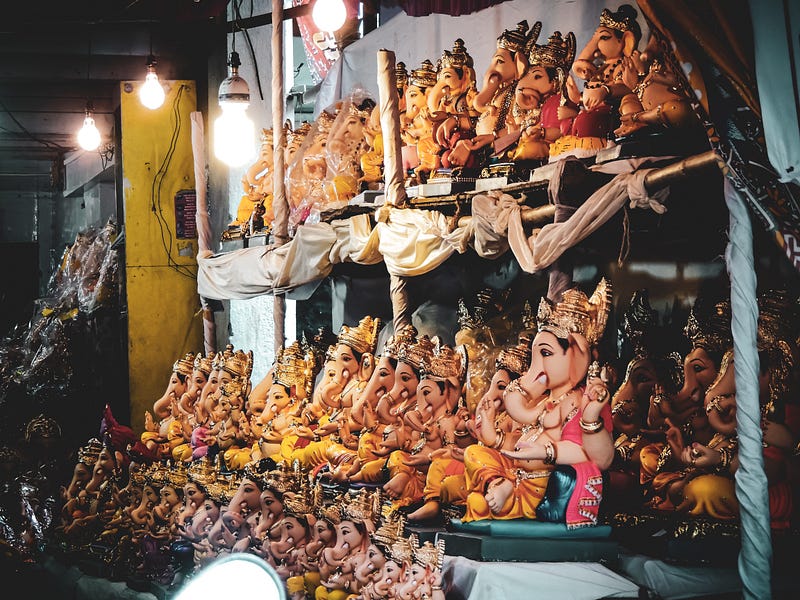
Domestic celebrations
Domestic celebrations of Ganesh Chaturthi last one and a half to seven days. Devotees build decorative altars to house Ganesh’s idol (made from clay). They perform daily poojas and aartis, sing devotional songs, and offer sweets such as modak to the deity. These are fun-filled events where not only family, friends, and relatives but even strangers are welcome to join in the worship and gaiety.
Public celebrations
The public celebrations see pandals (temporary platform) being built on every other road — especially in the state of Maharashtra, the birthplace of Lokmanya Tilak. Mammoth Ganapati idols are center-stage with brilliant lightings, themes, and decorations grand enough to put wedding decorations to shame.
Serpentine queues to get a glimpse of the beloved deity adorned in all his glamour, are not uncommon in cities such as Mumbai and Pune. Singing, dancing, chanting devotional songs (aarti), all go hand in hand. The most famous aarti Sukhkarta Dukhharta (literally. bestower of happiness, remover of sorrow) reverberates in every nook and cranny.
.jpg)
Food
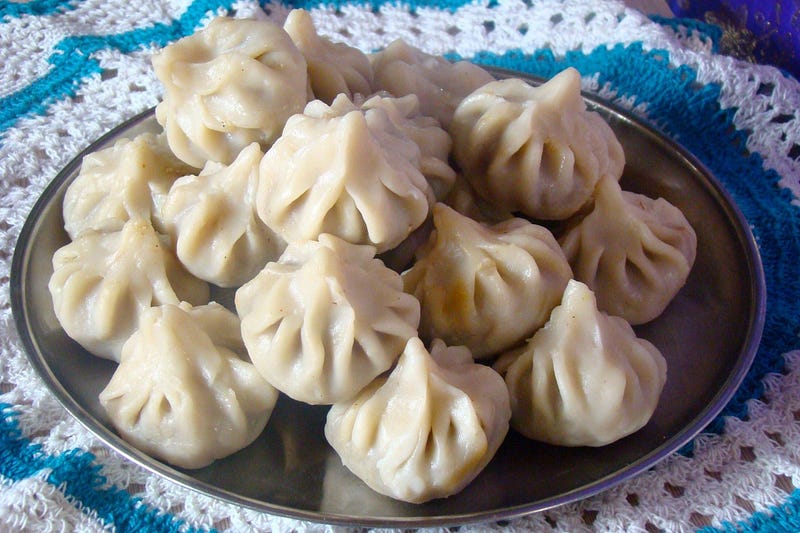
Ganesh is the quintessential lover of food and sweets. His favorite sweet is modak, which is prepared in multifarious ways and flavors — the traditional ones — milk, saffron, pistachio, and the modern ones — chocolate, mango, strawberry, etc. In their homes, people either make ukadiche (steamed) modaks or fried modaks — both contain a coconut and jaggery filling. Whichever variety you choose, the modak is a mouth-watering, delectable, nectar-sweet delicacy like nothing else you’ve ever tasted.
Visarjan (Immersion)
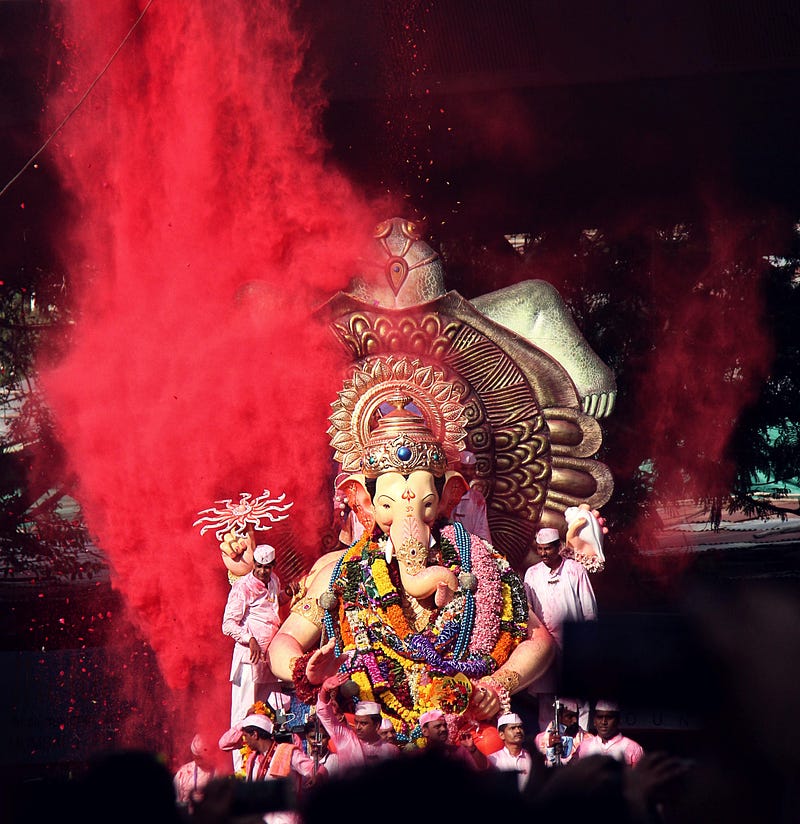
On the 11th day — also called Anant Chaturdashi — people immerse the idols in lakes, ponds, or the ocean (this is called Visarjan in India). All night processions accompanied by singing, dancing, and music go through the lanes of cities to the seashores, as people bid adieu to their favorite deity. The immersion is symbolic of letting go of attachments — even to God — to attain moksha (emancipation from the repeated cycles of birth and death).
Interesting Facts
- Ganesh is also called Ganapati, Vinayak, Gajanan, Ekadanta, Vakratunda, and so on. He has 108 names signifying 108 multitudinous qualities.
- We consider Ganesh the remover of obstacles. The big elephant head represents a big intellect and balance. So, it shows that if we keep your intellect keen and balanced, we can overcome any obstacles in life.
- Ganesh is the God of knowledge, wisdom, and material prosperity.
- Hindu philosophy associates each chakra in the human body with a presiding deity. Ganesh is the reigning deity of the Muladhara or coccyx chakra, where Kundalini energy resides.
- Being the remover of obstacles, spiritual aspirants pray to Him to absolve their karmas and expedite their liberation.
From Ganesh Chaturthi to Anant Chaturdashi, this is how devotees of Ganesh immerse themselves in him completely. They sing his praises through songs, mantras, and aartis, dance before him, cook his favorite foods and sweets, decorate him, and adore him. And finally, immerse him in water, and await his return the next year with these words.
“Ganapati Bappa moraya, pudhchya varshi lavkar ya”. (Praises to the Lord Ganapati, may he arrive soon the next year).
Get all my stories about the Festivals of India.
Manasi is a writer, poetess, practicing yogi, and travel enthusiast who loves humor. You can find her on Twitter @Manasi_K99.
References:
- Isha Yoga
- Hindu Fasts & Festivals by Sri Swami Sivananda
- Sri Sathya Sai Official