Stormy Clouds brewing for the Global Economy
Geopolitical & Economic risks mounting — Argentina, Hong Kong, Trade wars, Brexit & more…
The U.S markets recorded a steep loss of about 400 points its Dow Index yesterday. And it seemed well poised for another loss today as the global markets slumped under the pressure of weak economic data & rising geopolitical risks. At the time of writing, the U.S has delayed the additional tariffs on Chinese imports to Dec. 15th, that were going to be originally enforced on Sep. 01. With the news, the U.S markets have staged a dramatic rebound up more than 400 points erasing losses from yesterday.
Nevertheless, the risks to the global economy are significant as the broader indicators point towards further weakness and external shocks are in the form of geopolitical risks are not helping. Throw in a Black swan event in the mix and we can be looking at a major set back for global growth. Let’s review some flashpoints which are causing the investors to flee towards safe-haven assets.
The U.S-China Trade War
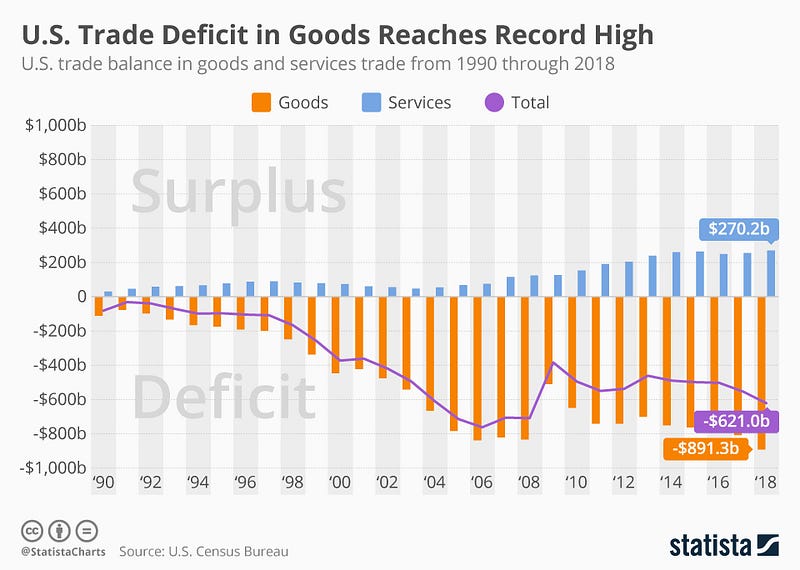
The mother of all economic battles has grown to epic proportions — not only embroiling the two biggest economies of the World in a tit-for-tat response but adding other dimensions to it like technology, currency & energy. Not to mention the contagion effect from this trade hostility to other regions. An economic slowdown in China — the manufacturing hub of the world is usually a precursor to tough times ahead. For the U.S, the trade gap has continued to rise (infographic below) & so has the budget deficit — climbing to $867B in the first ten months of the fiscal year, a 27% increase over the previous year.
Hong Kong Protests
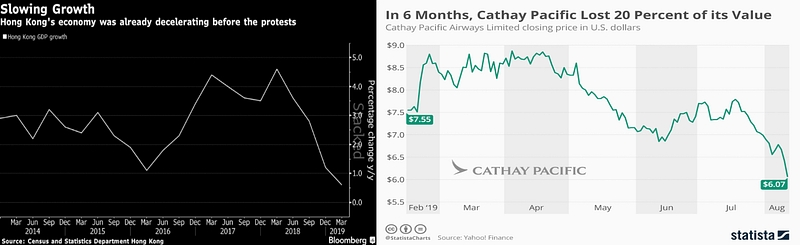
One of the major markets in Asia has been held hostage to violent protests going on for weeks now. The protests which have taken the shape of a democracy movement started off after a bill that would have allowed the extradition of people to mainland China was presented in the Parliament. The protests which have turned violent at times have severely curbed the economic activity with the Hang Seng index sliding.
The protestors have now been occupying the terminals of the Hong Kong airport causing the cancellation of the flights for the second straight day. Imagine the chaos from the closure of one of the busiest airports in the World. This happened after some employees of the national carrier Cathay Pacific who joined the protest were sacked off their positions. As the Hong Kong’s Chief Executive Carrie Lam said the unrest risks tipping the city into an “Abyss,” it’s an ominous sign for an already slowing economy (chart below).
Argentina Elections Fallout
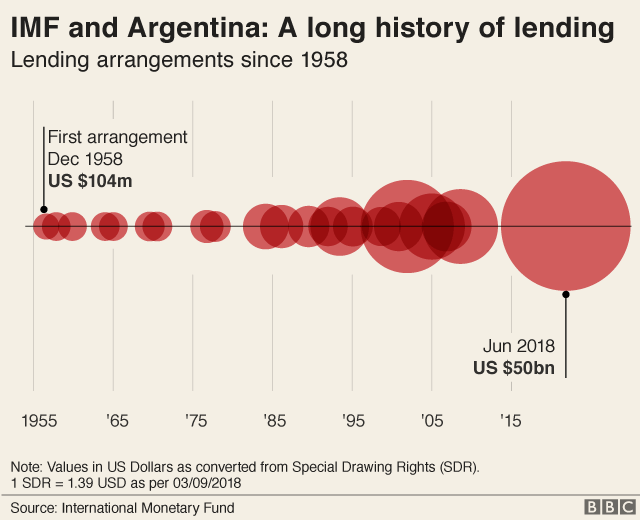
It was only last year that IMF reached an agreement with the second-largest economy of Latin America — extending a credit line of $50 billion, the biggest in its history to bail out the country suffering from a falling currency & soaring deficits. Just when you things looked they were settling down for the nation, results from the election primaries yesterday showed people soundly rejecting President Mauricio Macri’s austere economic policies.
This threw the markets into a tailspin as the Argentina Peso dropped 37% at one point against the US dollar. The USD/ARS pair spiked from 45.30 to 62.00 — currently trading around the 55.00 area. The country’s main stock index plunged by 48% — marking the second-biggest one day market plunge of the 94 stock exchanges tracked by Bloomberg. The market turmoil was exacerbated by the yields on shorter-maturity notes hitting 35%
Japan-South Korea Head to Head
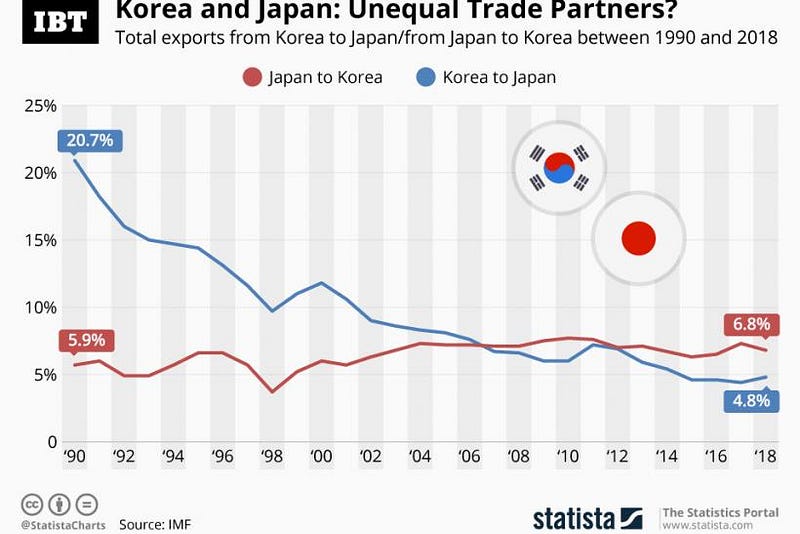
Talking about the contagion effect from the U.S-China trade war, a trade spat has erupted between the traditional allies & strong trading partners — South Korea & Japan. It started after a Korean court decision that ordered Japan to compensate the victims of forced labor during the Second World War. Japan points to a 1965 treaty that had settled matters between the two neighbors.
As a retaliatory measure, Japan tightened the export controls of hi-tech materials to South Korea — by removing South Korea from its list of “white nations” considered safe enough to export strategic materials. South Korea has retaliated by dropping Japan from the list of most trusted trading partners while seeking talks at the same time. Analysts believe that Tokyo’s decision might backfire in the long term as Korean tech giants like Samsung, LG & SK Hynix rethink their supply chain partners.
Brexit Uncertainty
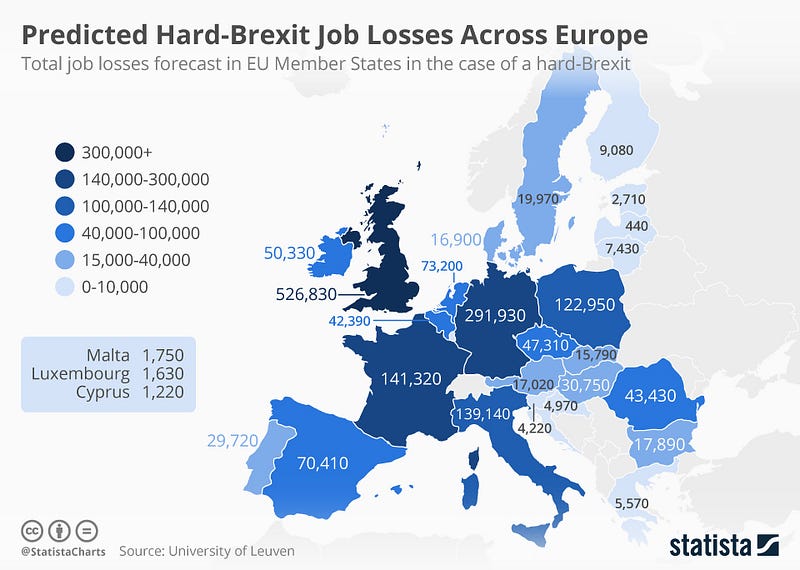
The never-ending saga of Brexit continues to unfold. A new Prime Minister in the UK has been in the hot seat for a few weeks and there are no signs of an amicable resolution to the economic divorce in sight. With EU unwilling to negotiate a new agreement & the new PM’s ready to take the no-deal Brexit route, things are looking bleak for the UK & the whole region. Recent negative growth numbers in the UK— the first time since 2012 points to further trouble. Predicted Job losses (infographic above) don’t paint a pretty picture either for the region.
Germany & Singapore Weaken
And finally, the economic data from the export-driven economies of Germany & Singapore provide further evidence of a global economic slowdown. The trade-reliant Singapore today announced a cut to its growth outlook to 0–1% from 1.5–2.5% this year.
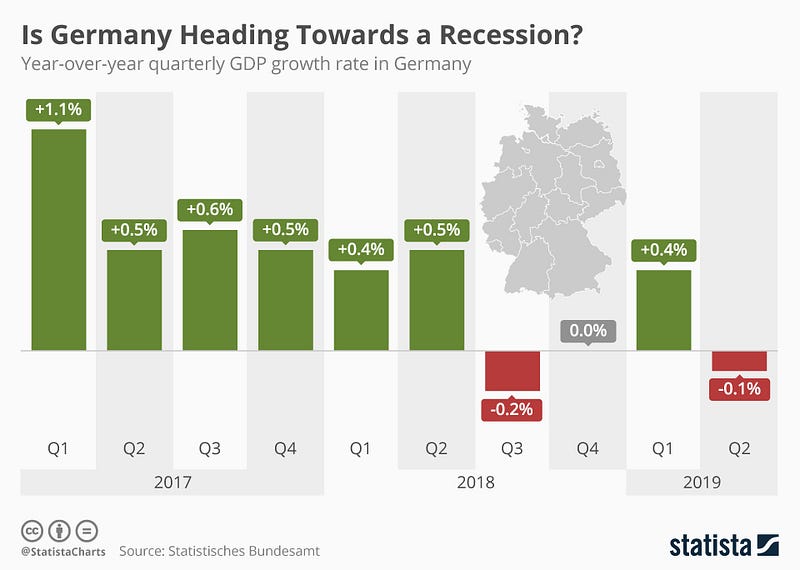
While Europe’s biggest economy — Germany — reported ZEW expectation figure for investor confidence dropping to -44.1, hitting its lowest level since 2011. Germany’s GDP contracted by 0.1% in the second quarter with the EU’s growth slowing down to just 0.2%. The region which is already reeling with Brexit & political instability in Italy (region’s third-largest economy), the bad economic news continues to pile.
Rush to safe-havens
Investors are jumping to the safety of bonds & currencies like Yen and the US Dollar as an anticipated reaction to the risk-off sentiment in Equities. The U.S. yield curve is at its flattest level since 2007, as the 30-year treasury closes in on its record-low of 2.0882%. The numbers dictate an extended period of monetary easing from the financial authorities around the World to counter these risks. The only problem is that you can’t predict the unforeseen circumstances.
Email 📭| Twitter📜 | LinkedIn 📑| StockTwits 📉 | Telegram 🔗