Currency War & China’s change of heart towards Cryptos
Trade war worries, Libra launch & currency manipulation blame seem to be pushing PBoC towards creating a CBDC
The Trade war kicked into high gear as the U.S announced new tariffs on Chinese imports to take effect on September 1st. As is the case when risk-off sentiment takes hold in markets — Gold rose, Yen rallied, the global stock of negative-yielding bonds to a record $15 trillion & but more importantly Bitcoin jumped 17% in the two days that followed.
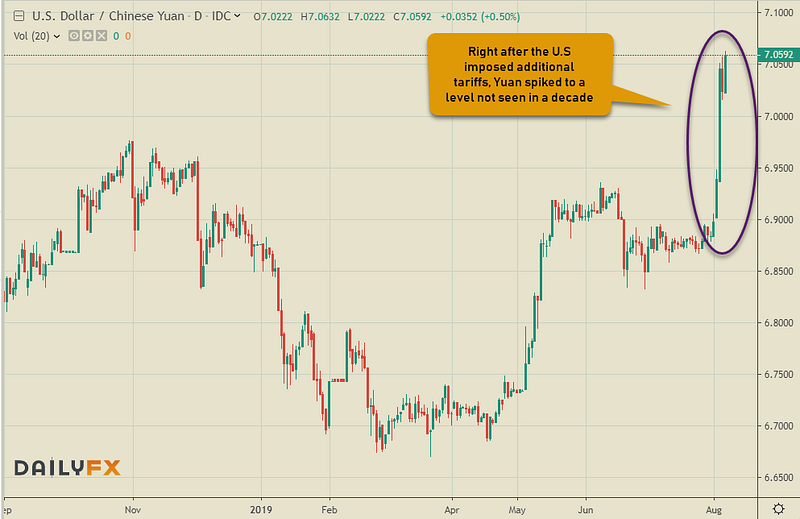
China retaliated by putting a halt on buying U.S agricultural products. Overnight the Chinese Yuan skyrocketed past the psychological level of 7.00 against USD, which it has not seen in a decade. The level has acted as an unofficial ceiling to the pair (USD/CNY — chart below). On the other hand, Americans saw this is a deliberate action from the Chinese Central bank (PBoC) to gain an unfair trade advantage.
The U.S has long accused China of manipulating its currency to make its exports cheaper — a claim that the latter has vehemently denied. Economists have predicted previously that China might play the currency card if it is pushed against the wall. Whether there is any truth to the currency manipulation or not, the latest exchange of unpleasantries between the two biggest economies has added yet another dimension to the trade hostilities — a currency war.
In the backdrop of all these macroeconomic events coupled with some other developments has led to a softening of Chinese stance on Bitcoin & other cryptocurrencies, which have been banned from the country since 2017.
Rise in Bitcoin
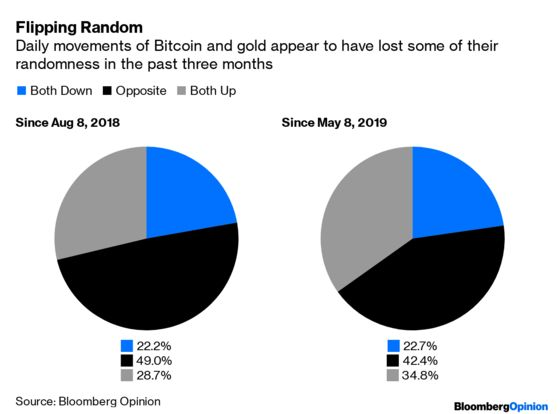
The premiere crypto has not only staged a sustained recovery ever since the trade war that has intensified since March this year. With the extreme uncertainty around the traditional asset classes, it has started to act as a hedge, which can be seen from BTC’s strong correlation with Gold (figure below), in these difficult economic times. Add to this a rising market dominance of Cryptos, which is just shy of 70% right now, BTC is the best store of value in digital assets right now. These properties with the pouring in of institutional money in BTC has made it enticing for China to embrace it.
Chinese Adoption
Despite a blanket ban on Chinese citizens’ to trade cryptocurrencies, there is huge participation from the country using offshore exchanges. Huobi, one of the major crypto exchanges was originally founded in China, now based in Singapore, created a Communist Party committee in Beijing in late 2018 — you know how things work in China when the government gets involved. The interest is evident. The Bank of China, one of the four biggest state-owned commercial banks also released an infographic on the usefulness of Bitcoin.
Macroeconomic factors
The trade war between China and the U.S is now going to epic proportions with a lot more at stake than just the imports & exports. The technology dimension was already added to the trade hostilities, but now we have another casualty in the form of currency manipulation that was discussed above. Even if China is manipulating its currency to gain an upper-hand as the U.S implies, the solution for China is only temporary.
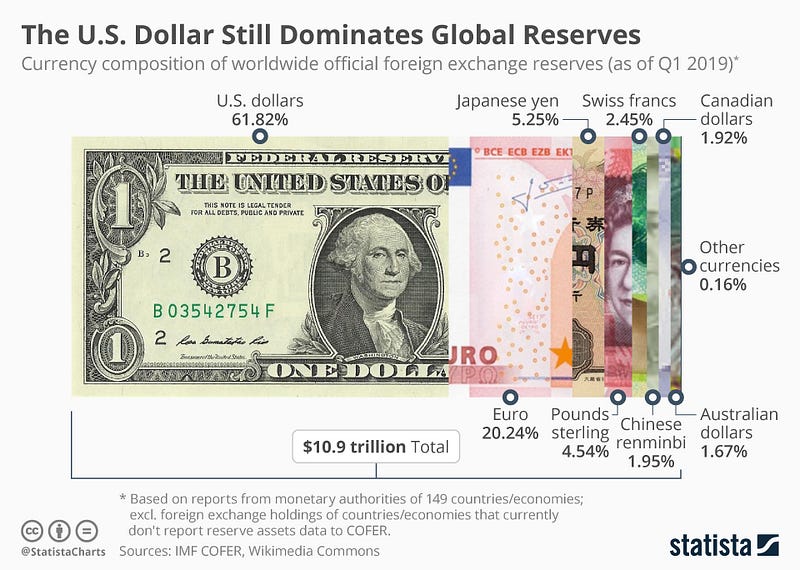
At the end of the day, the US dollar is the reserve currency of the world, which accounts for almost 62% of the total global reserves. China can cause some headache but can’t dislodge the current fiat-based economic system, which is entirely dependent on the Greenback. The only other option would be to bring disruption to USD dominance via and an alternative system — currently evolving in the shape of decentralized cryptocurrencies. This could actually work as people lose faith in the manipulative fiat-based system.
Facebook’s Libra
The creation of the social media giant’s digital payment coin maybe one of the most important factors. Although Libra has run into some severe regulatory hurdles in the U.S & around the globe, China is taking it seriously. Even a limited approval of Libra coin with an ecosystem of 2.5 billion users backed by the U.S dollar will reinforce the hegemony of the Greenback.
“[Libra]… could create a scenario under which sovereign currencies would coexist with U.S. dollar-centric digital currencies. But there would be in essence one boss, that is the U.S. dollar and the United States. If so, it would bring a series of economic, financial and even international political consequences.” PBoC director Wang Xin
Keeping this reality in mind, PBoC (Peoples Bank of China) has prioritized the development of a digital Renminbi (Central bank digital currency). The central bank has already got the approval from the State Council to start working on the project. PBoC has also suggested that much attention should be given to other mainstream cryptocurrencies in a statement released August 2nd. The clearest sign yet of how Chinese authorities are coming around on this issue.
The U.S, on the other hand, remains mired in regulatory confusion on what to do with Cryptocurrencies. The Federal Reserve Board is planning FedNow — interbank real-time payments and settlements service slated to be released in 2023–24. This might be too little, too late as China embarks on a much more ambitious plan to not only issue a CBDC but be more receptive to the idea of integrating Cryptos in the financial ecosystem.