
Stop Tweeting Your Articles Like This
It’s not a Where’s Waldo game

I’ve been encouraging folks to try out promotion on Twitter, and I can’t wait to see more writers join the Twittersphere.
But as I’m retweeting and supporting my fellow writers, I’m noticing a few key mistakes that make it really hard for the Twitter community to engage with Medium articles.
I’m here to put an end to the confusion once and for all.
What not to do
The Buried Link
While most people do access Twitter on their mobile and website platforms where there is a link preview, this link preview might not show up for a variety of reasons, including the type of app they use.
For me, I use Tweetdeck to manage multiple social media accounts, so the tweet shows up to me like this:
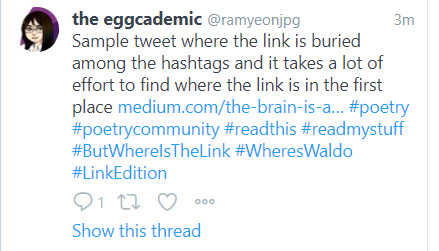
Regardless of whether a link preview shows up, it makes it difficult to find out where to click. The more resistance and thinking that someone has to do to click on something, the less likely they’re going to do it.
(Side note: as someone with fat thumbs of low dexterity, I also have a higher chance of mis-clicking the hashtags. We want to avoid that, please and thank you.)
The #Every #Word #Is #A #Hashtag
I think the intention behind using so many hashtags is to get noticed under all of these hashtags.
It doesn’t actually work because not many people just search up the hashtag “#how” and “#is”. These low search value hashtags then clutter up your tweet and make it hard for people to find your link.
Also know that for the most part, people have started to ignore the hashtags when they read a post. I know for me, when I see something in blue, I know it’s not core content.
Sure, sometimes people throw tongue in cheek humour in their hashtags (see: #itmakesmedieontheinside in my tweet), but it’s more of an afterthought Easter egg than something people prioritize when they glance through a tweet.
Be intentional with your hashtags; use the ones that the community is using (e.g., #WritersLift, #PoetryCommunity) but are niche enough that people actually see your tweets within that community.
What to do instead
Give ample space around your link
A tweet like this makes it easy to see where the link is, relative to the ones shared above.
Use emojis and punctuation to format your tweet
Here’s something closer to my default format of the tweets I use to promote my Medium articles.
Because the link and the hashtags still show up in the same colour, I’m going one step further to associate the link to one emoji while the hashtags are associated with a different emoji. The goal is to help your regular readers know what to search for when they’re looking at a tweet.
The summary
Don’t
- Bury your link amongst your hashtags.
- Make every word a hashtag.
Do
- Visually separate your links and hashtags with strategic formatting like spacing, emojis, punctuation.
Good luck! I can’t wait to read more articles on this platform from the Medium community (and do less searching for links with my eyeballs because fam, I am so bad at it).
Lucy (The Egg Girl) probably spends way too much time on Twitter, but she thinks this makes her an eggspert? She’s ready to share that knowledge to help others build their readership on this platform, so stay tuned! She’s written about her experience recovering from abuse, her meal prep routine that’s saving her time each week, and how she upcycles objects destined for thelandfill around her apartment. She wants to amplify Susan Scandiffio’s article: You just might want to get a second opinion when it comes to your mental health treatment.


