avatarLucy Dan 蛋小姐 (she/her/她)

Summary

The website content discusses the concept of Kintsugi as a metaphor for personal growth and the futility of trying to fix others, emphasizing the importance of self-repair and setting boundaries.

Abstract

The article delves into the Japanese art of Kintsugi, which mends broken pottery with gold, symbolizing that breakage and repair can enhance the beauty of an object. The author draws a parallel between this art form and personal development, reflecting on their own experiences of attempting to 'fix' people, particularly an abusive mother. Realizing that people cannot be fixed without their willingness, the author focuses on self-repair and creating an environment conducive to positive change. The piece acknowledges the transformative power of creativity, words, and boundaries in personal healing and growth, inspired by the concept of upcycling and the song "Bbibbi" by IU about setting boundaries.

Opinions

  • The author values the philosophy of Kintsugi, seeing beauty in the transformation and repair of objects.
  • There is a personal belief that while one can provide the space and environment for change, ultimately, people can only be fixed if they are willing participants in their own repair.
  • The author expresses a sense of duty and subsequent disappointment in not being able to change their abusive mother, despite their father's insistence.
  • Self-fixing is seen as a viable alternative to the impossible task of fixing others, with the author identifying as a skilled 'fixer' of objects and themselves.
  • The concept of upcycling is appreciated as a way of giving new life and functionality to discarded materials.
  • The song "Bbibbi" by IU is credited with influencing the author's understanding and implementation of personal boundaries, which has been instrumental in managing abuse.
  • The author invites further discussion on the topic via Twitter, indicating an openness to dialogue and sharing of personal experiences related to the themes of the article.

Kintsugi

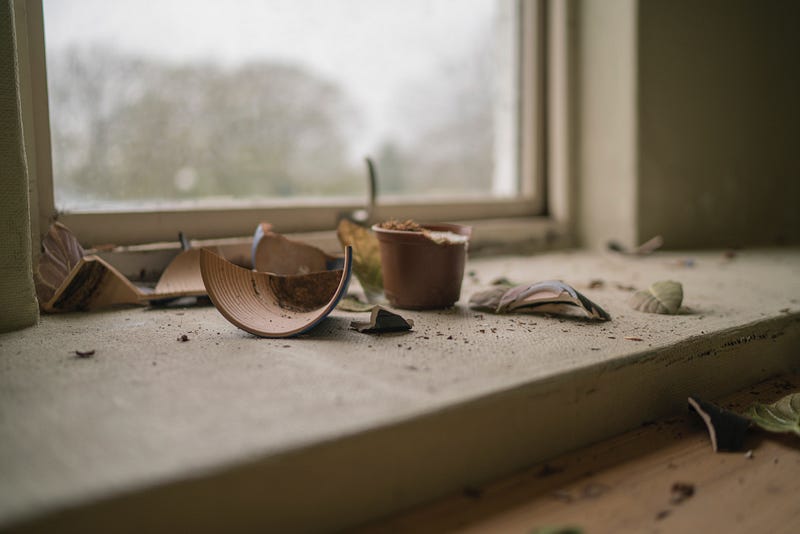
Photo by Daniel Tafjord on Unsplash

When pottery breaks, it can be fixed; some even say the final product’s beauty far outweighs the original.

Held together, with gold highlighting these pottery scars.

Something from nothing, was a story that followed me like the blanket that followed the boy, fixed and mended, growing from a blanket, to a hat, to a button, growing together.

I value this mindset.

And so all my life I tried to fix people, like I did with objects.

I expected that a dash of creativity, the right words strung together — might change someone.

Might protect me for real, if I did it right.

Sadly, it took me decades, it took me 99% of this life, to learn that unlike objects you cannot fix people.

You can create the space and environment in which it’s easier to make change, to develop new habits.

But you cannot fix someone, unless they are a willing participant.

I cannot fix my abusive mother no matter how much my father insists that it is my duty to stop her violence.

I can only fix myself to put together the shards that have shattered as she repeatedly smashed my dream to smithereens.

My dream to be safe.

I can only offer up the space and environment the boundaries, expectations to guide her behaviours, but only if I feel safe.

I am a fixer.

I am a good fixer.

And I fix and upcycle objects; I mend myself.

That is the line.

This poem was inspired by a few things.

First, the concept of Kintsugi, where golden resin is used to mend pottery. First and a half, the concept of upcycling old materials destined for the trash into functional, beautiful day to day items. I value

Second, thank you to Jay Avery for his poem on Kintsugi.

Finally, to IU’s song “Bbibbi”, a song about boundaries. The concept of boundaries has changed my life in terms of managing previously ongoing abuse. Thank you to IU, who has grown with me across the decades.

Tweet me your thoughts here!

Kintsugi
Abusive Mother
Abusive Relationships
Poetry
Abusive Parents
Recommended from ReadMedium
avatarDavid Rudder
Taking Time Out

A sojourn.

1 min read