
Stop Stress in its Tracks with This Simple Habit
Bonus points: it only takes 5 minutes
Let’s start with stress.
Have you ever felt like you were drowning while standing in a room?
Quite literally gasping for air. Quite literally gulping in breaths. Quietly f r e a k i n g out that with every breath you’re taking it doesn’t feel like you’re filling up your lungs.

This was me. Two years ago. I was regularly having those sensations because I was stressed. I was constantly on the hop-and-go and I just didn’t know it at the time.
I thought my breathing difficulties were due to my asthma, but taking my inhaler and preventer only helped a little, and for a short period of time. And the dreadful sensations kept coming back.
I visited the doctor who had prescribed my preventer and organised blood tests; and found nothing out of the ordinary. Since it kept happening, I thought, maybe I just have to live with it.
It was only when I visited my osteopath and when she laid her hands on my form, she helped me feel it for what it was. Tight, hard and constricted. STRESSED.
The lack of sleep, lack of movement and poor form with caring for two young ones and returning to work, for the better part of 10 months meant my body was unnaturally tense. It had been for a long time. I wasn’t sleeping, nothing was quite flowing, much less the air and the oxygen that I needed.
The stress had built up to the point where it smothered my breathing. Cue, the feeling of drowning in a room.
“Feelings come and go like clouds in a windy sky. Conscious breathing is my anchor.” — Thich Nhat Hanh
I turned to yoga because I was stressed. In yoga, I found meditation. In meditation, I was able to get closer to my breath.
What is meditation?
Some say it’s emptying the mind. Others define it as stillness of thought. Headspace likens it to exercise for the brain, while Cambridge Dictionary defines it as
I agree with the last school of thought. My meditation is less in my head, and more in the breath. I meditate to find my breath. Find more flow.
The benefits
Personally, I feel better in my body. Open up, rather than closed in. I meditate to feel better in my mind. More clarity, less noise.
There’s also science that supports this, with over 3,000 scientific studies on how meditation benefits our minds, bodies and performance. Such as:
- decreases depression, stress and anxiety,
- improves information processing and decision making,
- gives you mental strength and resilience,
- relieves pain better than morphine,
- improves rapid memory recall.
Ok, it all sounds good. Now the question is, how do we do it? What do we need?
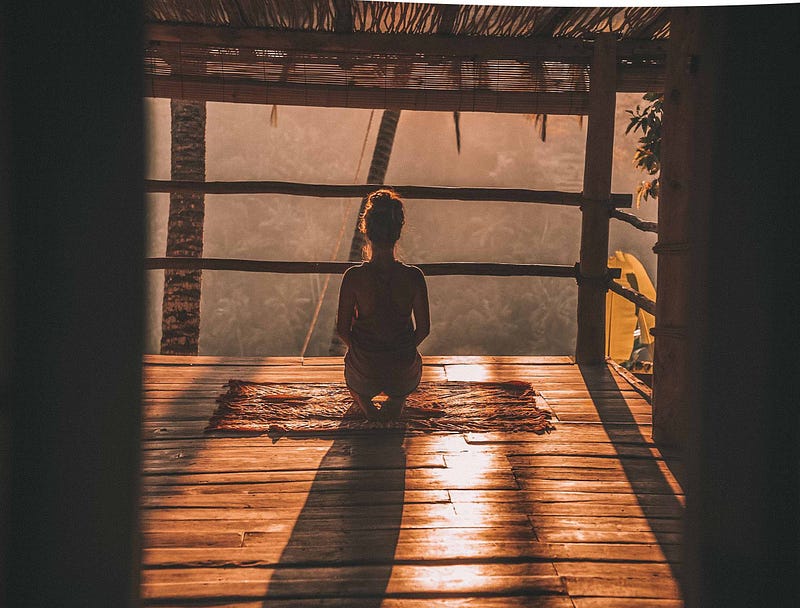
Start in a comfortable seat
No props required. No change in clothing. No warm up sequences.
- Sit cross legged on the floor.
- Roll your shoulders back; and relax them, creating space between them and your ears.
- Keep your back strong rather than slouching
- Chin is parallel to the floor, relax your jaw.
- If you want, you can also scan your body from head, neck, shoulders, arms, wrists, fingers through to chest, thighs, shins, ankles and toes to sense and release any tension you may be holding.
Bring your attention to your breath.
Notice if it’s fast or slow, shallow or full. Meditation is the act of giving your attention to one thing. Your breath.
- When you’re ready, inhale in and slowly count to 4. The entire breath in, starts at 1 and continues until you get to 4.
- When you breathe out, slowly count to 4. The entire breath out, starts at 1 and continues until you get to 4.
- Feel your breath enter through your nose, notice how your chest and belly moves as you breath in and out.
- Do this for 4 breaths. This is even breathing.
As you start out with a meditation practice, even breathing is all you need. Your focus is on the breath and the counting will help keep you present. Try it for 5 minutes a day, every day for 5 days. Notice how you feel after that.
If it feels easy enough, extend it a little longer to 7 minutes, every day for 7 days. Notice how you feel after that. Slowly work up to 10 minutes every day.
Looking for more?
Let’s try uneven breathing. Uneven breathing is where your breath out is for a longer count. Your parasympathetic nervous system switches on, and starts to slow down the heart rate, relaxing your body.
- When you’re ready, inhale in and slowly count up to 4. Pause for a count.
- When you breathe out, slowly count backwards from 8.
- Feel your breath enter through your nose, notice how your chest and belly moves as you breath in and out.
- Do this for 8 breaths.
Again, your focus is on the breath and the counting will help keep you present. Try it for 5 minutes a day, every day for 5 days. Notice how you feel afterwards.
If this feels easy enough, extend it a little longer to 7 minutes, every day for 7 days. Notice how you feel after that. Slowly work up to 10 minutes every day.
Where to after that?
There are many ways to meditate; we can be guided by an app such as Headspace or Insight Timer, listen to Youtube guided meditations, there’s even meditation hacking.
I try and keep it simple and it’s worked so far. I haven’t tapped into rapid memory recall just yet, but thankfully, I’ve stopped having those dreaded sensations; the feeling of shallow breathing, the gasping for air. I’m now taking little bursts of breath counting every day.
The longer we sit in meditation, the more benefits we reap.This is just a start. I just want you to start. And it starts with 5 minutes, today.
Go on. You’ve got nothing to lose. Except the tight coils of stress.
More like this:


