avatarRocco Pendola

Free AI web copilot to create summaries, insights and extended knowledge, download it at here

3100

Abstract

obviously be sitting on a nice profit out of the gate (2.50 minus the 0.70 premium paid for the option).</p><p id="dcd7">I’m more likely to do this if Ford reinstates its dividend and I want to stay in Ford stock, at that level, for the long term. When you hold call options, you do not collect the underlying stock’s dividend. If Ford does reinstate the dividend, the stock should fly. I anticipate this happening early next year. In part, this drove my decision to buy the calls.</p><p id="0b5a">I could always exercise my option to buy Ford at 15.00 on a handful of contracts, closing out or letting the rest ride. But that’s not at the forefront of my thinking.</p><p id="d907">In the past, I have played what is a potentially dangerous psychological trick on myself. You open a LEAPS position like this and set your sights on the stock making an insane run and crossing your strike price in no time. Ford would need to a little less than double by Spring 2021 for this to happen. Not likely. But it’s easy to idealistically vision this happening.</p><div id="9d6b" class="link-block"> <a href="https://www.datadriveninvestor.com/2019/10/17/12-simple-rules-to-start-investing-in-stocks/"> <div> <div> <h2>12 Simple Rules to Start Investing in Stocks | Data Driven Investor</h2> <div><h3>How to invest and not lose a shirt doing it? The thing is people who never invested money are afraid to do so. It may…</h3></div> <div><p>www.datadriveninvestor.com</p></div> </div> <div> <div style="background-image: url(https://miro.readmedium.com/v2/resize:fit:320/0*c78Ql6xdaXM0QfXG)"></div> </div> </div> </a> </div><p id="027d">The more you fall into this trap, the more likely you are to hold onto the position for too long. To a point where you do a tightrope dance between selling for a profit and holding on too long (out of wanting and making yourself believe your idealized story will pan out), subsequently seeing profits fade and eventually morph into an irreversible loss.</p><p id="6b27">This can happen fast with options, even LEAPS. So I prefer to err on the side of extreme caution rather than unrealistic exuberance.</p><p id="5209">It’s far more likely I’ll simply sell the call and close out the contract as, presumably, Ford stock rises in price, the option premium increases in value accordingly, and I’m sitting on a profitable trade.</p><p id="11e8">While you can never be certain about the forward-looking math, this chart shows the profit potential of my option position if Ford continues to increase in price.</p><figure id="4277"><img src="https://cdn-images-1.readmedium.com/v2/resize:fit:800/1*QqahObcVvUngHEFlHBjtPQ.png"><figcaption><b>Source: <a href="http://opcalc.com/h4E">Options Profit Calculator</a></b></figcaption></figure><p id="48bb">So if Ford trades at 10.00 come mid-February, I’m looking at a 33% profit on the option trade itself. I don’t need Ford to hit or pass the strike price to m

Options

ake money on this trade. If I had purchased 1,000 shares at 8.75, I’d be sitting on a 14.3% profit at 10.00.</p><p id="0ce8">This said, as the chart makes clear, the longer I keep this position open, the more upside I need in Ford stock to turn a profit on the option trade. While a long-dated LEAP option provides some breathing room, you can’t merely set it and forget it.</p><p id="ff78">As indicated, I’m extremely cautious (maybe too cautious) when I use LEAPS. If I’m not sitting pretty come Q1/Q2 of 2021, I’ll probably bail. Hopefully with a profit. If Ford is flying, I’ll probably sell half of the position and ride out my remaining contracts for another one to six months.</p><p id="530a">A big danger inherent in using LEAPS — and I’ve been here before — is letting the far-out expiration date mystify you into a false sense of security. Clearly, I can ride whatever happens out into 2022. Sounds logical. It can be. But, again, I have been here before and find I see more success using LEAPS with an ultra-conservative strategy. I like the breathing room, but I don’t want to abuse it and let it put me in a bad situation.</p><p id="8091">Quick note on breathing room — if my Ford calls had, say, a Jan 2021 expiration, I’d need to move on a dime to properly handle the position. I also would not have gone so far out of the money. But the point is, with an expiration date of Jan 2023, I have time to act, react, and decide. Simply put, it’s an easier position to manage, as long as you keep time on your side.</p><p id="ac34">I strongly suggest reading and holding onto for reference this discussion of LEAPS options and time decay via the Options Industry Council. I could not have said it better in terms of risk — and how to manage risk and your position — when using LEAPS.</p> <figure id="a8c7"> <div> <div> <img class="ratio" src="http://placehold.it/16x9"> <iframe class="" src="https://drive.google.com/viewerng/viewer?url=https%3A//www.optionseducation.org/OCC/media/OIC/Advisor%2520Content/leaps-long-view.pdf&amp;embedded=true" allowfullscreen="" frameborder="0" height="780" width="600"> </div> </div> </figure></iframe></div></div></figure><p id="5a04">Unless you really know what you’re doing, I don’t suggest buying (or selling) options with a near-term expiration date. You have to consider too many variables too soon to be nimble enough to effectively manage your position.</p><p id="8ff0">If you don’t understand the variables, they’ll burn you. Even when you do understand them, they’re difficult to manage. They have a way of manipulating you. Generally, you cannot manipulate them. The type of math that dictates how options function doesn’t operate on your timeline, nor is it all that flexible.</p><p id="874e">With LEAPS — as long as you plan to assess things far ahead of expiration — you can stop, think, and strategize before you absolutely have to make a decision.</p><h2 id="d8a6">Gain Access to Expert View — Subscribe to DDI Intel</h2></article></body>

Spend Less, Profit More on Stocks You Love

A strategy you can use that costs less than buying shares of stock

Photo by Aljoscha Laschgari on Unsplash

It’s the best name ever for a trading or investing vehicle. It’s also one of the most potentially lucrative.

In this article, I discuss stock options known as LEAPS, providing guidelines you can use to maximize them without getting hurt or, at the very least, minimize your risk exposure. I use a real-life example from my portfolio to illustrate how LEAPS work and why I use them.

LEAPS — Long-term equity anticipation securities

For an overview of option basics and then some, see Marc Guberti’s excellent Data Driven Investor article.

In the shell of a nut, a LEAP option is an option contact with an expiration date far off in the future. LEAPS tend to track the price of the underlying stock more closely than options with a near-term expiration date.

LEAPS are more expensive than near-dated options. Look at it in the most basic way, using my real-life example with Ford. I own 100 shares of Ford stock directly. In just two weeks, I’m up 13.5%. While Ford did not participate in the pandemic stock rally, it’s hitting its stride now. I expect double digits in 2021.

Source: Author’s Charles Schwab Account

I want more exposure to Ford because I do think it will be one of the top breakout stocks over the next year. If I went with the stock, 1,000 additional shares would cost roughly $8,750. Using options, I can purchase 10 Jan 2023 LEAP call options with a $15 strike price for approximately $700. I opted for the latter. Worst case, I lose my entire investment. Theoretically, there’s unlimited upside.

Source: Author’s Charles Schwab Account

I do not intend to hold these contracts to expiration. There’s probably only one scenario where I would. That is if Ford goes on a meteoric rise over the next three to six months and blows past $15.00. In that picture, I could purchase Ford shares (100 per contract) at $15.00 apiece. If Ford was trading at, say, $17.50 at that point, I’d obviously be sitting on a nice profit out of the gate ($2.50 minus the $0.70 premium paid for the option).

I’m more likely to do this if Ford reinstates its dividend and I want to stay in Ford stock, at that level, for the long term. When you hold call options, you do not collect the underlying stock’s dividend. If Ford does reinstate the dividend, the stock should fly. I anticipate this happening early next year. In part, this drove my decision to buy the calls.

I could always exercise my option to buy Ford at $15.00 on a handful of contracts, closing out or letting the rest ride. But that’s not at the forefront of my thinking.

In the past, I have played what is a potentially dangerous psychological trick on myself. You open a LEAPS position like this and set your sights on the stock making an insane run and crossing your strike price in no time. Ford would need to a little less than double by Spring 2021 for this to happen. Not likely. But it’s easy to idealistically vision this happening.

The more you fall into this trap, the more likely you are to hold onto the position for too long. To a point where you do a tightrope dance between selling for a profit and holding on too long (out of wanting and making yourself believe your idealized story will pan out), subsequently seeing profits fade and eventually morph into an irreversible loss.

This can happen fast with options, even LEAPS. So I prefer to err on the side of extreme caution rather than unrealistic exuberance.

It’s far more likely I’ll simply sell the call and close out the contract as, presumably, Ford stock rises in price, the option premium increases in value accordingly, and I’m sitting on a profitable trade.

While you can never be certain about the forward-looking math, this chart shows the profit potential of my option position if Ford continues to increase in price.
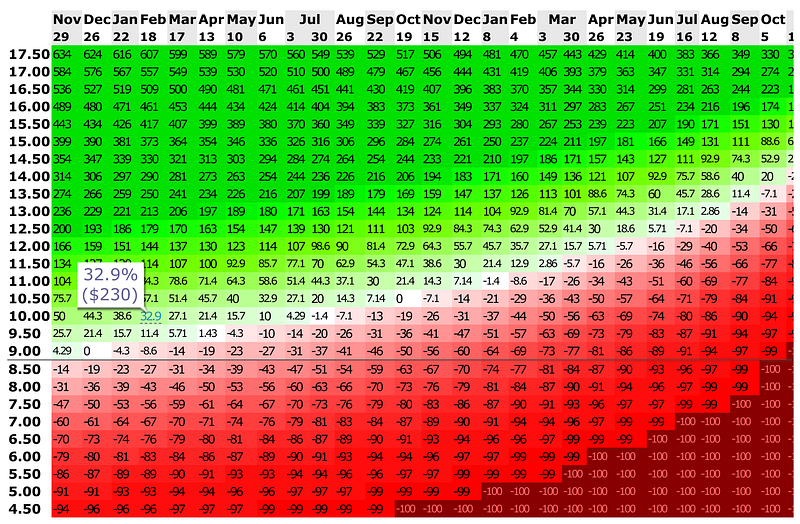
Source: Options Profit Calculator

So if Ford trades at $10.00 come mid-February, I’m looking at a 33% profit on the option trade itself. I don’t need Ford to hit or pass the strike price to make money on this trade. If I had purchased 1,000 shares at $8.75, I’d be sitting on a 14.3% profit at $10.00.

This said, as the chart makes clear, the longer I keep this position open, the more upside I need in Ford stock to turn a profit on the option trade. While a long-dated LEAP option provides some breathing room, you can’t merely set it and forget it.

As indicated, I’m extremely cautious (maybe too cautious) when I use LEAPS. If I’m not sitting pretty come Q1/Q2 of 2021, I’ll probably bail. Hopefully with a profit. If Ford is flying, I’ll probably sell half of the position and ride out my remaining contracts for another one to six months.

A big danger inherent in using LEAPS — and I’ve been here before — is letting the far-out expiration date mystify you into a false sense of security. Clearly, I can ride whatever happens out into 2022. Sounds logical. It can be. But, again, I have been here before and find I see more success using LEAPS with an ultra-conservative strategy. I like the breathing room, but I don’t want to abuse it and let it put me in a bad situation.

Quick note on breathing room — if my Ford calls had, say, a Jan 2021 expiration, I’d need to move on a dime to properly handle the position. I also would not have gone so far out of the money. But the point is, with an expiration date of Jan 2023, I have time to act, react, and decide. Simply put, it’s an easier position to manage, as long as you keep time on your side.

I strongly suggest reading and holding onto for reference this discussion of LEAPS options and time decay via the Options Industry Council. I could not have said it better in terms of risk — and how to manage risk and your position — when using LEAPS.

Unless you really know what you’re doing, I don’t suggest buying (or selling) options with a near-term expiration date. You have to consider too many variables too soon to be nimble enough to effectively manage your position.

If you don’t understand the variables, they’ll burn you. Even when you do understand them, they’re difficult to manage. They have a way of manipulating you. Generally, you cannot manipulate them. The type of math that dictates how options function doesn’t operate on your timeline, nor is it all that flexible.

With LEAPS — as long as you plan to assess things far ahead of expiration — you can stop, think, and strategize before you absolutely have to make a decision.

Gain Access to Expert View — Subscribe to DDI Intel

Money
Investing
Stocks
Options
Personal Finance
Recommended from ReadMedium