
How To Get Started As An Options Trader
Many billionaires invests in options. You should too

Almost every billionaire in the stock market buys and sells options…even Warren Buffett.
In fact, Buffett added an extra $7.5 million to his net worth in a few minutes using cash secured puts, a strategy I outlined in the article below.
Options are commonly seen as a complicated investment that has more risk than traditional stock investments.
Like any investment vehicle, there are ways to reduce risk and ways to take on an unnecessary amount of risk.
The two options you can choose from are calls and puts. Calls increase in value as the underlying stock’s price increases. Puts decrease in value as the underlying stock’s price decreases.
In other words, you would buy a call if you think a certain stock has more room to run and you would buy a put if you think a certain stock will tank in the near future.
Not only can you buy calls, but you can also sell them.
If you sell *covered* calls and cash secured puts, this strategy is significantly less risky.
For a covered call, you own 100 shares of the underlying stock. You sell a call and earn an immediate premium. The premium you earn is based on the strike price you set and the expiration date.
For both calls and puts, the closer the strike price is to the actual price and the further out the expiration date, the higher premiums you will earn.
Notice how calls and puts for Etsy stock are higher with 8 days away from expiration versus just 1 day away from expiration.
For the 130 strike price, the extra 7 days makes the calls and puts almost twice as expensive.
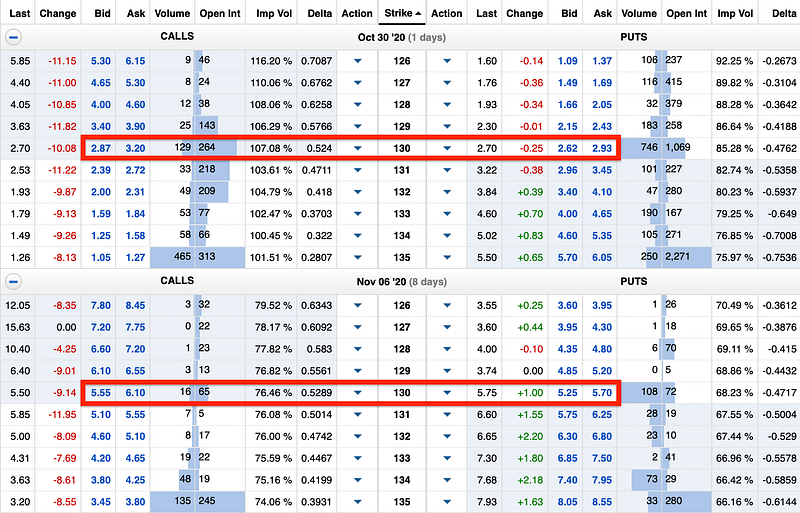
The 130 strike price is very close to the actual stock price. Shareholders who want to keep their Etsy shares may choose a further out strike price such as the 165 strike price.
This results in a lower premium but a lower chance of you being forced to sell 100 of your shares at the set strike price.
Covered calls are a great way to collect additional income. They especially help if you choose stocks with lower volatility although the premiums won’t be as high.
Many dividend investors use this approach to make an extra 5–10% return with a conservative strategy.
If you sell covered calls, stay away from earnings. Selling at a near the money strike price will result in you missing out on potential gains in the event of a stellar earnings report.
Many investors use cash secured puts to buy their favorite stocks at more attractive price points. Rather than needing the 100 shares, you just need enough money in your reserves to buy 100 shares at your desired strike price.
If you want to buy 100 shares of Etsy at $130/share, you would need $13,000 to initiate the cash secured put.
If you sold a cash secured put for the 130 Etsy contract expiring in 8 days, you would make roughly $580, lowering your cost basis to $124.20/share if the cash secured put was exercised.
However, you can also sell options that will expire in 1–2 years. Let’s return to Etsy for this example.
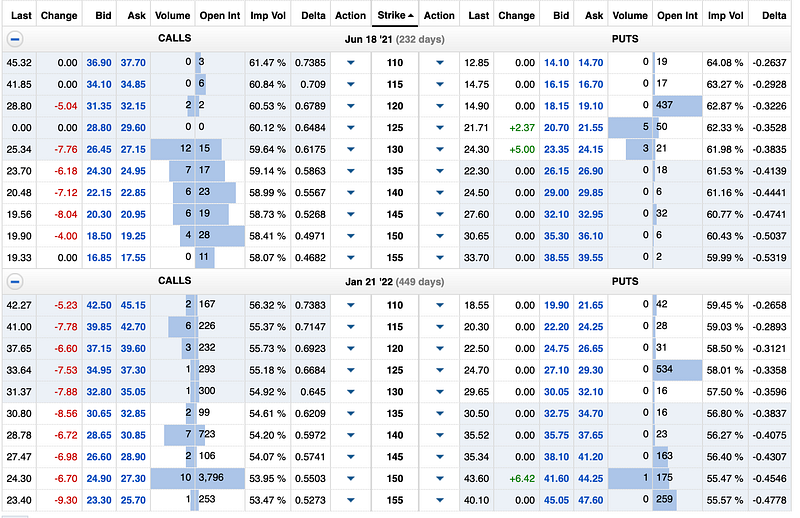
Etsy currently trades at around $130/share. Let’s say you think the stock is overvalued, has some room to fall, and you want to buy in at a more attractive price.
You can sell the June 18, 2021, cash secured put with the 110 strike for an instant $1,440 (using the midpoint in this example).
If Etsy stock goes down and you are forced to buy them at $110/share regardless of the price. Even if the stock falls to $70/share, you have to buy them at $110/share.
However, that’s far better than the price you’d pay today, and the extra $1,440 cushions the blow and would bring you down to a $95.60/share cost basis.
If Etsy stock continues charging ahead, the put will expire worthless and you won’t get your 100 shares of Etsy with this strategy.
However, for the cash secured put, you put $11,000 into it and got an extra $1,440 at the end of the journey. That’s a 13.1% return in less than a year which is higher than the stock market’s average annual return.
You can sell options in a way that creates a win-win scenario.
The Best Way To Get Started
The smaller you start, the more you can learn. It’s better to learn with a few hundred dollars than thousands of dollars.
There’s also a toxic, speculative approach known as the YOLO where some investors become millionaires relatively quickly and others lose every cent.
The article below discusses the YOLO, but I wouldn’t try it.
I got started selling covered calls and cash secured puts that expired within a week and were likely to expire worthless. I set far out strike prices and even sold options that expired in under 3 days.
This is an easy way to get started for your initial trade just to better understand options. It significantly caps your upside in the event the stock price rallies, but there isn’t much time for the stock to rally.
I also recommend using this strategy if you wouldn’t mind selling your 100 shares (covered call) or buying 100 shares of the stock (cash secured put).
Sell enough options, and you’ll see some of them fall to zero (good for you as the seller) and other options that will double in value (bad for the seller).
If you understand selling options, you’ll also get a better understanding of buying options.
Buying options present the opposite risks and rewards of selling options, so you’ll already have a firm grasp.
I recommend starting off with calls and puts that are under $100.
If you mess up with a Workhorse put, you won’t lose too much money. If you mess up with an Amazon call, you’ll lose a lot more money because Amazon calls are far more expensive than Workhorse puts.
As you continue buying and selling options, you’ll gain a deeper understanding for different trading strategies and adjust based on your risk tolerance.
Starting small allows you to do a greater quantity of options trades. The more trades you do, the more you learn. You’ll learn the same lessons whether you spend a few hundred or a few thousand, so spread out your money rather than YOLOing it all on one options trade.