
How to Pick Stocks That Will Crush the 2020s Like Netflix and Domino’s Did the 2010s
Look for a non-tech company that acts like it’s a tech company

A heaping handful of us who write about personal finance and investing discourage day trading. In fact, a significant chunk of that heaping handful advocate long-term strategies, such as pure buy-and-hold alongside dividend-paying stocks with dividend reinvestment turned on.
All else equal — and we know it’s not in individual personal finance — this way of investing suits most people. It’s defensive and relatively easy to execute. And, while waiting for the power of compounding to become evident takes time, it’s the most direct path to building wealth via the stock market, particularly if risk concerns you.
You want to be the cat. Chill rather than refresh your investment account twelve times an hour.
This said, other ways exist to buy stocks. There’s a place in most portfolios for speculation. I keep a speculative segment in my portfolio. In all but one case, these slightly more speculative stocks (e.g., CVS Health) pay formidable dividends. In one case (Ford), it doesn’t pay a dividend.
In this article, I expand on a strategy I discussed in my most recent article for Data Driven Investor:
Thinking and acting like a tech company. This has always been a key component of my conviction in stocks I sensed about to breakout and breakout big over the long-term.
Exactly what does this mean? By the end of this read, you’ll have a good handle on what it means and how you can adapt my qualitative strategy to your process for selecting stocks.
I put Netflix and Domino’s in the title of this article for a reason.
They’re the #1 and #2 top-performing stocks of the decade starting in 2010:
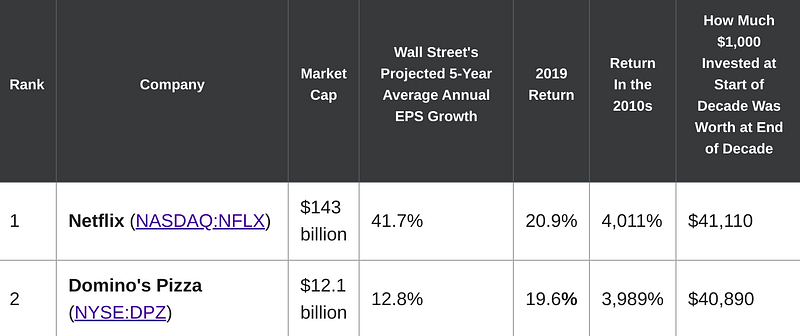
Most people would agree Netflix is a tech company. Like many media/content companies, it’s tech. The lines blurred before Netflix, but the company disrupted media to the point where you basically have to think and act like a tech company to compete.
In 2010, most people didn’t think of Domino’s Pizza as a tech company. I’m willing to bet a significant chunk of “most” still don’t today. This is where the edge lies. If you, as an investor, can wrap your head around Domino’s Pizza being a tech company, you can spot the stocks that have the potential to do what Domino’s did — alongside Netflix — between 2010 and 2020.
As I indicated in the above-linked and quoted article, I used this lens to pick Domino’s and Starbucks early last decade. I recently used it to select CVS Health and Ford as non-tech companies that think and act like tech companies with stocks about to crush the present decade.
You can see the referenced article for the numbers, but Domino’s and Starbucks worked out remarkably well (sadly, I never owned Domino’s, but I’m long Starbucks). CVS Health and Ford did not participate in the pandemic rally, however there’s a newly positive narrative forming around both stocks and they’re starting to move (I own CVS Health and Ford).
It all starts with building an ecosystem that takes a company beyond its core (and obvious) mission.
It can be absurdly simple. Consider Domino’s.
It basically followed the Starbucks’ model. You have a food and beverage company. How do you create a consumer ecosystem that brings people in and makes them want to come back?
I could go on all day about the main architects of Starbucks’ digital and mobile platforms. I won’t go on about them all day (I have elsewhere). I’ll keep it short, sweet, and to the point of this article.
Two guys — Adam Brotman and Stephen Gillett — started crafting digital and mobile at Starbucks prior to 2010. They saw the future. They realized they could create an ecosystem every bit as sticky as Apple’s or Google’s and not suffer the fate of so many other brick-and-mortar retailers. Little did they know how handy the on-the-ground execution of their strategy would come in during a global pandemic. Or maybe they did?
Domino’s took a page out of Starbucks’ book, no doubt. The company set up sexy mobile and digital interfaces that effectively gamified the pizza ordering process. They did this after trashing themselves in one of the greatest and most effective ad campaigns ever. All so very bold. So very tech.
CVS Health started with stores. It was little more than a convenience store and pharmacy. Then, as it set out to expand its pharmacy services, it bought Aetna. CVS Health decided it was a going to build out a tech-like, sticky, and all-encompassing as possible healthcare ecosystem.
But now, as I explained in a recent Seeking Alpha article, stealing the CEO’s words, CVS is more than just your corner drugstore:
This is President and CEO Larry Merlo on the company’s recent Q2 earnings conference call:
CVS health is much more than just your corner drugstore. And in this era of COVID-19 our strategy of diverse assets across healthcare, this triad of care where connections are delivered in the community, at home and in the palm of your hand could not be more important…
Increasingly, the power of our assets is taking us into areas that provide greater choice, as well as new areas for growth, ranging from diagnostic testing to B2B solutions, to the potential of clinical trial, recruitment and enrollment.
The results we share with you today underscores that our strategy is right, that it’s working, and the COVID-19 is driving us to bend our innovation curve markedly and accelerate solutions that will have long-term sustainability. There are numerous interdependencies in our three core businesses that the pandemic has made more apparent, driving the strength in our diversification while bringing new solutions to market. (my emphasis)
Merlo sounds like a tech CEO. What he says sounds a lot like the language we heard from Starbucks 10 years ago as it made its digital push. And it’s in a similar realm with the things Starbucks CEO Kevin Johnson is saying lately:
Our digital leadership and ability to transform lower performing locations and formats to successful new store formats (i.e., relocate Starbucks stores from low-traffic malls to new, thriving Starbucks locations that combine the third place with drive-thrus) are unique strengths that we will lean into in the coming months. The plans we had for this broader store transformation over a three- to five-year period will now occur over the next 12 to 18 months.
It’s all about leveraging technology and being, pardon the buzzword, nimble.
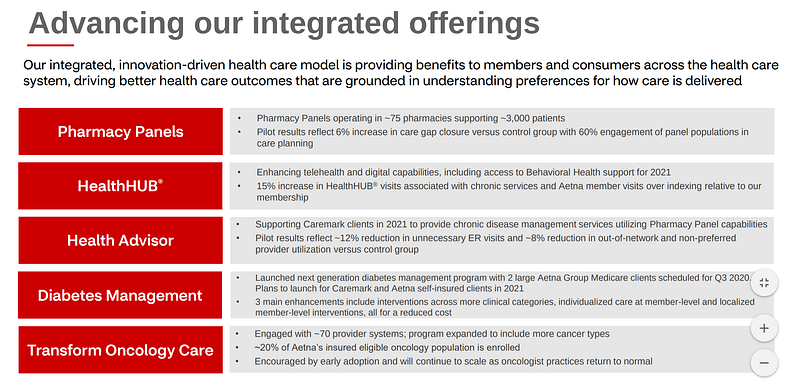
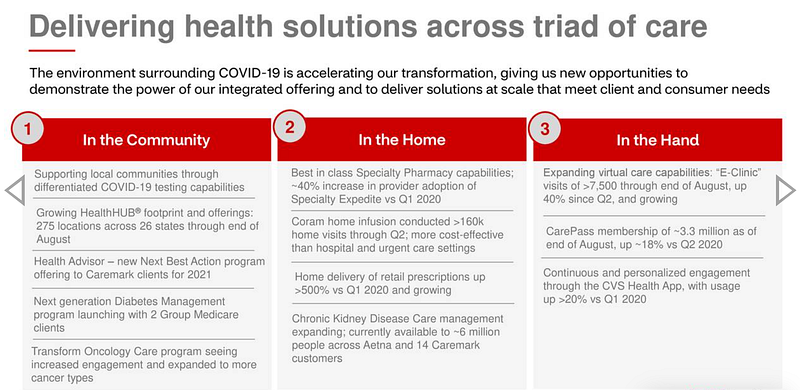
I hope it’s all coming together. The notion of a company we don’t traditionally consider tech thinking and acting like a tech company.
To pull it together, let’s look at Ford. These two slides say it all:
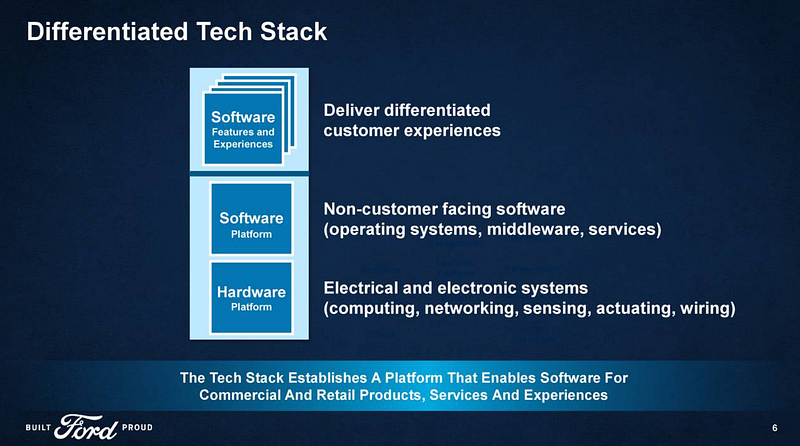
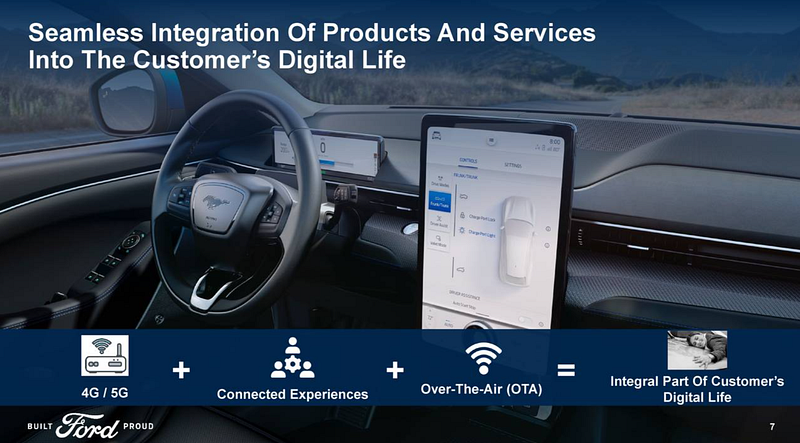
“Connected Experiences.” “Integral Part Of Customer’s Digital Life.”
Ford gets it. Technology permeates, if not dominates, most of our lives. I don’t consider this a negative. In fact, it annoys me when something interrupts this permeation.
Android Auto doesn’t always work perfectly in my Hyundai Elantra. Not having full functionality and connectivity with apps such as Google Maps and Spotify makes me less productive, among other things. The digital experience in the car must work as seamlessly as it does anywhere else. Car trips should be a logical extension of our digital and mobile lives, not a break from them (unless, of course, you choose to use your car time to disconnect and decompress). Ford understands this and is crafting an ecosystem that reflects this understanding of how people live.
At CVS, it’s not all that different. From my above-linked Seeking Alpha article:
A visit to your local CVS can lead to a multi-faceted, multi-layered relationship. CVS can be one of your healthcare providers, far beyond picking up a prescription. In and out of the store, CVS appears to have a strategy of getting in your face, of being everywhere, all of the time to acquire you as a customer across the many areas it does business.
You can still get a bag of chips and can of soda at CVS. You can buy makeup or condoms or holiday decorations there. It’s a convenience store. You can also pick up a prescription or check your blood pressure independent of or at the same time as doing any or all of the above.
However, as CVS has morphed into CVS Health, you can do a drive-thru COVID test. You can take care of a growing number of health-related issues — preventive and otherwise — that used to require an office visit. You can do this in a CVS store or without ever stepping into one. You can do it from home, on the phone, online, or via CVS’s expanding community presence.
CVS has become a new kind of healthcare company that happens to have brick and mortar convenience stores with pharmacies. It used to be a brick and mortar convenience store that performed a limited number of basic health-related tasks and interventions.
Here’s the thing — it’s as much about embracing a tech company mindset as it is practically employing tech-based solutions.
A tech mindset means understanding that consumers expect a lot because of the omnipresent influence and impact of mobile and digital technology in their lives. They want experiences. They want convenience. They want to build relationships with brands who offer a wide range of logically connected and complementary products and services.
Most brick-and-mortar retail doesn’t understand this. Maybe they’re incapable or unwilling to understand this and vision how they can think and act more like tech companies. The reasons notwithstanding, large swaths of brick and mortar died or are dying (think: department stores such as J. C. Penney and Sears) because they didn’t set a Starbucks- or Domino’s-like course. CVS and Ford get it. They’re in the ecosystem-based, experience business. They just use stores with stuff in them and cars with four wheels as foundational springboards.
This article isn’t meant to tout CVS Health and Ford. Of course, it’s tough to stifle my conviction amid the goal of better explaining the broad strategy that led me to be so hot on the two companies.
This said, you might use some or all of my approach to identify companies I never thought of. I tend to have luck in retail. An honorable mention to CVS Health and Ford: Peloton. Though that one might be a bit too speculative and far from paying a dividend for my liking.
In any event, we’re always looking for an edge as stock pickers. Even if you take a relatively conservative approach with dividend payers, stocks don’t begin and end with their dividend-related metrics. There’s a company fronting the stock that’s doing things — or at least should be doing things. You can tell a lot about a company’s growth and expansion prospects by asking if it thinks and acts like a tech company and is cultivating a tech-like, consumer-focused ecosystem.