
“Slavery in the 21st Century”
Have you ever asked yourself: “How is it that in ~100 years (since 1913), we have all converged to governments with lots of problems?”

We are “supposed to be in charge.” Are we? Why is it that regardless of ideology, we seem to get deeper into a hole we can’t crawl out of?
Encyclopedia Britannica says, “Slavery has no consensus on what a slave was or on how the institution of slavery should be defined.”
In the USA, it was known as a “condition” where one person was physically owned by another. The “slave” was deprived of freedom ordinarily held by free people and was treated accordingly.
Eventually, the physical subjugation of a “Human” in reality was “inhuman.” No rational explanation could support such ownership and make it passable for a country whose basic tenet was “FREEDOM.”
Today, human trafficking of slaves still exists but is not lawful Worldwide.
In the “free” world today, the definition of slavery has changed. Our bodies are free, our minds may not be. This paper studies the possibility that the non-definition of slavery has gone from being “Physical” to becoming “Mental.”
How Could this be Possible?
The ultimate form of slavery is the ownership of “brains.” Obviously, this ownership is “walking around.” It is not physical; this ownership is ideological.
We did not get to where we are overnight (radical change- a la Stalin).
This can be done through inculcation of ideas through the process of “incremental seduction.” Otherwise known as “the slow boil” in the Paradox of the Boiling Frog. This change took 110 years to get to where we are.
A year ago in spring, a squirrel was sitting in front of my backdoor. I put some pecans out, and she ate them. the next day, the squirrel was not just sitting at the door; she was “knocking on it,” I made the mistake of feeding it again. A long story short, I fed the poor squirrel for one year. I don’t know what happened; she stopped coming.
Our country had several calamities in the early quarter of the 20th Century: the Dust Bowl (1933–1938) and the Great Depression (1929–1939).
Franklin D. Roosevelt, a progressive President, passed “The New Deal (1933–1938).” Like all the enacted ACTs of Congress, it created an amalgam of new Federal Agencies. Wikipedia:
“The Civilian Conservation Corps (CCC), the Works Progress Administration (WPA), the Civil Works Administration (CWA), the Farm Security Administration (FSA), the National Industrial Recovery Act of 1933 (NIRA) and the Social Security Administration (SSA), provided support for farmers, the unemployed, youth, and the elderly. The New Deal included new constraints and safeguards on the banking industry and efforts to re-inflate the economy after prices had fallen sharply. New Deal programs included both laws passed by Congress as well as presidential executive orders during the first term.”
As usual, since then, nobody in government stopped to think, “For how long are we going to keep this program?” VERY FEW have sunset clauses. It is as if calamities will last forever, and once a government “Agency” is created — it is nearly immortal. We have 436 of them. They employ nearly 3 Million people.
The world civilization typically uses “Persuasion.” Persuasion, according to Wikimedia, is “Persuasion or persuasion arts is an umbrella term for influence. Persuasion can influence a person’s beliefs, attitudes, intentions, motivations, or behaviors.[1]” Today, there is no greater “influence” than “Social Media.”
With the onset of “Social Media,” Social slavery is performed through the repetition of messages by “influencers” or selected people in politics and the free adoption of those ideas into “blank slate” brains, otherwise known as “tabula rasa,” as John Locke put it.
Before Social Media, the government would “regulate” our lives. Logically, this was done through “regulations.” These “Regulations were/are written by the government “Agencies” for any little thing they thought was “wrong” with our society. Not a complete list because others are written for “corporations, schools, the Military, etc.”
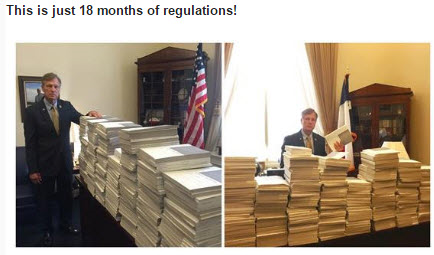
Are we in Control? Really? Would you let the Chinese buy “Land” in the USA? They own all kinds of land here and buy as they wish.
Are we the Land of the “Free?” Why does the government own land they have no business owning?
There is no stopping the government anymore. WE, the royal we, who think we know everything, are allowing the government to run rough-shod on “the land of the free.” How are WE elevating ourselves to take care of our Neighbors?
When it comes to IDEOLOGY, we are ideology-myopic.
Enter “partisanship.” Our Cosmopolitan-nation is “our cake.” Politicians “sold us ideology.” Have we elevated ourselves to think NATIONALLY? Not LOCALLY?
Voting nationally means voting for “people” who believe in the Declaration of Independence and the Constitution. If this is true, the rest takes care of itself because the government has “Rules of Engagement.”
This requires that each and every one of us needs to understand that the Constitution is the “Law of the Land we own.”
If we believe the “Rules of Engagement” are not clear enough or strong enough, we need to change them. “WE” means us the people.
IF WE DID — we would think about the whole Nation, not just “to the front door of your home.”
As discussed in “Are You a Partisan?” In other words, do you react with a knee-jerk when someone touches one of your political hot buttons?
To Save OUR Country, “We” Can Not Allow to Be Brainwashed!
Think with your BRAIN, not with a brain-washed mind. We cannot afford to be “Partisans” within our own country!
Maybe nobody realizes this — We are fighting a WAR! This is a war about BRAINS. Who owns yours?
If you think like the people who showed up at Trump’s inauguration or on the 6th of January 2021 to march for Trump, you are brainwashed with partisanship-only thinking.
If we elevate our thinking and imagine where we are, and think how it could have been different if we differentiate who works for whom and how we get to control the outcomes, we may be in a different place today.
WE CAN THINK LOCALLY BUT NEED TO ACT NATIONALLY
This writing is one of hope. Hope that reasonable people can be reached to think and reason, and thus, save our civilization.
The first question to ask ourselves is: “Am I really Free?”
Some verifiable Truths first:
- Corruption has always existed.
- Royalty still exists in Britain AND The United States of America (we just don’t use that name).
- Slavery has existed since the Dawn of humanity — why? People are always looking for the subjugation of others to use for their own means.
- Physical/forceful slavery exists today. It is called “human trafficking.”
- Persuasion, not a whip, is today’s weapon, and it is real.
The first four are self-evident. №5.
Persuasion
In their article “A systematic review on political ideology and persuasion,” Aylin Cakanlar and Katherine White define “Persuasion” as “a symbolic process in which communicators try to convince other people to change their attitudes or behaviors regarding an issue through the transmission of a message in an atmosphere of free choice” (Perloff, 2009, p. 17).
The system reviewed looks at the “Social Structure,” contained within the “Economic Structure,” Driven by “Institutional Actors,” and how they maintain “the current social and economic structure.”
The “System” is applied to “the people’s social structure” through “Communication structures” designed to continue to persuade through “identity signals” in the right groups (conservative/liberal) by using their “Social Influence.” As polarization increases, conservatives and liberals have developed less favorable views of each other while maintaining positive perceptions of their own group (Levendusky, 2018) — Social Influence. This says Levendusky can be improved by elevating National identity rather than Partisan identity. The Partisan identity is rooted in the Common Intergroup Identity (hastened by social media, sometimes called “echo chambers”). On the other hand, if we want to elevate National identity and ask, “What does it mean to be “American,” it is itself a difficult question, subject to much scholarly debate. However we define it, our traditions are central to American political and economic life.
Shown below as an image:
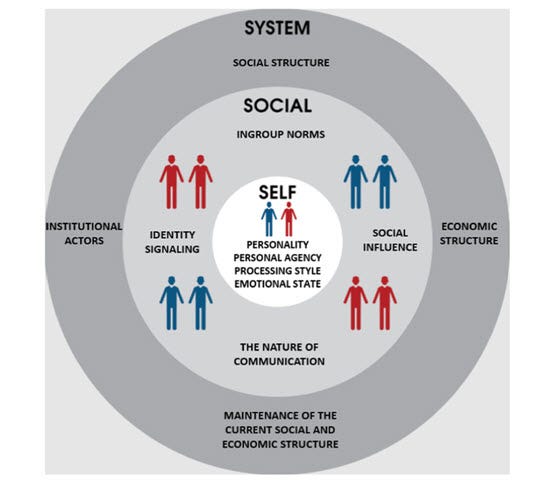
Institutional Actors, such as governments and companies, strive to affect social change by influencing the attitudes and behaviors of individuals in the institutional environment (Eilert & Nappier Cherup, 2020).
Institutional actors — Speaker Pelosi, keeping her cover while reacting as to whether she “hates the President (Trump).”
But she doesn’t hate the President
Message to the partisans, “Take it any way you like.”
Influencers: neither the message that was delivered in the speech nor the messenger who published the note is right. Both are fomenting partisanship:
Corporations — similarly participate in partisanship to appeal to consumers. It is a calculus to maintain/improve sales. Dick’s Sporting Goods removed guns from its product assortment to take a stance on gun policy. Walmart did the same thing in 2019 and decided to return to the market in 2020.
In another article, “The neuroscience of persuasion: A review with an emphasis on issues and opportunities,” John T. Cacioppo, Stephanie Cacioppo & Richard E. Petty define it as “Persuasion, a prevalent form of social influence in humans, refers to an active attempt to change a person’s attitudes, beliefs, or behavior. There is a growing literature on the neural correlates of persuasion.”
The article makes the connection between science and the study of brain reactions to different stimuli by using a contrast in an fMRI for example, “comparing the responses to objects that were preceded by celebrities rated as high in expertise minus objects that were preceded by celebrities rated as low in expertise.” Like that, many other connections between stimuli and information/data have been established to understand where the brain stimulus is and what triggers it.
In the article “A systematic review on political ideology and persuasion,” Authors Aylin Cakanlar & Katherine White
Self Awareness (How to Wash Your Brain)— Then, in the Article “How to Deal with Cognitive Illusions,” Our Medium author, Dr. Mehmet Yildiz, discusses in Illumination, “Systematic patterns of deviation from the norm or rationality in judgment can lead to perceptual misinterpretations of information, leading to cognitive distortions.”
Consider reading this post many times. Read it to understand it with the intention of using the information. It is very helpful. It explains in more detail how our brain yields behavior changes and how to become aware of them in order to have a choice in the ideology under consideration.
Good Things to Know
- The new Royalty — They own the government. They get what they want. We don’t — they just want to be “Legal” (that is what our vote does).
2. Breach of Ethics — Demand standing down anyone from ANY position in government.
3. How are we slaves? we are subservient to the government and allow them to have too much power.
4. What do we know? It has to be Mandatory to know only TWO Documents: The Declaration of Independence and the Constitution. No IDEOLOGY is involved.
5. What do we do? We need to VOTE for the Federal Government positions with those two documents in mind.
6. What are schools for? To instigate learning, NOT INDOCTRINATION.
7. The molding Brain — We own our Brains. Keep them clean and wash them often, or somebody will own you.
every time you see a bolt of lighting, think: “There goes another USA Citizen to jail,” for using his 1st Amendment right to speak. We can stop our people’s abuse. LOVE AMERICANS FIRST!

THE END!


