
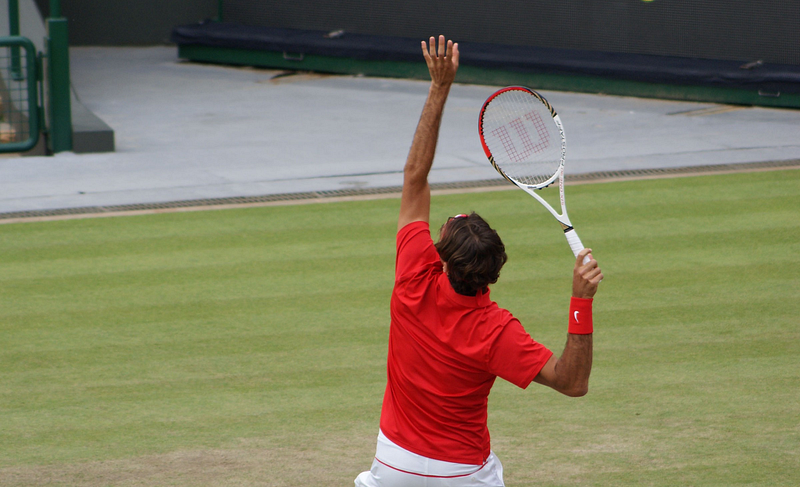
7 Valuable Lessons Learned From Tennis Legend — Roger Federer
Skill Development Expert Profile — Roger Federer
His graceful style of play, technically clean shots, elegant footwork and finely touched volleys have won him many fans around the world. Roger Federer is a great role model with excellent sportsmanship behaviour on and off the court and is regarded as one of the greatest athletes of the 21st century.
He is leading the race of becoming the GOAT (Greatest of All-Time), with a current standing of 20 Grand Slam titles. He has won Wimbledon (8 times), Australian Open (6 times), US Open (5 times) and French Open (1 time).
He was ranked the best player in the world for 310 weeks, including a record-breaking 237 weeks in a row, and at age 38, he is impressively ranked as number 3 in the world, still looking to extend his number of grand slam titles.
What did it take to achieve this amazing career and success? What are his secrets, and what can we learn from Roger about skill development?
Growing up
Roger began playing tennis at age eight, at the tennis club where his parents played recreationally. He had an extreme winner instinct from a young age, and according to his first coach, Madeleine Barlocher, he always wanted to become the number one in the world.
His mum was a tennis coach, but she never coached him, and according to her it jokingly would have ‘pissed her off’, as Roger loved to experiment and try his creative shots, rather than just do what the coach instructed.
As a boy, he was involved in activities like squash, skiing, wrestling, swimming, skateboarding, basketball, handball, tennis, table tennis, badminton and football. He loved almost any sport, especially if it had a ball. He later gave credit for his wide range of sports experience to his excellent hand-eye coordination and athleticism.
His parents were interested in what he was doing, but in no way obsessed with his sporting career or being too pushy. If anything, they tried to hold him back, telling him to try different things.
Getting serious
At age 14 he made his first considerable sacrifice to work towards a career as a tennis player. He decided to move away from his family to live at the national tennis academy in Switzerland, from Monday to Friday. He also gave up other sports, most notably football, to focus more on tennis.
During his junior years, he showed a lot of promise, and his most significant achievement at this age was to win the junior tournament at Wimbledon. But he was in no way as dominant as he would become later in his career.
After this, he started to focus on what it would take to become the best in the world, and his workouts got more serious, both physically and mentally. The hard work paid off, and at age 21 he won his first grand slam (Wimbledon).
During his younger years, Federer worked exceptionally hard to build his speed on short distances. According to his fitness coach for almost two decades, Pierre Paganini, ‘nine times out of ten on the court, the speed is in the first three steps and then you’re playing the tennis ball. So you have to train to be particularly strong in the first three steps.’
Lessons to learn from Federer
1. Keep calm under stress
Roger is now a role-model of staying calm in stressful and pressurised situations, to achieve his best play on crucial points. But Federer wasn’t always the calm guy he is today.
When he was younger, he was very emotional, often complaining and throwing rackets. He was wasting a lot of energy and it prevented him from performing at his best.
As he was improving and playing in front of more people, Roger had a realisation. He describes the change like this: ‘I started feeling embarrassed, breaking rackets on the main court and breaking things. So I thought, let’s get it together.’ He worked hard on his mental game and is now one of the best mental performers in any sport.
2. Embrace hard work
Roger has worked hard throughout his career, but it has been especially evident after he dropped down from the number one position in 2012, and as he had some injuries in the later years of his career. Before this, it was often assumed that he had received God-given natural abilities, and there was less focus on his incredible work ethic.
After Wimbledon 2016, Federer announced that he would not play for the next six months, to take time off and recover from a knee injury. In January 2017 he returned spectacularly, reclaiming the Australian Open title, winning against his arch-rival, Rafael Nadal in a five-set thriller.
The journalists kept asking how he was able to come back better than before, considering his recent injury, advanced age and extended absence from playing. His response was simple: ‘I worked very hard with my team. I tried to work the hardest.’ The journalists tried to find the ‘real secret’, but Roger just kept insisting, ‘My team worked very hard, we simply did it.’
According to his coach Paganini, Roger has this incredible ability to be both an artist and a hard worker. ‘Not once did he complain during training. You never had to push him. I’ve never seen him in a bad mood during training. His motivation is always stronger than his fatigue.’
‘The physical requirements and demands on professional tennis are among the most gruelling of all sports. Anyone who wants to win major tournaments and become a top player must be quick as a sprinter, have the endurance of a marathon runner, take punishment like a boxer and execute like a forward in soccer. He or she must have the overview and cleverness of a chess grandmaster, the nerves of a mountaineer, the strength of a decathlon competitor as well as the calm hand of a painter, the patience of a sailor during a lull in the winds and the courage and cold-bloodedness of a matador.’ -Rene Staufler, in The Roger Federer Story: Quest for Perfection
3. Preparation
Tennis always comes first. Anything he does in life is planned according to how it will affect his practice schedule and preparation for the next event. He usually takes his wife and four kids with him on tour, and tries to fit holidays after the key tournaments to rest and recover.
He also sleeps for up to 12 hours per day, around 10 hours every night and up to two hours of naps during the day. This sort of rest and recovery is vital, to be able to withstand the gruelling practice regime you go through to compete at the highest level.
4. Constant quest to improve
‘If you’re not getting better, you’re getting worse’, according to Roger. As the opposition is continually improving, staying the same is going backwards, so he is continuously looking for ways to improve himself.
This showcases the outstanding ability the ‘best in the world’ in any domain have to keep trying to get better and never thinking that they have ‘mastered’ a skill. There is no limit to how good you can become, and there is always a chance to improve some part of your game.
His excellent opponents have also helped to push him to become better. If it wasn’t for other amazingly talented players like Nadal, Djokovic and Murray, Federer might not have found the same inspiration to continue developing and improving (and vice versa).
5. Learn from loss
Roger says learning from losses are more illuminating than learning from wins. Failures reveal where you are lacking and what you should work on, to become a better player.
Every miss you make during a game can be used as feedback to become better. The more mistakes you can eliminate from your game, the more difficult it will be to beat you.
Even though you win the game, you can still regard every point you lost during the match as a loss. This gives you plenty of room to improve, even though you may have been better than your opponent in a given match.
6. Going for goals leads to success
Both short term and long term goals are necessary to stay motivated to practice hard. According to Roger, you need to have structured goals and be clear on what you want to become and achieve. He says, ‘you have to believe in the long-term plan you have, but you need the short-term goals to motivate and inspire you.’
If your long-term goal is too far away, it can be challenging to focus on every practice. Both short-term and medium-term goals are therefore beneficial, to have something more concrete to work towards.
7. Develop your strengths
According to Roger, working on your weaknesses make you a better player, but it doesn’t make you dangerous. He, therefore, prefers working on his strengths, the shots where it’s tough for his opponents to come up with answers. Luckily for Roger, he has a lot of strengths and very few weaknesses.
You must work on your weaknesses so that your opponent cannot easily exploit them. But focusing on building your strengths, can make those shots so good that the opponent is helpless to do anything about them.
The Roger Federer Foundation
Roger is also working hard to make a difference after he finishes his tennis career. He is aiming to create better lives for underprivileged children, particularly in Africa. He is a huge inspiration for so many people, and through this foundation, he seeks to give back for all the opportunities he has received in life. The foundation aims to teach the students skills for life and give them a proper education. By the end of 2019, they had reached and benefitted 1,550,000 children.
Take home message
Federer is the perfect athlete. He devoted most of his life to tennis, kept his head down and worked tirelessly over several decades to become the greatest player of all times.
He had a very diverse background in many sports, which he regards as one of the reasons why he developed such excellent hand-eye coordination and athleticism.
With his incredible athleticism and will to practice hard, Federer’s life trajectory could have been very different, and he probably could have become world-class in several different sports. Imagine seeing Roger playing football for Real Madrid or Barcelona or winning the Olympic gold in badminton or table tennis.
Thanks for reading, sharing, and following! :)
If you liked this article, you may also like: