
Six Things Big & Tall Runners Need to Know

From shoes to weight loss, here’s what I learned on my journey.
Runners with different levels of fitness and body shapes face different challenges. At six feet five inches, I don’t look too overweight, but I’m clearly not svelte either. I weigh around 280 lbs, which gives me a Body Mass Index (BMI) of around 33. Current standards put me at the cusp between overweight and obese.
Running keeps me from slipping over the edge. I have some job requirements to maintain a certain level of fitness, and if I run a couple of half marathons a year the training will keep me where I need to be.
While most of the common running wisdom works for larger runners, there are also some tips and tricks that make things easier, especially if you’ve never been a runner before or are starting over again in middle age.
1. Buy good shoes
Every story about running preaches the shoes, but bigger runners need to choose especially wisely. I started paying attention to shoes in 2008 when I really started to be serious about fitness. I was deployed to Iraq, and our tiny BX only had size 13 and up, which was fine for my big feet. I bought some New Balance 1064s (since discontinued) and noticed that I liked them.
Upon returning home and after a couple of months of light running, I developed lower back pain after workouts. I finally bought new shoes and the pain went away. The light bulb came on. In college, 20 years younger and 100 pounds lighter, I could run on the same shoes for years at a time, especially since I rarely did over 3 miles. Once I reached my 40s, not so much.
I run in Glycerins by Brooks because they are consistently rated as among the most cushioned. There are other comparable choices out there, but some shoe brands are really confusing and to me it’s hard to figure out which model to get. Brooks work, so I try to buy last year’s Glycerin models on sale.
Also consider going to a dedicated running store for the first couple of pairs. Often they will look at your gait to make sure you don’t need any extra support.
The cushioning is vital for larger runners, especially older ones. Two men with size 10 feet have vastly different impacts at 160 lbs versus 320 lbs. Usually I change them out after 200–300 miles, depending on what kind of distances I’m running, though many people get more distance.
2. Clothes make the man
Another oft-repeated piece of wisdom is that you just need some good shoes, any old t-shirt and shorts will do. Just go run! That’s true to a point. You don’t need to go spend hundreds of dollars on UnderArmor or Nike. On the other hand, some careful consideration might improve your experience.
- I’m going to use the C-word. Chafing. When I weighed 180 lbs at 20 years old, I ran exclusively in the tidy-whitey underwear I was raised in plus some kinda short shorts. Decades and five-score pounds later, my thigh gap is not what it used to be. I’ve since migrated to mid-thigh length polyester/spandex blend underwear, often Champion brand bought at Target. They need to fit your thighs snugly.
- Get some good socks. I run in Hidden Comfort by Balega, but they are ten bucks a pop. To me they are worth the price. I only use them for running, and they are easy to get on and off my size 14s. You can pick up something much cheaper that will do the trick, but get some thin athletic socks.
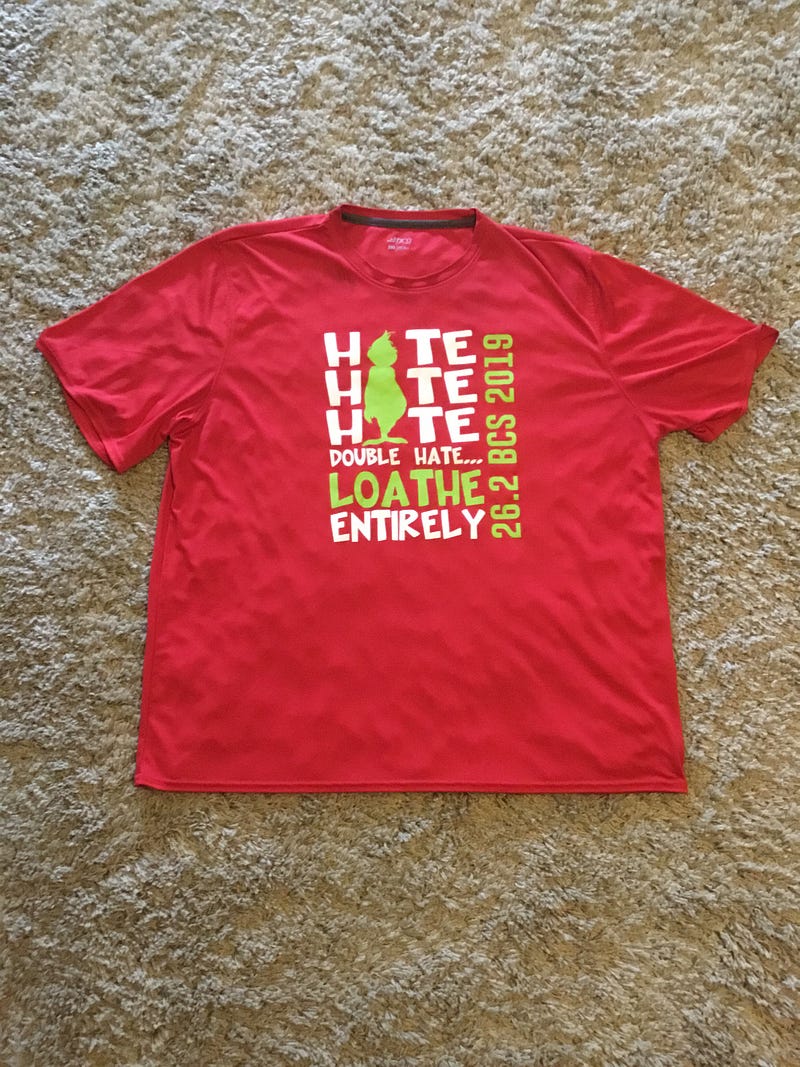
- I don’t much care about the shorts as long as they mostly cover my mandex undies mentioned above, but cotton shirts suck. Some of the best workout shirts are the BCG brand from Academy Sports. They are about as inexpensive as you can get, and I have a friend that likes to make custom t-shirts for major races. Go large on the size so that the shirt is loose. You will be more comfortable and also feel less self-conscious.
3. Get the gear
You don’t have to have any electronics, and I’m not suggesting that you spend hundreds of dollars on a new GPS watch before you set foot out the door. But it also doesn’t hurt to download Runkeeper or another app to keep track of your progress. Get some headphones if you like music, keeping in mind safety. I use Marshmallows by JVC because the memory foam stays in my ear better.
If closing the exercise circle on your iWatch or winning your Fitbit steps competition is what keeps you motivated, then by all means do use them. If getting another piece of data from your heart rate monitor to plot on your Excel spreadsheet tips the balance to get you off the couch, then maybe it’s an investment.
4. Start slow
You’ve probably read the tired advice to run at a pace where you can comfortably converse. Run slower than that to start. It doesn’t really matter how fast you run, and if you push and are in pain the next day, you are less likely to stick with it.
Also, start with short runs. Is shuffling for 100 yards all you can do? Great, do that. If you keep with it, you will naturally want to run farther. As your aerobic capacity develops, you will start to run a little faster.
When I’m training, sometimes I do tempo runs, where I’ll do a shorter run faster. I avoid speed work. Running sprints is not fun for me, and I’ve got a chronic injury that gets aggravated every time.
At the end of the day, I’m not going to be an elite runner, I just need to stay in shape.
5. Get a crew
Running is a solo sport, but it doesn’t hurt to have a team. If you have 2–3 friends to meet with on Saturday morning, you are a lot more likely to make the scheduled meeting. Friends provide structure and mutual support.
Don’t be intimidated out of joining a local run club. Most clubs welcome all levels and body shapes. If you don’t click with that group, find another one. It’s a great way to add structure and meet people from all walks of life.
6. You are not going to lose much weight
We all want to lose weight. If you are just starting out, and starting slow as you should, running won’t do all that much to help. As a rule of thumb, think about burning 120 excess calories per mile. (Actual results vary depending on weight and speed)
Even if you are running three miles, that’s just over half the calories in a Big Mac. One of the greatest dangers is actually eating more. You feel a feeling of accomplishment. I ran today, I deserve a thousand calorie Frappuccino. It doesn’t work that way.
When I’ve laid off running and start to ramp up, I actually gain a little in the first couple of weeks, then settle back down. I don’t start to notice weight loss until I’m consistently running six miles, three or more times a week. At my training peak in mid-winter, I’m usually about 10 pounds lighter than when I started. I lost twenty pounds while training for my first marathon, but I gained it back because I can’t reasonably maintain 120 miles per month.
You might also like:
Brian E. Wish works as a quality engineer in the aerospace industry. He has spent 29 years active and reserve in the US Air Force, where he holds the rank of Colonel. He has a bachelor’s from the US Air Force Academy, a master’s from Bowie State, and a Ph.D. in Public and Urban Administration from UT Arlington. The opinions expressed here are his own.


