
The Secret of Verifying Your Passion: Do You Love the Thing, or Just the Idea of the Thing?
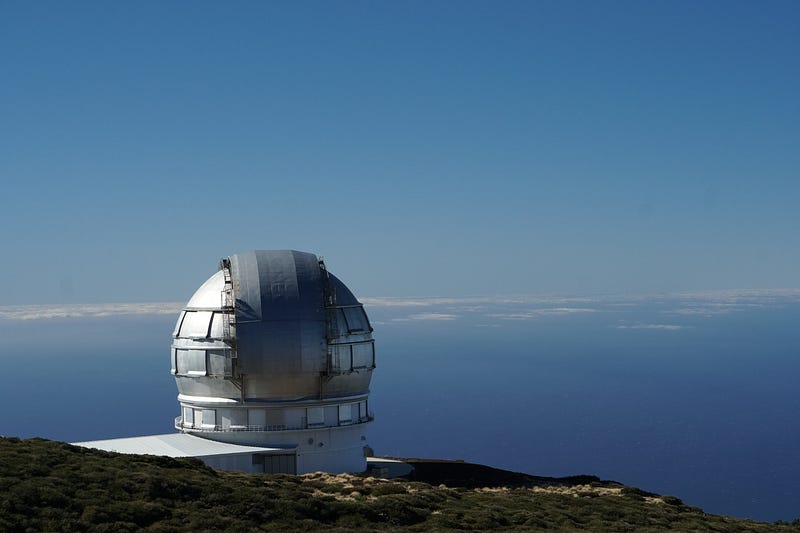
Astronomy, writing, and everything else in life
My young hands trembled as I tried to work the focus knobs on my telescope. February is cold, even in Texas; I had bundled up in my winter coat and pulled my knit cap down over my ears, but I needed my fingers free. The the grey metal tube swiveled and the light wooden tripod swayed in the lightest wind. I needed a delicate touch as I honed in on my target, switching between the spotting scope and eyepiece.
There! After a few minutes of wrangling I found Alcor and Mizar, a famous double star in the Big Dipper’s handle. Easy to see with any optics, but still just two points of light next to each other. I started there most nights.
Next I might find Jupiter, peering at the cloud bands across its face and count how many of Galileo’s moons I could see. I’d search for the Great Red Spot, but I think I only saw it once. Sometimes I would turn to Saturn and peer at the rings, and sometimes I would look for famous craters and seas on the moon.
After 20–30 minutes at most, I packed up and headed inside to drink hot tea with my mom. It was cold, and my passion had limits. Later in life I understood why.
I truly loved the sky, now I realize I loved the idea of the sky more.
Before kindergarten, I made a conscious decision to follow all things that touched on outer space. Once I could read, I clipped newspaper clippings and put them in a scrapbook (kind of a manual Pinterest for any curious Gen Z). Most of all, I followed the stars.
I read all of the non-fiction books at my library. I used my allowance to photocopy sky maps out of appendices. I collected star maps and moon maps and pored over them. I saved up for National Geographic’s Our Universe book.
I started saving for a telescope. I scrimped and saved for months; whenever we went to K-Mart I visited the camera department with the telescopes on display. Finally, I gave up, and was going to by a small cheap telescope half the price of the one I wanted. My mom told me to wait until after Christmas, and I counted the days. On Christmas morning, Santa surprised me.
I loved that telescope. I looked at sunspots with a dangerous solar filter that I would never use today. I looked at the moon, the stars, the planets. I peered around the neighborhood. I still have the telescope packed away today, because I know money was tight and my parents fulfilled my dreams anyway.
The thing is, while I did use it to look at the sky, I spent far more time peering at catalogs figuring out what eyepiece or accessory I needed. I spent vastly more hours reading Astronomy magazine than I did looking at the stars.
I loved the idea of the thing more than the thing itself
The doing-it test
The lesson is to compare how much time you spend doing the thing that you think you love to the time you spend studying and thinking about doing the thing you love. I’ve repeated this pattern over and over.
In college, a friend suggested we join the karate club. He waved off after two weeks, and I stayed for a year and a half until I graduated. I worked out two hours at a shot, 3–5 times per week.
Off and on over the years I returned to martial arts when I had opportunity. I moved every couple of years in the Air Force, but I at least tried to find a class at every base. After leaving the Air Force, called up as a reservist and sent to the sandbox, I worked out with some friends in a vehicle maintenance hanger every day. I never earned a black belt but it’s on my bucket list.
I picked up the occasional martial arts magazine and went on a Kung Fu movie binge, but I’ve spent hundreds of hours doing the thing, rather than thinking or planning or studying the thing. I made a conscious decision to prioritize my jobs, school, and family when I started eleven year PhD journey, but I know in my bones that I’m not done.
My woodworking went the other way. I like working in the garage and building the occasional thing, but it’s always too hot or too cold. I covet the next cool saw, drill, biscuit joiner, or whatever, but when it comes right down to it, I’ve spent a lot more time reading magazines about woodworking than I have doing woodworking.
If I really loved it, my garage would be clean and I’d be down there now instead of writing this and feeling guilty about the half-finished toy chest that my fourteen year-old doesn’t really need anymore.
Is writing my latest passion?
I don’t know, but I think so. Like everyone new to Medium I’ve spent a few hours reading about how someone got ten gazillion views and made a ton of money. At the end of the day most of the advice is the same.
I’m bored with those stories, but not with writing. This is my 19th story on Medium in less than two months, about topics ranging including Coronavirus, history, philosophy, anime, my favorite whiskey, and whatever other ideas I’ve wanted to share. I don’t write much about writing, or writing on Medium, because I want to talk about more important things.
Sometimes the ideas spill onto the page, and sometimes I spend all afternoon on my day off getting a story just right. Right now, there is nothing more fulfilling to me than when a stranger reads my work and is touched.
I’m proud of this recent story. It debunks a piece of overused pop psychology and describes why there is a place for amateurs to contribute to whatever field they are passionate about:
This one just has a cool title, and I took the picture myself:
Brian E. Wish works as a quality engineer in the aerospace industry. He has spent 29 years active and reserve in the US Air Force, where he holds the rank of Colonel. He has a bachelor’s from the US Air Force Academy, a master’s from Bowie State, and a Ph.D. in Public and Urban Administration from UT Arlington. The opinions expressed here are his own.