
Dimensions of Knowledge Engagement
Objectivity, Subjectivity, and Objectification
Yesterday Michael Koch commented on my post about Methodological Empathy on Linkedin:
Oliver, your theory and methods are very unique. So many layers to your work. Thanks for sharing.
It inspired me to revisit an annual review of CALL in Oct 2020: The House of Boundary Innovation. In the review, I mentioned Transdisciplinary Thinking and Interdisciplinarity Thinking.
I replied to Michael Koch with the following message:
Yes, I embrace both Transdisciplinary Thinking and Interdisciplinarity Thinking.
According to the editors of The Oxford Handbook of Interdisciplinarity (2010), there are two words about inter- or transdisciplinary knowledge production. The ‘interdisciplinarity’ refers to current efforts of knowledge production that cross or bridge disciplinary boundaries and the ‘transdisciplinarity’ refers to the growing effort to make knowledge products more pertinent to non-academic actors. However, in the US, ‘interdisciplinarity’ covers both the integration of knowledge across disciplines, narrow and wide, and the intercourse between (inter)disciplines and society. The latter often goes by the name of transdisciplinarity, particularly in Europe (p.xxx).
I choose ‘transdisciplinary thinking’ to refer to the knowing between academic domains and non-academic domains.
From 2020 to 2022, I worked on the Knowledge Curation project which aims to connect THEORY and PRACTICE. This is about ‘transdisciplinary thinking’.
This year, I move to ‘interdisciplinarity thinking’ and focus on the Knowledge Engagement project, especially professional knowledge workers’ creative life.
This micro conversation inspired me to reflect on my journey of knowledge engagement from 2020 to 2022.
I have made such a reflection many times. Each time, I always discovered some new insights.
How did I capture this time?
Initially, I realized that there is a 3D model of the World of Activity for Knowledge Engagement.
- Transdisciplinary dimension
- Interdisciplinary dimension
- Temporal dimension
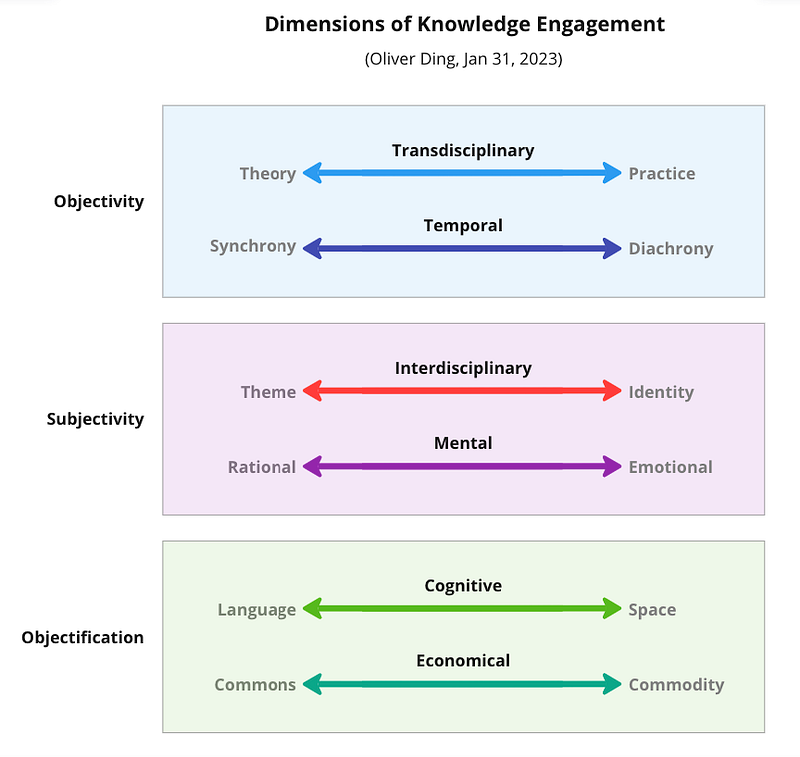
Later, I expanded to six dimensions. On Feb 2, 2023, I made v2 which has seven dimensions.
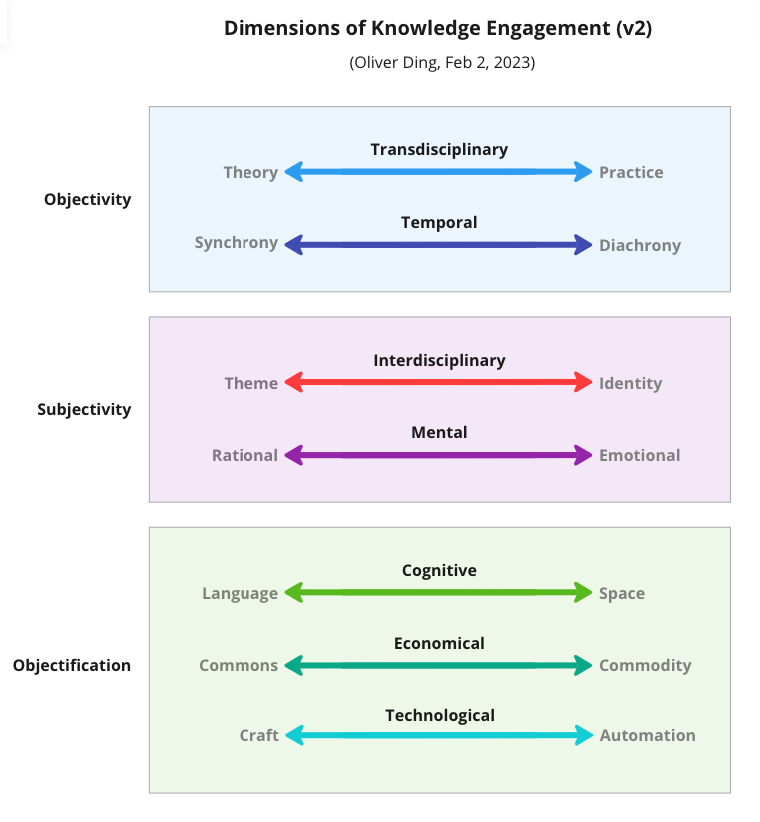
This is a Significant Insight!
On Feb 16, 2023, I made a new version with a section about objectification.
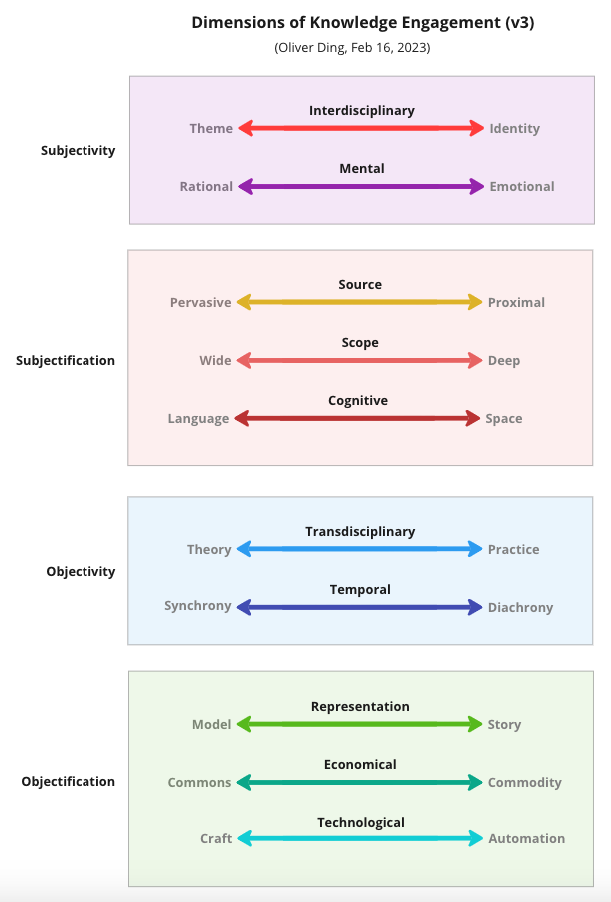
The World of Activity for Knowledge Engagement
In Nov 2022, I developed a concept called “The World of Activity” for the Creative Life Curation framework.
The notion of “the World of Activity” is a new definition of “Lifescope”. It also proposes a new theoretical approach to rethinking Activity Theory.
The new notion is inspired by “the World of Working” and it also emphasizes the perspective of subjective experience, we can consider it to be a creative thematic dialogue between Phenomenology and Activity Theory.
I also made the following diagram which was inspired by A Universal Reference for Knowledge Engagement.
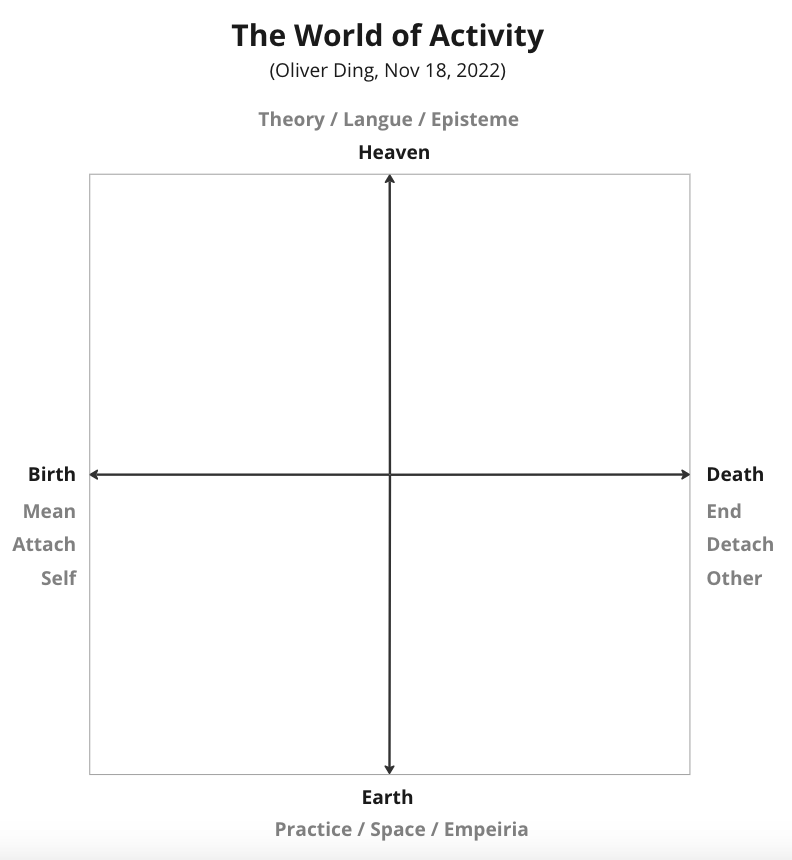
The World of Activity = The “Activity” of Life + The “Theory” of Life = “Activity Theory”
Today, I realized that the above “Universal Reference” should be expanded to contain more dimensions.
Thus, the new diagram uses a simple format to display six dimensions of Knowledge Engagement.
Transdisciplinary: Theory v.s. Practice
According to the editors of The Oxford Handbook of Interdisciplinarity (2010), “… in the US, ‘interdisciplinarity’ covers both the integration of knowledge across disciplines, narrow and wide and the intercourse between (inter)disciplines and society. The latter often goes by the name of transdisciplinarity, particularly in Europe.” (p.xxx)
I choose ‘transdisciplinary thinking’ to refer to the knowledge between academic domains and non-academic domains.
Moreover, I made a diagram called HERO U and used it to represent transdisciplinary thinking and single-theory curation. Below is the primary diagram of the Activity U project.
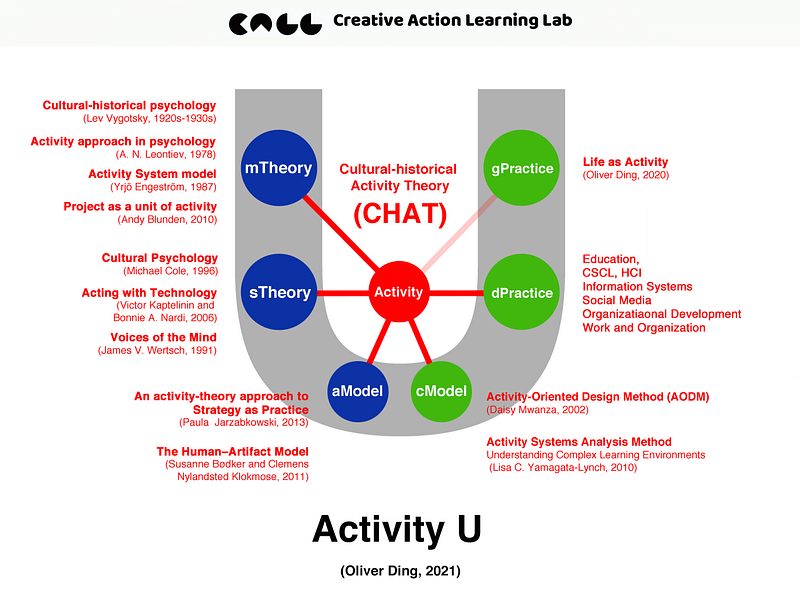
You can find more details in the following two articles:
- The Knowledge Curation Toolkit #1: Theme U for Single-theory Curation
- Activity U — A Knowledge Curation Project
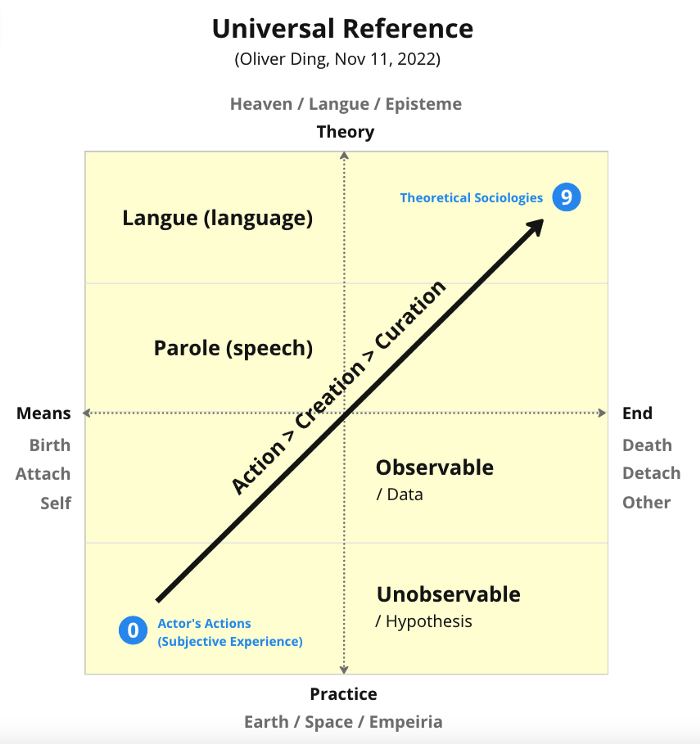
In Nov 2022, I made a new canvas called “Universal Reference” for the Knowledge Engagement project. By using the new canvas, I discovered a path for “Knowledge Engagement”:
Action > Creation > Curation
This path covers 1) Action and Reflection, 2) Knowledge Creation, and 3) Knowledge Curation. See the diagram below.
I also the landscape of Sociological Knowledge to test the universal reference canvas. See the diagram below.
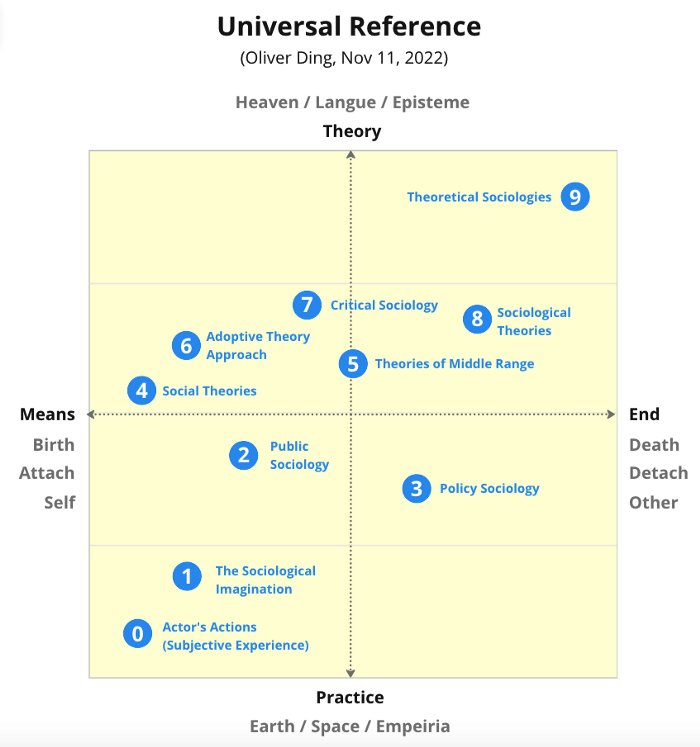
You can find more details in Diagram: A Universal Reference for Knowledge Engagement.
Temporal: Synchrony v.s. Diachrony
There are many models that can be used under the temporal dimension. One important idea is the pair of “Synchrony - Diachrony” which was developed by the Swiss linguist Ferdinand de Saussure.
For the Creative Life Curation framework, I use several units of analysis.
- Journey: This is the Diachronic view
- Landscape: This is the Synchronic view
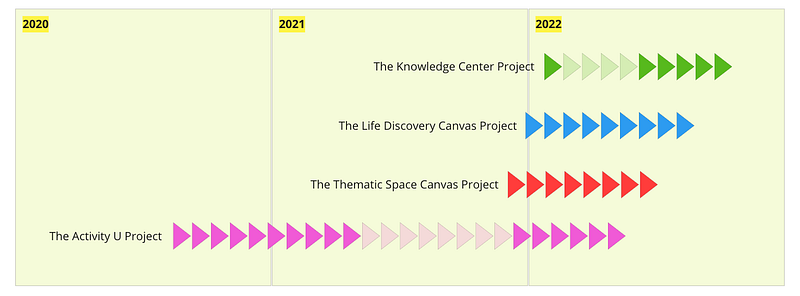
The above diagram is part of a case study of Mapping Thematic Journey. You can find more details in the original article Engaging with Activity Theory, 2020–2022.
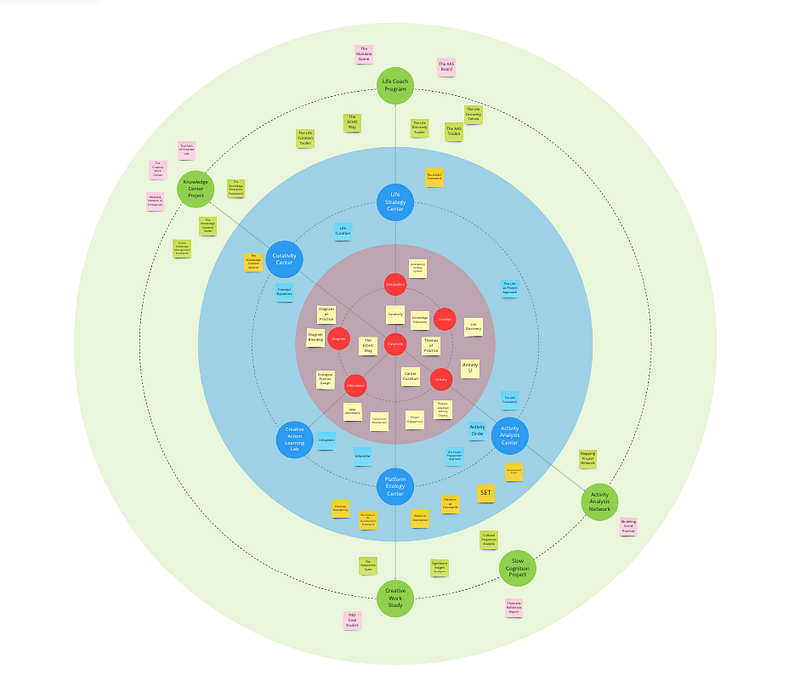
On Sept 2, 2022, I used my “Curativity” Knowledge Enterprise as an example to develop the “Thematic Landscape” method. The final result is the above diagram.
You can find more details and the large-size picture in Mapping Thematic Landscape (Curativity, 2019–2022).
Transdisciplinary + Temporal
In August 2022, I use the HERO U diagram to reflect the development of the Anticipatory Activity System (AAS) in the 12 months.
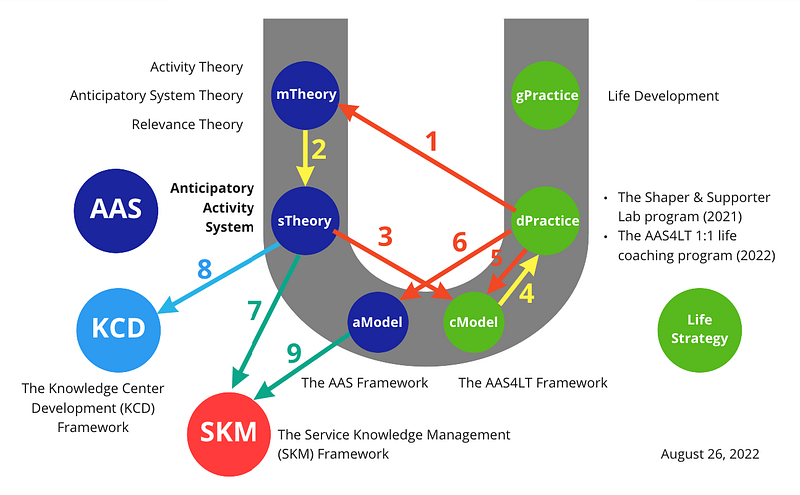
The above diagram represents 9 moves between several thematic spaces.
You can find more details in The Development of AAS (August 21, 2021 — August 26, 2022).
On Dec 31, 2022, I also used the Attachance framework to reflect on my journey of engaging with Activity Theory. See the diagram below.
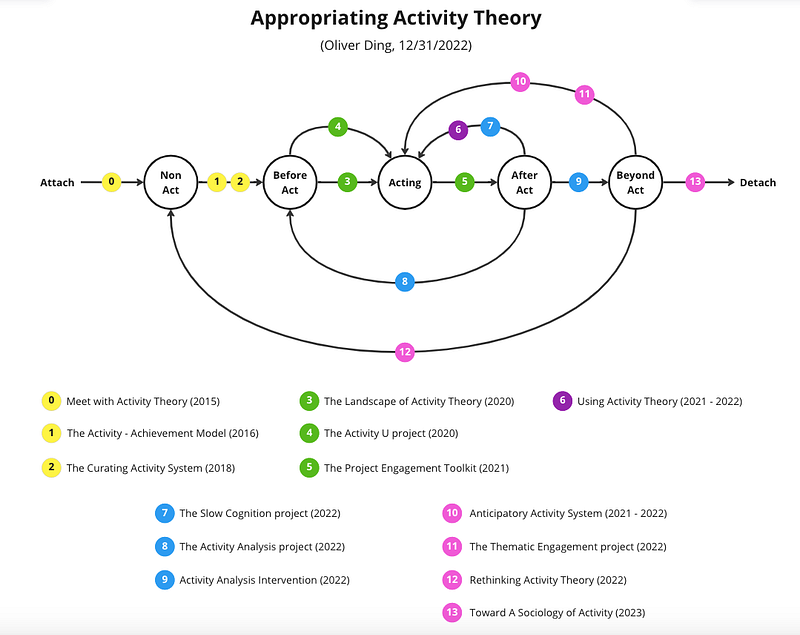
The above diagram highlights several important movements of my journey of Appropriating Activity Theory from 2015 to 2022.
You can find more details in Appropriating Activity Theory (Book).
Subjectivity + Objectification
On Oct 19, 2022, I reflected on the Knowledge Curation project and made the diagram below.
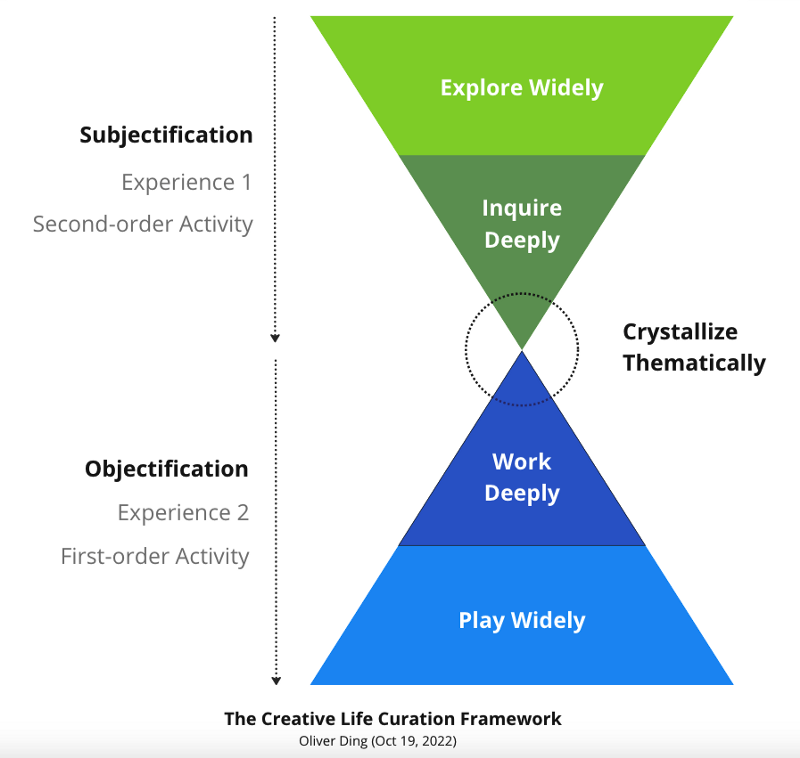
The above diagram is called Creative Life Curation. You can find more details in the following three articles
- The Creative Life Curation Framework (Oct 20, 2022)
- Three Paths of Creative Life and A Semiotic System (Oct 26, 2022)
- A Semiotic System Diagram for Creative Life Curation (Nov 14, 2022)Interdisciplinary dimension
I also used it to reflect on the Activity U project. See the diagram below.
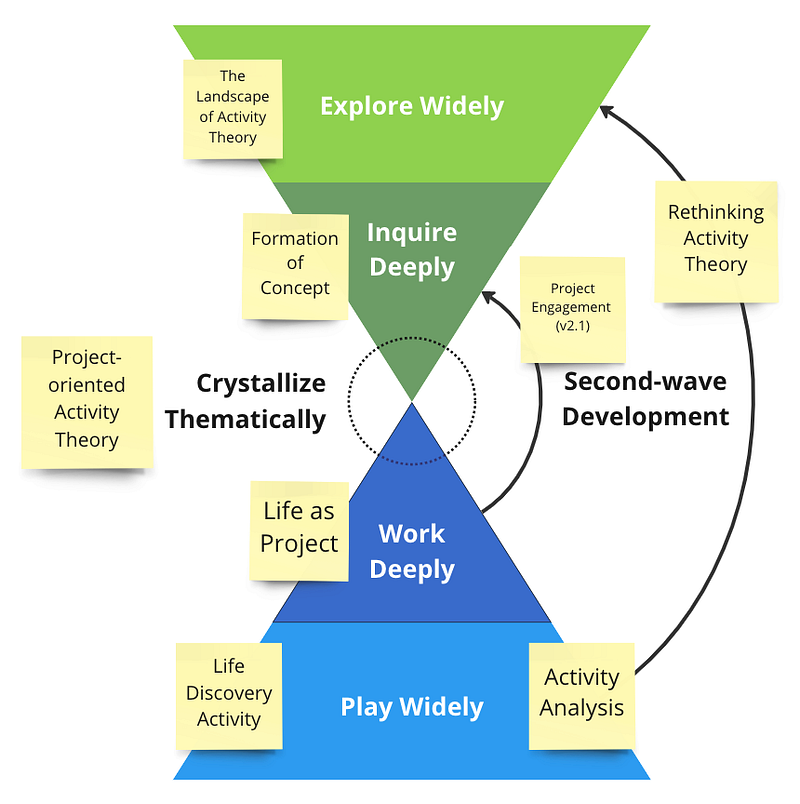
You can find more details in Slow Cognition: The Activity U Project and Creative Life Curation.
Possible Configurations
Why do we need a such multi-dimension framework and many models/diagrams for understanding Knowledge Engagement?
I see “Knowledge Engagement” as a dynamic thematic space that contains many ideas for knowledge curation and knowledge creation.
There are many Possible Configurations of these ideas.
We can’t use only one 2D model to represent the complexity of the “Knowledge Engagement” thematic space.
In the past several months, I developed a series of models to reflect on my own journey of knowledge engagement. Now we can use a multi-dimension framework to curate them together.
The framework also indicates further directions for developing more models.