
Roleplaying Games
‘Apocalypse World’ Reinvented Roleplaying Games
(Optional) Sex and (Mandatory) Violence: The Roleplaying Game
When the Kickstarter for Avatar: Legends launched, a good chunk of the RPG scene shat a brick because it didn’t attribute the Powered by the Apocalypse system to its creators. It mentioned other PbtA games as examples: Masks, Monster of the Week, and Root. But nowhere did it mention Apocalypse World itself, which all of the above games owe their existence to. This was fixed a few weeks back, but attribution is not what the RPG community owes Apocalypse World.
They owe it awe.
The Good
It’s Rated R
Specifically for three of my favorite things: Language, Sex, and Violence. Strong language is used liberally. Death and dying is everywhere. One of the ways to gain experience is by fucking.
AW isn’t the only Powered by the Apocalypse game to feature sex-related mechanics. Monsterhearts and Night Witches are two of the better examples.
The Setting is an Exquisite Corpse
Apocalypse World’s setting is Mad Max-ish, with some supernatural elements. But there’s no definitive reason given for the apocalypse, no detailed lore, no canonical maps, and no official backstory. The world is mostly left for the players and the MC to fill in.
The only narrative landmark is The Psychic Maelstrom, and even that isn’t detailed much. The designers leave its properties and implications completely up to you.
The Mechanics are Stupid-Proof
Every roll in Apocalypse World has the same range of results. A 6 or less on a 2d6 is a miss, a 7 to 9 is a hit, and a 10 or more is a strong hit. You usually add a stat to you roll, of which there are only five, and you will never modify a roll more than plus or minus 1. That’s about it. Because who has time to consider a dozen modifiers every time you want to sneak into a Warlord’s compound and cut their throat?
Most of the time, a hit means you pick one option on a list, and two on a strong hit. There are just enough exceptions to make things interesting but not so many it gets confusing.
Moves Are More Far Compelling Than Typical RPG Actions
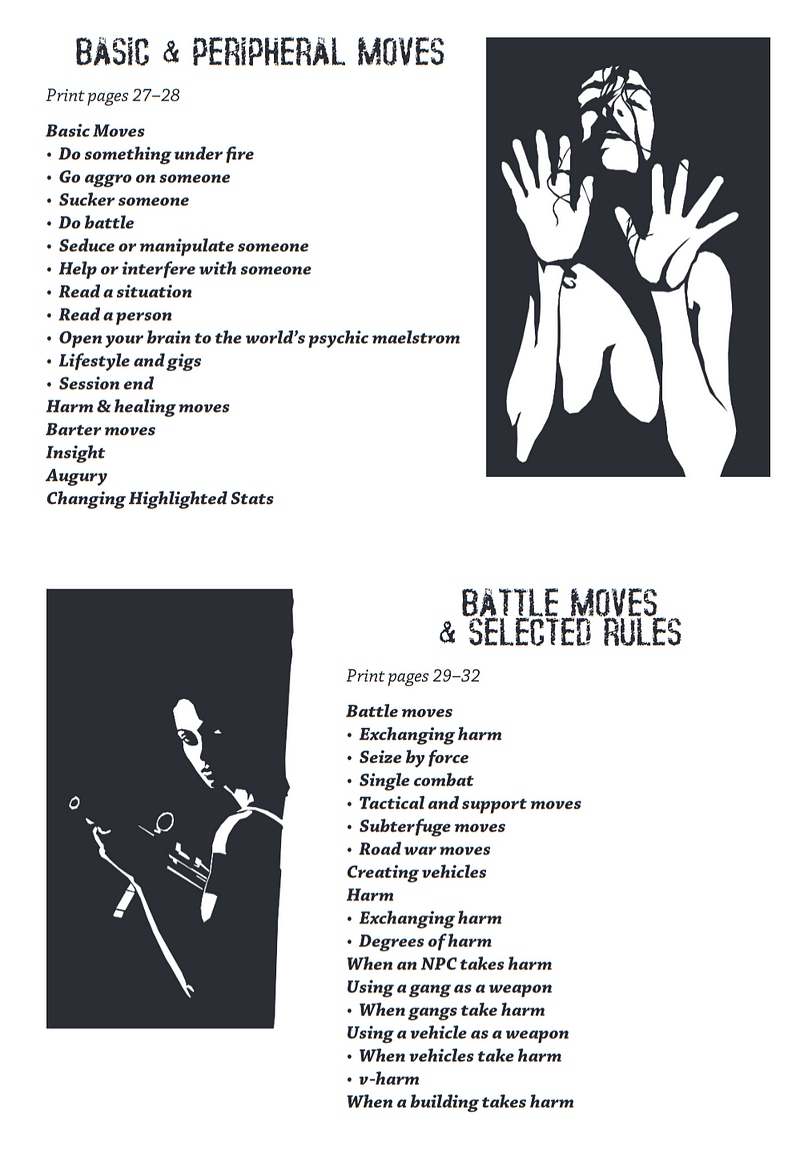
Moves are kinda like actions in other RPGs, except not. You don’t punch someone. You Go Aggro or Seize by Force. You don’t apply ambush modifiers to an attack. You Sucker Someone. You don’t ask the GM what’s around or what the NPCs are doing. You Read a Sitch. There are 30+ Moves that all characters can do plus another 50 or so Playbook-specific Moves.
Moves give players a menu of interesting options, but the basic formula makes remembering them easy without making them samey. Moves are structured “when x , then y”. Most of the time “X” is “When the character acts” and “Y” is “Roll such-and-such”. Again, there are a enough of exceptions to keep things interesting.
The Playbooks are Bizarre and Brilliant
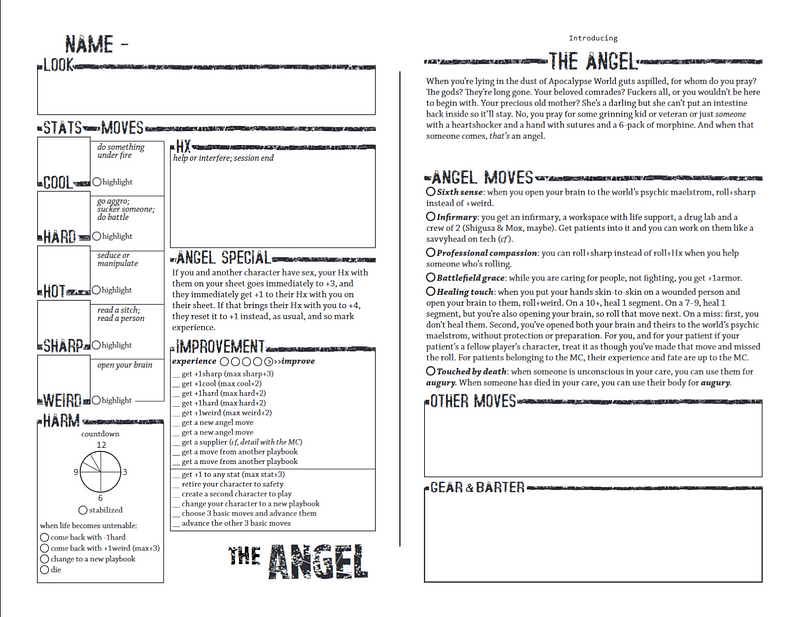
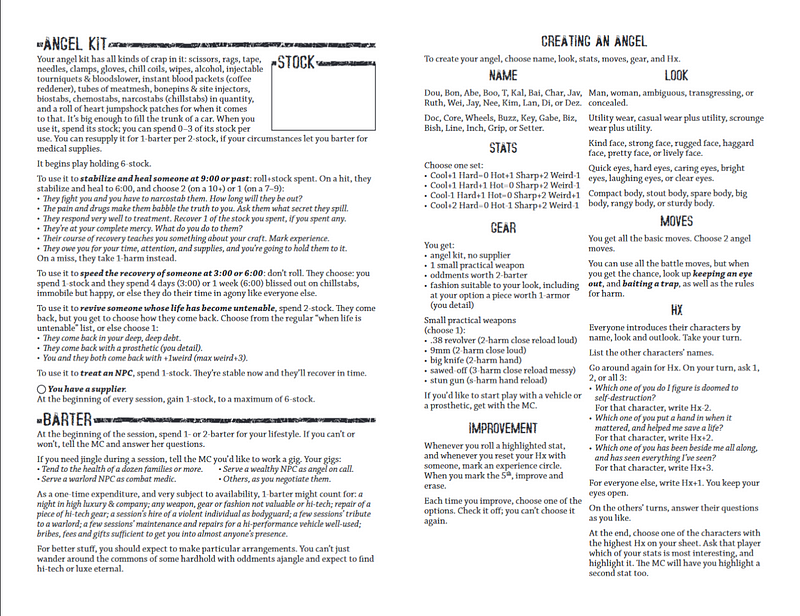
A Playbook is a character class, a character sheet, and a cheat sheet all in one. Your unique-to-you Moves, Gear, and whatnot are already listed and detailed in the Playbook. You just have to fill it out. This drastically speeds up character creation.
Aside from simplifying things, the Playbooks are strange onto themselves. The Battlebabe isn’t just a good fighter. They’re a good fighter who’s super-hot. The Hocus isn’t just a psychic. They’re a psychic with a small cult. The Savvyhead isn’t just a mechanic. They’re a mechanic who might have a supernaturally-attuned machine in their garage.
But it gets better. Every Playbook has a Special Move that further distinguishes it from the others, almost all of which are triggered by having sex with someone else.
For example, the Angel automatically increases the other character’s Hx (your personal history score with a particular character) with the Angel by 3 and the Angel’s Hx for the other character by 1. This is often enough to improve a character after just one roll in the hay with the Angel.
The Hardholder, on the other hand, can transfer 1 Barter worth of gifts to their sex partner if they want. Because they’re well-heeled, the other person is “compensated”…if the Hardholder wants. On the surface, that makes any intimacy with the Hardholder way more transactional than with the Angel. Then again, because of character improvement, maybe doing it with the Angel is more valuable.
The Special Moves set the Playbooks apart, but also make sex a gameplay concern with mechanical consequences. Potentially icky with the wrong group, but certainly revolutionary.
Apocalypse World is Distinctly Anti-Module
The authors make it abundantly clear that the MC should not pre-plan a storyline or plot. I almost listed this as a Bad thing. I used to wing RPGs when I was younger and looking back, I regret it. Published modules and prep are your friends.
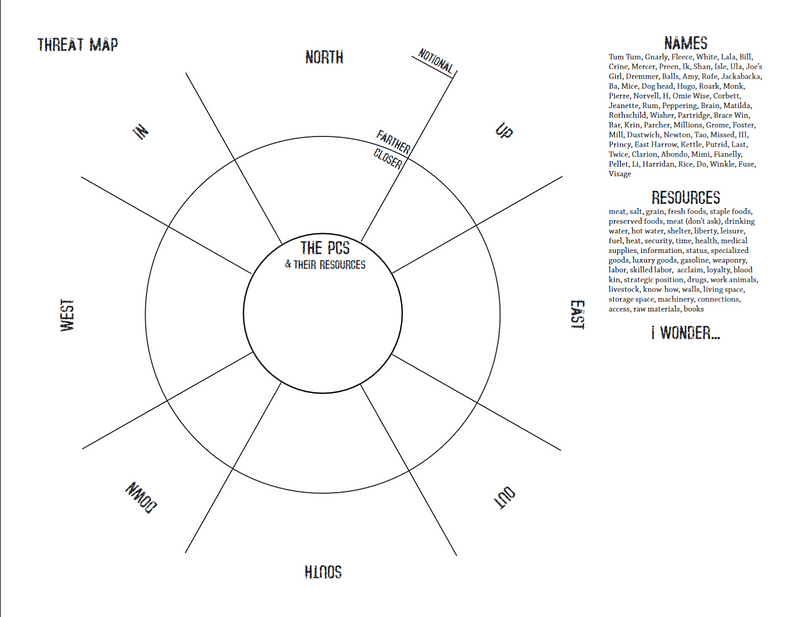
But Apocalypse World’s Threat Map helps the MC manage an otherwise chaotic affair. It’s a map that displays all the current Threats in both literal and figurative directions, as well as their distance from the PCs. The Threat Map helps the MC build and maintain a more reactive, less story-driven world. Interesting stuff happens, believe you me. It’s just not predestined.
Combat is Beautifully Abstract
I dislike dudes-on-a-grid combat a lot. It’s boring. It doesn’t matter if it’s an RPG or a board game in which the dudes have stats (so not chess). There are exceptions. Star Wars: Starship Battles. The original Marvel Super Heroes RPG. Blood Bowl. Maybe two or three more and that’s about it.
AW’s combat is perfectly suited to theater-of-the-mind play. You can do a lot with just Go Aggro and Do Something Under Fire, which are both Basic Moves. But the Battle Moves offer even more variety, and the examples that shine are Lay Down Fire and Stand Overwatch. Lots of RPGs that try to make their super-granular systems do what these two Moves achieve.
In other RPGs, trying to pin an NPC down usually involves an attack roll, then another roll to see if the NPC is brave enough to try something. Then maybe a damage roll if you hit the NPC. Or the NPC manages to attack, which requires its own to-hit and damage rolls.
But Lay Down Fire wraps it all into one roll. Even on a miss, Lay Down Fire achieves at least one expected effect…
- You provide covering fire, which means an ally doesn’t have to roll to Act Under Fire.
- You provide supporting fire, which helps an ally on a roll.
- You provide suppressing fire, which prevents an NPC from making a Move.
- You take an opportune shot, which inflicts Harm.
Put another way, AW lets you game out the big firefight in Heat (1995) in 5 or 10 minutes. With old school RPGs, that firefight would take at least half an hour.
The MC Doesn’t Roll Dice
MC Moves are automatic. Some drive events forward and some affect the setting or characters directly. This even includes doing damage. The MC can inflict Harm on whoever they want, whenever they want.
This would be unheard of in D&D, where the DM has to go through the hassle of an encounter with orcs or whatever, then focus on attacking a specific character. This gives the MC a huge amount of power. How they apply that power separates good MCs from bad MCs real quick.
Terrain Can Do Stuff in Apocalypse World!
The Threat Moves are equally conceptual, and also automatic. No rolls needed. Threats include typical villains (Warlords and Grotesques) and gangs (Brutes), all with their own Moves.
But even Terrain can make Moves, like Stall Someone or Inflict Harm or Give Someone a Secure Position. It might do these things to a PC or an NPC, so it can be an ally or an enemy. Note that this isn’t because grass and dirt is sentient in Apocalypse World. It’s because shit happens. Cars get stuck in the mud, rain makes rocks slippery, and tall grass conceals people with guns.
Jingle and Oddments, aka Money
Except for the Hardholder, players have to spend at least 1 Barter at the start of every session. Otherwise, they’re extremely hungry and thirsty, and the MC can Inflict Harm and Take Away Their Stuff. However someone else, PC or NPC, can cover that cost for them. It rarely comes to anything, but the act of having to pay an upkeep for basic needs reminds everyone that they’re barely surviving the apocalypse. It’s rare that a tabletop RPG brings this to the fore. Cyberpunk RED has rules for rough-sleeping and D&D has always had hunger and thirst rules, but AW ties it directly to the societal situation with one procedure.
Of course, having someone else cover your basic survival might come with strings. And if it’s an NPC, it probably will come with strings. Going Aggro and intimidating someone into covering your needs is one option. Seducing someone to the same end has ickier implications, and those implications are not shied away from. If they were, Apocalypse World would be boring.
Mechanically, the easiest way to make some jingle is to Work a Gig, which is usually resolved offscreen. Every Playbook includes one or two “Serve a wealthy NPC as a [whatever]” options for Working a Gig. That has some terrifying real-world implications. The more climate-aware gamer will be reminded that the only “employment” during the coming climate apocalypse will be for people who already have everything they need. Some would say that’s the way it is now, but at least now we can pretend we work for companies and not directly for the ruling class.
The Bad
“To Do It, Do It.”
As written, you’re not allowed to simply declare a Move by saying “I Go Aggro”. You have to say something like, “I grab him by the jacket and shove him against the wall”. Being creative is great, but to absolutely forbid using a Move’s name is too contrived. Ignore it.
Special Moves Might Be a Deal-Breaker
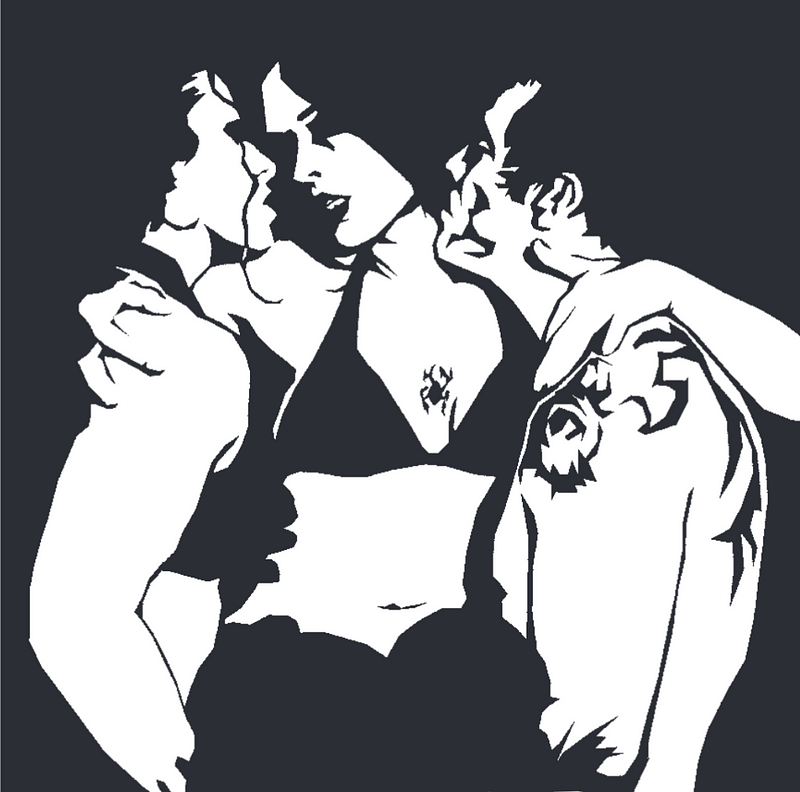
The inclusion of the sex-powered Special Moves can “other” asexual people that aren’t into that stuff. And even if that’s not the issue, sex in an RPG is ALWAYS awkward. Most AW groups either have these scenes fade to black, or they just announce the Move and go on with the game. But I’m sure someone in the world has put the peddle to the metal and graphically described their “encounter” because everyone else was too shocked to stop them.
The book suggests leaving Special Moves out if the group isn’t into them. Doing so removes one way to improve characters, but no Playbook loses more than any other (I don’t think). And with an entire chapter dedicated to inventing new Moves, you can always create something to fill in that gap.
The Ugly
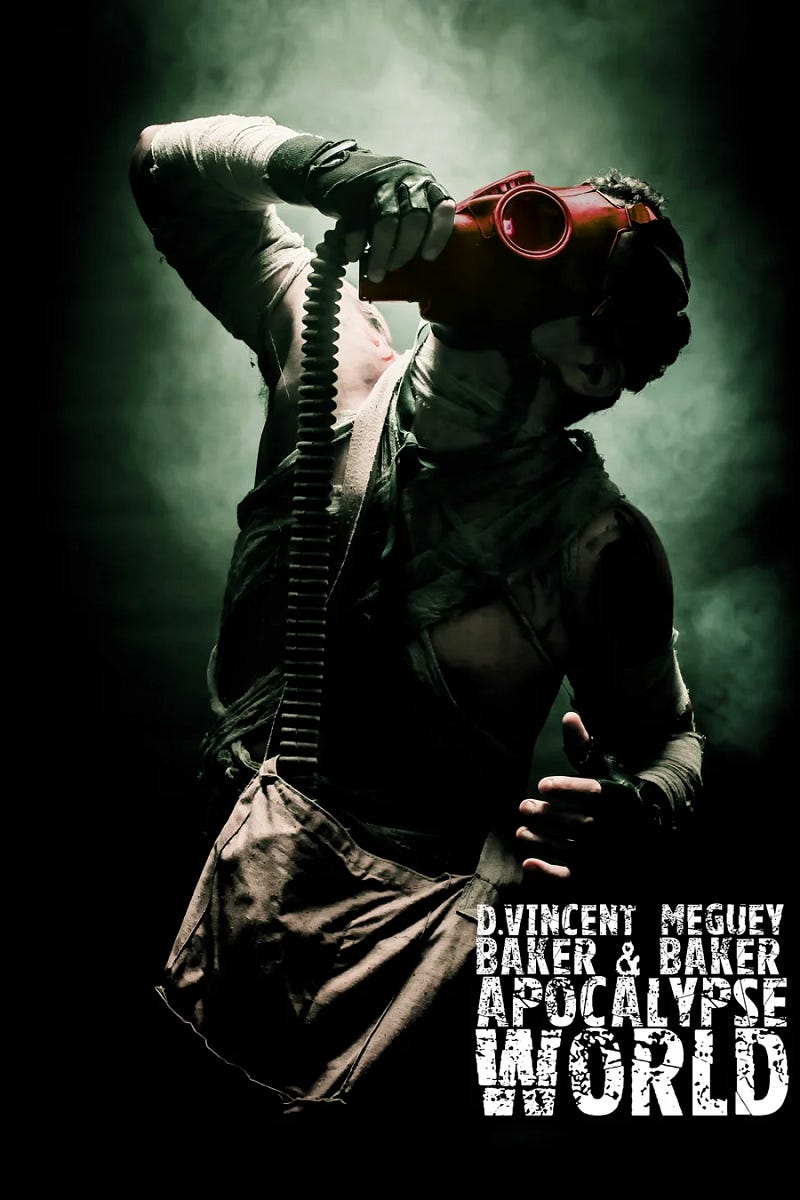
D. Vincent Baker and Meguey Baker Are CRIMINALLY Underappreciated
Apocalypse World launched a new paradigm of tabletop RPG design. Ironsworn, City of Mist, The Sprawl, Flying Circus, Thirsty Sword Lesbians, Comrades, Beat the Boss, Moonpunk, Transit, and about a billion other games owe their existence to Apocalypse World. Not to mention the offshoot systems. Both Belonging Outside Belonging and Forged in the Dark were inspired by the Powered by the Apocalypse philosophy.
If there was any justice in this world, they will be hired to design the inevitable DCEU RPG.


