Roleplaying Games
Let’s Talk About Sex (and other difficult topics) at the Table
Gaming groups take all different shapes, and there are all kinds of different relationships between members of every group. Some are family, some are friends that have known each for a long time, some groups are made of people who were strangers until their first session. Most gaming tables are probably playing as a group of characters who also may or may not have known each other prior to the start of the adventure.
Many groups don’t bother to create especially firm ties between characters during the game, outside of figuring out how to get each member to carry their weight in combat. Combat synergies or the occasional in-character debate about what to do next are the majority of character interactions at most tables. This makes sense when you consider that many people playing may not really know each other outside of the context of the table.
Newer games seek new ways to broaden these interactions. In particular, many games ask characters to develop bonds at the start of play. Some even ask players to contribute to each other’s character creation.
This is all well and good, but I was surprised when I cracked open my copy of Monsterhearts by Avery Alder and saw rules for sex. I’m not a prude, and I didn’t blush and shut the book or anything, but I did have a reaction. When my sister-in-law asked politely if it was a game that we would play as a family I think I just said, “Uh, no, I’m not sure you all would be interested in it” and changed the subject.
How would you even go about introducing sex at the table? Is sex at the table something that should be introduced at all? What kind of new gameplay becomes available when sex is introduced? As I pondered over the idea of having sex through a dice roll, I came to a few realizations about gaming and consent. Mature content can be really enriching in a game, but only if it is handled delicately. Here are some ideas to help you along in the process.
Consider Your Group
Not all groups are the same. Sex and other mature concepts are going to play differently with different people. For a group of people who largely met in the context of playing together (like my group), mature themes should be brought up carefully and discussed thoroughly and without judgement. Our group contains a married couple, so they should also be given space to consider on their own whether or not they would want to engage in a game where sex between characters was possible. For a group containing family members, I wouldn’t even bring it up, since the idea kind of weirds me out. Though, your mileage may vary. Finally, even in a group of strangers, there’s always the possibility of unresolved feelings. Introducing sex at a table full of single people might lead to discomfort or even jealousy if it isn’t discussed ahead of time. It’s important to know your table before introducing mature content.
Do the Mechanics Require Sex?
With the possibility of discomfort, jealousy, or embarrassment at stake, one might ask why sex or other mature themes should even be brought up in play. It’s a good question, and one answered by a game’s rules. For example, a standard fantasy game probably doesn’t need sex involved at all. There are no mechanisms in games like D&D that make sex something you can really play out or that has consequences. Horror stories abound about sex scenes shoehorned into these games, and many of them end with one or more players leaving.
But then you have games like Monsterhearts or Apocalypse World, which include specific mechanics for sex to play out and for sex to mean something to the characters. To declare sex is off the table is fine, but it removes an entire mechanic from the game. These games are less about adventuring and more about the relationships between characters, so it makes a lot of sense that sex, something that happens between people, would be a part of them. Including sexual themes in your game of D&D might make sense in some contexts, but maybe it would be best to leave it to games that actually have a use for it.
Talk About Boundaries
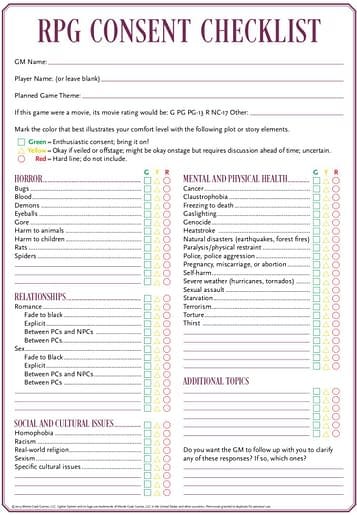
This should happen as part of literally every session zero: you have to discuss boundaries. Players ought to have a say in what kinds of things are possible in a game they are expected to be engaged in. This includes sex, yes, but it should also include things like torture, violence against the innocent, etc. I always use Lines and Veils. Lines and Veils is a system that allows players some control over a game’s content. A Veil is something that happens, but is never fully depicted, always fading to black. Torture is a good example. Rather than allowing a description of how an orc pulls out a halfling’s tooth to get information, the GM simply states that the halfling was tortured, allowing you to see the results of this after the fact. Lines are things that don’t happen in the game world. For example, if torture is a line, even the baddest, nastiest villain around would never even think to cause pain for the sake of extracting information.
In addition to encouraging players to bring a list of Lines and Veils, GMs should mention some sensitive subjects they expect to come up. Since sex is a part of the rules for Monsterhearts, if I were running it, I would say during session zero, “This game includes rules for sexual content. We’re all adults here, and I believe we are mature enough to handle this content, but since it may be uncomfortable, I want to discuss Lines and Veils related to sex.” From there, we can ban it from the game altogether, or we can decide not to depict it, or we can decide what the limits of depiction may be. Some groups may want to play out the entire scene in detail! Some may want characters to avoid sexual contact of any kind. What is important is the conversation.
Check in About Boundaries
And what is doubly important is having the conversation, again. When discussing difficult or mature content, players should always have the right to go back on what they said at any time. It can be as simple as saying “I’ve thought about it, and I am uncomfortable with having sex in this game, can we make it a Line?” Boundaries shift, and sometimes may even become more open! Players need to know that they have the final word on things that may make them uncomfortable.
In situations like this, I also believe that players must have the right to rewind and rewrite some events, with group consent of course. If someone comes to the group and wants to remove sex from the game, it makes sense that they may also want to replay the sex scene from last session, so that something else happens instead. Flexibility and understanding are key to a good experience for everyone at the table.
_______________________
Is sex at the table worth it? Yes. Roleplaying games are an incredible gift because they allow us to play as people different than ourselves and tell stories together. Sex is an important part of human (or depending on your game, inhuman) relationships. In games like Monsterhearts it provides interesting and impactful ways for characters to interact and develop. I don’t think any table should totally abandon anything that might make the story more interesting or more real.
But it must be done carefully and with consent. People may not need to know about the goblin ambush up ahead, but they should know if sexual content is expected in a game that otherwise may not have it. Like all relationships, RPG groups are built on trust. Trust that everyone is here to have fun, and trust that everyone can respect one another’s boundaries. This same model can be used for everything from immense violence (as discussed above) to issues of race. Some people may not want to engage in a game where orcs are called “greenskins” and denied jobs due to their race. Some people might want a game that digs into these issues, but sensitive topics can also be triggering to players who did not expect them or who did not expect them to go as far as they did. After all, a player might be comfortable with racism against orcs as a part of the game world, but might be triggered by the party discovering an orc who was hung by a mob at a crossroads.
Finding a careful balance between mature content and player’s comfort is vital. Knowing when to push and when to let it alone is an essential task for GMs, and a difficult skill to master. People mess up all the time. The only thing for it is communication, flexibility, and grace.


