
Seeing the World Through Younger Eyes
Gratitude for the greatest of travel companions
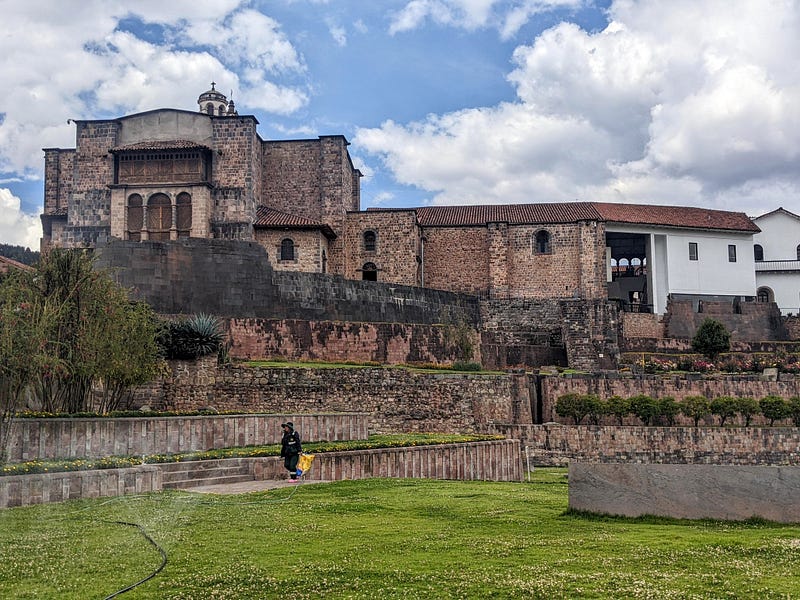
A few blocks from the central plaza in Cusco, Peru sits the Church of Santo Domingo, one of hundreds of Catholic churches that dot the city. It’s unremarkable in almost all ways. Only the abundance of vendors marks the church as significant. Knowing that the site attracts thousands of tourists daily, vendors wait with mass-produced textiles, baby alpaca, with whom a visitor can take photos for a small fee, and coin purses burnished with “Cusco.”
The church appears typical in all ways: It’s neither the biggest, the smallest, the grandest, or the prettiest. But 500 years ago, this patch of land held the most important building in the entire Inca empire, a kingdom that stretched from modern-day Colombia through nearly the whole length of Chile, an empire that sheltered almost 13 million inhabitants and that was larger, grander, more efficient, and more prosperous than Spain, from which its conquerors eventually came.
The Inca’s Temple of the Sun
On this patch of land sat the Temple of the Sun, watched over by specially-trained priestesses and visited only by high priests and the Inca king himself. Those who entered removed their shoes and performed rituals at the sacred site.
One day this week, my daughter and I visited the Temple of the Sun, known as Qoricancha, or “Golden Temple” in the Inca language of Quechua. Spanish historians speak of the place with awe. They tell of walls clad from top to bottom in sheets of gold, adorned with massive golden suns, and surrounded by a garden filled with gold and gem-encrusted statues.
Little is left of the Inca masterpiece; only the shells of a few rooms remain, constructed with remarkable Inca engineering to withstand earthquakes measuring as high as 8.4 on the Richter scale.
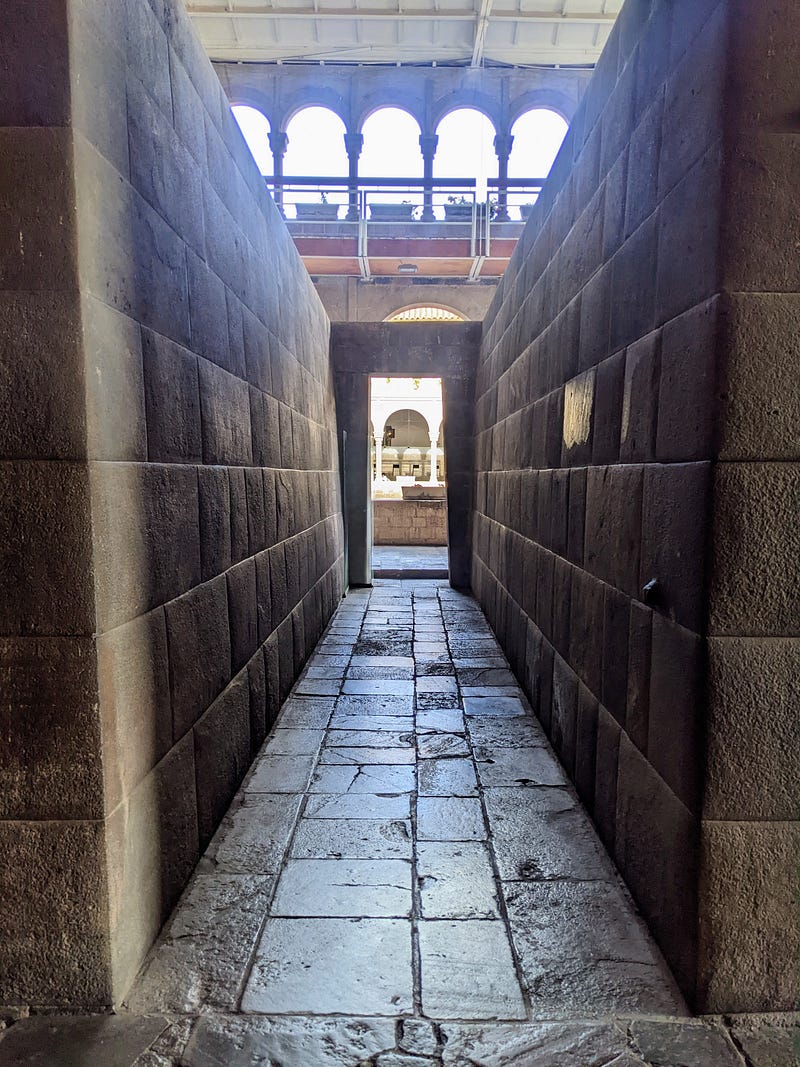
As we gazed at elegant Spanish archways meeting sturdy Inca walls, I told my thirteen-year-old daughter a story from 500 years ago. Spanish conquistador Francisco Pizzaro and fewer than 200 men somewhat miraculously captured the Inca king Atahualpa, who had at his disposal at least 200,000 soldiers. (The details surrounding how the Spanish won battle after battle while outnumbered a thousand to one are mind-boggling. I recommend Kim Macquarrie’s Last Days of the Incas for those interested.)
Noticing the greed of the pillaging Spaniards, Atahualpa famously promised to fill a room with gold one time and silver two times to secure his freedom, I told my daughter. The king sent runners along 25,000 miles of roads to collect gold and silver from all corners of the kingdom, but after many months, the Spanish became impatient.
I looked my daughter in the eye. “So the Spaniards sent three men to the capital city of Cusco — two illiterate sailors and a notary — to supervise the collection, the theft, really, of Inca gold. Where do you think they came?”
We looked around. “Right here. Right where we’re standing. This was the heart of the capital city at the heart of the empire, and this place was filled with gold.” I paused for emphasis. “The uneducated Spaniards in their soiled clothing and dirty boots came into the most sacred space for a thousand miles and pried gold off the walls with crowbars.”
I felt like an exceptional parent at that moment, a proud worldschooler linking history to the present location.
My daughter paused thoughtfully, looked back at me, and said, “Well then, maybe we shouldn’t be here?”
Gratitude for my travel companions
When my daughter was born, my husband and I hatched our Ten Year Plan. In ten years, we’d depart the United States to travel the world. It took twelve years. In that time, we had a second daughter.
During the last school year, we traveled through Europe, into Egypt, and through Southeast Asia, visiting 13 countries in 11 months, subsisting on savings and careful planning. Not content to settle home just yet, we’re off on year two of our adventure, this time with remote work.
When we become parents, we marvel at what has become mundane for us. We witness wonder in our children’s eyes when they see their first rainbow, the ocean, or an airplane. We pause and notice details we stopped seeing in adulthood: the plumpness of a bumblebee or the coloring of the neighborhood cat.
And when we travel with our children, their awe becomes our own. Not only that, their questions open new pathways in our own minds, shining a light on details we may never have seen.
Is it right for us to be in the ruined Temple of the Sun, I wonder? The Spanish were unable to eradicate the Incas, as it turns out, try as they might. Their culture lives on in the Quechua language spoken all over the region, in the usage of coca for stomach pains and lethargy, and in the textiles worn by the men and women who trod up and down the hilly streets of Cusco. Their god, Inti, is still celebrated in festivals all over the region.
I hadn’t considered how I entered the Temple of the Sun if I was showing respect, but thankfully, my teenager, who brings her own sense of curiosity and insightfulness to our travels, did. She and her sister make traveling the world fresh and fascinating.
So what about the Inca king, Atahualpa?
Allegedly a brilliant man, Atahualpa picked up Spanish in a few months and bested his captors at chess, a game he’d just learned. He took Pizarro at his word — perhaps his fatal flaw — believing that he would be released if his ransom were paid. So Atahualpa fulfilled his pledge, taking a year while captive to direct his people to fill a room once with gold and twice with silver. He believed the Spaniards would take their loot and go back from whence they came.
From the Amazon rainforest to modern-day Quito to south of Santiago, Chile, Incas stripped their temples of sacred sculpture, handed over important ceremonial goblets and plates, and gave their best jewelry to secure the release of their king.
The Spanish killed Atahualpa anyway.
Stephanie Tolk is currently traveling and worldschooling with her children. If you’re curious about extended travel with your family, check out her course: Worldschooling: A Comprehensive Guide to Long-Term Travel.
You might also enjoy: