
CULTURE|SELF
Ryuichi Sakamoto Taught Me How to Survive in a Stifling Society
The outdated definition of hikikomori in Japan
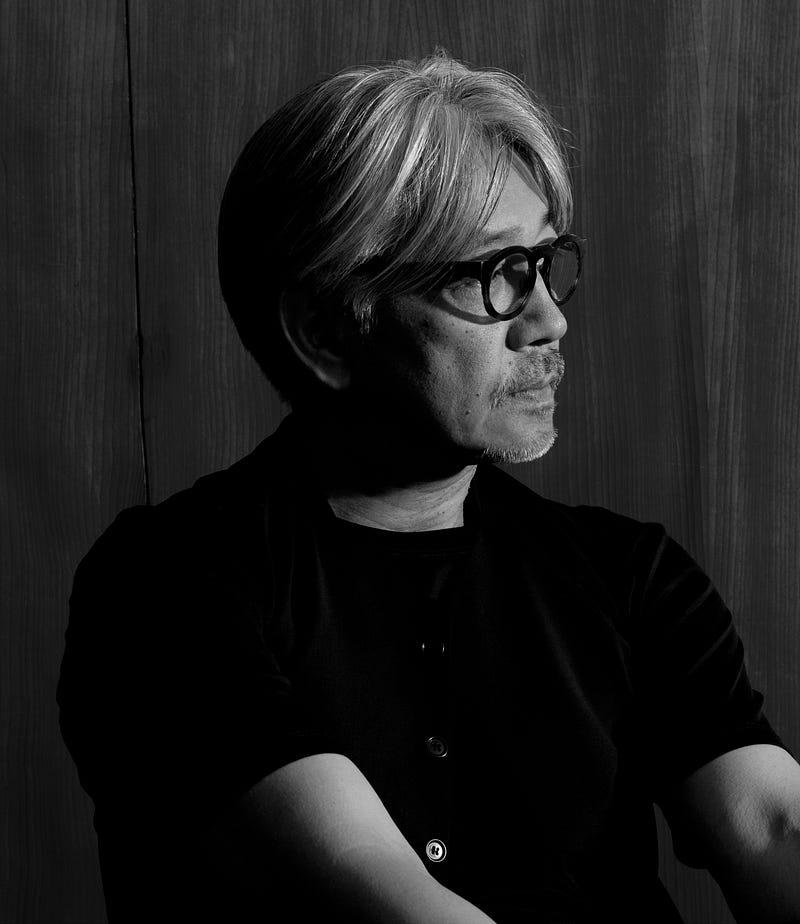
A month or so after the world-renowned composer Ryuichi Sakamoto passed away, an advertisement grabbed my attention on Instagram. It was a photo of him dressed in a tux, his gray hair neatly separated and his piercing eyes staring at the camera behind the tortoiseshell-framed glasses.
Across his chest was written the following Japanese sentence.¹
息苦しい社会に対しては「引きこもるかアウトローになるか、外国に出るか」が有効な手段だ。
In the face of a stifling society, there are three effective options: shutting yourself in, becoming an outlaw, or moving to a foreign country.
I couldn’t take my eyes off the photo and eventually took a screenshot before closing the app on my phone. My life seemed suddenly validated by him because I’ve always felt like an outsider, though I’ve lived my whole life in Japan.
Why Ryuichi Sakamoto Left Japan
After establishing his reputation in Japan and winning an Academy Award and a Grammy, Sakamoto moved to NY City in 1990 when he was in his late 30s.
According to old interviews, since his teens he’d been determined to live anywhere on the earth as a cosmopolitan. He also claimed that Japan is stifling for creators because overseas culture is imported to this island country as finished packages.²
NYC appealed to him with its cultural richness and openness, which allowed creators to be inspired by other artists amidst the lively art scene.
Nevertheless, Sakamoto never forgot about his home country. When the Great East Japan Earthquake hit, he organized charity events in the battered Tohoku region and raised donations.
He even had a plan to move back to Japan in the hope of appreciating nature and local food, but not to his hometown, Tokyo. Kyoto spoke to him as the ideal environment to connect with fellow artists.
However, in 2014, while he was in the process of buying land in Kujoyama and narrowing down potential architects, he was diagnosed with throat cancer.
Undergoing radiation therapy, he overcame this first bout with cancer, but later he was forced to fight stage 4 rectal cancer. Sakamoto passed away at a hospital in Tokyo on March 28, 2023, at age 71.
Embracing the Hikikomori Lifestyle
As a daughter who lost her father to lung cancer, I felt genuinely sorry for his family’s loss, especially for his daughter, who is close to my age. My father was a nameless entrepreneur, but it was he who opened many doors for me by taking me to other countries.
I vividly remember how I felt liberated when surrounded by people from diverse backgrounds on my family trip to Hong Kong. Every time I returned from an overseas trip, Tokyo felt monotonous and dull, with everyone dressed in gray suits and beige coats.
Japan might be known for sushi and geisha, but becoming a full-fledged sushi chef or a top-notch geisha requires immense patience, hard practice, overtime work without proper compensation, and a terrible life-work balance. It means dealing with impolite consumers who believe they should be treated as gods. Japan is a seriously suffocating country, not only because of the muggy weather.
Coincidentally, my first solo trip abroad took me to NYC. It was during a period when I was between jobs, and my friends didn’t have free time that fall, just one and a half years after college graduation. As a huge fan of pop art, I yearned to immerse myself in the air of freedom and visit MoMA.
There’s a Japanese saying — ishi no ue nimo sannen — which means if one sits on a stone for three years it’ll get warm and easy to manage. But I was neither patient nor blind enough to remain in a situation where I felt frustrated, undervalued, and exploited. I didn’t move to the States physically, but I took a job at an American company in Tokyo and ended up becoming a writer in my second language.
Sometimes people ask me why I don’t write in my native language. They raise a good question. It would be much easier and less time-consuming if I wrote in Japanese. But Japanese media is heavily male-dominated, and the language always reminds me of the hierarchical nature of this society.
Now I live like a professional shut-in, writing at a dining table day and night. While I’ll stay based in Tokyo to care for my family for at least the next couple of years, nothing is set in stone. I’m always open to other options.
The Outdated Definition of Hikikomori and Mental Health
The Japanese government takes the reclusive lifestyle seriously and calls it hikikomori, which has made the cut as a new English word in the Oxford Dictionary.
Hikikomori means people who have shut themselves in at home for over six months without interacting with other people at work or school except for their family.³
Japanese media reports that there are currently 1.46 million hikikomori⁴, but I find it hard to grasp the seriousness of this issue. That’s partly because I’m sick of what the government touts as a healthy lifestyle. With the current availability of remote work and asset management, it’s nonsense to categorize people as sick only because they stay at home. As a writer, I’m sure that most introverted writers fall close to the periphery of this definition.
The label of hikikomori highlights how this country marginalizes people who don’t work for major employers. In Japan, you’re considered unhealthy if you don’t go out and socialize, regardless of your wealth or physical fitness. Working overtime too long and getting harassed at work seem way more toxic, but that’s not the government’s business.
Japanese society fails to recognize how this social pressure leads to tragic outcomes like suicide and overwork death, also known as karoshi, and results in the exodus of talented individuals like Sakamoto. It is not uncommon to hear the news of children moving abroad to get away from the one-size-fits-all educational system.
Now that I’m older than the age when Sakamoto moved to NYC, I work from home but receive inquiries from many overseas media outlets, ranging from BBC to CNBC to Al-Qahera News Channel. Warm feedback from readers feels incredibly rewarding, regardless of the form it takes.
The government may label me as a troublesome hikikomori, but I won’t let that deter me from trusting the voices of those I truly admire. For someone like me, this is a means of survival in this densely populated homogeneous nation.
No one can confine us in one place, one language, or one prevailing mindset that often marginalizes underrepresented individuals. We’re the ones who can set ourselves free from someone’s definition of mental health and success, embracing our own unique path.
Sources 1: Forbes Japan, 2: mu-mo, 3: MHLW, 4: Asahi Shimbun
If you enjoyed this article, follow Yuko to read more stories like this and get an email whenever she publishes. She’s currently writing her debut novel set in Tokyo.


