
British Network Television
‘Father Brown’: S01.E06. “The Bride of Christ”
Father Brown investigates the murder of two nuns
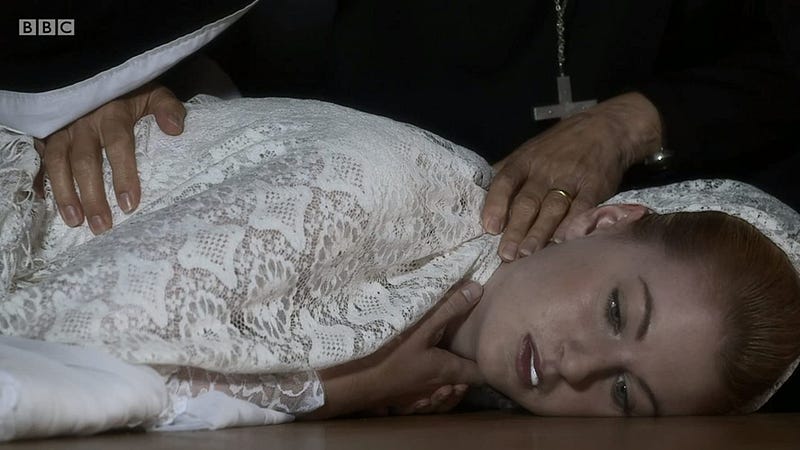
Everything about the Catholic Church, even becoming a nun, is cloaked in ceremony. This latest episode, The Bride of Christ, opens with Father Brown leading a Ceremony for Veiling and Profession. A young woman, dressed all in white, suddenly finds herself in difficulty. She collapses to the floor in front of Father Brown and several Catholic nuns.
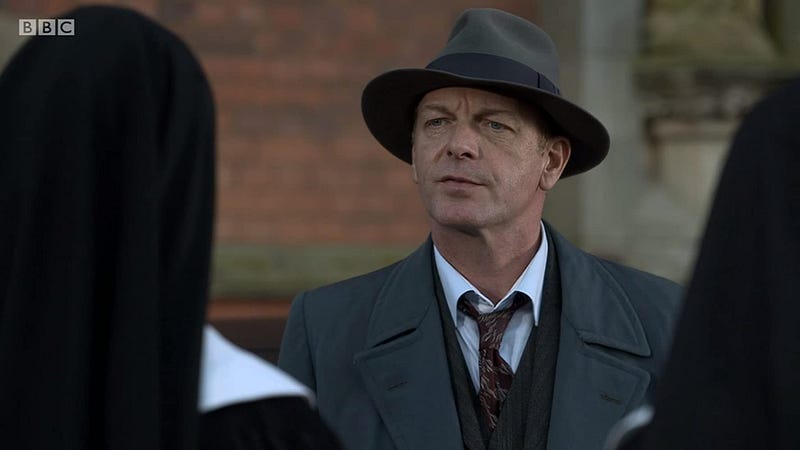
Inspector Valentine (Hugo Speer) isn’t surprised to find Father Brown (Mark Williams) at the crime scene. The young woman, referenced as Sister Mary Magdalene, is dead. Father Brown, based on an observation of Sister Mary Magdalene’s lips, suggests to the police inspector the cause of death could be attributed to possible cyanide poisoning. Inspector Valentine, as per usual, doesn’t want to involve Father Brown in his investigation.
Outside, ordered to lay on the ground, we find Sister Bernadette being berated by the new new novice Mistress. Sister Paul (Roberta Taylor), having arrived from Calcutta the previous week, is a strong disciplinarian. Whilst disciplinarian seems like the right fit, given Sister Paul’s attitude, tyrant feels more appropriate.
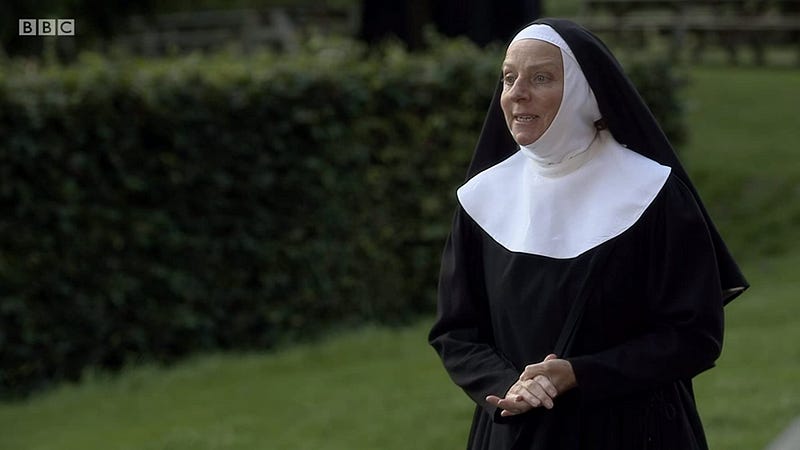
There is an exchange of words, observed by Reverend Mother Augustine (Penny Downie), between Sister Paul and Sister Gregory (Selina Cadell) which suggests there will be trouble. The Reverend Mother, despite Sister Paul’s position, directs Sister Bernadette to the kitchen so that she might get herself a cup of tea and something to eat. Sister Paul’s facial expression suggests she’s less than amused by how the Reverend Mother chooses to conduct herself.
The Reverend Mother, noting how Sister Mary Magdalene would have been observing her fast before Holy Communion, tells Inspector Valentine the young woman wouldn’t have consumed anything. Even though Sister Gregory confirms the Reverend Mother’s statement, Sister Paul has a different opinion of the victim. Sister Mary Magdalene, according to Sister Paul, was “a wilful girl with a streak of rebellion.”
Not wanting Sister Paul’s opinion, with more than a hint of annoyance in her voice, Reverend Mother Augustine directs the new novice Mistress towards duties she must attend to that day. Sister Paul glares at the Reverend Mother before leaving her to speak with the police inspector.
When Inspector Valentine asks about there being any cyanide kept on the premise, mainly because of his unfamiliarity with converts, the police inspector is surprised to learn nuns make wine.
“Our Lord asks for poverty, chastity and obedience,” Sister Gregory correctly tells Inspector Valentine. “He never said anything about sobriety.”
Reverend Mother Augustine, not wanting the convent or the nuns inconvenienced with Inspector Valentine’s presence, requires the police inspector to be accompanied by chaperone. She feels it “would be both reassuring and appropriate.”
It is here that Inspector Valentine learns Father Brown is the convent’s Chaplin. Consequently, much to the police inspector’s chagrin, there is no getting around involving the Catholic priest in his investigation.
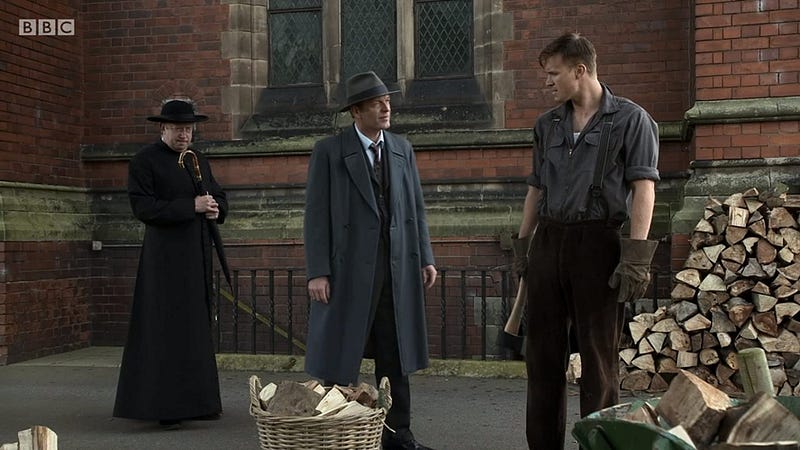
Tom Evans (Paddy Wallace), the first person the police inspector speaks with after being directed to have with him a chaperone, is hard at work chopping wood for the convent. Mr Evans, when asked about his whereabouts between 09:00 and 10:00 that morning, simply tells the police inspector he was in the garden. Where else would one expect to find a gardener?
Joyce Evans (Joanna Horton), Mr Evans’ wife, merely collects the shopping from the local store. That is the extent of the work she does for the nuns. There is a distinct tone in Mr Evans’ voice suggests a dislike for the nuns. His reference to the novices, having no interest in conversing with them, suggests an underlying issue which isn’t addressed here.
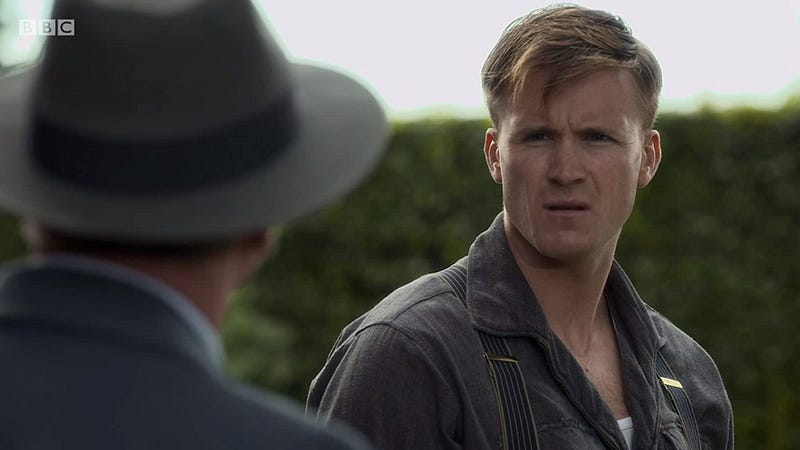
Mrs Evans, in Cheltenham on account of her mother apparently having TB (Tuberculosis), isn’t available for the police inspector to question. There is something about how Mr Evans speaks of his wife that suggests he views married women as being property.
Elsewhere, in a clearly disrespectful tone, we find Sister Paul making her presence felt with the Reverend Mother. She is annoyed that the “novices are refusing to drink from the water fountain in case it’s poisoned.”
“Sister Lawrence,” according to Sister Paul, “says the kitchen is in chaos.”
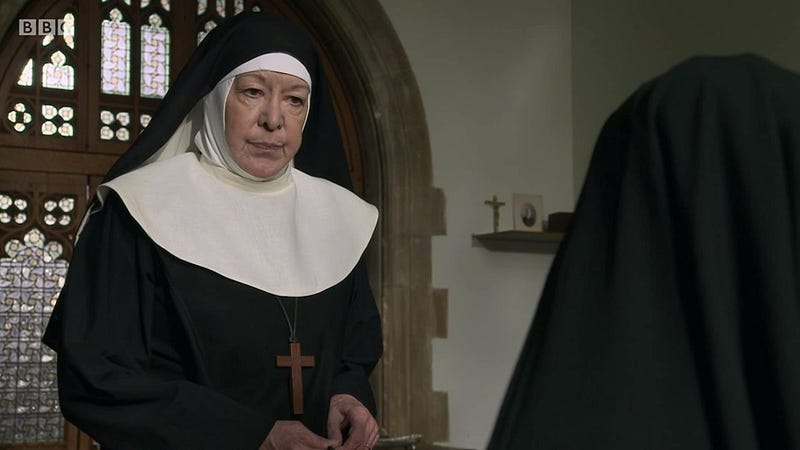
Whilst the Reverend Mother believes the novices are simply frightened to drink from the water fountain, Sister Paul suggests that it is more likely they are guilty of something untoward. The new novice Mistress believes the “deplorable incident will turn out to be some of their juvenile horseplay.”
Sister Paul’s reference to “the character of some in charge” suggests a familiarity with Reverend Mother Augustine which dates back to long before her becoming the new novice Mistress. What could that familiarity stem from?
Sister Paul, angry she is subordinate to Reverend Mother Augustine, considers the Reverend Mother her “spiritual and moral inferior.”
There conversation is cut short when the Reverend Mother receives a call from Sister Mary Magdalene’s father. Unbeknownst to both Reverend Mother Augustine and Sister Paul, their conversation is overheard by Sister Gregory. Sister Gregory, based on her previous encounters with Sister Paul, isn’t thrilled by her being at the convent.
Moments after Sister Paul leaves the Reverend Mother’s office, something we should have seen coming, we see Sister Gregory challenge the new novice Mistress to her face. Sister Paul, not backing down one inch, asks Sister Gregory what exactly she is going to do about her attempting to destroy St Agnes.
Not actually interested in a response, Sister Paul walks away. Sister Paul, if she had bothered to hang around long enough, would have heard Sister Gregory respond “Whatever I have to.”
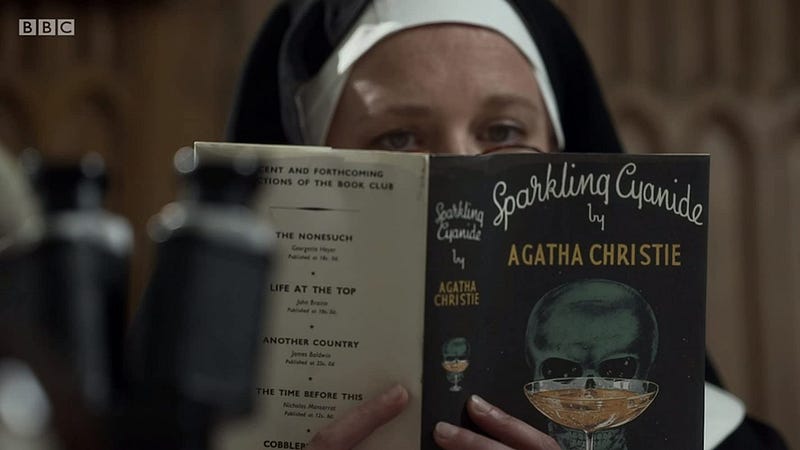
Sister Boniface (Lorna Watson) is reading Agatha Christie’s Sparkling Cyanide when Father Brown and Inspector Valentine finally arrive in the winery. The Vintner’s choice of reading material, mainly because of the way Sister Mary Magdalene died, doesn’t escape the police inspector’s attention. Sister Boniface tells Inspector Valentine she is merely doing some research on the murderer’s choice of poison. Father Brown clearly approves of Sister Boniface’s reading material.
Sparkling Cyanide, for people not familiar with Agatha Christie’s work, was first published in 1945. The dust jacket references the coming publication of Georgette Heyer’s The Nonesuch (1962), John Braine’s Life At The Top (1962), James Baldwin’s Another Country (1962), Nicholas Monsarrat’s The Time Before This (1962), and a fifth title beginning with the word Cobbler or Cobblers.
How many novels, possibly a 1962 publication, were published in the British Isles with the word Cobbler, Cobbler’s, or Cobblers beginning the title? The only book title I managed to find that comes close to what we see in the image is Monica Dickens’ Cobbler’s Dream (1963). Whilst it isn’t unusual for a production’s prop manager to not properly vet items used in a scene, for social historians looking for historical accuracy, it can be somewhat annoying.
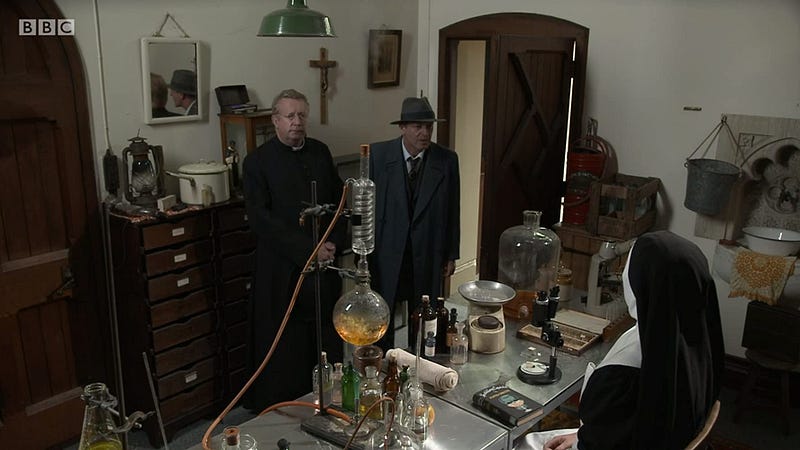
Inspector Valentine, even though the Vintner is pleased to see Father Brown on the case, tells Sister Boniface that the Catholic priest is there as merely a chaperone. Its’ funny, considering how long the police inspector has known Father Brown, that Inspector Valentine believes he could prevent the Catholic priest from investigating the murder.
Sister Boniface, with a marvellous grasp of crime fictions, suggests to Inspector Valentine he is the Inspector Charles Parker to Father Brown’s Lord Peter Wimsey. Inspector Charles Parker and Lord Peter Wimsey, both fictional characters, can be found in various novels and short stories penned by Dorothy L. Sayers.
Questioning how and where Sister Mary Magdalene could have ingested the poison, Sister Boniface accompanies Father Brown and the police inspector to the cabinet where she stores the Potassium ferrocyanide.
Whilst Sister Boniface correctly observes twelve bottles present, noting how one of the bottles is bearing the wrong name, Father Brown directs her attention to how easily the label can be removed. Someone has taken a bottle of Potassium ferrocyanide from the cabinet.
Inspector Valentine notes in Sister Boniface’s facial expression a thought that could be important to his investigation. Even though Sister Boniface doesn’t care to gossip, something she finds sinful, Father Brown reminds her that “it doesn’t count as gossip if it’s pertinent to a police investigation.”
Sister Boniface references Sister Abelard having found anomalies in the stock take. Whilst she initially thought it was a mistake, something Sister Boniface thought peculiar, Sister Abelard apparently never makes mistakes. Sister Abelard has a double first in mathematics. If you are wondering, not that you wouldn’t be, that’s a reference to a degree. The convert’s nickname for Sister Abelard, because of how precise she is with figures, is Sister Abacus. Father Brown finds this rather amusing.
Meanwhile, elsewhere at the convert, we see Sister Paul taking to her typewriter to inform the Diocese of Reverend Mother Augustine’s apparent transgressions. Sister Paul, even though she is a nun, is a seriously nasty piece of work. There is no forgiveness in this nun’s heart. She obviously puts the heart in both heartless and heartlessness.
Sister Paul, noting Sister Ignatius running outside, berates her for running in G-d’s house. After catching up with Sister Ignatius, mirroring what she did with Sister Bernadette, Sister Paul forces her to lay on the ground. Sister Paul, seemingly taking pride in humiliating others, soon discovers her comeuppance is delivered faster than anyone could imagine. Her death, like that seen with Sister Mary Magdalene, is swift.
When Inspector Valentine arrives on the scene, to his annoyance, he discovers Sister Mary Magdalene has allowed a few of the nuns to disturb the crime scene because she placed “the sensibilities of our Sisters first.”
Reverend Mother Augustine, needing to find information pertaining to Sister Paul’s relatives, discovers Sister Gregory snooping in the late novice Mistress’s office. Sister Gregory makes the excuse that she is there to find “some personal information.”
Sister Gregory, stealing a letter from the typewriter, fails to retrieve the carbon copy that fell to the floor. It is curious how the Reverend Mother failed to see the carbon copy of a letter on the floor under the desk.
Inspector Valentine peculiarly asks Father Brown whether Sister Mary Magdalene “was a looker.” Contextually speaking, if you don’t understand where the police inspector is coming from with this question, you’ll be surprised to learn he’s asking if she was attractive. This is typically not a line of questioning one would expect when the murder victims are nuns.
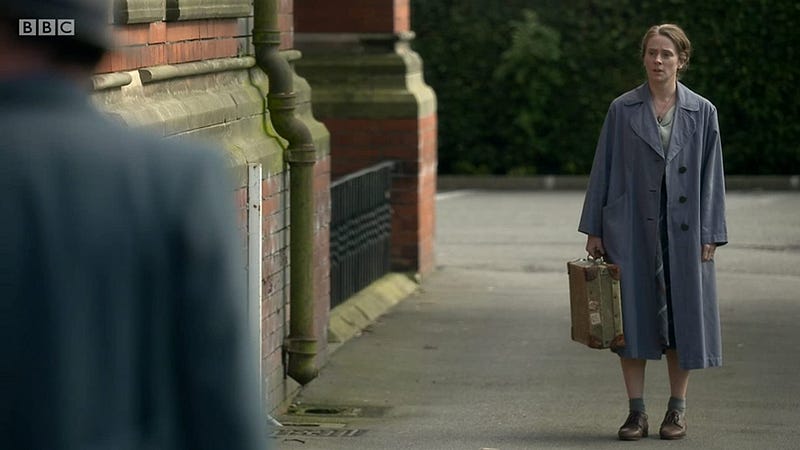
Mrs Evans, to her husband’s annoyance, returns to the convent. He had told her to stay with her mother in Cheltenham. Mr Evans, continually treating his wife as property, feels the need to direct her every move. It doesn’t take long for the police inspector to notice how Mr Evans treats his wife.
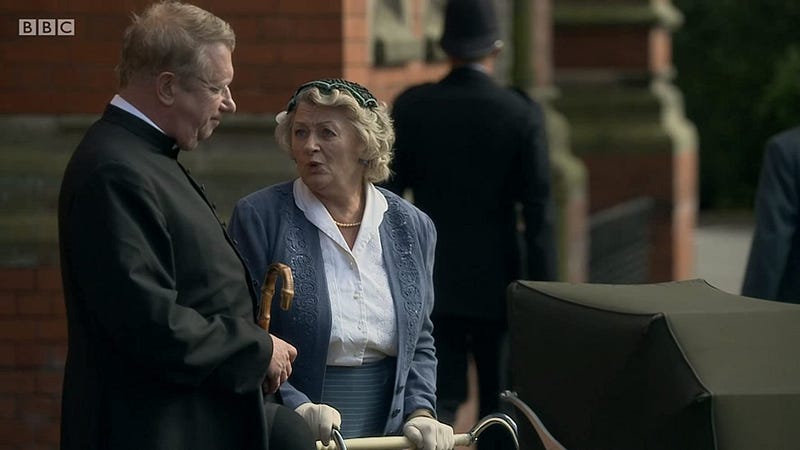
The first time we see Mrs Bridgette McCarthy (Sorcha Cusack) in this episode, she’s pushing a pram. Mrs McCarthy, rarely a loss for words, is in the company of her goddaughter Abigail (Hebrew for beautiful). Consequently, because of this, Mrs McCarthy is seemingly less inclined to speak her mind. Who knew there was a mute button on this motor-mouth?
Elsewhere, with policemen searching Sister Paul’s office, Inspector Valentine finds an open bottle of wine. He wonders whether she was a secret lush. Sgt Albright (Keith Osborn) locates the missing bottle of Potassium ferrocyanide.
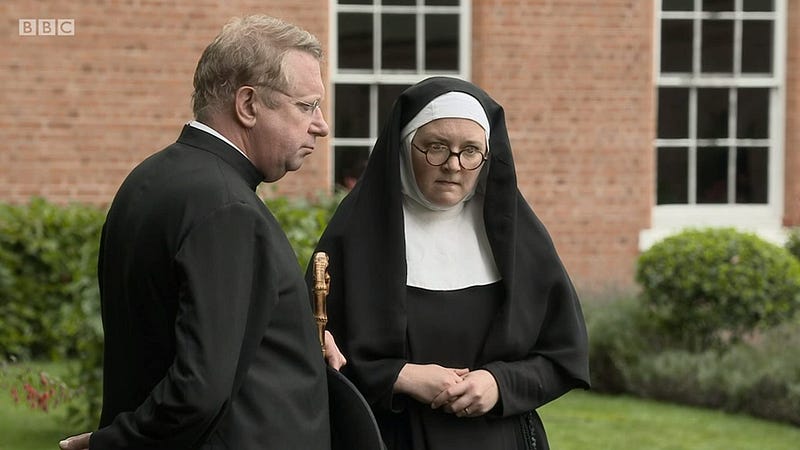
Meanwhile, somewhere in the shrubbery, Sister Boniface is discovered by Father Brown digging around for potential clues. Sister Boniface, when asked what she’s doing, reminds Father Brown that it is commonly known “murderers returns to the scene of the crime.” The Catholic priest momentarily questions whether this comment is meant as a “confession.” He soon realises what she means.
“Sister Paul was in full sight for ten minutes before she died,” Sister Boniface tells Father Brown, “giving Sister Ignatius a record tongue lashing by all accounts. But like Sister Mary Magdalene, the police found nothing to explain how she ingested the poison.”
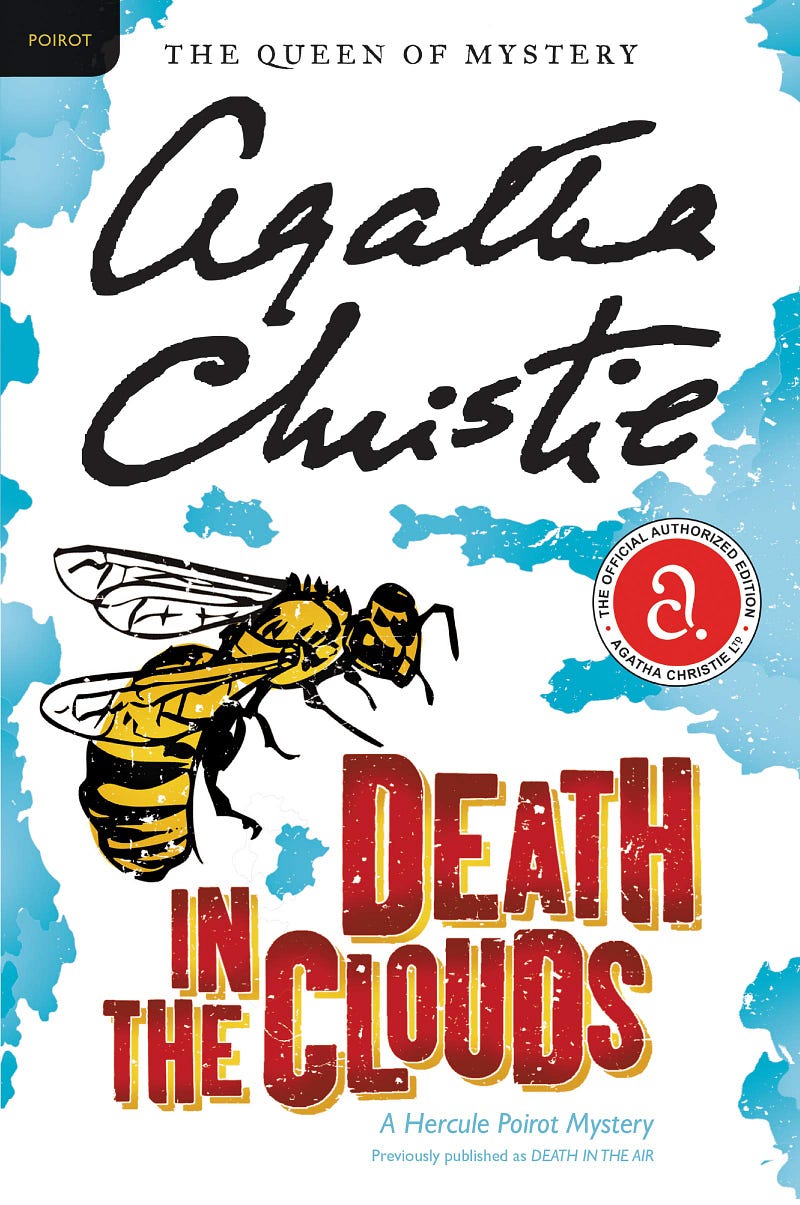
It is here that Sister Boniface references Agatha Christie’s Death In The Clouds. Death In The Clouds, first published in 1935, features a character named Madame Giselle. She was murdered with a poisoned thorn. The thorn was dipped, as Father Brown correctly recalls, “in the venom of a South African boomslang snake.”
The South African boomslang snake is not a creature one is not likely to find in the Cotswolds.
Father Brown, as everyone familiar with the series knows, loves a mystery. He informs Sister Boniface that Inspector Valentine would very much appreciate it if she could make an identification. Sister Boniface confirms to the police inspector that the items found in Sister Paul’s office were the ones missing from the winery.
Inspector Valentine tries to come up with a plausible reason for Sister Paul having been the murderer. He fails to account for certain salient facts which are obvious to both Father Brown and Sister Boniface. Whilst it is Inspector Valentine that is the professional detective, noting how the Catholic priest and nun are much better sleuths, he might want to consider leaving the investigative work to them. That’s not going to happen.
The next time we see Mrs McCarthy, because Father Brown has awoken Abigail from her nap, she’s annoyed with the Catholic priest. Father Brown wasn’t as much interested in meeting with Mrs McCarthy as he was seeing if there was anything he could do for Mrs Evans. Mrs McCarthy was at the Evans residence when Father Brown arrived. Mrs Evans assures Father Brown there is nothing she needs him to do for her.
When Mr Evans arrives home, not happy to see either Father Brown or Mrs McCarthy, his facial expression suggests a modicum of concern. Mrs Evans is holding Abigail when Mr Evans enters the house. Mr Evans, a lapsed Catholic, has no interest in Father Brown’s opinions or beliefs. The tension in the air could be cut with a butter knife.
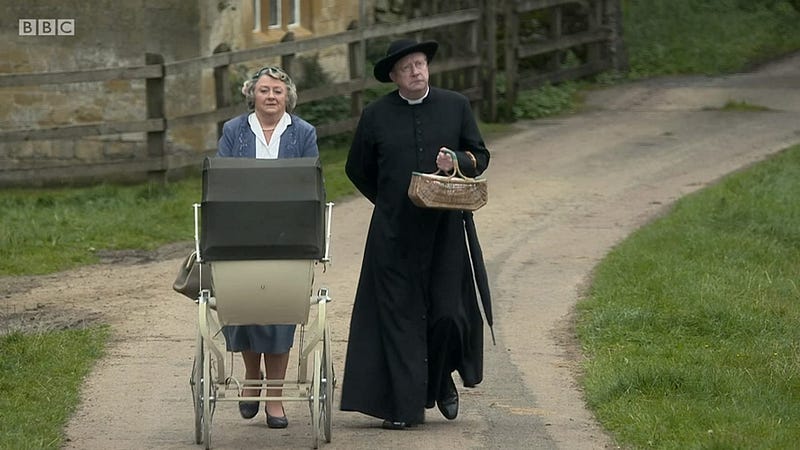
Mrs McCarthy, as series fans will know, has annoying habit of insisting she is no gossip. It is always the ones spouting their inability to gossip that typically spread the most rumours. Mrs McCarthy is no exception. When will Mrs McCarthy stop lying to herself? Maybe it will come when she remembers that Saint Paul lumps gossipers with murderers and G-d haters.
This is possibly one of only a few episodes where we see very little of Mrs McCarthy. Not seeing her at all, mainly because of her archaic attitude towards life, would be much more preferable. I guess, with the series set in the 1950’s, Mrs McCarthy seems to have a get out of jail free card.
It’s incredible how Mrs McCarthy states she’s not one to gossip and then immediately gossips about how Lady Felicia Montague’s (Nancy Carroll) cousin, Lord Compton, had to let Mr Evans go on account of “trouble” with the housemaids, the scullery maids, and the dairy maids. Is there any woman Mr Evans didn’t want to shag? It sounds like his own wife isn’t getting any.
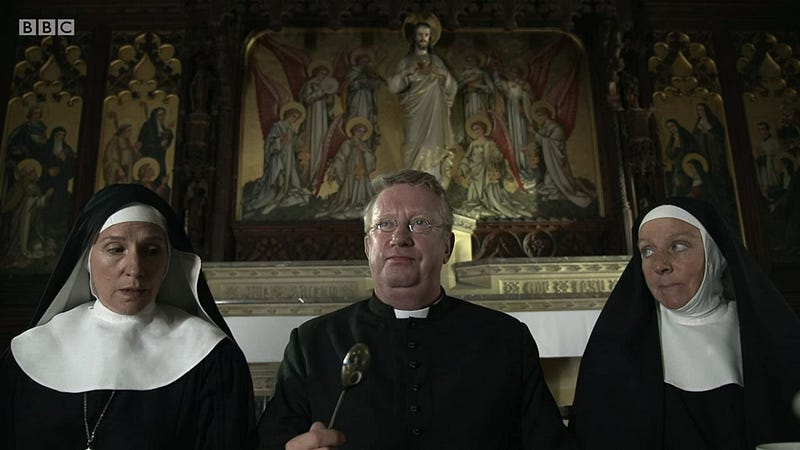
Settling down to a meal with the nuns at the convent, as they prepare to eat, Father Brown finds himself surrounded by nervous individuals. They are naturally concerned the food might be poisoned. Father Brown settles everyone’s nerves by taking the first bite. They discuss Sister Paul and how the novices intensely disliked her.
“She, Reverend Mother Augustine referring to Sister Paul, “found our postulants lacking in the humility of their sub-continent counterparts.”
Sister Gregory’s reference to Sister Paul always sucking on pear drops makes a lot of sense. It was to mask the alcohol on her breath. Father Brown is curious as to where Sister Paul was before her stint in Calcutta. Whilst Sister Gregory hasn’t a clue as to where Sister Paul was before Calcutta, noting Reverend Mother Augustine’s facial expression, it looks like she might have a few answers the Catholic priest would like to hear.
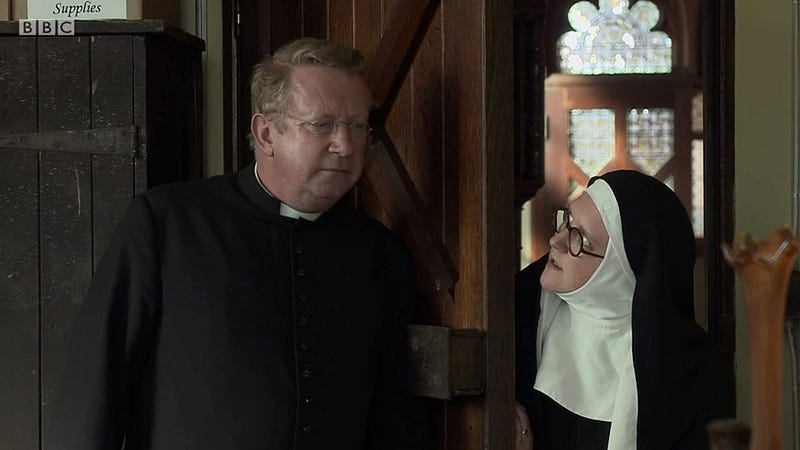
Later, after the meal, Father Brown discovers Sister Boniface snooping in Sister Paul’s office. Both of them had obviously arrived at the same conclusion and needed facts supporting their respective beliefs.
Sister Paul liked things spit spot, squared away, it surpassed military precision. Father Brown, having noticed an error in labelling , directs Sister Boniface’s attention to a picture of the shrine at Lourdes. It is mislabelled as Gloucester’s St Bridget’s Moral Welfare. Not surprisingly, it doesn’t take long for Father Brown to pay a visit to the establishment.
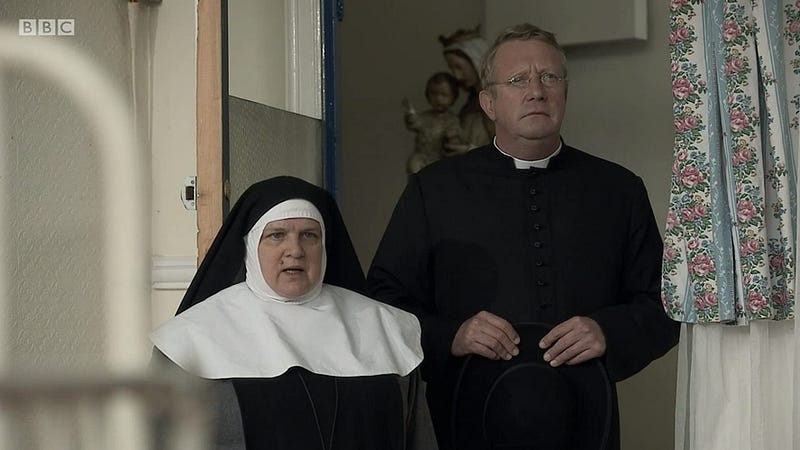
Sister Thomas Aquinas (Jenny Galloway) blames the war, not least for the Americans, for how more and more parishioners are requiring the facility’s discrete services. The American so-called youth culture and Devil’s music doesn’t sit well with Sister Thomas. Father Brown, knowing how Mrs McCarthy doesn’t like to gossip, wasn’t surprised to find it was her that delivered the news from St Agnes to Sister Thomas’ ears.
The reference to Sister Paul having been “warden” at St Bridget’s Moral Welfare makes it sound more like a prison than a religious institution. Father Brown’s lack of surprise at the use of the title warden, remembering how much of a disciplinarian Sister Paul was, is expected. Even though Sister Thomas refers to Sister Paul has having been “a fine woman,” recalling how the novices disliked her, the word “fine” doesn’t enter the conversation.
Sister Thomas believes G-d sent Saint Joseph to Mary so that he could make an honest woman of her. This phrasing, to anyone living in the early twenty-first century, might sound a tad old fashioned.
When Sister Thomas asks Father Brown if he was impressed by the facility, noting his response, she might have completely misinterpreted his meaning. He said that he’s “yet to see a ship more tightly run than this.”
Whilst waiting for the warden to return, noting Father Brown’s typical behaviour, he takes a moment to look through a few files. There he discovers a piece of information which points him towards possible murderers.
Staring at a framed photograph, when Sister Thomas returns, Father Brown tells her that he sees a familiar face. Whilst he doesn’t go into detail, the comment leaves the warden perplexed.
Meanwhile, at the convent, Sister Boniface observes Reverend Mother Augustine give Mr Evans a box filled with personal documents to burn. What could the Reverend Mother want the gardener to burn?
Sister Boniface, after Mr Evans leaves the fire, takes a closer look at it and finds a a half burned photograph on the ground. There is enough of the image remaining for her to see there is at least one person she knows personally. Sister Boniface calls Mrs McCarthy and asks her to relay a message to Father Brown.
Reverend Mother Augustine discovers Sister Boniface searching Sister Paul’s office. When asked why she isn’t at vespers, a service of evening prayer, Sister Boniface tells the Reverend Mother that she lost her rosary. Sister Boniface finds the carbon sheet still on the floor from earlier that day and pockets it before Reverend Mother Augustine can see it.
The Reverend Mother suggests to Sister Boniface that she give thanks to St Anthony when in vespers. St Anthony, as I recall from my religious education classes, is the the finder of lost things. As well as being the saint of small request, St Anthony is also known as the patron saint of the illiterate and the poor.
Instead of attending vespers, as we should have known Sister Boniface was not going to do, we find her copying the writing found on the carbon paper.
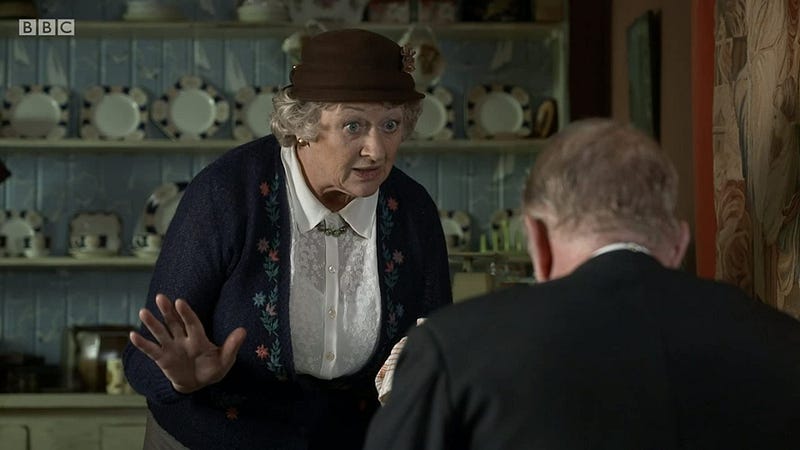
Father Brown, confronted with a plate consisting of three slices of spam, three boiled potatoes, and a tomato, is grateful to see Mrs McCarthy with a more substantive meal prepared for his enjoyment.
Even though Mrs McCarthy believes Sister Thomas Aquinas provides a fine service, Father Brown finds the establishment unsettling because he feels the separation of mothers and their children defies nature.
The Catholic priest believes it would be surely better if society found ways of keeping them together. Mrs McCarthy, adamant those girls are moral degenerates, tells Father Brown they are unsuitable to bring up good Catholic children. Someone should tell Mrs McCarthy not everyone is Catholic.
Elsewhere, at the convent, Sister Boniface examines the photograph she retrieved from near the fire. She is certain there is at least one person in the image she recognises. The sound of someone walking about distracts her from the image. As she investigates the sound, something Sister Boniface is prone to doing, she is pushed down a flight of stairs.
The following morning, we find Mrs McCarthy at the village store collecting provisions for the convent. Mrs McCarthy correctly observes Sister Paul, with her having been murdered, will not be needing her pear drops. Father Brown purchases for himself a quarter of a pound of pear drops. Whilst pear drops are nice, my personal preference is a nice lemon drop.
Meanwhile, at the convent, we see policemen charging around like bulls in a china shop. Inspector Valentine and his policemen are looking for Mr Evans because they believe him responsible for killing Sisters Mary Magdalene and Paul.
Father Brown, on his way to the convert, is told by Inspector Valentine that Sister Boniface was attacked the previous night. When the Catholic priest enquires as to her health, noting Inspector Valentine annoyance, the police inspector states she’s voluble as ever.
The police inspector points to Mr Evans having a criminal record. Three counts of soliciting, as Father Brown sees it, doesn’t make Mr Evans a murderer. Whilst that might be true, it does make him quite the ladies man.
Inspector Valentine wonders where Father Brown knows something he is yet to learn. When doesn’t Father Brown know something the police inspector doesn’t?
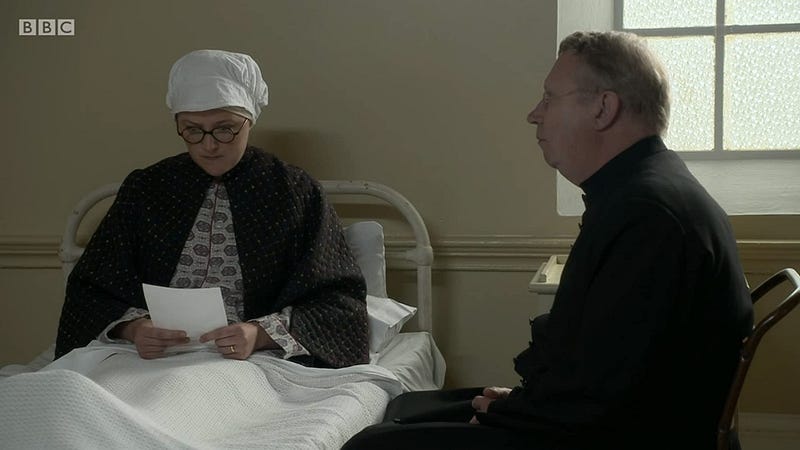
When Father Brown meets with Sister Boniface, she tells him of what she discovered. She reads from the transcribed letter: One in particular, who has hidden her heinous character, and concealed transgressions of so serious a nature that I can only assume the diocese has no knowledge of them.
The photograph has been taken. Father Brown notes that all paths, except for Sister Mary Magdalene, lead directly to Sister Paul. Sister Mary Magdalene, according to Sister Boniface, was in Sister Paul’s office five minutes before she died. This is where Father Brown connects a few of the missing dots. Sister Mary Magdalene had been known to fain in mass.
Sister Mary Magdalene must have taken one of Sister Paul’s pear drops because of her low blood sugar. Sister Paul, not Sister Mary Magdalene, was the intended target.
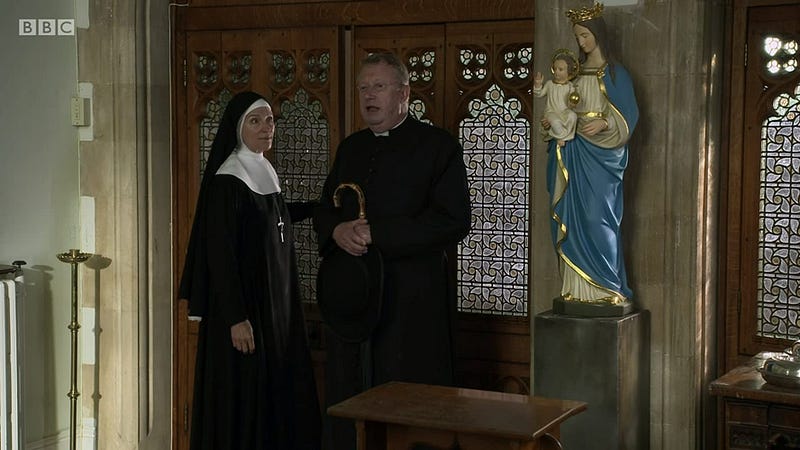
Father Brown informs Reverend Mother Augustine that he went to Gloucester’s St Bridget’s Moral Welfare the previous day and spoke with Sister Thomas. The Catholic priest confronts the Reverend Mother about her having been at St Bridget’s when Sister Paul was warden.
Even though she didn’t deny it, noting Father Brown’s response, she didn’t draw attention to it either. Father Brown wonders why it is a woman of her integrity would do such a thing. It is here that Sister Gregory arrives and defends Reverend Mother Augustine. The Reverend Mother believes herself an adulteress. She has since confessed her sin and made atonement.
Sister Gregory reveals, even though she was tempted to kill Sister Paul, she wasn’t the one responsible for the deaths. She admits to stealing the letter. Sister Gregory wasn’t prepared to stand by and watch Sister Paul ruin Reverend Mother Augustine and St Agnes.
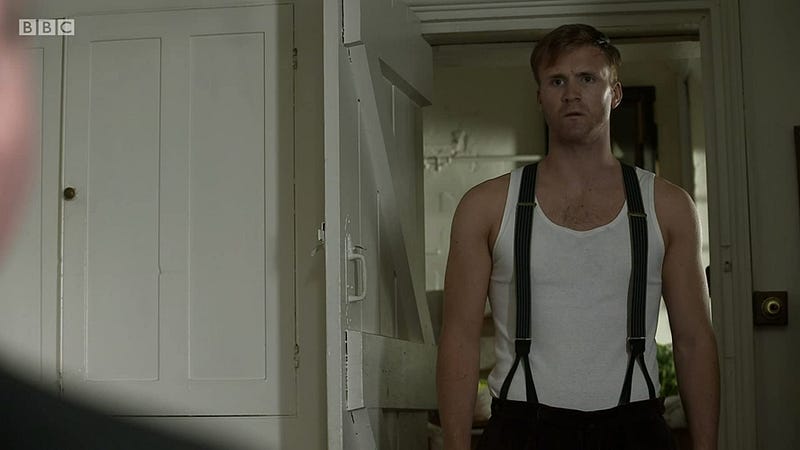
Realising the truth of the matter, something that had been staring him in the face the entire time, Father Brown confronts the Evans about their involvement in the murders.
Father Brown tells Mr Evans that the police are looking for him because they believe he attacked Sister Boniface. Mr Evans doesn’t believe himself answerable to either Father Brown or his G-d. Mrs Evans tells Father Brown that her husband was with a woman because she gives him what she doesn’t. Father Brown believes Mr Evans. He sees a man trying to protect his wife.
Whilst Father Brown acknowledges Mrs Evans never goes to the convent, she does do the sisters’ shopping in the village. It is difficult, mainly because he makes such a show of it, not noticing Father Brown pull his bag of pear drops from his pocket. Even though he purchased the pear drops himself, Mr Evans not knowing this, the Catholic priest tells her that he liberated them from Sister Paul’s horde.
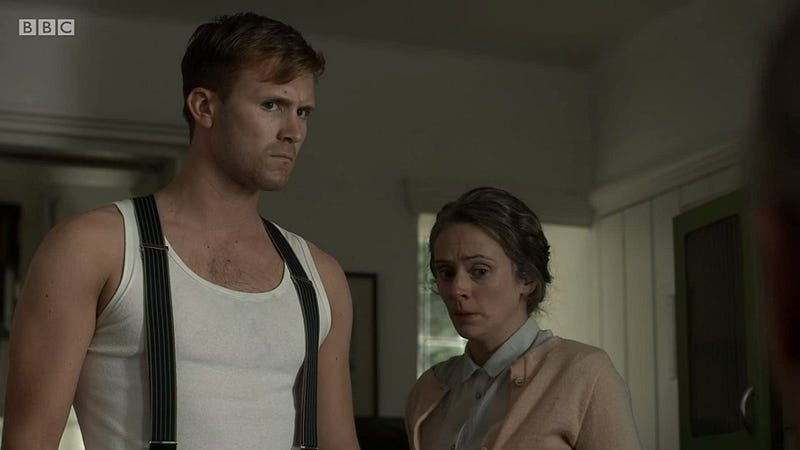
There are red pear drops and there are yellow ones. Like Father Brown, when I was growing up, I couldn’t tell the difference between them because they both tasted the same. The only difference was the colour. Before Father Brown could drop one into his mouth, Mrs Evans knocked it from his hand.
Mrs Evans killed Sister Paul because of what she did to her when she was at St Bridget’s. She was forced to sign over her parental rights to her newborn son. Father Brown had the documentation he took from St Bridget’s. Mr Evens burns the evidence. Inspector Valentine arrives and takes Mr Evans into custody. Questions must be addressed.
Elsewhere, Mrs McCarthy finds Abigail missing from the pram. She tells Father Brown that the baby has been taken. The sound of a baby screaming can be heard. Father Brown and Mrs McCarthy follow the sounds.
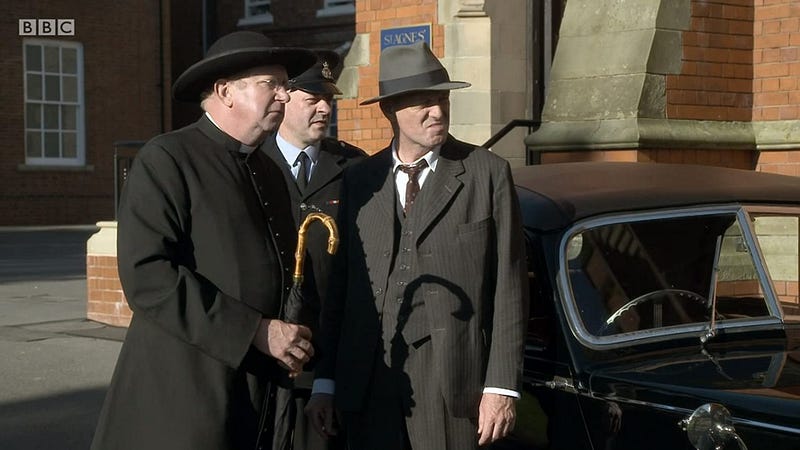
Mrs Evans took the baby because she believed it was her son. This baby, as Mrs McCarthy keeps reminding us, is actually a girl. Father Brown retrieves the baby from Mrs Evans. Mrs Evans is arrested for the murders of Sisters Mary Magdalene and Paul. In many ways, acknowledging the similarities in their stories both Mrs Evans and Reverend Mother Augustine paid terrible prices for a single act of love.
The Reverend Mother wants Father Brown to allow her to inform Bishop Talbot (Malcolm Storry) herself. he denies the request because he wants her to remain at the convert. Father Brown believes St Agnes’ convent has been through enough without losing the rock that is its foundation.
Sister Boniface begins to realise that true crimes, real life murder mysteries, are nothing at all like the ones depicted in Miss Christie’s novels.
Side Note …
People interested in seeing more of Sister Boniface, even though we only saw her in this one Father Brown episode, should be aware The Sister Boniface Mysteries has been commissioned. The Sister Boniface Mysteries, set in the 1960’s, could possibly feature characters that were introduced in Father Brown.
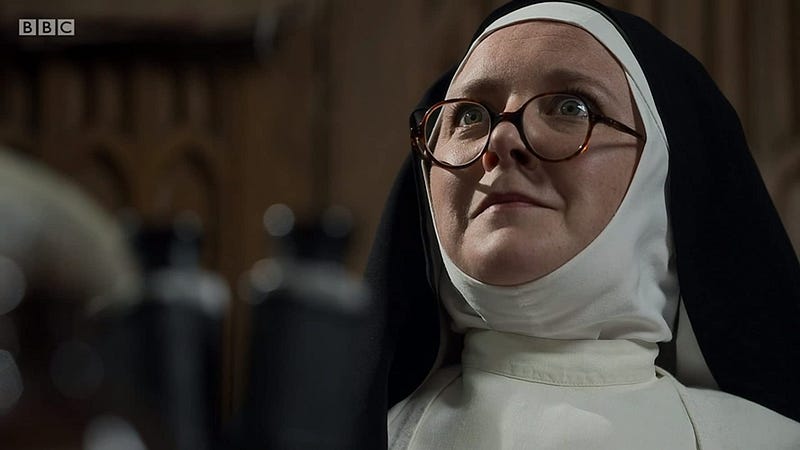
Created by Jude Tindall, The Sister Boniface Mysteries will follow the sleuthing nun as she uses advanced techniques for tracking down killers. Tindall, further to Father Brown, has also written teleplays for Land Girls, Doctors, Casualty, and Shakespeare & Hathaway: Private Investigators.