
British Network Television
‘Father Brown’: S01.E03. “The Wrong Shape”
A poet apparently hangs himself in his locked conservatory.
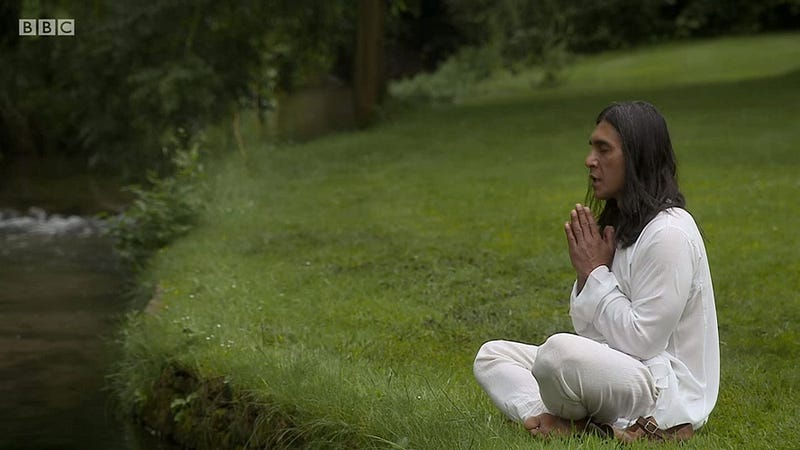
The third episode opens with a scene of Umesh Varma (Ramon Tikaram) running frantically running towards a house. When it comes to Father Brown episodes, something fans can testify to most sincerely, this can never be a good sign. Umesh is convinced his employer, former Doctor Leonard Quinton (Robert Cavanah), will meet with his death. This is where, as most episodes do, cuts to the opening credits.
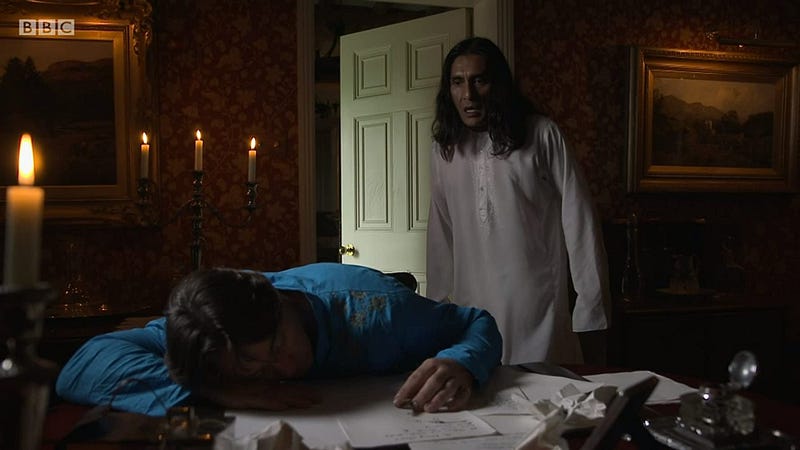
The teasers for Father Brown episodes, frequently brief, give us a modicum of information. Despite the crumbs we are given, something indicative of great teasers, it successfully makes us want to watch the instalment beyond the opening credits.
When we return to the episode, post-opening credits, it very much sounds like someone in Father Brown’s (Mark Williams) church is trying to strangle a cat. There is a woman seated at the church organ. Whilst she’s making a valiant effort to rehearse a hymn for the coming Sunday service, she’d have more success flogging a dead horse.
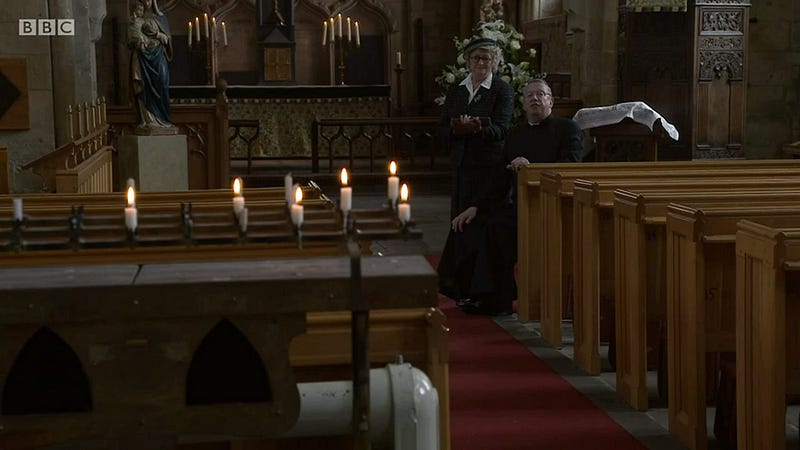
The reaction from both Mrs Bridgette McCarthy (Sorcha Cusack) and Father Brown a less than thrilled anticipation towards hearing the singer’s performance. Father Brown thanks the woman for her efforts.
As the woman leaves the church, with Father Brown not wanting to hear any more from her, we find Lady Felicia Montague (Nancy Carroll) entering. Father Brown greets Lady Felicia. Lady Felicia, even though Mrs McCarthy correctly observes Father Brown is in the middle of auditions, has an invitation to a poetry recycle.
Father Brown, based on the previous offering, is sure the auditions can wait. He’s not wrong. There is terrible and then there is deplorable. It isn’t easy determining where any of them fall on this particular scale.
Mrs McCarthy initially believes that Father Brown’s invitation came from one of Lady Felicia’s “highfalutin cronies.” Her tone and metaphorical tune quickly changes when she discovers the individual’s identity is a Mr Quinton. It’s almost as if Mrs McCarthy has a personal interest in Mr Quinton that surpasses mere admiration.
On route to Mr Quinton’s residence, seated next to Mrs McCarthy in the passenger compartment, Father Brown asks of Lady Felicia if she knows the reason his attendance is required. Lady Felicia states Mr Quinton is “a peculiar man of very few words.” Not wanting to spread gossip, innuendo, or malicious rumour, Mrs McCarthy reveals there has been talk of their host having “lost his marbles.”
Anyone familiar with the series, even though this is only the third episode, will know Mrs McCarthy is an accomplished gossiper. There is nothing Mrs McCarthy likes to do more than tittle-tattle with her friends about village rumours.
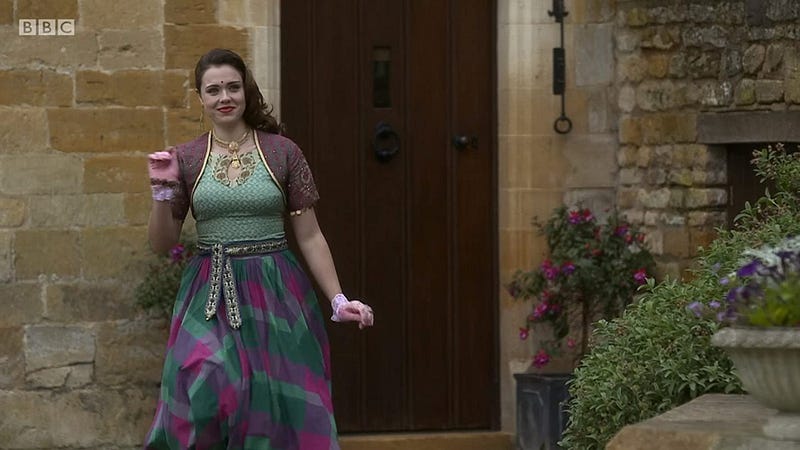
The trio, on their arrival, is greeted by a young woman attired in traditional Hindu clothing. Mrs McCarthy correctly observes Violet Parnassus (Jennie Jacques) is young. Despite the church secretary’s observation being accurate, something which alludes to her conservative values, there could be a modicum of jealousy behind her words.
It’s the 1950’s. Mrs McCarthy quintessentially reflects values typically of the period typically held by village residents. Mrs McCarthy isn’t not accustomed to the multicultural aspects of life that comes with city-living. She doesn’t visit big cities all that often and when she does, noting how she usually wants to get home almost as soon as she’s arrived, Mrs McCarthy isn’t there very long.
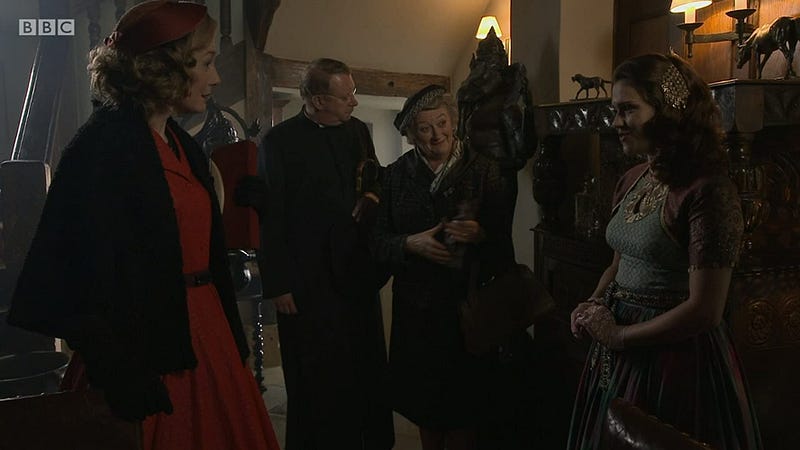
Miss Parnassus’ comment about Lady Felicia’s clothing being a “Christian Dior” design and her being “mature women” goes unaddressed. It is here that Mr Harris (Simon Thorp), the family solicitor, makes his presence felt.
The solicitor takes an obvious tone with Lady Felicia which suggests, even though he has worked for her husband in the past, he doesn’t care for the aristocracy. Mr Harris’ recognising how Lady Felicia would rather live off the spoils attained from her husband’s business affairs isn’t completely unregistered by all present.
Recognising a certain chill in the air, addressing Miss Parnassus as Mrs Quinton, Mrs McCarthy comments on the home being “delightful.” Miss Parnassus, correcting Mrs McCarthy’s error, tells the visitor she isn’t yet married to Mr Quinton. The tone Mr Harris takes, when out of earshot of Miss Parnassus, reflects something Mrs McCarthy would say to her friends in confidence. Miss Parnassus, rather than being his wife, is Mr Quinton’s mistress.
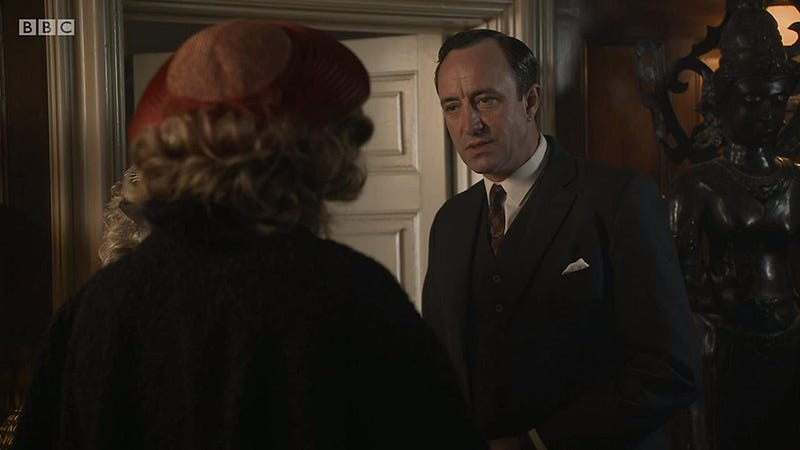
Mr Harris, despite working for Mr Quinton, finds both his employer and Miss Parnassus equally “insufferable.” Lady Felicia, not being wrong, considers the entire arrangement “very French.” This is not the way an English gentleman, based on Lady Felicia’s tone, would behave.
Shortly thereafter, following Miss Parnassus into the next room, Father Brown and Mrs McCarthy finally get to meet Mr Quinton, his wife Martha Quinton (Ruth Gemmell), and their cat.
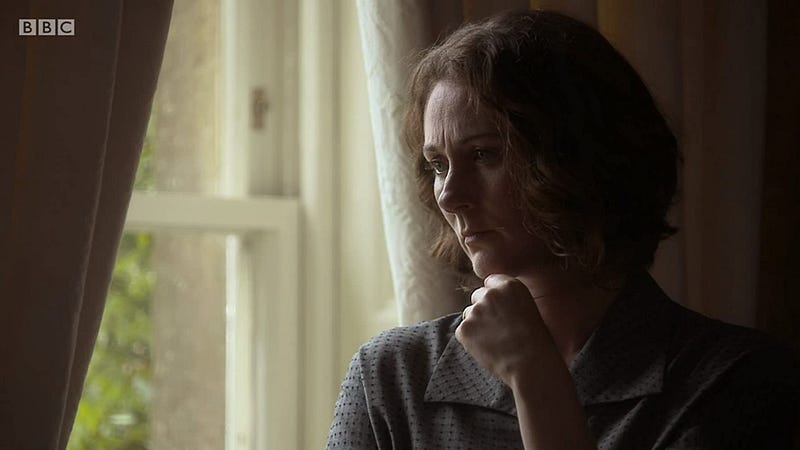
Mr Quinton’s reference to his “domestic arrangements” seeming “a little odd” is the understatement of the year. Whilst he insists the arrangements “are mutually agreeable,” noting Mrs Quinton’s facial expression, there is something in her sneer which suggests a difference of opinion.
Father Brown, noting how Mr Quinton looks East for spiritual guidance, is curious why it is he would be invited to the residence. The Catholic priest also notes that he’s not exactly known for is literary prowess. Whilst both of these observations are correct, noting there is more to him than meets the eye, something Father Brown can’t deny is his ability to solve a good mystery.
It turns out Mrs Quinton is Catholic and, because of this, possesses a distinctly different perspective on life to her husband. Mr Quinton, despite his hesitance to reveal any pertinent information to Father Brown, is concerned that something untoward might happen.
Mr Quinton requests of Father Brown that he look after his wife if anything should happen to him. Father Brown’s questions, even though they are more than warranted, go unanswered. The poetry recycle begins.
Miss Parnassus recites a provocative poem with makes certain people feel a tad uncomfortable:
Entwined in the long grass,
sun freckling buttocks,
The last thing on our minds
are priests in cassocks.
My pulse races
as he traces his finger
‘cross creamy white skin,
with a lovely linger.
’Twas as if we were otters,
frolicking as hot as
a great ball of fire
in the wet sand.
Oh, yes!
YES!
I cry to the skies
with quivering thighs.
It doesn’t seem wise
to dwell on the lies.
But my heart goes cold,
and I can’t help but fidget,
As the band of gold I spy
wrapped around his digit.
Alas! Alack!
There’s no going back.
Till she loosen the noose
and cut him loose.
Forever.
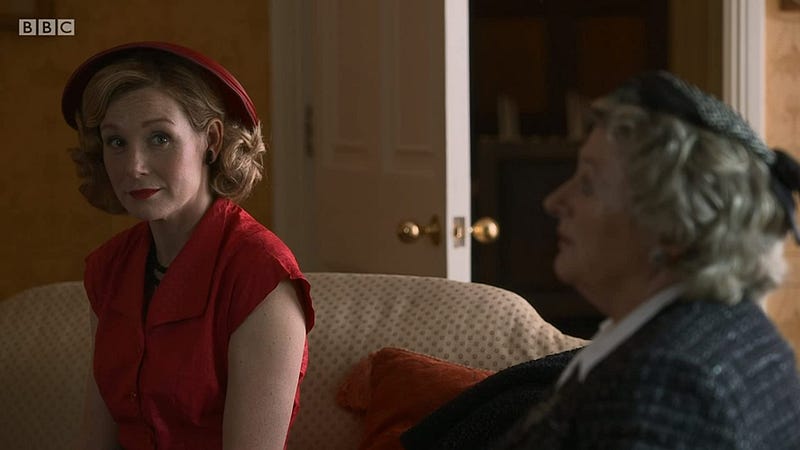
As the poetry recycle continues, it becomes increasingly obvious from Mrs Quinton that her mind is elsewhere. Her husband is far more interested in entertaining the guests than he is with attending to his wife’s needs.
As Mr Quinton recites his poem, something which Father Brown correctly notes as he gauges the room, tension increases significantly. Whilst the inspiration for Miss Parnassus’ poem is Mr Quinton leaving his wife for her, recognising the words he uses, it becomes evident he might have had second thoughts.
The tone of this second poem clearly suggests a desire to remain with his wife rather than be married to Miss Parnassus. Everyone in the room, especially Miss Parnassus, recognises the direction Mr Quinton is going with his words.
It slithers out white,
sticky.
Lump meets stump.
Blood thumping, pumping.
Bone against bone.
Howls crunching.
Retch.
If I could.
If I hadn’t.
If you were.
Hands.
No, feet.
Clasping air.
Gasp in pain.
Unfurled.
Horror swaddled in twisted
crimson ribbons.
Vomiting love.
Self-pity.
Shame.
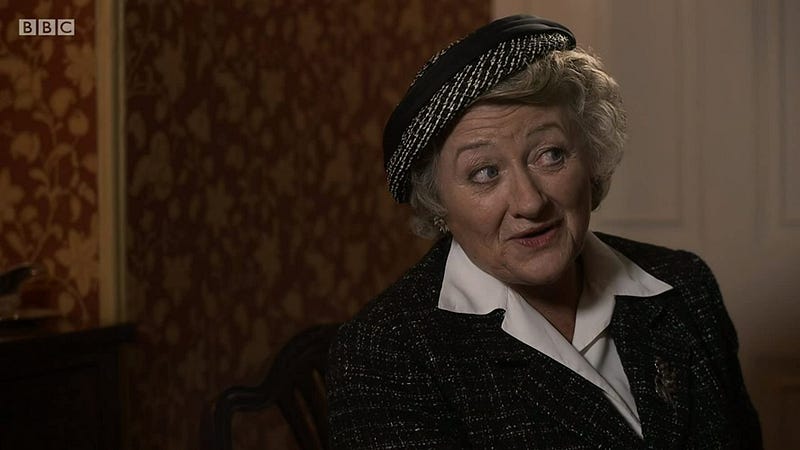
Mr Quinton’s words, causing Mrs Quinton to become emotionally overwhelmed, results in her horridly exiting the room. Mrs McCarthy is disgusted that they were invited to witness such a sceptical. Lady Felicia, not backwards with her words, correctly recognises they “weren’t all invited.”
Lady Felicia has a point. When she arrived at the church earlier that day, Lady Felicia referenced an invitation had been extended to Father Brown to attend the poetry recycle. There was no mention of Mrs McCarthy also being invited.
The guests are drawn to a covered painting which, according to Miss Parnassus, can’t be viewed until Mr Quinton is ready to show it. The piece, an oil on canvas, is initially reported as a nude portrait of Miss Parnassus.
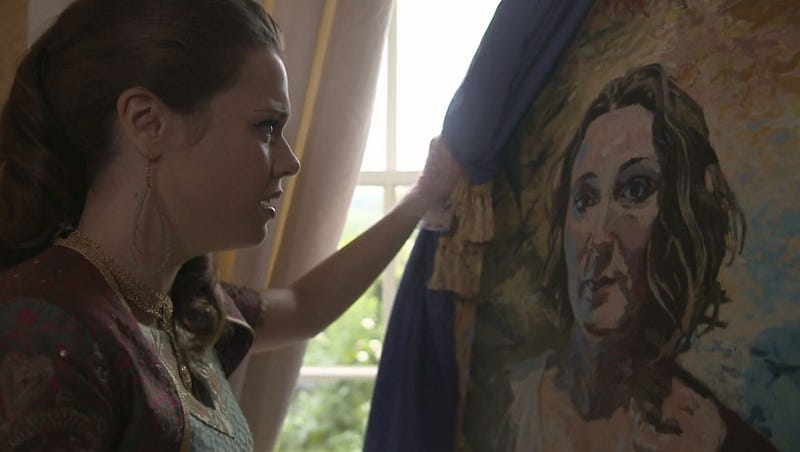
Later in the episode, whilst the guests wonder around the garden, Miss Parnassus takes a moment to sneak a peek at the portrait. Miss Parnassus, not the subject of the painting, comes face to face with a portrait of Mrs Quinton.
When Mrs Quinton returns, noting how her husband is feeling “out of sorts,” she kindly asks Mr Harris to take their guests on a stroll in the garden. Mr Harris complies with the request.
Father Brown’s reaction to not being allowed to see Mr Quinton suggests a certain unease with the entire situation. Despite Father Brown wanting to see Mr Quinton, because Mrs Quinton refuses to allow it, the Catholic priest heads to the garden with the other guests.
It is in the garden that we learn, from his tone, Mr Harris has no time for foreigners. Mr Harris believes, despite Mrs Quinton calling him the gardener and Mr Quinton referring to him as his spiritual advisor, Mr Varma is “a fake and extortionist.” There is nothing to suggest that the solicitor has ever thought to venture outside the United kingdom. If anything, giving his attitude towards anyone not English, it’s evident he’s a quintessential xenophobe.
During their exploration of the garden, with Mrs McCarthy noticeably taking clippings from various plants, Lady Felicia breaks a heel when she trips over something dead. It’s the cat. Mrs Quinton, according to Mr Harris, never liked the cat. Father Brown, as one could imagine, is far more sympathetic to the cat than Lady Felicia. All she sees is “ears and fleas.”
Father Brown notices a small gravestone in the garden. There are curiously no words on the white grave marker. The size of the marker, possible for a baby, is indicative of one used for a child.
Meanwhile, back at the house, we find Miss Parnassus confronting Mr Quinton about the painting. She’s angry the portrait is of Mrs Quinton rather than herself. Miss Parnassus comes to realise Mr Quinton is never going to leave his wife. Their headed one-way conversation is overheard by Mr Harris. He had returned to the house to find a first aid kit to tend to Lady Felicia’s ankle.
Father Brown and Mrs McCarthy are assisting Lady Felicia walk back to the house when Mr Harris returns with the first aid kit. It is there that Lady Felicia, focusing on something dreadful in the conservatory, sees Mr Quinton hanging. After Mr Harris breaks into the conservatory, with the use of Mrs McCarthy’s garden sheers, Father Brown cuts the now dead Mr Quinton down. Mrs Quinton directs Mr Varma to call the police.
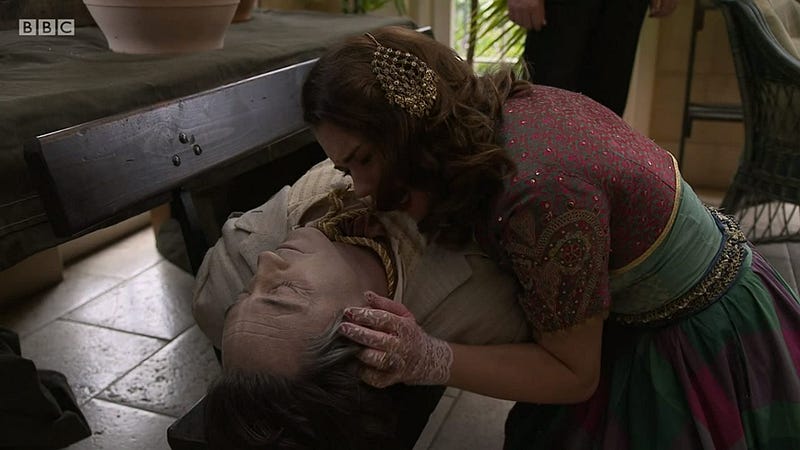
Whilst Miss Parnassus is overwhelmed with grief, noting the juxtaposition with Mrs Quinton’s stone cold expression, the two women couldn’t be emotionally further apart. Naturally, with what we know of Father Brown, it shouldn’t surprise anyone he’s always making observations. He doesn’t always immediately share what he thinks with everyone.
When Inspector Valentine (Hugo Speer) shows up at the house, with Sergeant Albright (Keith Osborn) accompanying him, the police inspector isn’t surprised to find Father Brown on the scene with his usual friends. A potential suicide note, reading “I die by my own hand,” is discovered by Lady Felicia. There is something in Father Brown’s facial expression which suggests he believes a murderer is at large.
There is a humorus exchange of words between Mrs McCarthy and Lady Felicia, after leaving the police inspector in the conservatory, where we find the women enjoying a spot of tea. Lady Felicia criticises how the oolong tea is made. Mrs McCarthy correctly notes, with Lady Felicia being an aristocrat, she has probably never set foot in a kitchen or made for herself a pot of tea.
After examining a quill on Mr Quinton’s study desk, after using the writing implement, Father Brown’s attention is immediately drawn to the quill’s nib. Keeping his suspicions to himself, something we have come to expect of Father Brown, the Catholic priest ponders speaking with Mr Varma before taking his theories to the police inspector. Mrs McCarthy, before Father Brown heads off to speak with Mr Varma, is directed to bring everyone to the drawing room.
When Father Brown speaks with Mr Varma, noting his loyalty to Mr Quinton, he is hesitant to address questions the Catholic priest puts to him about the family’s history. Mr Varma is momentarily surprised Father Brown could know anything of Mr Quinton and his sorrows. Referencing the grave marker in the garden, one that bears no name, Father Brown inquires where Mr and Mrs Quinton lost a child. Mr Varma, as the tension in the room clearly becomes more heated, refuses to discus the matter with Father Brown.
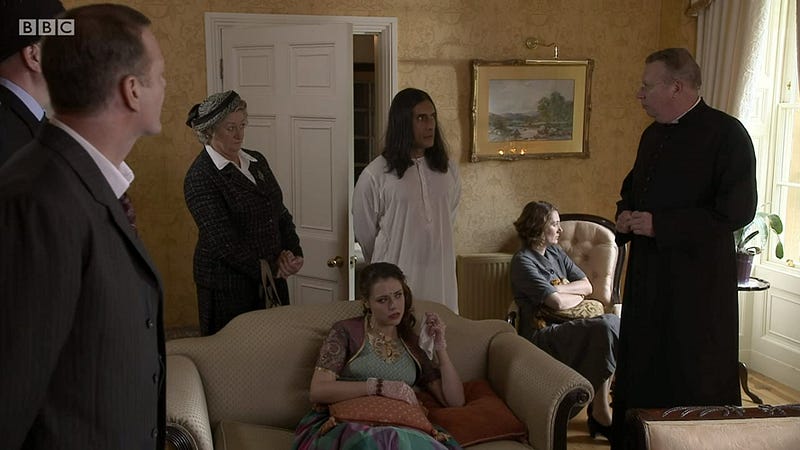
By the time Father Brown returns to the drawing room, Mrs McCarthy has gathered everyone together. Miss Parnassus speaks of Mrs Quinton with clear disdain for her lack of emotional expression.
Whilst Mr Harris correctly notes “some people are simply able to keep their emotions in check,” there is a distinct difference between keeping one’s cool and being emotionally stunted. The English, from many perspectives, are renowned for being overly reserved in many matters.
Inspector Valentine, not one to waist time over trivialities, insists that Father Brown get to the point. This prompts Father Brown to reveal what he has learned thus far in his unofficial investigation.
The arrangement of Mr Quinton’s desk points to him having been left-handed. The knot on the robe used to hang Mr Quinton, as the police inspector references, was most likely tied by someone right-handed. It was tied right over left. Consequently, because of these facts, it could only have been a murder.
Both Father Brown and Inspector Valentine, with knowing glances towards each other, seem rather pleased with their deductions. It’s really Father Brown that should receive the praise because it is his observations that points Inspector Valentine in the right direction.
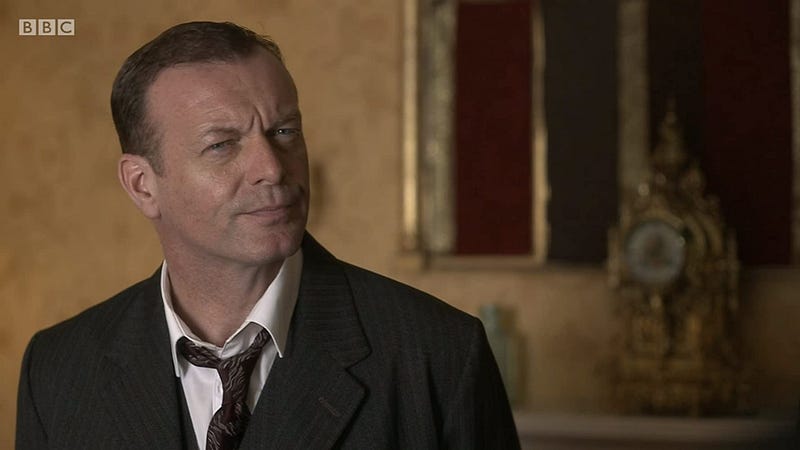
Inspector Valentine, even though he is thankful for Father Brown’s assistance, insists he take the lead on addressing questions to the various suspects. Father Brown, not responding to the police inspector, follows Inspector Valentine’s lead to a point before asking his own questions.
Mr Varma references a vision he had of Mr Quinton’s death. The police inspector doesn’t seem impressed by either Mr Varma or his explanation for his vision. Mr Varma talk about the vision having come to him when he saw an Othalanga in bloom. The Othalanga is apparently also known as the Suicide Tree.
Mr Varma, pointing towards Father Brown as being the most likely person to solve the mystery, suggests the police inspector is incapable of the task. looking at the police inspector, Mr Varma questions where Inspector Valentine believes his words.
Father Brown surprises Mr Varma when he states that he believes there is “normally a rational explanation for the phenomenal.” Mr Varma, in referencing Jesus having apparently walked on water and feeding of thousands with only a little food, questions the integrity of his religious text.
“I also believe the world becomes a very dangerous place,” Father Brown responds, “when we interpret holy scripture too literally.”
Mrs Quinton, obviously uncomfortable with the direction the conversation is heading, chooses to leave the room. With a nod from Inspector Valentine, Father Brown follows Mrs Quinton out of the room.
After Father Brown leaves, even though he really doesn’t understand the various religious references that are made, Inspector Valentine continues to question Mr Varma. This, because of his obviously worldly approach to most things, is probably more of a job for Father Brown. The police inspector arrests Mr Varma on suspicion of having murdered Mr Quinton.
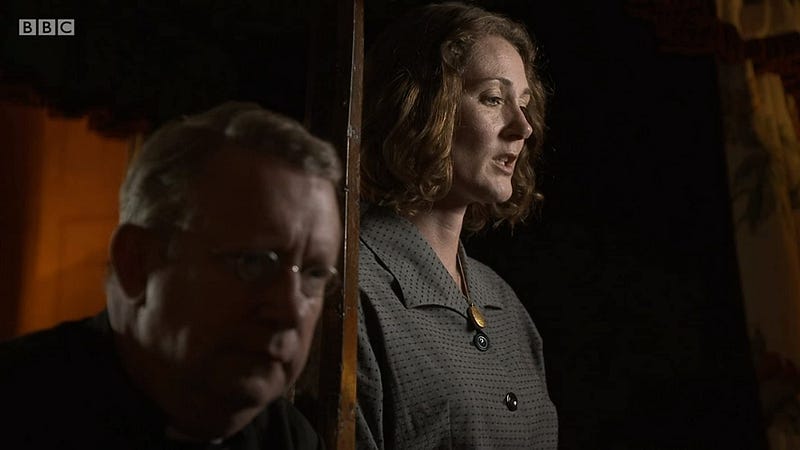
Elsewhere, Father Brown offers Mrs Quinton his “sincerest condolences.” Mrs Quinton, a true Catholic believer, gives her confession to Father Brown. Her previous spiritual confession was more than 16 months earlier.
Mrs Quinton speaks of her daughter, Olivia, having died a year earlier. It was the anniversary of her death. There is a lock of Olivia’s hair in Mrs Quinton locket. There are no photographs of the little girl. Olivia, noting how Mrs Quinton speaks of her as having been handed to her in a blanket, grotesquely deformed with misshaped limbs.
Mr Quinton, unable to face the enormity of the situation, ran off to India before his wife was discharged from hospital. He was away in India for three months before he returned home to the British Isles. Olivia died three hours after Mr Quinton returned from India. Mrs Quinton believes it was almost as if Olivia was waiting for her father to return home so she could finally breathe her last breath. Not once did Mr Quinton speak of Olivia again.
Meanwhile, after conversing with Lady Felicia in a mainly off-camera conversation, Inspector Valentine reverses course on arresting Mr Varma. There is evidence putting into doubt Mr Varma having a motivation for killing Mr Quinton. Lady Felicia apparently recalled Mr Varma, during a speech at a London gala, publicly speaking about his plans to set up a leprosy charity.
Inspector Valentine goes over where everyone was at the time Mr Quinton was murdered. Miss Parnassus, saying she was in the drawing room, lies about her whereabouts. Mr Harris tells the police inspector he overheard part of a heated conversation between Miss Parnassus and Mr Quinton.
Interestingly, whilst it doesn’t take a rocket scientist to figure out, Mr Harris places a huge hole in his own alibi when he reveals he wasn’t with Father Brown, Lady Felicia, and Mrs McCarthy in the garden the entire time. Mr Harris believes it ridiculous he could be considered a suspect because, even though he had no love for Mr Quinton, there was apparently nothing for the solicitor to gain from his employer’s death.
Father Brown rushes back into the drawing room. Needing to know what the botanical name for the othalanga tree is, Father Brown puts the question to Mrs McCarthy. Before Mrs McCarthy can respond, Mr Varma tells the Catholic priest is is Cerbera odollam. Father Brown asks Inspector Valentine if he can take another look at Mr Quinton’s body.
Not having a justifiable reason to deny the request, Father Brown is allowed access to the body. it doesn’t take long for Father Brown to note the presence of a white substance on Mr Quinton’s clothing. The white substance on Mr Quinton’s clothing, a toxic sap, likely came from the so called Suicide Tree.
Seeing which direction the wind is blowing, Mr Harris takes responsibility for killing Mr Quinton. Father Brown, never satisfied with taking anyone’s word for anything, doesn’t believe Mr Harris’ confession. It’s far too neat and tidy for his liking. There is something more to this story.
Even though there are numerous pointers suggesting murder, something which rarely occurs in a Father Brown episode, this one is actually a suicide. Mr Harris was so busy forging a suicide note to throw suspicion off Mrs Quinton that he failed to recognise Mr Quinton was already dead at his own hand. Inspector Valentine still arrests Mr Harris. Mr Harris has only ever been interested in Mrs Quinton.
Mr Harris reveals Mrs Quinton had been stockpiling her sleeping pills. Noting the urgency of the moment, with no time to waist, Father Brown and Inspector Valentine rush to her bedroom. They are just in time to prevent Mrs Quinton from taking her own life.
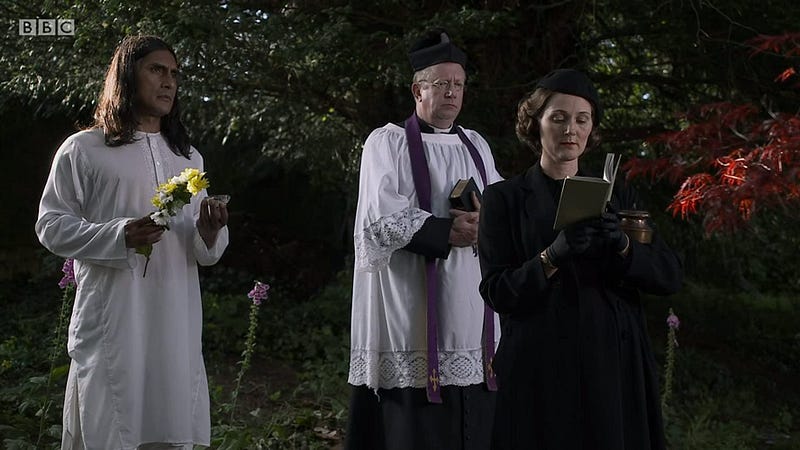
The episode closes, now with writing having been added to the gravestone, with a funeral scene for Olivia.


