
British Network Television
‘Father Brown’: S01.E01. “The Hammer of G-d”
Reverend Wilfred Bohum’s brother, Norman, is discovered dead after having his head smashed with a small hammer
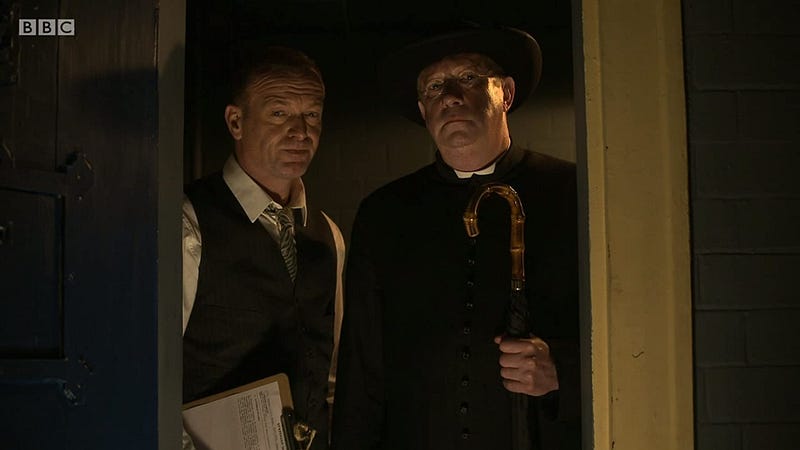
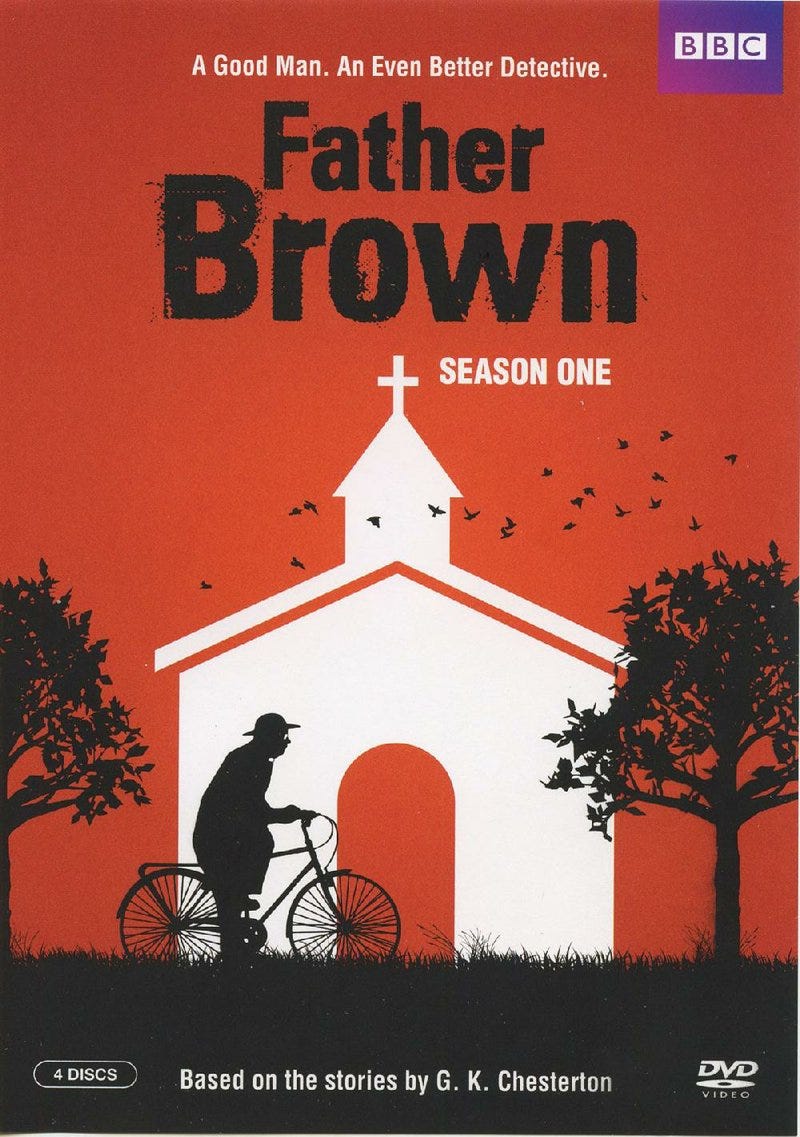
The BBC, during the current crisis, has been rerunning previous Father Brown series. Father Brown, returned to British television screens in 2013, with accomplished actor Mark Williams filling Father Brown’s shoes. Father Brown, a character created by English author G. K. Chesterton, is an amateur crime-solving Roman Catholic priest every bit as intuitive as Agatha Christie’s Miss Jane Marple.
Williams, even though he has established a significant television, film, and theatre resume, is best known for playing Arthur Weasley in the Harry Potter film franchise. British television viewers, in the early 1970s, had previously seen Kenneth More playing the title character. Both Father Brown versions are loosely based on a series of Chesterton’s short stories.
Further to Williams, the first BBC series stars Hugo Speer, Sorcha Cusack, Nancy Carroll, Alex Price, Kasia Koleczek, and Keith Osborn as Inspector Valentine, Mrs Bridgette McCarthy, Lady Felicia Montague, Sidney “Sid” Carter, Zuzanna “Susie” Jasinski, and Sergeant Albright, respectively.
This series, respectively played by Tom Chambers, Emer Kenny, John Burton, and Jack Deam, predates Father Brown characters Inspector Sullivan, Lady Penelope “Bunty” Windermere, Sergeant Daniel Goodfellow, and Inspector Gerry Mallory.
The first episode featuring Williams as the title character, televised in the British Isles on Monday, 14 January 2013, revolves around an Anglican vicar and the killing of his brother. The instrument used to cause the death, a blacksmith’s hammer, points local police towards the blacksmith, Simeon Barnes (Barry Sloane), and his wife. Elizabeth (Bryony Afferson), the blacksmith’s wife, had been blackmailed by the victim. Believing her husband killed the vicar’s brother, Elizabeth provides police with a convincing confession.
Naturally, because of his inquisitive nature and an uncanny ability to sense when there is something wrong, Father Brown sets out to prove Elizabeth innocent. We should not forget, given when the series is set, the death penalty is still a thing in the United Kingdom. The innocent woman, in protecting her husband, risks going to the gallows.
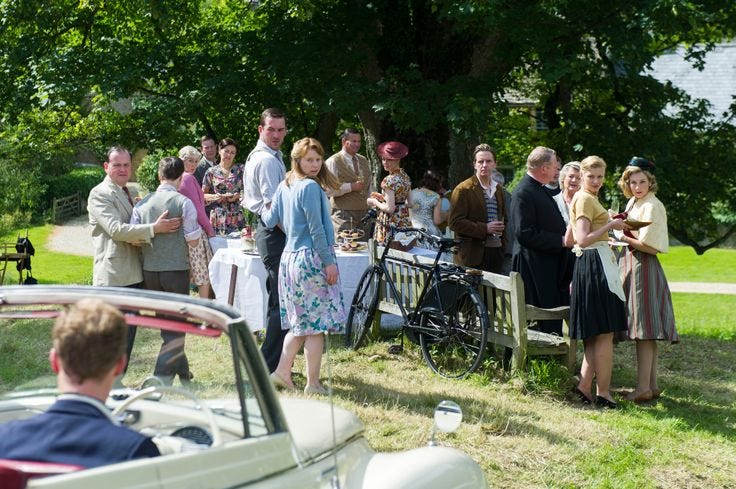
Anglican Reverend Wilfred Bohum (Adam Astill) hosts a garden party to celebrate the recent installation of a clock in his church’s tower. Everyone that’s anyone in Kembleford, including Father Brown, Mrs McCarthy, Lady Felicia, attends the garden party.
Unfortunately for Reverend Bohum, even though he hadn’t extended an invitation to his brother, Norman Bohun (Sam Hoare) gatecrashes the garden party. There is a scene between the village blacksmith and Norman where Simeon accuses the vicar’s brother of having a sexual relationship with his wife. Whilst there is more than a modicum of truth to Simeon’s allegations, noting the circumstances surrounding the alleged affair, Elizabeth wasn’t a willing party as she is blackmailed into giving Norman sexual favours to cover her husband’s gambling debts.
Soon thereafter, not far from the Anglican Church, Norman’s body is discovered. His head had been smashed in with a small heavy implement. Even though Norman is proven a real cad, as Inspector Valentine pursues a logical line of inquiry, the police inspector is close to arresting Simeon when Elizabeth confesses to the crime.
Father Brown, not convinced by Elizabeth’s confession, believes she came forwards to protect her husband. Consequently, because of his understanding of human nature, Father Brown believes the killer remains at large.
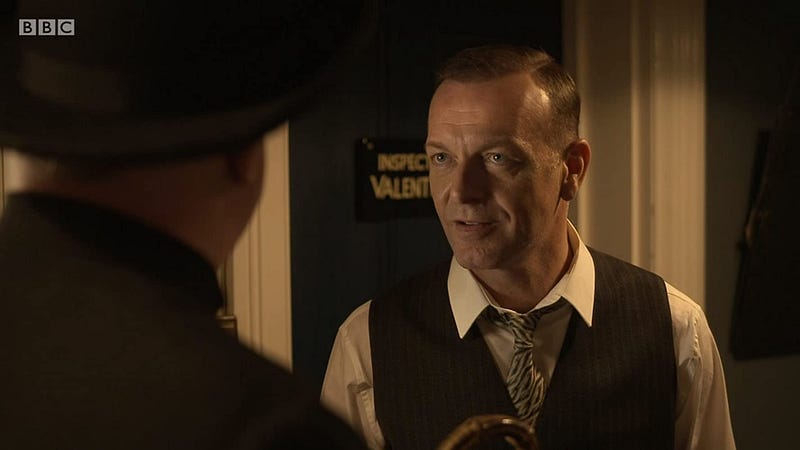
Despite Inspector Valentine advising Father Brown to not get involved in his investigation, one that could take the Catholic priest down dark traitorous paths, we see the series title character disregard the police inspector. Father Brown, having done a little of his own sleuthing, discovers the new the church clock holds the answer to the true killer’s identity.
Norman’s funeral soon arrives. Mrs McCarthy, in understanding there is a potential killer in their midst, tells Father Brown about what she witnessed the day Norman was killed. She happened to see Zuzanna “Susie” Jasinski and Norman arguing in the churchyard shortly before his death. Susie failed to mention this argument to Inspector Valentine.
Overhearing the conversation between Mrs McCarthy and Father Brown, feeling she has no choice but to flee the village, Susie decides to purchase a train ticket bound for London. Father Brown, after Mrs McCarthy informs him of Susie’s disappearance, finds her waiting for the train to arrive at the Kembleford Station.
Susie, knowing how Father Brown can be in such situations, tells him she took a cleaning job at Norman’s house shortly after witnessing him in bed with Philip Walker (Oliver Ryan). She saw this as an opportunity to blackmail Norman into helping the people in the Polish camp.
The series is set in the 1950s. Homosexual acts remained illegal in England and Wales until 1967. The Sexual Offences Act 1967, applying only to England and Wales, saw the legalisation of homosexual acts between consenting adults aged at least 21.
The only for people in the LGBTQ community to remain true to themselves during the period in which the Father Brown series is set was to be closeted. This is what we see with Norman and Philip. They had no choice but to keep their relationship a secret.
Elsewhere, at the blacksmith’s forge, we find Reverend Bohun confronting Simeon about his brother’s murder. The conversation quickly becomes heated. The Anglican Reverend doesn’t understand why it is Simeon is allowing his wife to take the fall for a murder she didn’t commit. Simeon storms away from the forge in a vile temper.
Father Brown, having seen at least some of the altercation between Simeon and Reverend Bohun, follows the blacksmith to a local gambling establishment. Father Brown encourages Simeon to speak with his wife. When Simeon arrives at the police station, noting the appeal to retract Elizabeth’s confession has been rejected, she is facing execution unless the real killer confesses.
Father Brown, having understood there was more to Norman than first meets the eye, visits with Philip. It is here that Philip tells Father Brown of his relationship with Norman. Knowing the predicament that Philip is in, especially considering the legal standing of homosexuality, Father Brown promises to keep their conversation secret.
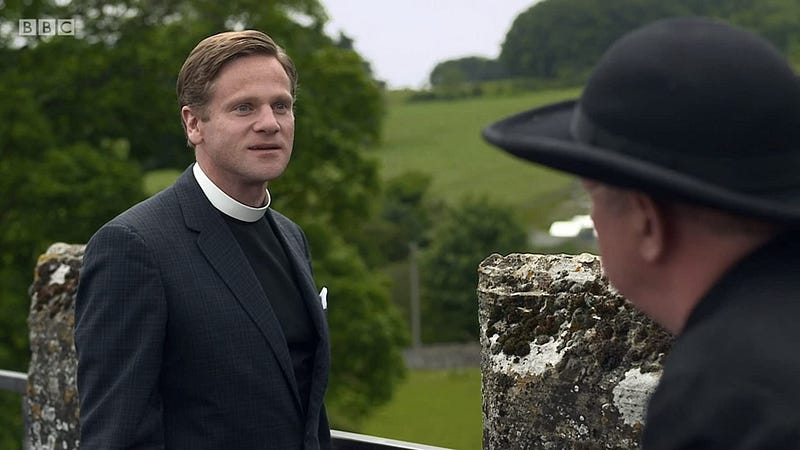
Later, on hearing the church bells striking late again, Father Brown soon uncovers evidence key to his investigation. Father Brown’s ringing of the church bell attracts Reverend Bohun’s attention. Reverend Bohun’s curiosity brings him back to the church where he finds Father Brown waiting for him. Father Brown correctly observes the Anglican reverend isn’t the kind of person that would allow his clock to go unadjusted for too long.
Father Brown reveals to Reverend Bohun, whilst on the tower roof, he stumbled across a pair of workmen’s gloves. The Catholic priest correctly surmises that these were the gloves the killer wore when he was on the roof. It was also these gloves that the reverend borrowed from the blacksmith when he last visited the forge.
Reverend Bohun admits to killing his brother, Norman, because he discovered he was homosexual. When last on the roof, attempting to adjust the new clock, the reverend overheard a conversation between Norman and Philip where the truth was revealed. This was essentially the final straw for Reverend Bohun. The Anglican reverend, not as enlightened as Father Brown, threw the blacksmith’s hammer at his brother from the church roof. Surprisingly, considering the distance, the hammer hit Norman and killed him.
Whilst Father Brown urges Reverend Bohun to confess his crime, noting the Anglican’s commitment to his beliefs, the revered claimed that he was merely following G-d’s faith. He believes throw must have been done with divine assistance. Father Brown, as logical as ever, makes it clear Reverend Bohun’s actions were his own. The Reverend finally realises his mistake. Elizabeth is ultimately released.
The episode closes with Father Brown waiting for his congregants to arrive for the Sunday morning service. Once the parishioners have entered the church, after a momentary pause, Father Brown follows suit.


