
This Writer’s Life
Restoring Your Writing, Lesson Two: Fix One Thing at a Time
Instead of envisioning the completed draft, work on addressing one problem
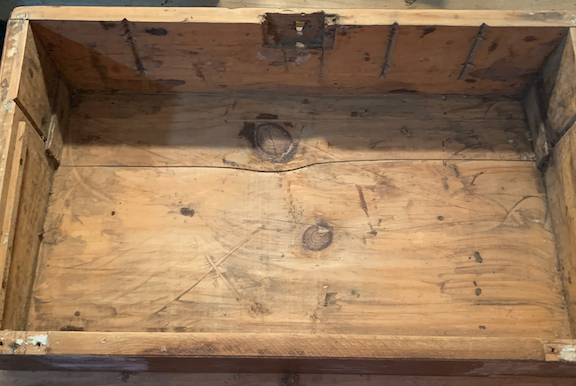
The writing slope I am restoring was not manufactured by a fine furniture maker. It was quickly and cheaply assembled. Some of the wood in the box had not even cured before it was pressed into service. In fact, I spent part of today straightening out a warped divider that had been papered over when the pine was still fresh. When I soaked the thin board for fifteen minutes to scrape off its coating of paper, the board’s long edges curled toward its center.
That put a kink — literally — in my restoration process. However, a quick internet search taught me that it’s possible to straighten out a warped piece of finish wood by wrapping the wood completely in a damp towel, placing it on a countertop or ironing board concave side down, putting the steam iron to the highest setting, and pressing and steaming the board in sections. After two rounds under the steam iron, the board — maybe 120 years old, and about 3/8” thick — was flat and straight again. I set a phalanx of Progresso soup cans on top of it all along its length while it dried completely, to make sure it didn’t curl up out of spite. But the board stayed true; so that’s a handy restoration tip I’ll file away.
So the mini-lesson there is: things will go awry with your project, but don’t despair. Things can be fixed.
But the main lesson I’ve taken away from this phase of work on the writing slope is twofold:
1) Break down your project into its largest component pieces first
2) Focus on one problem in one part of your draft
This writing slope has four major parts: the top half of the box, the bottom half of the box, the writing surface (which comes in two pieces), and the top half compartments. All these parts needed to be separated from one another so that I could focus on just one problem: the one millimeter crack running the length of box bottom. Oh, I could see so many problems that need fixing. The skiver boards were awfully ratty and uneven beneath their paper and velour coverings, the gap where the lock used to be needs to be filled with putty, one of the skiver supports was split by a nail used in an old repair and needs to be replaced. Just a lot going on.
So I focused on the most basic structural problem I could: repairing that rather significant crack.
I considered two different approaches: filling it with wood putty or trying to glue the box back together.
I went with the more difficult option: gluing the board back together along the full length of the split.
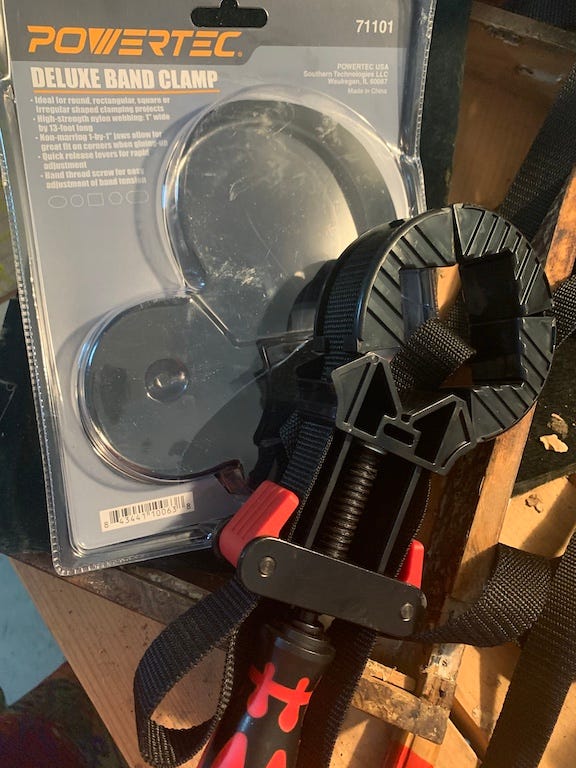
I got some Elmer’s Wood Glue and a band clamp. A band clamp allows you to basically pull a strap tightly around an entire square or rectangular box, gripping the box and putting equal pressure on every corner and pulling the whole structure more tightly together.
I applied a bead line of glue all along the split in the box bottom, pulled the band clamp tight, and locked the bands in place.
And that was all I did on my project, for a whole day. I just fixed one crack, and waited for the glue to dry.
Should I have been doing something else? Could I have been doing something else? Sure. But I didn’t see the point in proceeding to repair other parts of this antique until I knew that I had solved its most substantial flaw.
I think it’s good to approach some writing projects in the same way, depending on where you are in your draft. If you have a janky but fairly complete draft that somewhat naturally breaks into sections — chapters, stanzas, whatever — just narrow your focus to fixing one section. Work on making that one part better. When you think you have it in better shape, let it sit…and let the rest of the draft sit too. Wait a day and come back to the page; see if your fix worked.
My fix on the cracked bottom board of this writing slope did what I hoped it would do: it rejoined the wood all along the split. However, my fix ended up creating another problem I would have to address later: sanding down the excess wood glue that had seeped out from the split when I clamped it together.
And it’s okay for one fix to create another mess. That’s how a piece of writing is. Changing one thing means you have to change everything, and you have to do more work on every part to make it all work as a whole.
But if you can make just one part of your draft a little better, solve just one problem that you know needs fixing, you will find the encouragement you need to push ahead.
Everything may still look like a mess, but it’s a better mess than it was before.


