
This Writer’s Life
Restoring Your Writing, Lesson One: Start Where You Are
Revive your writing voice by stripping some things away
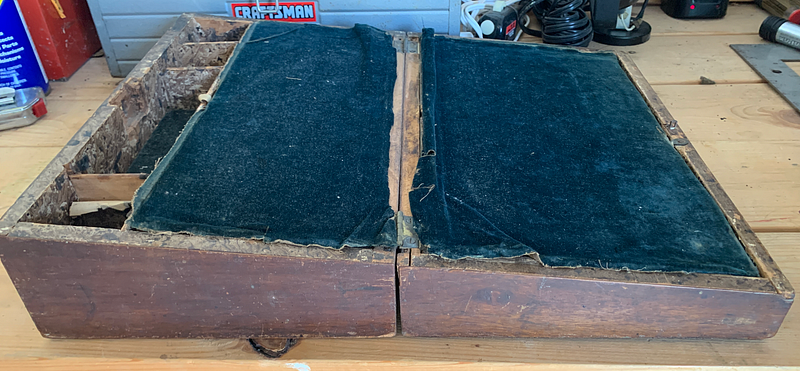
As I attempt the restoration of an antique writing slope, I am learning as I go about what works and what doesn’t when it comes to repairing what seems beyond salvaging. That holds true for this writing slope, and it holds true for my book manuscript. Each step in the process of restoring this writing tool offers a lesson that applies to restoring my writing. In this series of posts, I will share those lessons with you.
The writing slope I am restoring now is a lot like my (theoretically extant) book manuscript: a mess.
Like this battered writing slope, there’s a basic structure to the book’s argument I can see beneath all the disconnected verbiage I have piled up in draft after draft like so many layers of grit and glue and unsightly paper. But that structure is buried beneath a lot of material that is no longer relevant and will have to be discarded.
There may be some verbiage from all my desultory drafts that I can salvage and re-use. But as I face a January 1, 2022 deadline, I feel as if I am practically starting over, except I’m not. I can’t. I don’t have time. I have to save what I can. But when I discard everything that doesn’t belong, I wonder, will there be much left? Will what is left prove worth the effort it takes me to save it? Do I have time to get it right?
Well, if I imagine myself already standing on the calendar square for January 1, then I will see that I am out of time and all is lost.
If I imagine this writing slope already looking as it should look, or as I would like it to look, I will see how impossible that vision is, and I will give up.
So the first lesson of restoring my writing is to start right where I am, in the middle of a mess.
You can’t clean up a mess, even a huge mess, by tackling everything at once; you have to tackle one small thing at a time.
In its current condition, this writing slope has absolutely nothing going for it. There’s a one millimeter crack running through its base, the veneer is peeling off in places, the original hinges have been poorly replaced, the original skiver covering has been blanketed in a layer of thick and now mildewed velvet, the lock is missing, the writing boards are cracking and warped, the whole interior is covered in a layer of hideous brown marbled paper glued fast to every surface.
It’s a lot.
The first thing I decided to tackle in restoring this writing slope was to take off the hinges and then strip off the paper from the interior of each half of the box. Everything else I need to do — glue the boards where they are cracked or broken, repair the veneer where it is peeling, attach better-fitting hinges and figure out what to do about the lock, restore the box’s finish — requires me to clear away this old paper that was meant to look antiqued when it was first glued in place, but now looks grimy and gross.
At first I tried to simply peel off the paper using a plastic paint scraper. But the paper was glued down so snugly and so completely that all my scraping yielded only tiny shavings. I realized I would have to dissolve the glue beneath the paper without doing any damage to the finish outside the box or to the wood beneath.
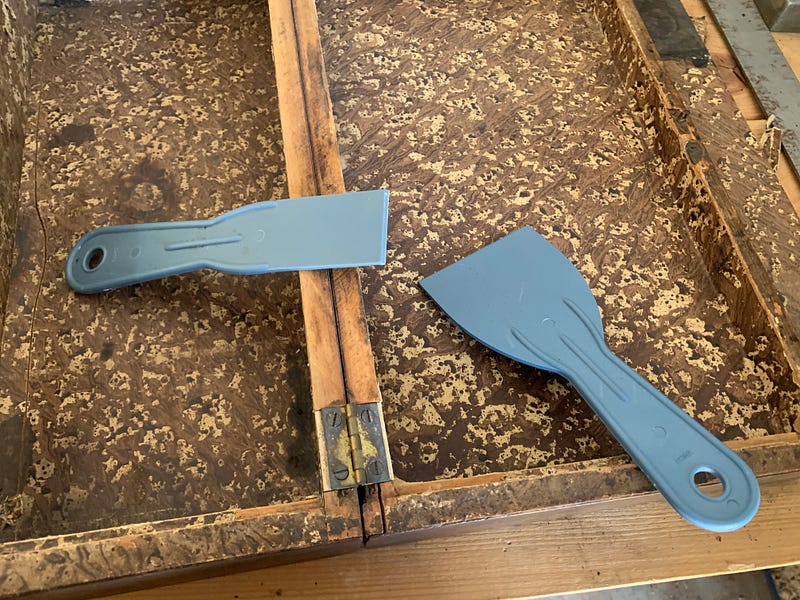
I combined one part rubbing alcohol to one part water, poured a thin layer of this solution into one half of the box — the half without the ink compartments — and let it sit for fifteen minutes.
Then I started in again with the paint scraper, pushing it along the grain of the wood.
The soggy paper peeled off easily, with no glue residue left on the wood. That was nice.
But here was something marvelous, something I did not expect: from the humble unfinished plank long hidden beneath that layer of paper arose the scent of freshly cut pine boards. The paper was glued into place to disguise the commonness of the materials used in the construction of this writing slope. No rosewood here, no American hardwood beneath the walnut veneer. Just plain old pine.
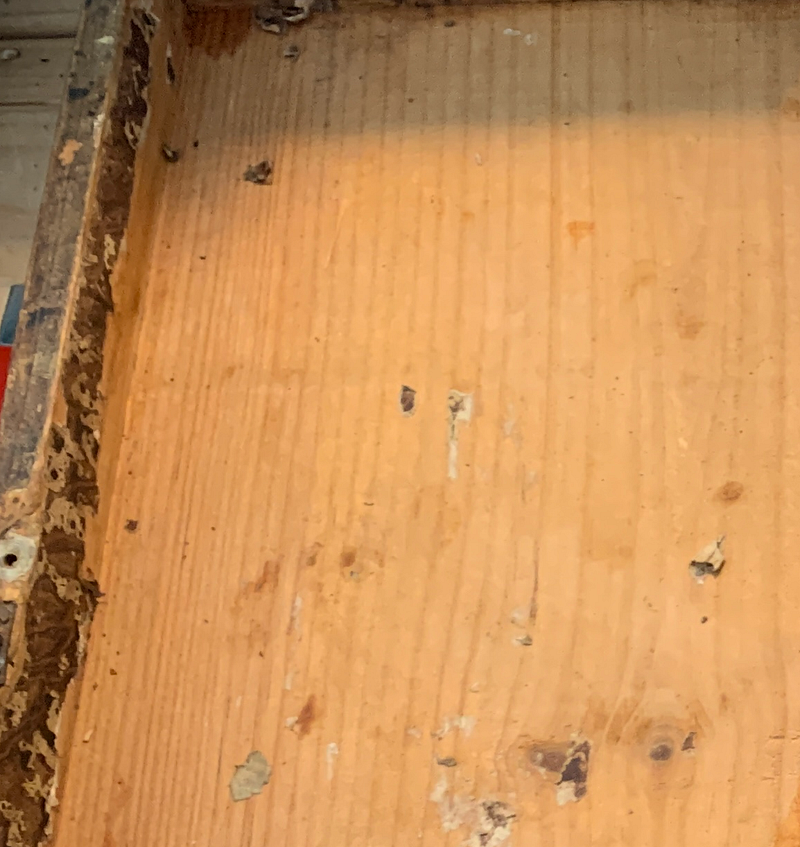
And would anything else have smelled so fresh, so new, so alive, over a century later? Standing there in my garage I could smell the life of a forest felled a hundred years ago or more. I could smell the lumber yard, and then the factory where this cheaply-made box was first put together in quick assembly-line fashion.
Someone stood at a table all day, gluing pre-cut paper inserts into the bottom of these writing slopes. Someone else stood across the table, perhaps, gluing a differently shaped and angled paper insert into the top halves of these boxes. Their job was to hide the pine, to seal it away, to make the box a little bit fancy, a little bit more appealing to its eventual buyers. They did their job so well that I could catch the scent of pine sap a century afterward.
What a benediction that seemed to me, standing there in my garage, little soggy bits of paper clinging to my hands. Beneath all this mess, there is something fresh and new that speaks of life.
So that’s the first writing lesson from my restoration project: don’t despair for the mess. Start with cleaning up the simplest thing — a single paragraph, perhaps, or a transition that doesn’t work. Instead of trying to fix it, see what happens if you just take it out. Make a little file on your desktop where you can copy and paste all your deletions, so it doesn’t feel so fatal or final to remove them — but peel off a whole layer of your prose where you can, the extra words you added to make a passage seem fancier than it needs to be.
Let the humble pinewood of your writing know the air again. It will refresh you and renew your faith in your own living voice.


