This Writer’s Life
In Praise of the Writing Slope
A search for better posture led me to new ways and new reasons for writing
Because 2020 just wasn’t quite done with me, I began 2021 with a bulging disc and excruciating pain that radiated down to my ankle. I couldn’t stand up straight, I couldn’t walk, I practically couldn’t move without sobbing.
Some muscle relaxants and physical therapy took care of the immediate problem. “However,” said the doctor, “we need to address the underlying issue here. How much time do you spend sitting at a desk every day?”
I just laughed.
So we talked about various chair adjustments and cushions and keyboard rests that might help correct my posture while I am sitting at my desk (thinking about) writing.
The key thing: don’t hunch over your work, and don’t slouch.
I can manage this correct posture when I am working on my computer. But when I am writing by hand, I bend over my journal like a drooping sunflower. Because my desk is perfectly flat, I have to.
Or at least I had to.
“Doesn’t somebody make slanted writing desks you can put on top of your desk to tilt the surface towards you?” I asked Twitter.
Everyone said “Levenger,” and they were correct. But when I happened to be looking for this particular tool, it was not on offer from the Levenger catalog.
“Look on eBay,” one of my friends said. “You’ll find something.”
So I did a few searches: “portable writing desk,” “tabletop writing desk,” “travel desk.”
And then I found them: writing slopes.
These are wood or wood veneer boxes. Some are very plainly made and some exquisitely crafted. They are roughly letter-sized or larger when closed. Their lids are cut on a slant. When you open the lid, inside you will find a writing surface (usually covered in embossed leather or velvet) that folds in the middle, resting on supports inside the top and bottom lids.
The slope of this surface varies from box to box, but it’s at something like a twenty-five or thirty-degree angle: perfect for tilting your writing surface towards you so that you can write by hand while sitting up straight.
These writing boxes, writing desks, or writing slopes were hand-crafted and then mass manufactured from the 17th century to the mid-twentieth century.
The earliest writing slopes were made of solid hardwoods. The “campaign box” or “campaign desk” slopes widely used by officers of the British Army or the British East India Company were usually made of solid mahogany through the Regency period. Beginning in the mid-19th century, more writing slopes were made using a base hardwood, like rosewood of various kinds, and a more stylish wood veneer.
Writing slopes were made to lock, so that they would not spill open when being transported from room to room, or from one’s valise to one’s lap in a train car, or from steamer trunk to shipboard table. Most antique slopes for sale now do not have working locks, or if they have working locks they are missing the key.
The inside of a 19th or 20th century writing slope has various compartments in the higher half of the box for glass ink bottles, stamps, blotters, and other accoutrements. There is also usually a pen rest for a dip pen of some kind. Both halves of the folding writing surface lift up to reveal storage underneath, sometimes including tiny hidden drawers with little bone or ivory handles.
I learned all of this handy information about writing slopes after I bought one.
I paid way too much for the first writing slope I purchased — about $300, plus shipping — and it came to me with damage that the online Etsy seller had not disclosed. “Pictures are the description” is something sellers often say, but the best sellers will conscientiously describe even minor damage.
But the damage did not affect the functionality of the writing slope. I was delighted and relieved to be able to sit at my desk and write in my journal without bending forward and putting pressure on my lower back.
However, I forgot the first lesson of handling antiques, which is also the first lesson of writing: don’t do anything in a hurry, don’t rush yourself, don’t panic.
I forgot that lesson, and I broke my writing slope.
I was rearranging my desktop to set up my computer stand for a Zoom call and shifting things around too fast and I dropped that heavy stand right on top of the writing surface, breaking the walnut-veneered rosewood side plank clean away from the main surface.
I was sick to my stomach. My heart sank.
I asked my dad if he could repair the broken board for me. He fixed it in a way that was very utilitarian (my dad can fix anything) but not cosmetically attractive. (I should have been more clear!)
The slope was still useful, but — well, I remembered the second lesson of writing: mood matters.
I wanted something sturdy and nice and lovely for my desk. Something that looked as serious and as important and as beautifully crafted as I hope my best writing can be.
So I went shopping online.
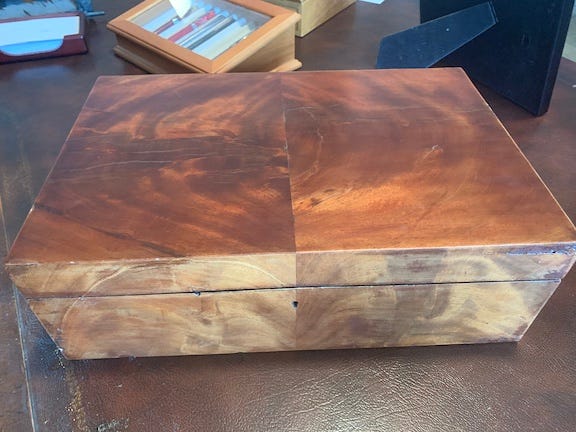
I managed to place the winning bid on a stunning walnut veneered writing slope from the mid-19th century. It had belonged to someone’s great-aunt or great-grandmother. It was certainly well cared for: not a scratch on it. It’s a larger slope, and when I opened it a very familiar scent wafted towards me: Estée Lauder powder. That’s what my own great-aunts’ homes smelled like. I guess it is an “old lady smell,” but it made me feel young again, and safe, and swathed in love.
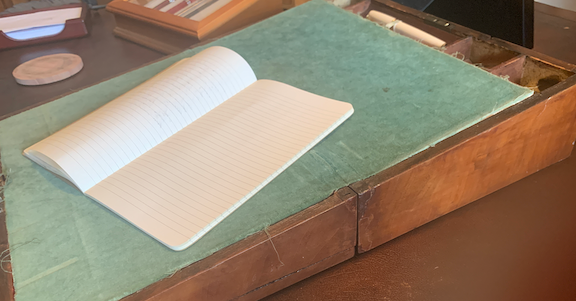
I use that writing slope daily at my own desk now. Whoever owned it first and most recently took good care of it. The green velvet covering the writing surface is clearly old but not terribly worn. There are ink stains in the inkwell compartments, and a fine patina on the pen rest. It was used, but well used.
The unknown, unnamed woman who sat down at her secretary or her dining room table and opened up this little chest that held her love letters or her business correspondence or her novel in progress is long gone now. But what worked for her can work for me as well. That’s another lesson of writing: not everything has to be shiny and new; sturdy and lovely and loved works as well.
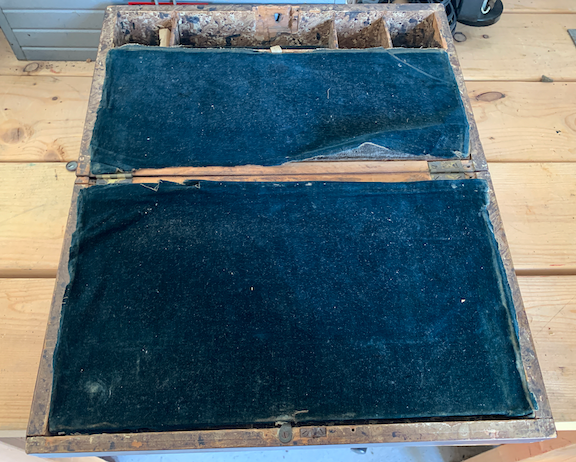
Since purchasing that writing slope, I have bought a few more, including an absolutely battered and busted up slope that had at some point in the early 20th century been converted to a sewing box. It was a mess; it is a mess. The veneer is peeling off in many places, the finish has been ruined with watermarks and ink spills. This writing box has been poorly used indeed.
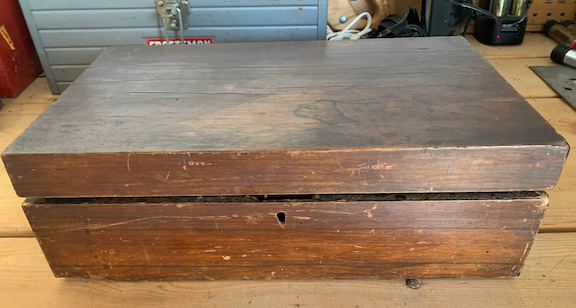
I have decided to restore it — not to its original condition, which cannot be done, but to a functional and attractive condition.
I began this restoration project last week. It is quite a process, and I am learning a great deal as I go: learning about furniture repair, and learning about writing, and learning about what matters.
I will share some of those lessons in the coming days with my readers here and at The Mudsill.
In the meantime, if you are looking for a writing slope of your own and don’t want to get snookered by an unscrupulous Etsy or eBay seller, you will be pleased to learn that the exact desk I was looking for is now for sale again at Levenger.com
That’s another lesson of writing, and life, that I am still learning at 52: patience, patience, patience.