
Researchers Asked Men To Choose Their Favorite Vulva Shape
Of course, they struggled to pick just one
In 1996, Dr. Paula Pendergrass set out to do the unthinkable— measure the average vagina.
To accomplish this feat, she used dental silicone to make delicate molds of each fold and crevice. Unfortunately, Pendergrass struggled to get funding, so she had to use cadavers and even her own vagina. Oh, and she was also called a “dirty old woman” for her work. So there’s that.
But Pendergrass’s objective was not salacious. She wanted to determine how the shape of a woman’s vulva and vagina might impact childbirth and sexual pleasure.
Her research identified five common genital shapes — conical, parallel sides, the heart, the pumpkin seed, and slug.
Slug? What kind of slug? Because if your lady bits look like one of those fantastical sea slugs, that’s kind of badass. But the tentacled mollusk that admits slime… no thanks. We can do better.
A woman’s genitals are not sluggish. They are delicate flowers that bloom and die depending on the season.
Too purple prose(y)? Perhaps. But I get poetic when discussing female anatomy.
Thankfully, researchers do not. They asked over 2000 men what vulva shape they preferred. Here is what the study found.

First, only 63% of men correctly labeled the labia majora (outer vaginal lips), and only 63.3% found the labia minora (inner vaginal lips). The respondents who failed this anatomy quiz were not eliminated from the study. I find that approach problematic. Sorry, Gentlemen, but you shouldn’t get an opinion if you can’t find it. Also, this study was an online survey, so some men must have googled. Therefore, I suspect more than 63% of men couldn’t find a labia if it hit them in the face. (But not my male readers. You are all brilliant.)
The researchers then showed the men pictures of three different-sized labium— small, medium, and large. Men 18–24 years old were approximately three times more likely to find only a small labia minora attractive. Shocker. Since younger men have been spoonfed porn, it’s not hard to see why they would appreciate only one anatomy shape.
Overall, 46% of men found a large labia “unattractive.”
But don’t despair my big lips cohorts. These findings contradict a more recent (and more extensive) study, which found a significant preference for a larger outer labia.
So which is it? Large or small lips? Hold that thought…
54% of men responded they had no preference for labium size. Only 21.5% of men said that the size of a woman’s labia affected their sexual pleasure. (I would avoid those men.)
But although this study mainly focused on labia size and not shape, it’s time we finished Pendergrass’ research. Thus, I combined my medical illustration skills and love of botany to identify six common vulva shapes. (Note: Some women fall into more than one category.)
Feel free to make magnets and throw pillows with your genitals. It’s time we celebrate the exquisitely unique vulva.
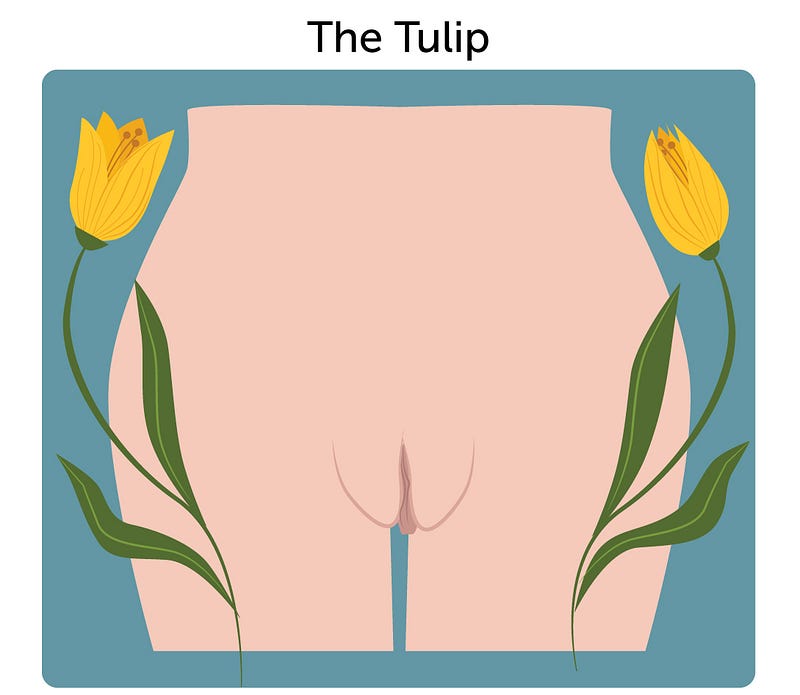
The Tulip
The tulip is the strip tease of vulvas. With this shape, the inner lips peek slightly beyond the outer lips, creating a narrow slit. Some women think that a labia minora that extends past the labia majora is abnormal, but 56% of women have this shape.
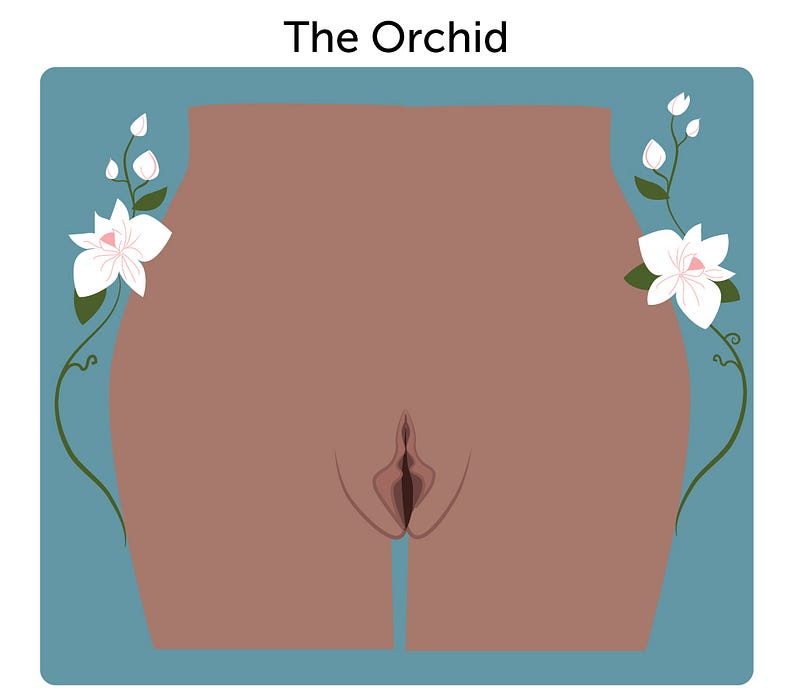
The Orchid
An orchid’s beauty is found in its asymmetry. Its pinwheel petals fan out in different sizes and color variations.
Women often worry about the asymmetry in their vaginal lips, but it is perfectly normal for one lip to extend below another. Like a woman’s breasts, a woman’s labia lips are not twins. They are sisters.
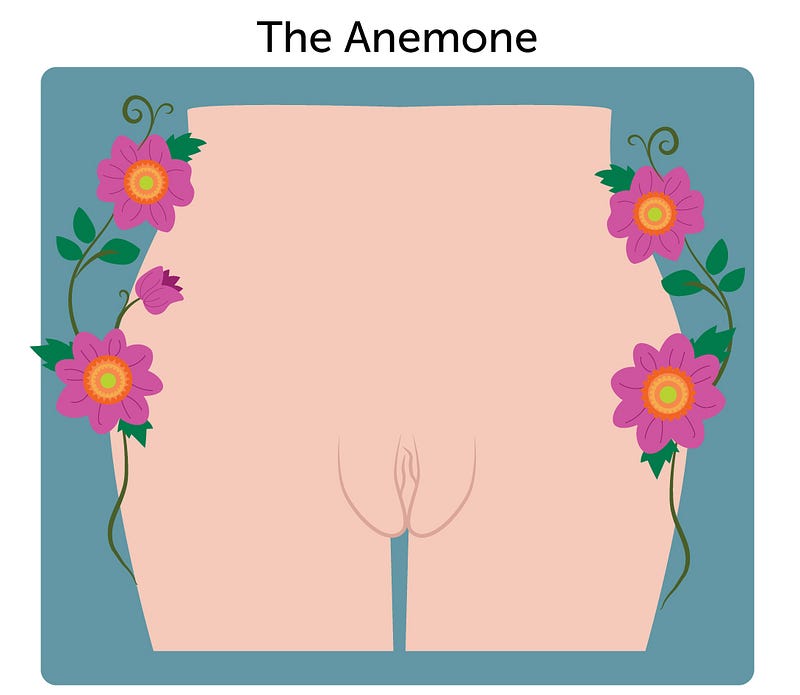
The Anemone
With the anemone shape, the labia majora curves in a horseshoe shape that closes at the bottom and reveals an opening at the top. This shape is like a winking eye — half open and half closed. Its beauty is in the center.
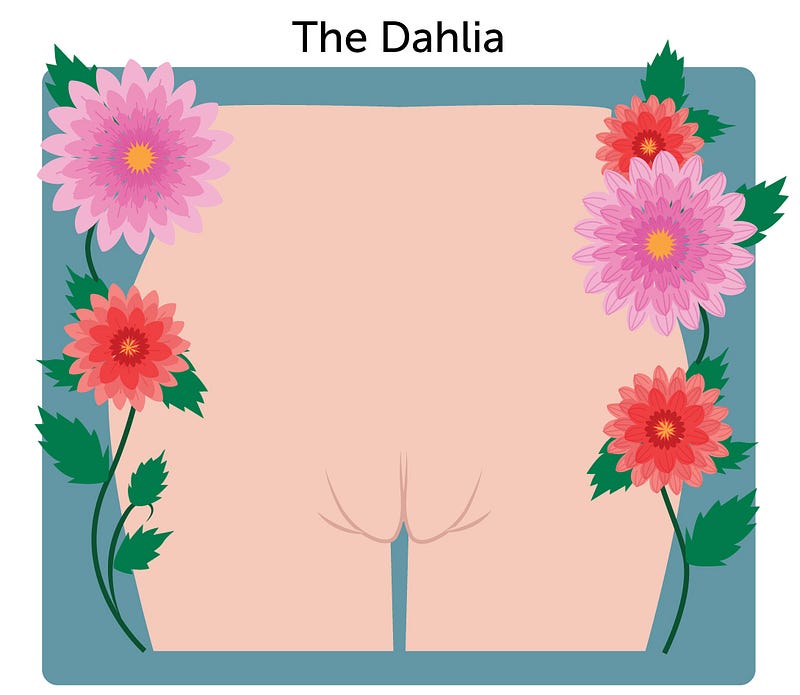
The Dahlia
A dahlia’s petals demand attention. They are so full and ample that you can hardly see the center. This shape has also been called the “puffy” vagina. Interestingly, a study examining women 15–84 found a correlation between body mass index (BMI) and labia majora size, but you can be rail thin and still have a dahlia.
The dahlia may grow big and tall, but it is still a temperamental flower that rarely survives a winter frost. A woman’s labia majora also shrinks with each passing season. This shrinkage happens because a woman loses subcutaneous fat when estrogen and progesterone decrease. Again, this is all normal.
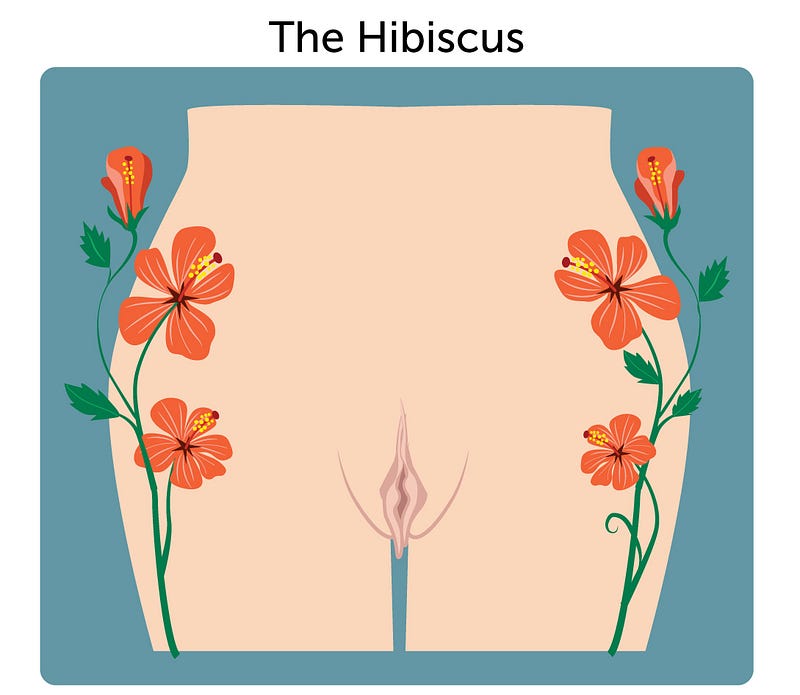
The Hibiscus
When a woman’s inner lips extend well beyond the outer lips, I have heard it referred to as “curtains.” Curtains block out light. I prefer a more flattering comparison. This is the vulva shape with a protruding stigma.
The stigma or pistil is the sex organ of the flower. Flowers like hibiscus are the flashers of the flower world. They display their inner sanctum loud and proud.
Again, women with large inner lips might think this shape is abnormal, but it is only a problem if you develop a vaginal prolapse. A vaginal prolapse, or pelvic organ prolapse, occurs when pelvic floor muscles weaken and vaginal organs slip out of place — uterus, vagina, rectum, urethra, and bladder. If you are worried that your inner lips hang too low, ask your gynecologist to examine you for organ prolapse.
And no, a larger labia does not signify that she has had a lot of sex.
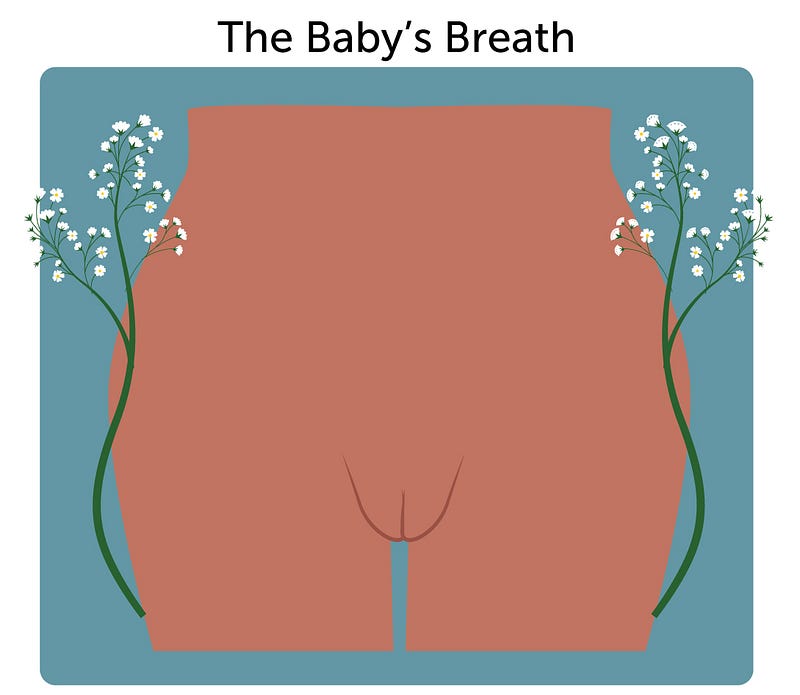
The Baby’s Breath
This shape is defined by small tight outer lips that conceal equally small inner lips. This vulva shape is seen the most in pornography. I suspect there might be a reason for that.
When a woman is aroused, her labia minora engorges with blood and increases two to three times in thickness. This increase in thickness causes a spreading of the labia minora. So while this is a beautiful shape in an unaroused state, it is less common during (pleasurable) sexual activity.
In 2019, labiaplasty — surgical alteration of the vulva — rose by 24.1%. The majority of these surgeries are for cosmetic reasons. A 2020 study found no anatomical correlation between labia size and the ability to orgasm.
But since all sex begins in the brain, that fact is a small relief to women who dislike their labia shape. So here’s the most crucial question researchers asked men: Would you want your partner to alter her genitals surgically? Only 9.6% of men said yes.
Of course, men’s opinions would not matter in a perfect world. Unfortunately, most women who take a knife to their flower do so to conform to cultural beauty ideals. Too often, women judge their bodies harshly because they think men only love one shape.
Such is not the case. Men (the good ones) love all shapes.
So whether your vulva is a budding baby’s breath or a proud flashy hibiscus, it is a thing of beauty. Let’s celebrate it.
Carlyn Beccia is an award-winning author and illustrator. For more info: www.CarlynBeccia.com


