
Redefining What Success Means
Thoreau, a mystic seeker, can teach us to seek and fight as well
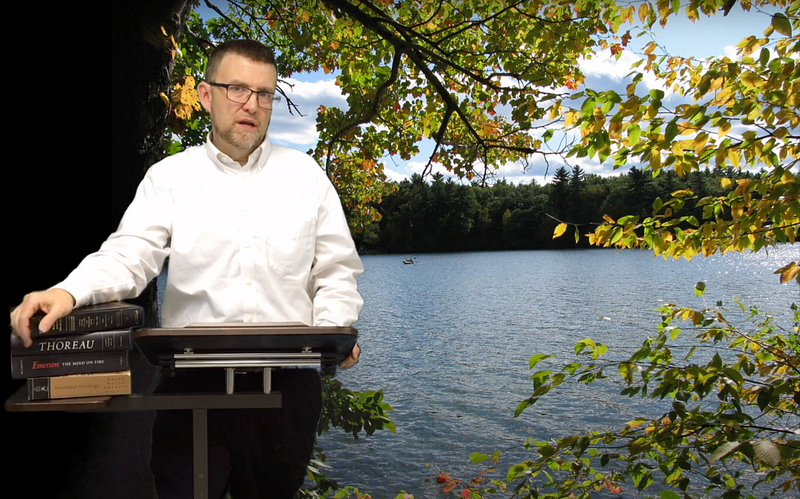
What does it mean to be a success?
Let’s reframe the American writer Henry David Thoreau as a religious “seer.”
Often times we criticize Thoreau for not making enough of himself. You’re a Harvard graduate, and yet what do you do? You tend Emerson’s garden. You’re a surveyor. You make a chair for Emerson’s wife Lydia. You make (and perfect) pencils for your dad’s pencil factory — which may have caused his early death — this thing called lead poisoning.
So it’s like, really — ?
Imagine if you graduated from college, especially from Harvard, and you’re just kind a gardener and “huckleberry” and “inspect snowstorms.” You talk to the Irish laborers — escaping Ireland because of the potato famine — the very ones who were building the railroad right past Walden Pond to Fitchburg.
And this is what you do? And then you get some stuff published — even a small piece in The Dial. Then, you self publish. Store seven hundred unused books in the attic? And then you cause a major fire in the neighborhood.
And you think: am I a success?
But think about the life Thoreau was living — living deliberately. The idea that I don’t need things. I really don’t need the things my neighbors seem to want — a large farm that will make me a serf to my property. Or closets of clothes for my stuff.
Do people really — in the long term — need all of this stuff to be happy? Will they talk about all your stuff at your funeral? If so — how shallow, right?
Look at religious instructors — or even the prophets — whether it’s Mohammed — Buddha — Moses — or Jesus — or —
We look at these mystics, these seers — or even Yoda in a popular culture sense, but there are people who, of course, prophets in religion, but also people that we just know by archetypes — like the wise man or the woman on the mountain — and do think of them owning anything except “the light” or “the truth?”
What made them happy? Were they content? What do lilies want, after all? What makes you happy?
Try not to chase things that will rust or break
It may not be things — and just because Chase Visa says “chase things that matter,” they just want to charge 21.4% interest and hit you with late fees. Things will rust. Things will decay. But what will really really make you happy?
So Thoreau shares this lineage, this history of retiring from society in order to find oneself. That’s why he went on a boat trip with his brother up the Concord and then the Merrimack River. That’s why he hiked to Mt. Katadkin in Maine with Native guides. It was there that he realized he wanted to become a vegetarian.
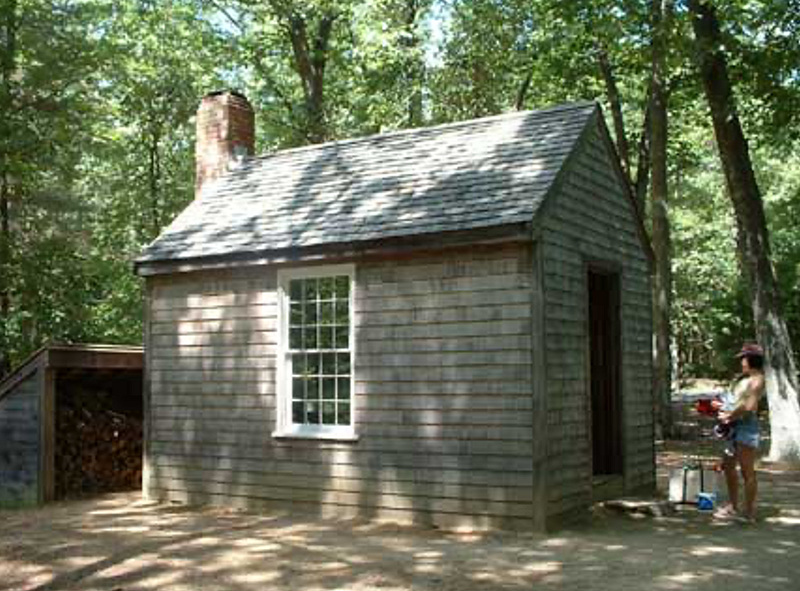
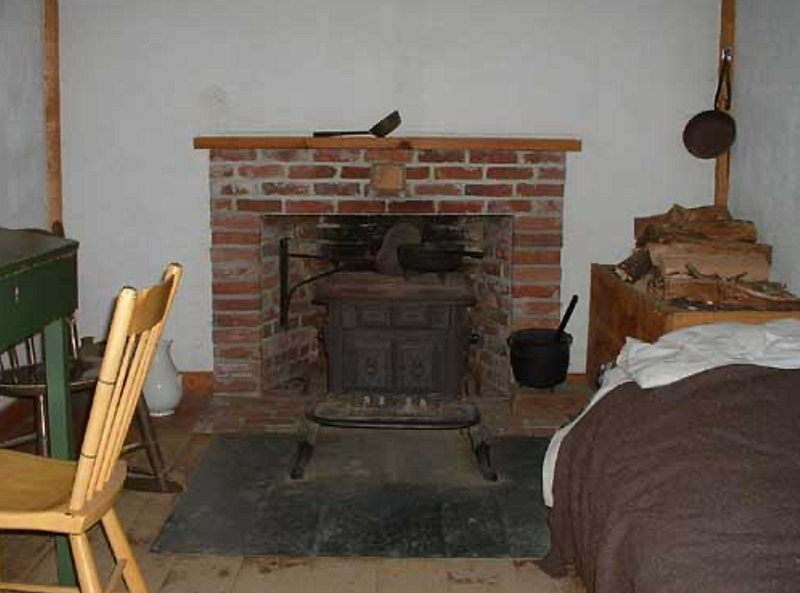
That’s why he constructed his cabin on Emerson’s property by Walden Pond with used materials. Then he lived there for two years and two months. He officially moved in on the 4th of July — the day we celebrate freedom.
And what freedom for Thoreau, right?
That’s why we go on retreat. That’s why we head to the beaches, to the mountains. That’s why we might go to summer camp. To get away from technology. To get away from all the problems that we have in life, in school, in our jobs — to connect with Nature or to shed the stuff that may be unnecessary.
Now, on that lake, suddenly, we’re free. And Thoreau’s like, “Why can’t I have this every single day, right?”
So we have this tradition with the Thoreau of being able to leave it all behind. What can I do, he asked, to be more self-reliant, more like the Native Americans, and hoe my beans, and be a vegetarian, and live a deliberate life. What can I give the world? What can I give myself? What can I give to others?
When I open Walden, I say, “Thank you, Thoreau.” Over, and over, and over.
Some people would say, “Well, that’s being selfish! He’s not helping the poor. He’s not helping his students. He’s not paying his taxes. He’s not contributing to the GNP. He didn’t need to work and take out loans for Harvard — and that’s true. He did start a school. He didn’t like being a teacher, of course. He didn’t want to whip kids and discipline them the way he was expected to.
But Thoreau, given the opportunities he had, was gonna live life on his terms. Why discredit the man for that? Are we jealous?
Right — of course we can criticize Thoreau, like James Russell Lowell did, saying something like, “Okay, Thoreau — your squatting on your buddy’s land. You’re borrowing someone else’s axe. It’s pretty easy. Your aunt bails you out of jail. And you don’t have children. You don’t have a wife. And whose wife is going to live in a cabin like this?”
Try not to criticize the choices an individual makes regarding their life
Well, the thing is — he didn’t really want that. He didn’t want a wife. Once bitten, always shy, I guess. Love hurts. He got rejected. His brother also proposed to the same woman. They were both rejected. Maybe it was better for all of us that he did not pursue the tradition route for a man of the time.
Can you picture Thoreau as a lawyer, a politician, a minister? Okay — a professor — but who needs a Ph.D when you can read and become a self-taught naturalist and start the Green Movement?
It’s interesting that women do not feature so much in Walden. Do other men feature all that much more? After all, Thoreau is writing his thoughts about his life and his observations. He mentions Branson Alcott — quite a character, and the father of Louisa, who wrote Little Women, just up the road. He mentions Emerson, what? Once? Twice?
So when we feel like criticizing someone for making decisions that they make, but their decision. That’s their decision not to have children. Do we criticize Jesus for not raising a family? Do we criticize, you know, other religious instructors? Or Yoda? Or one of our friends who has remained single? Did Thoreau have a sex life — or even talk about that stuff — no — but so what?
When we get to Whitman — oh! That’s gonna be a huge change, right? But we need to understand Thoreau in the context of a religious teacher. As one who may instruct CCD. BBYO. United Methodist Sunday School. These lesson are not about how to make money or how to find a major.
How can I find myself? How can I be content? How can I live in the moment? How can I tap into the consciousness of Thoreau — and he says discard anything that you find not helpful, but his words may well fit you. Opening up Walden can help us.
It helped me — tap into my consciousness and understanding and finding connections to the natural world in a pantheistic way. When it comes to the soul and the spirit, what does Walter Bowne think about this? What do you think about?
I could listen to the news, or like Sting sings: “poets, priests, and politicians.” I can listen to Rachel Maddow or Hannity. They can tell me what to think, but no! Please, just turn that off! It’s noise. Turn that off! Go outside! Experience the world! Connect with neighbors. Come back and think about it. Write about it.
And don’t parrot what other people tell you, right?
Now, of course, I’m parroting. Am I doing what Emerson warned me about? Looking back to the past? But at the same time, if we take a look at Thoreau, who believed in books more than Emerson, we know reading great works of literature requires great readers.
Great writers require great readers. So it’s not like I take this as, like the Bible. As Scripture. And this is like the Letters of God — because we know that the letter kills. Once it’s on paper, well, what can be done. Socrates didn’t just warn us out this — so does this:
Not that we are sufficient of ourselves to think of anything as being from ourselves, but our sufficiency is from God, who also made us sufficient as ministers of the new covenant, not of the letter but of the Spirit; for the letter kills, but the Spirit gives life. 2 Corinthians 3:4–6
Happiness derives not from what kind of car you drive. Not how big your house is. Not your mortgage payment. Not where you went to school, but who you are as a person, which I think is essential.
Yoda, of course, teaches Skywalker how to be a man and to conquer his dark demons and his inner Dark Father. Those powers can be used for good.
Martin Luther King used his powers as a writer and as a thinker as a Christian minister in order to dismantle Jim Crow South. Gandhi — the same way, right?
All these people who were geniuses who went up against the man — Galileo in the Catholic Church — Socrates having to poison himself for corrupting youth — and there are tons of examples, right?
Do two things when you read: read receptively and resistantly

To understand Thoreau, let’s understand him in the context of the luminaries that have were before him and who came after him and who were influenced by Thoreau.
When you read literature like Walden, you should really do two things.
Italo Covino, the famous Italian writer, says that we should read receptively — so when you wade into Walden — you never step into the same Walden twice. You know, even if I just read this yesterday, I opened up again. I’m a new man.
And that’s how it should be, right?
So we should read receptively — open to new ideas.
Calvino also advises to read resistantly — like if you read something that insults your own soul. Oh, my goodness! This comes right into Transcendentalism and Whitman and Emerson and Thoreau — it’s like wait a second!
I’m not really sure if I agree with Emerson’s treatment of the poor. Or when he says, “Are they my poor?” As a self-reliant guy, handing out free money makes people dependent on the State. I guess that may be true, but should we just let people starve in a country of plenty?
Hopefully this helps you understand Thoreau in a religious vein — a kind of luminary aesthetic, a semi-hermit — but someone who is still very very connected to his village — to Concord and the people there.
Because you go away, but you come back. You return from the cabin or Dagoba or the the desert after forty days — and you come back to to fight for social change — like Martin Luther King — like Gandhi — like Jesus — like Buddha.
And in a way, in a very small way in his own time, Thoreau, beyond his life time, became quote influential — through Walden and “Civil Disobedience.”
And I’ve been to Concord and Walden Pond enough times to see the tour busses come through. It’s not only crowded with tourists, but Bostonians looking for a swim and relief from the humidity and heat of summer.
It’s ironic, right?
So I often see Thoreau where there is no one but me, myself, and I — and that robin — and those gathering storm clouds — and in that opening of a daisy — and in the running of a brook.
If you’re interested in reading more about Thoreau, check out this great book: Henry David Thoreau: A Life by Laura Walls.


