avatarWalter Bowne

Free AI web copilot to create summaries, insights and extended knowledge, download it at here

2797

Abstract

ost</i>.</p><p id="d8a9">But I’m not a great poet. I might be an okay poet, and I may be an even better reader, but there’s no way I’m going to be able to access the core of that work of that science because it’s just a process, it’s all about trying to get at the truth of things.</p><p id="1e22">That does not mean we cannot enjoy the stars, use a telescope, or go to the planetarium. We can read books like “Cosmos” by Carl Sagan or listen to Neil deGrasse Tyson or Bill Nye the Science Guy. Of course, I’m using the ideas of science here and scientists, but it can apply to poets too.</p><p id="0f83">So when you’re reading something like Shakespeare, or something that just seems so esoteric or so beyond you, don’t criticize yourself too much. They’re on a different plane. It’s like trying to understand parables in the Bible from Jesus; you’re not Jesus, so learn what you can from the parable. But to have the empathy, sympathy, insight, and love of someone like Jesus, well, that’s impossible.</p><p id="3c06">But if you say it is possible, well, perhaps you’re right. You might have a messiah complex, or it might be blasphemy. But the idea is that we could become more like that with practice, effort, patience, and the right education. Education should always be difficult; if it’s not difficult, then it’s not really education.</p><p id="2297">And the real point I’m getting at here is not to say, “Don’t read the Iliad because you’ll never be Homer. Don’t read Shakespeare because you’ll never get to the end of Shakespeare.” What he’s criticizing here is that people read just to serve a simple purpose, like filling out a form or understanding the directions on a medicine bottle. It just serves a paltry purpose — commercial and not spiritual.</p><p id="d838"><i>Paltry means really simple, almost meaningless.</i></p><p id="86f9">We’re not actually encouraging active readers, especially in school. We’re just saying, “Read this passage. Answer a few questions,” because we don’t really want great readers. We want compliance. We just want proficiency and move on. But is that really what we want as readers?</p><p id="11a9">Nay, we want to strive to become like the great poets, the great writers, the great scientists, the great thinkers, the great prophets of the world. Because, as Emerson said, “God will not have his work made manifest by cowards.”</p><p id="06d3">And it is through reading that we can really connect and have empathy with each other, read stories from people who are so different from us in order to understand their struggle. So we can become their advocate, their fan, and not just circle the wagons on our own beliefs. If I just read or watched a program that reinforces my own bias or unconscious bias, that’s really paltry.</p><p id="bda5">Even when

Options

you look at reading scores and active reading, people’s reading scores are so down, and I’ve written a lot about this. So, on one hand, it may sound pretty pompous, but really, he’s saying that reading should be taken seriously and not just done as a function of society.</p><p id="c068">It’s a type of church. It should serve as a gateway into the soul, into the depths of the subconscious, into understanding what it means to be human, whether in the 19th century or the 21st century.</p><p id="1a0f"><i>Happy reading. Happy writing. Cheers.</i></p><figure id="7b8a"><img src="https://cdn-images-1.readmedium.com/v2/resize:fit:800/1*MsU-z6Q0y7b_nYYF0Yco7A.png"><figcaption>The author with fellow writers in his study overlooking his “Walden” in Lake Ariel, PA. Photo by author.</figcaption></figure><h2 id="2cbf">Check out more from Walter Bowne on The Masterpiece!</h2><div id="57dd" class="link-block"> <a href="https://readmedium.com/stepping-into-the-paintings-of-claude-monet-d2eadd59fde6"> <div> <div> <h2>Stepping into the Paintings of Claude Monet</h2> <div><h3>On Honeymoon #2, we traveled by train (and by foot) to Giverny</h3></div> <div><p>medium.com</p></div> </div> <div> <div style="background-image: url(https://miro.readmedium.com/v2/resize:fit:320/1*_muLvQ6q2heE8cDhAkiQEA.jpeg)"></div> </div> </div> </a> </div><div id="1f50" class="link-block"> <a href="https://readmedium.com/the-sun-ignited-the-rose-window-bc47c1e7a943"> <div> <div> <h2>At Poet’s Corner, I Found My Calling as a Teacher and as a Writer</h2> <div><h3>The sun ignited more than just the Rose Window at Westminster Abbey</h3></div> <div><p>medium.com</p></div> </div> <div> <div style="background-image: url(https://miro.readmedium.com/v2/resize:fit:320/1*xBubIzNwjY3bQBa2IbLoHg.png)"></div> </div> </div> </a> </div><div id="ac06" class="link-block"> <a href="https://readmedium.com/nurturing-deliberate-readers-in-a-modern-age-28c9ea3e5176"> <div> <div> <h2>Nurturing Deliberate Readers in a Modern Age</h2> <div><h3>Exploring Thoreau’s Insights on Reading Amidst Distractions</h3></div> <div><p>medium.com</p></div> </div> <div> <div style="background-image: url(https://miro.readmedium.com/v2/resize:fit:320/1*cY6JlYO6q0T5JMFxEfmAzA.jpeg)"></div> </div> </div> </a> </div></article></body>

From Stars to Sonnets

Reading as a Spiritual Journey: Connecting with the Soul of Humanity

Becoming More Than a Reader: The Quest to Understand Great Works
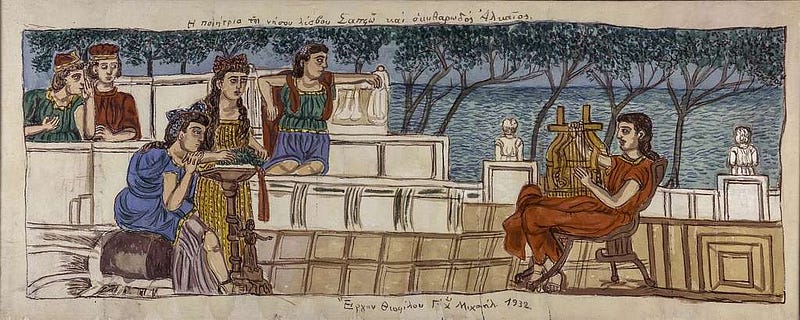
The poetess of Lesbos island Sappho and Alcaeus the guitar player. Natural pigments on cotton tissue. Thephilos Museum, Mytilene, Greece. (link)

“The works of the great poets have never yet been read by mankind, for only great poets can read them. They have only been read as the multitude read the stars, at most astrologically, not astronomically. Most men have learned to read to serve a paltry convenience, as they have learned to cipher in order to keep accounts and not be cheated in trade.”

“The best books are not read even by those who are called good readers.”

— “Reading” (Chapter 4) from Walden by Henry David Thoreau (1854)

It’s lunchtime, and I’m in the middle of teaching between my morning classes and my afternoon classes. I’m sitting out here on a cloudy day in New Jersey, but the sun is finally beginning to poke through, and I do see some patches of blue.

So I thought this would be a good time to talk about my boy, Henry David Thoreau, and two quotes from him on “Reading” in Walden.

“I think we’ve got it. Let me know if I need to go somewhere else or if you’d like me to discuss something else.”

Sorry — teaching stuff!

Okay, this may seem like I’m being a snob here, but let’s think about this for a second. I could read Charles Darwin on The Origin of the Species, and I can maybe garner some knowledge from it, but do I really have to be as smart as Darwin to understand Darwin? Well, kinda.

Or let’s just say Einstein; I can theoretically tell you about E=mc², but can I really comprehend time, space, and black holes the way Einstein could, my friend?

Stephen Hawking can, and other astrophysicists, but the same goes for poetry. I can look at the stars and admire them, and maybe pick out Mars and Venus and the Little Dipper and the Big Dipper, and I can do the same thing with Homer when reading the Iliad and The Odyssey or reading Dante’s Inferno or John Milton’s Paradise Lost.

But I’m not a great poet. I might be an okay poet, and I may be an even better reader, but there’s no way I’m going to be able to access the core of that work of that science because it’s just a process, it’s all about trying to get at the truth of things.

That does not mean we cannot enjoy the stars, use a telescope, or go to the planetarium. We can read books like “Cosmos” by Carl Sagan or listen to Neil deGrasse Tyson or Bill Nye the Science Guy. Of course, I’m using the ideas of science here and scientists, but it can apply to poets too.

So when you’re reading something like Shakespeare, or something that just seems so esoteric or so beyond you, don’t criticize yourself too much. They’re on a different plane. It’s like trying to understand parables in the Bible from Jesus; you’re not Jesus, so learn what you can from the parable. But to have the empathy, sympathy, insight, and love of someone like Jesus, well, that’s impossible.

But if you say it is possible, well, perhaps you’re right. You might have a messiah complex, or it might be blasphemy. But the idea is that we could become more like that with practice, effort, patience, and the right education. Education should always be difficult; if it’s not difficult, then it’s not really education.

And the real point I’m getting at here is not to say, “Don’t read the Iliad because you’ll never be Homer. Don’t read Shakespeare because you’ll never get to the end of Shakespeare.” What he’s criticizing here is that people read just to serve a simple purpose, like filling out a form or understanding the directions on a medicine bottle. It just serves a paltry purpose — commercial and not spiritual.

Paltry means really simple, almost meaningless.

We’re not actually encouraging active readers, especially in school. We’re just saying, “Read this passage. Answer a few questions,” because we don’t really want great readers. We want compliance. We just want proficiency and move on. But is that really what we want as readers?

Nay, we want to strive to become like the great poets, the great writers, the great scientists, the great thinkers, the great prophets of the world. Because, as Emerson said, “God will not have his work made manifest by cowards.”

And it is through reading that we can really connect and have empathy with each other, read stories from people who are so different from us in order to understand their struggle. So we can become their advocate, their fan, and not just circle the wagons on our own beliefs. If I just read or watched a program that reinforces my own bias or unconscious bias, that’s really paltry.

Even when you look at reading scores and active reading, people’s reading scores are so down, and I’ve written a lot about this. So, on one hand, it may sound pretty pompous, but really, he’s saying that reading should be taken seriously and not just done as a function of society.

It’s a type of church. It should serve as a gateway into the soul, into the depths of the subconscious, into understanding what it means to be human, whether in the 19th century or the 21st century.

Happy reading. Happy writing. Cheers.
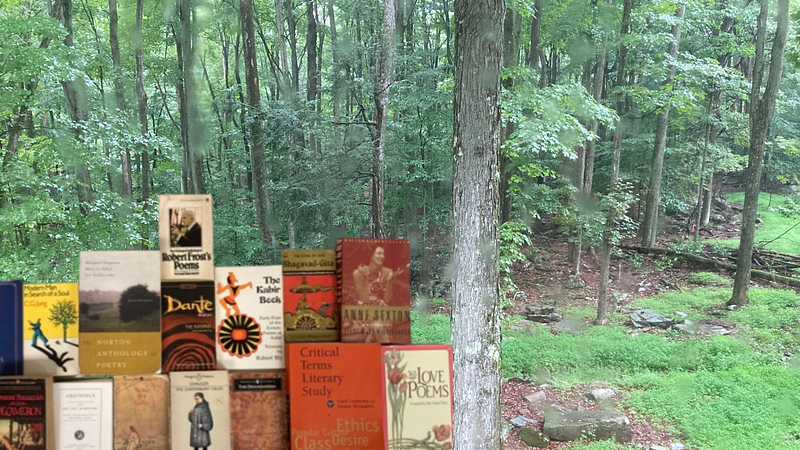
The author with fellow writers in his study overlooking his “Walden” in Lake Ariel, PA. Photo by author.

Check out more from Walter Bowne on The Masterpiece!

Reading
Writing
Literature
Poetry
Education
Recommended from ReadMedium