“READING” — WALDEN
Nurturing Deliberate Readers in a Modern Age
Exploring Thoreau’s Insights on Reading Amidst Distractions
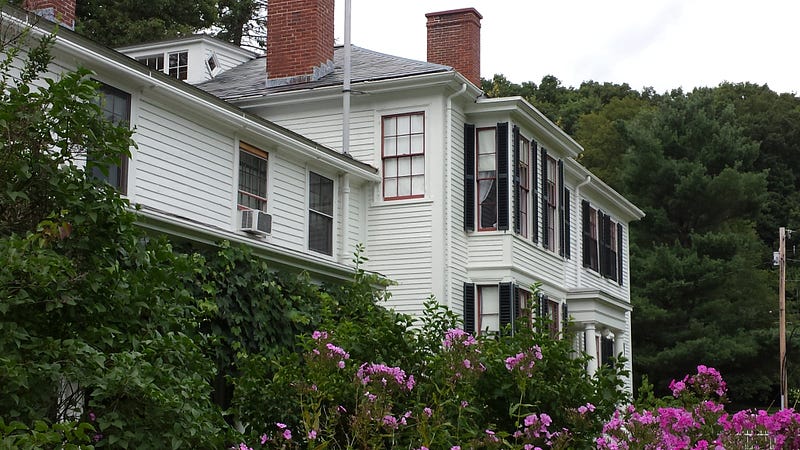
I selected quotes from Chapter 4 — “Reading” from Henry David Thoreau’s — Walden. (1854) On various quotes, I recorded my thoughts on “Reading” today — in bed — looking out to the woods.
Cultivating Deliberate Readers in a Distracted Age
“Books must be read as deliberately and reservedly as they were written.”
Okay — this doesn’t happen much anymore. Am I wrong? Please — I hope I’m wrong. Maybe my audience here is biased. Then, Amen!
As an English teacher for 24 years — “books being read deliberately?” Whoa — man, I wish.
I want students to read deliberately — like living deliberately. The secret, perhaps, is not to make reading such a fawwking chore — with notes and double entry journals and quizzes and tests. No wonder I hated English in high school. I just read what I wanted — and BS’ ed the rest for “exams.”
Reading and writing a book is very difficult — especially if treated as craft. Taking your time. Most of us do, I hope. Unless writing is a 5 minute blog. Much like masturbation and not love with a loving partner?
Sorry — too crude? Too close?
Writing a novel is bleeding tough — I know. I’m recording this essay because this is easier — and brings me more immediate endorphins than finishing my novels — and these essays are fun side trips, but may not be getting me to the Promise Land. New York. London.
Love and effort and work — hard work — hard edits — “killing your darlings” — goes into genuine writing. We need to read in the same vein. In our busy, hectic, anxious lives — even with time — yeah — it’s hard, brothers and sisters, right?
It has to be a priority. We can become very smart — as smart as Emerson who entered Harvard at 14 and read four languages. Thoreau did not have the Internet. There were no cell phones — no “Black Mirrors” to sap our humanity and attention into the Void.
But if technology is so great, how come education, not with everyone, mind you, is so low? We have the Library of Ancient Alexandria — the entire World — at our fingers — on the beach, bus, train, study, park bench.
And what occupies us? What consumes our precious moments on this rock hurling through space?
Reading and writing requires training — like athletes and musicians and actors. It is not enough to speak the language. That’s why so many English speakers have trouble, right?
So writes Thoreau —
“There is a memorable interval between the spoken and the written language — the language heard and the language read.”
This relates to traditional oral storytelling — and the ‘modern technology’ of writing — which, when it came out, Socrates disliked for many reasons. But that’s another essay.
The Enduring Impact of Great World Writers
“Books are the treasured wealth of the world and the fit inheritance of generations and nations.”
There’s a scene in The Great Gatsby that’s really funny. I still laugh — after having read the scene thousands of times. My students oftentimes don’t get it — they don’t get Fitzgerald’s satire.
The relatively minor character, The Owl Eyed Man, is relatively major to a theme in the novel. He’s drunk. He thinks a library will sober him. He’s been drunk for a week. He’s startled to find the books in Gatsby’s library are real. “With pages and everything.”
Of course for Gatsby, it’s all show. He’s a mobster. He doesn’t read — we can assume that. The Owl Eyed Man thought they’d be kind of some kind of sturdy cardboard. He shows Nick and Jordan and says —
“See!” he cried triumphantly. “It’s a bona-fide piece of printed matter. It fooled me. This fella’s a regular Belasco. It’s a triumph. What thoroughness! What realism! Knew when to stop, too — didn’t cut the pages. But what do you want? What do you expect?” (Fitzgerald 35).
So I ask the class:
What is the target of Fitzgerald’s satire?
The target — the fake and superficial (and largely uninterested individuals in education and learning) of the 1920s — the “Jazz Age” — a term he coined. This was when, at least in the major metro centers, it was about partying and sex and liberation and drinking and making money — think the musical “Chicago.”
But there was another life out there — and it’s these books — “the treasured wealth of the world.” And Fitzgerald had a foot firmly in each world — the World of the Endless Party (he died early from complications of alcoholism) and the World of Literature and Culture (being sober — and cleared eyed and wise — like an “owl” with “glasses.” To see better.
Eventually, my students are like, “Wow, Teacher Dude! Deep!”
Think of your culture. Think about your country. The Irish are immensely proud of its writers — and its Celtic history. Three of the most famous and critically acclaimed writers in three genres (novel, poetry, and drama) were all Irish — James Joyce, William Butler Yeats, and Samuel Beckett.
In France, when Victor Hugo died (June 1, 1885), there was a State funeral. The country closed down to honor such a writer.
“A black shroud veiled the Arc de Triomphe’s imperial glory; the light of gas lamps and electric streetlamps filtered lugubriously through the crêpe” (Paul Lafargue — Lit Hub)
Can you imagine any country today doing this for an artist? And how do I know this? — reading!
Nigeria has fantastic writers — Chinua Achebe who brought to my school’s curriculum and Wole Soyinka.
There are amazing authors in Columbia — Canada — Germany — Mexico — Australia — Persia — India — And just how essential was Miguel Cervantes not just to the development of the first novel in Western Culture — but to Spain?
And the great thing? I don’t need to be German to like Herman Hesse or Günter Grass or Goethe.
I can really detest the Russian leadership — well, a dictator, who unlike Napoleon, didn’t fight on the front with his troops. But my vitriol is not for the Russian people — suffering and dying under a former KGB officer. I could mention how small he is, but that would be wrong — an ad hominem attack.
Russian culture, under the yoke of so much oppression, gave us Pushkin, Tolstoy, Turgenev, Nikolai Gogol, Dostoevsky, Mikhail Bulgakov, Anton Chekhov — and some of the greatest composers — like Tchaikovsky, Sergei Rachmaninof, Igor Stravinsky, Sergei Prokofiev.
Of course none of these writers would have the intellectual freedom to publish as an Individual under a dictator like Stalin. What is Russia producing today?
Why did Vladimir Nabokov (one of my favs) have to leave his native Russia? He wrote in Russian in Berlin — and left Berlin (duh — I wonder why) — and then France until 1940 — and then came to the States in 1941.
Besides the kitchen at the House of Bowne, the library is our cornerstone (and in my classroom — Room 605) where I fill the shelves with books from Used Book Sales. It’s my own lending library — and if they forget to return, that’s okay — just how many books can fill a shopping bag for $5?
At any point I can take a book off the shelf, sit down, and read for 15 minutes — half an hour — an hour — and think about how much learning can be done? In such a short amount of time?
There’s something about a tangible relic in your hands — like having the Koran in your Hands rather than reading online. Or the Vedas. The Torah. It’s gold bars in your basement. The equivalent value may exist in Vanguard, but there’s nothing like holding a gold or silver bar.
The value can go up and down — but the value of books increases. The book may have cost $.25 at a book sale, but it may have taught you to change your life — to see humans as humans and not as cockroaches.
Gold bars cannot do such magic. It may be the reason so many are ruthlessly killed and slaughtered — for money and land and power. And authors can be the counterweight to aggression and greed — like Thoreau’s stance against The Mexican War and slavery.
I remember my daughter, Katherine, in middle school, reading “Rocket Girl.” That book — along with many others — inspired her — and like Thoreau writes in his “Conclusion” — place the foundation underneath your dream. That dream must always be first — and in the sky.
Now she’s an aerospace engineer — finishing her PhD at Georgia Tech. And I’ll be needing to call her Dr. Katherine — and she’ll only be 27. She’s currently working on collecting 28,000 pieces of space junk that orbits our skies — very dangerously for satellites and astronauts.
But books and novels cannot alter the thinking of everyone. If that was true, those in the South and North — reeping the rewards of cheap cotton — reading Uncle Tom’s Cabin would have to seriously reconsider that “peculiar institution of slavery” and using Christianity to support its horrors. So what were the consequences?
4% of America’s population died — 620,000 to 750,000 soldiers and civilians. Not to mention the destruction of the land and industry — and it’s a War we are still fighting —