
The Nonduality of Peter Brown
Raw Experience is the Fastest Way to Nondual Self-Realization
[Updated 10/16/22] We know nothing beyond our direct sensory perception, everything else is faith and fantasy.

Non-Medium subscribers can access this full article by clicking here.
Contents
[1] We Know Nothing Beyond Our Direct Sensory Perceptions — [1.1] Reality — [1.2] Fantasy — [1.3] Faith — [1.4] Direct Experience & Presence [2] Peter Brown — A Modern Nondualist — [2.1] What is Reality? — [2.2] The Fastest Way to Self-Realization [3] Related Resources
[1] We Know Nothing Beyond Our Direct Sensory Perceptions
What we directly perceive with our senses, before our judgmental mind kicks in, is the only true reality that each of us ever knows. That unconditioned reality is a very real experience. We know it because our senses directly perceive and experience it in every moment.
But just because our senses are always directly perceiving and experiencing reality, does not mean our mind is doing so. Everything beyond our direct sensory experience is a mix of fantasy and faith created by our mind. And, unfortunately, most of us spend a lot more of our time in fantasy and faith than in our direct experiences of.
[1.1] Reality
What we perceive with our eyes are energy particles (photons) or waves vibrating in the visible spectrum of the electromagnetic energy field. They appear in our field of vision as a mass of colors and shades of light and dark.
What we perceive with our ears are multiple and intermixing waves of energy vibrating the space surrounding us and our ear drums at different frequencies (speed), wavelengths (pitch), and amplitude (volume). Our ears transmit those vibrations to our brain, which interprets them as sound.
Our skin also senses vibrating energy as it touches our body, which our brain interprets as pressure and touch. Touch is the pressure sensation that occurs when vibrating atomic level particles resist one another. Because of that resistance, we never really touch anything.
Similar energetic and vibrating processes are involved with our smell and taste senses. Even our thoughts arise from an underlying field of emotional and psychological energy before coalescing into concepts and words.
Those energy fields are the foundation of physical reality. It does not matter whether our physical reality is ultimately an illusion. Our direct sensory experience is always one of a physical body in a physical universe.
And there is a universal energy that lies beneath each of the energy fields described above. It is the Source (or God) that enlivens all creation. It is in everything that exists and is inseparable from everything that exists. It is what we directly experience, and it is the very act of experiencing.
“Its energy is so unbelievable that it does indeed form all universes; and because its energy is within and behind all universes, systems, and fields, it is indeed aware of each sparrow that falls, for it is each sparrow that falls.” — Seth trying to define “God” in ‘The Seth Material’, by Jane Roberts (1970), chapter 18
Universal energy is where physics and spirituality come together. But we also do not know what it is. We cannot describe it because it is more than what any words (or numbers in physics) can describe.
When we try to examine what we perceive with our senses, we find infinity. There are infinite points of light in our field of vision. There are infinite points of sound in what we hear. And there are infinite touch sensations across and within our body.
“Just because we cannot understand it and describe it, does not mean reality does not exist.” — Peter Brown
Universal energy is as infinite and eternal as the universe. It is always present in our direct experience. That makes it inseparable from the consciousness or awareness of experiencing. We do not know what it is, but we can be it when we transcend our mind’s concepts and judgments about reality.
For more on the universal energy of creation, see…
[1.2] Fantasy
We cannot consciously comprehend all the sensory inputs that we receive, which are infinite in nature. So, our mind takes those vibrations and generalizes and simplifies them. It puts infinity into finite categories or boxes. Each has a label, most of which we learned in infancy and childhood.
In the next stage of simplification, we use those finite labels and boxes to imagine and create stories that stereotype what we see. It is easier to interact with a stereotype than with the real thing — we don’t need to think as hard. The stories are the beliefs we hold about who we are, who others are, what is real, and how our world/universe works.
In fact, anytime we use words to describe anything, we are placing a finite box around an infinite reality. That is impossible to do because, by definition, everything in an infinite reality is infinite. If any part of the reality was not infinite, then the reality overall would not be infinite.
Words are a major way we box things. As such, words can never grasp or encompass an infinite reality. That is why many spiritual teachers say our reality, and us, are all an unreal illusion. Illusion refers to the fantasies created by our mind.
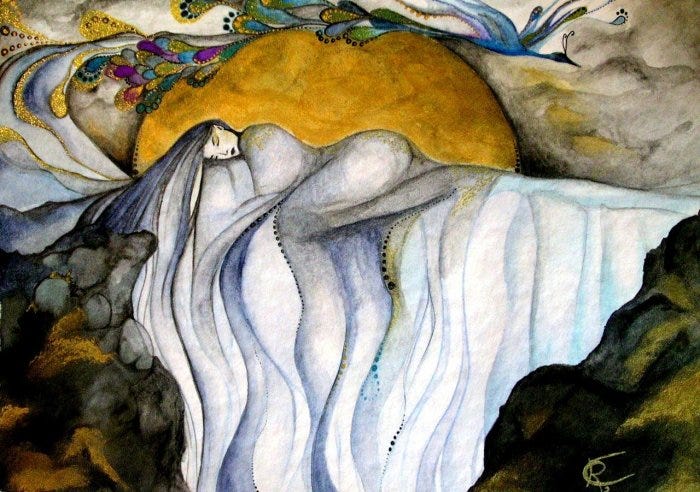
Spirituality has a much harder time talking about our direct sensory experience of reality because finite words can only point to the infinite.
For more on the impossible nature of spirituality, see…
[1.3] Faith
The spiritual problem we all face is learning to discern between our direct sensory experience and our mind’s fantasy experience. As newborn infants, we only knew direct sensory experience. As we grew, our society taught us to trust our boxes and over-simplifications more than what we directly perceived with our senses.
We came to have more faith in the finite boxes and stories than we do in the infinity of reality. We have forgotten how to have the reality of direct experience, which is raw and unfiltered by preconceived and simplified judgments.
We have flipped reality. We believe the fantasy is real, and we believe the real is not real. That is the source of human suffering.
Spiritual awakening is remembering how to know what is real and what is fantasy in our experience, and having faith in reality.
Reality is very easy to see. It is always being seen. Unreality is hard to let go of.
So, the challenge is not reality, in finding reality, seeing reality. The spiritual challenge is letting go of one’s delusion, letting go of one’s fantasies, and recognizing that one’s fantasies are not true, they aren’t actual. They are actual fantasies, but they aren’t actual descriptions of the nature of what is.
…It is impossible to see anything but reality.
… It [reality] is hard to recognize because the nature of what is is so utterly other than the kinds of linear concepts that people hold. — Peter Brown (YouTube link)
[1.4] Direct Experience & Presence
To return to our original knowing of reality (which is how some define enlightenment), we need to learn to distinguish between our direct and unfiltered real experiences and our unreal fantasy experiences and beliefs.
The ability to do that has always been with us because we never stop having a direct experience of the world around and in us. But we have covered it up with many filtered layers (or veils) of beliefs and fantasies.
In direct sensory experiences, we perceive an indescribable infinity and oneness in everything. In fantasy experiences, we see stories that limit and separate everything.
True spiritual practices dispel the filters and reveal the reality that is hidden right before us. (There are many spiritual practices that do just the opposite of that.)
“How could see me? All you ever see is light in your field of vision. The substance is actually the only thing you ever contact. You might say you saw Peter Brown, and he was this or that and the other. But all that is an abstraction. The only actuality that’s really present in your experience is a pattern of light, and in this case, a pattern of sound. … So, as far as you know, I am light and sound. And what exactly is light and sound?
… All that’s really happening is that raw energy present in experience. The mind can take it instantly and interpret it. … But none of that stuff [interpretations] is … what your experience actually is, which is a mysterious energy presence. Light and consciousness, sound and consciousness, touch and consciousness.
… You’ve never known anyone. All you’ve known is patterns of energy in your own experience.”
— Peter Brown (YouTube link)
[2] Peter Brown — A Modern Nondualist
The insights above are based on the teachings of the nonduality teacher, Peter Brown. I had not heard of Peter until just this past week, when a bunch of his talks from 2010 to 2013 appeared on a YouTube channel I subscribe to.
[UPDATE 9/2/22: Peter Brown (1951–2022). I saw on Facebook that Peter passed on yesterday. I have many more notes from the over 13 hours of his talks recently posted on YouTube (in 9 videos). I will probably write another article based on them.]
In my article on Radical Nonduality, I describe 3 types of Nondualism: Qualified Nonduality (Vishishta Advaita), Traditional Nonduality (Advaita Vedanta); a more Westernized Radical Nonduality (Neo-Advaita) (article below ⬇). Qualified Nonduality is the most flexible of 3 versions of Nonduality (above) and overlaps a lot with contemporary New Age spirituality beliefs.
Peter Brown falls in the Qualified Nonduality category of nondualism. (1) He occasionally mentions eastern traditions, but is clearly not teaching Advaita Vedanta; (2) He believes realization is a goal we can aspire to; and (3) He has a method to follow to reach enlightenment.
By contrast, Traditional Advaita Vedanta teachings are deeply tied to Hinduism (with similar forms in Buddhism). And extreme Radical Nondualists do not believe in enlightenment or any methods. In particular, a method implies there is someone to pursue the method. That is where things get tricky between Peter and Radical Nondualists. And it is the main reason I consider him a good example of a Qualified Nondualist.
For more on Qualified Nonduality, see…
For more on Radical Nonduality, see…
[2.2] What is Reality?
Radical Nondualists say all the reality we seem to know is an illusion, story, or fantasy. We are also an illusion and just a story. I think Peter would agree with that because all stories/fantasies/descriptions are beyond our direct sensory perceptions (as described above). He says those direct perceptions are the only real reality we can know.
Radical Nondualists typically describe experiences as simply “what is happening now”, which Peter also says. And they say we can never know what that is, which again Peter would agree with. There is only the indescribable, infinite emptiness (or nothingness) that is beyond all manifest (or phenomenal, or relative) reality, and is the source of all manifest reality.
That is the closest to describing who we are. He says realizing that is enlightenment, which is a Modern Nondualism perspective. (Enlightenment does not exist in Radical Nondualism.)
Peter also provides a technique, which is a kind of guided meditation to become aware of our pure, unfiltered, direct sensory experiences. That again is Modern Nondualism, rather than Radical Nondualism.
Radical Nondualism says because we do not exist, there is no experiencer having an experience. Peter says we are the experience that is happening right now. Some Radical Nondualists might agree with that.
But he has also said we are the consciousness of the experience happening right now. He may have misspoken when I heard that, as most Radical Nondualists would not agree because it sounds dualistic, with consciousness and experience being separate things. But many Modern Nondualists would agree with that statement because it refers specifically to the realm of experience in which there is some degree of duality.
Like all nondualists, Peter Brown believes in the absolute truth that all we know is really just one thing, an infinite and eternal oneness. Duality is an ever-changing illusion (or play, or maya).
For him, the one thing is the indescribable universal energy (as discusses in section [1.1] above]. It seems to have started with something like the big bang. And it is still exploding and expanding in our experience. Doing so, it enlivens our senses and creates the universal play in our minds.
He also refers to that energy as “transcendental radiance”, “transcendental presence”, and “radiant presence”. Everything we know is that infinite radiant energy, including the world/universe, life, death, good, evil, all animate and inanimate objects, and us.
Most Radical Nondualists would have no problem with that story, as long as it is seen as just a story.
“The universe is an ongoing explosion. That’s where you live. In an explosion. … When the explosion explodes hard enough, dust wakes up and thinks about itself. And then writes about it.”
— Cryptonaturalist, on Facebook and Tumbler
The quote above, along with Peter Brown’s teachings, inspired this article:
[2.2] The Fastest Way to Self-Realization
Peter Brown says that practicing direct perception (he also calls it presence and the Yoga of Radiant Presence) is the fastest way to spiritual self-realization that he knows of.
In one analogy, he likens our visual experience to the flashes of light that illuminate a movie screen. In actuality, they are only flashes of light that are made to appear in certain changing patterns. That is our direct sensory experience of the movie. But from those flashes of light, our mind imagines and creates people, objects, and stories, none of which is an inherent feature of the light itself.
That is the same way our mind creates our image of reality (our fantasy reality). Using our body’s sensing of reality, our mind creates the play of our existence on the movie screen of our consciousness.
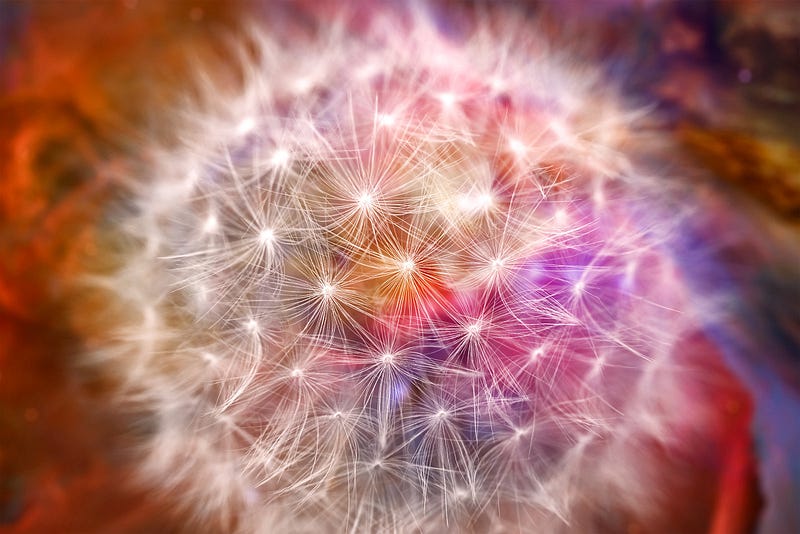
We experience true reality when we perceive raw universal energy, with no pattern and no story, before we apply any forms and labels.
Peter says we can do that by simply looking closer at what our senses perceive in the present moment. We are always only experiencing the present moment, so, theoretically, that would be easy to do. But it requires being able to distinguish between what is a direct experience and what is a belief (or fantasy).
For example, nothing we call the past is ever in the present moment. We only know what exists in the present moment. The past is always a story (or fantasy) that we create but can never directly experience.
By going closer into the present experience for each of our senses, we eventually realize that all sensed things are infinite and beyond description. We can never pin them down. We can never fully know what they are. That is because as soon as we apply any description or attempt at understanding, they are in the past and not in the present moment. They have become a fantasy.
Peter suggests our experience, our reality, and our consciousness are all the same thing. We sense that each of these exist, but we cannot experience them as separate things.
In addition, my consciousness is the only consciousness I can confidently know exists in my experience. I am the sole observer of all that I perceive in the present moment. There seem to be others out there, but I can never absolutely know that they are conscious in the same way I am.
Finally, if something is not in my experience, then it is not in my reality. It can be in my imagination, but I cannot know it in my direct experience. If I am not home, then my home is not in my experience — it is only in my fantasy, imagination, or story. Who I was yesterday is not in my direct experience — it is only in my fantasy, imagination, or story.
“The foolish reject what they see, not what they think. The wise reject what they think, not what they see.” — Ch’an/Zen Monk Huangbo Xiyun
Those are ways of inquiring into direct perception and presence. And those inquiries, in which we use our senses and direct present experience, are the easiest path to spiritual self-realization/enlightenment, according to Peter Brown.
Once that understanding is realized, then we see the forms of our world, including ourselves, as the infinite oneness that they truly are. We experience them directly, without any filters.
He suggests that perceiving everything as infinite and indescribable can wean us from our stories, or what some call our conditioned responses. (I talk about how our conditioned responses is our karma in this article.)
In another analogy, Peter says that spiritual understanding is like how quantum physics, by seeking the smallest particles, has given us new insights and appreciation of the nature of physical phenomena. Those insights have not changed our sensory experience of physical reality, just our appreciation of it.
Similarly, spiritual self-realization gives us a new understanding of reality and our existence. Our sensory experience of reality stays the same. But we now have a fuller appreciation of what reality is and who we are. (That is a very common definition of Nondual liberation and enlightenment. But there are other definitions.)
“Attend to what is directly before you. You have no responsibility to save the world or find the solutions to all problems — but to attend to your particular personal corner of the universe. As each person does that, the world saves itself.” — Seth/Jane Roberts, ‘Dreams, “Evolution,” and Value Fulfillment’, volume 1, p.12.
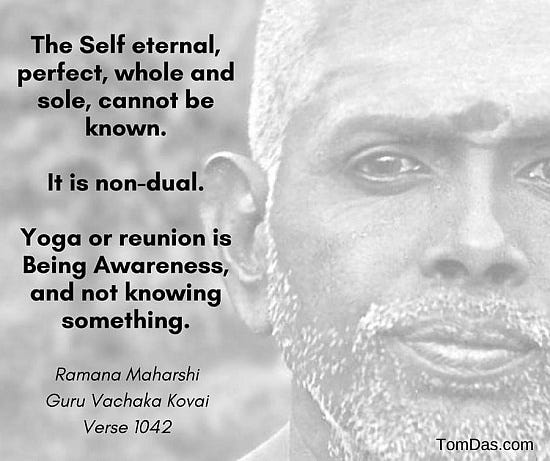
The Yoga of Radiant Presence is the name Peter Brown uses to describe his teachings. This quote ⬇ from Sri Ramana Maharshi seems to describe what that is…
[3] Experience in Vedanta
[Update added 10/16/22]
In Vedanta Hinduism, experiences arise when consciousness encounters objects. Consciousness is universal. It is the light or energy that fills all reality. (Panpsychism is how contemporary philosophers are currently attempting to grasp the universality of consciousness.)
As objects arise in the light of consciousness, experiences arise. Objects include physical things and nonphysical thoughts and emotions. In this way, our brain can be seen as an object around which the experiences of thoughts and emotions arise in our consciousness.
Different schools of Vedanta hold different beliefs about the reality of objects. They all believe that objects are maya (illusions) created by the 3 gunas or energetic forces of manifest reality. The gunas are tamas (contraction), rajas (expansion), and sattva (balance). Duality (Dvaita Vedanta) teachings say they are real, while Nonduality (Advaita Vedanta) teachings say they are not real.
The Vedanta definition of “experience” gives additional insights into Peter Brown’s “raw experience” in terms of: (1) Objects and (2) Consciousness.
Anything can be an object.
Peter emphasizes the smallest objects that our senses can perceive, which he calls “raw”. That includes particles of light and waves of sound, for example. But there are smaller objects beyond our perception (such as cells and atoms), which he also mentions. And there are larger objects that are human scale, and beyond human scale (such as our planet and galaxy).
And there are non-physical and subtle objects (such as thoughts and intuition). As Vedanta says, whenever we are aware of experiencing something, we are consciousness engaging with an object that is not consciousness. That is always the case.
Consciousness is full of experience, except when it is not.
Peter emphasizes that our experiential fields are always completely full of experiences. We have many experiential fields: visual, sound, touch, thought, and more. The only time our experiential fields are not full is in deep sleep or some other unconscious state where there are no objects to give rise to experiences.
Vedanta says consciousness is always present and permeates all reality. Pure consciousness also exists in deep sleep, but there is no experience of that because, again, there are no objects to give rise to experiences.
It does not matter if experiences are real or not.
Peter Brown emphasizes the reality of our direct or raw experiences (unfiltered by our thinking mind). In that sense his teachings are based in duality (an experiencer having an experience).
But the Vedanta teachings show that in any experience, there is no separation between the experiencer (consciousness) and the objects of experience. They arise together and are inseparable. That is also what Peter Brown is trying to communicate. And that is why he is considered a Nonduality teacher.
Experiences are objects arising in consciousness. If we see those objects as separate from us, then we are in a duality state of consciousness (or mind). If we see those objects as not separate from us, then we are in a nonduality state of mind (or consciousness). Either way, the same object and experience arises. Only our consciousness is different.
“Before awakening, chop wood, carry water. After awakening, chop wood, carry water.” — Zen/Ch’an Buddhist koan
[4] Related Resources
- [4.1] I listened to over 6 hours of Peter Brown (1951–2022) in putting this article together. Here ⬇ is the first of a 10-part series (9 videos ranging 1.5 to 5+ hours long) posted in mid-August 2022 on the Nonduality Podcast on YouTube. Also see his webpage.
- [4.2] As I was working on this article, one of my favorite Modern-Traditional Advaita Nonduality teachers, Roger Castillo, posted this satsang ⬇ on YouTube. He talks a lot about the same issues that I discuss above, especially in the 2nd half Q&A portion of the video. So I include it here for complementary perspective. (This has happened in the past. There seems to be some kind of synchronistic connection between my writings and Roger.)
- [4.3] This is a meditation (starting with a poem I wrote) that might help guide you into raw experience…
- [4.4] This article includes other methods to directly experience infinity…
- [4.5] I wrote this poem in September 2020 that very much aligns with the message of “raw experience”…
- [4.6] Peter Brown occasionally speaks of Zen Buddhism. This article describes a Zen perspective on direct experience:
- [4.7] For more on Nonduality (Advaita), see this collection of articles. Note that the articles in this collection are behind the Medium paywall. For paywall-free access to my articles go to www.AlanLew.com, linked below.
Contact
- I am not financially affiliated with any of the people or products discussed in this article.
- I appreciate comments, questions, and typo corrections. - See the About link in my Medium profile for contact information and related articles.
- Written in collaboration with my Energy Group/Higher Self. This is our perspective of the truth and not the whole truth of reality.
My Medium writings are available “paywall free” at www.AlanLew.com:
- follow my Facebook page linked to my Medium writings
- subscribe to My Medium Writings
- become a Medium member to support my writings
Visit and Follow New Earth Consciousness (NEC) for More Articles like this.
- Subscribe New Earth Consciousness NEWS, the occasional newsletter for NEC
- And Join our New Earth Consciousness Group on Facebook


