avatarAvi Kotzer

Free AI web copilot to create summaries, insights and extended knowledge, download it at here

3355

Abstract

vidae. What distinguishes New World deer from Old World deer has to do with a bone or two in their ankles or feet, something that I’m sure fascinates taxonomists, but me… not so much.</p><p id="7434">Now, even though the <i>pudu’s</i> subfamily is known as the New World deer, it includes members such as the reindeer and moose, both of which live in Europe and Asia, or the “Old World”. You think that’s confusing? One of the New World Deer is the gray brocket, also known as the… brown brocket.</p><figure id="50f3"><img src="https://cdn-images-1.readmedium.com/v2/resize:fit:800/1*i8rz9dI1-Fh0wclfzc3_tQ.png"><figcaption>Photo by Miguelrangeljr</figcaption></figure><p id="0bd4">Gray or brown? What color do you see? Maybe we can turn this deer into the next “White & Gold/Blue & Black dress” viral hit!</p><p id="1139">As I mentioned before, there are two types of <i>pudus. </i>The southern pudu has the boring scientific name of <i>Pudu puda</i> and is the bigger of the two (35 to 45 cm [14 to 18 in] tall at the shoulder and 6.4 to 13.4 kg [14 to 30 lb] in weight). It also likes to pose majestically for photos:</p><figure id="d797"><img src="https://cdn-images-1.readmedium.com/v2/resize:fit:800/0*wDWdXEDN2Qd62L7s.jpg"><figcaption>Photo by D. Gordon E. Robertson</figcaption></figure><p id="e158">Meanwhile, the poor tiniest of deer, the northern <i>pudu</i>, seems to throw you a look that says, “Oh, great, yet another tourist looking to take a picture of me. Woo-hoo!”.</p><figure id="3fef"><img src="https://cdn-images-1.readmedium.com/v2/resize:fit:800/0*nJxwdOw2RD_L1KDh.png"><figcaption>Photo by Eider Joselito Chaves Chaves</figcaption></figure><p id="a8d2">Oh, and for some reason the above animal was designated as <i>Pudu mephistophiles </i>by scientists. Yeah, you read that right. Mephistopheles. As in, the <b>devil</b>.</p><p id="eb03">Maybe <i>pudus</i> were <b>bedeviling</b> zoologists because they are solitary, shy animals, very secretive about their habits in the wild. This is what the 1911 Encyclopedia Britannica had to say about them:</p><blockquote id="d0f6"><p>“Skull and metacarpals generally as in <i>Mazama</i>; size very small; hair coarse and brittle; antlers in the form of short, simple spikes; cannon-bones very short; tail very short or wanting; no whorls in the hair of the face; face-gland moderately large, and gland-pit deep and oval; tarsal and metatarsal glands wanting; ectocuneiform bone of tarsus united with the naviculocuboid. South America.”</p></blockquote><p id="1dc5">And this is what the current Britannica explains, more than one hundred years later:</p><blockquote id="9b70"><p>“Two species of the tiniest deer, the pudu (genus <i>Pudu</i>), standing only 30 cm (12 inches) at the shoulder, live far apart in the central Andes and southern Chile.”</p></blockquote><p id="d912">It seems zoologists’ knowledge about this animal actually <b>decreases</b> as time goes on.</p><p id="35e6">Wikipedia does have an <a href="https://en.wikipedia.org/wiki/Pud%C3%BA">entry</a> about these tiniest of deer, but because of Wikipedia’s ill-deserved reputation and the supposed lack of knowledge regarding <i>pudus</i>, the entire article may have been made up. They have provided the wonderful pictures I’ve used in my column today, so I shouldn’t complain. Here’s another one:</p><figure id="d

Options

ee1"><img src="https://cdn-images-1.readmedium.com/v2/resize:fit:800/0*d4GpoxQWQerqmjK6.jpg"><figcaption>Photo by Andrzej Barabasz (Chepry)</figcaption></figure><p id="af25">The above was described as a “small <i>pudu</i>”, a phrase which I’ve officially submitted to the Department of Redundancies Department.</p><h2 id="392d">Other Pudus</h2><p id="9a81">I found a few other <i>pudus</i>, but obviously they can’t be included in today’s Spelling Bee list of words because they all begin with a capital “P”, being the proper nouns that they are.</p><ul><li>The <b>Pudu River</b> (Chinese: 普渡河; pinyin: <i>Pǔdù Hé</i>) is a major river in Yunnan Province in southwest China. There are a couple of theories related to the river’s name. One claims Pudu (普渡) is a slogan from Buddhism Classics that means “helping people get out of sorrows and troubles”. The other theory says “Pudu” may refer to “a ferry ran by Pu’s family”. Hmmm…</li><li><b>Pudu</b> is a census town in Dakshina Kannada district in the Indian state of Karnataka. And because it’s a census town, we would be remiss if we didn’t mention the results of the latest census: in 2001 Pudu had a population of 12,409.</li><li><b>Pudu</b> (Chinese: 富都, alt. 半山芭) is a ward of Kuala Lumpur located along a road named Pudu. It has a bus station named… Pudu, a market named…Pudu, and it used to have a prison named… Pudu.</li></ul><p id="2ab9">Well, okay, those were probably not as interesting — or cute–- as the <i>pudus</i> with a lowercase “p”. And here’s another picture to prove just how cute <i>pudus</i> are:</p><figure id="6478"><img src="https://cdn-images-1.readmedium.com/v2/resize:fit:800/0*suOToNjwF0_IcsuT.jpg"><figcaption>Photo by Rodrigo Fernández</figcaption></figure><p id="4371">Despite all this cuteness, the aloof <i>pudu</i> could not catch the attention of the aloof editors of the Spelling Bee, who decreed that this word<i> </i>is a <a href="https://www.merriam-webster.com/words-at-play/dord-a-ghost-word"><b>dord</b></a><b>.</b></p><p id="ebef">You can check out my previous entry on another <b>dord </b>here:</p><div id="2250" class="link-block"> <a href="https://readmedium.com/rata-24724d8eb87e"> <div> <div> <h2>Rata</h2> <div><h3>The man… the myth… the tree?</h3></div> <div><p>medium.com</p></div> </div> <div> <div style="background-image: url(https://miro.readmedium.com/v2/resize:fit:320/0*C-NAUGt15B5Arwrq.jpg)"></div> </div> </div> </a> </div><p id="2a6f">*What the heck is a <b>dord, </b>you ask? Here’s the answer:</p><div id="1078" class="link-block"> <a href="https://www.merriam-webster.com/words-at-play/dord-a-ghost-word"> <div> <div> <h2>'Dord': A Ghost Word</h2> <div><h3>One of the questions people like to ask lexicographers is this: Can you sneak something into the dictionary? Can you…</h3></div> <div><p>www.merriam-webster.com</p></div> </div> <div> <div style="background-image: url(https://miro.readmedium.com/v2/resize:fit:320/0*V5Isgr6JLmc3xgBj)"></div> </div> </div> </a> </div></article></body>

Pudu

This deer is so small that the Spelling Bee didn’t even see it!
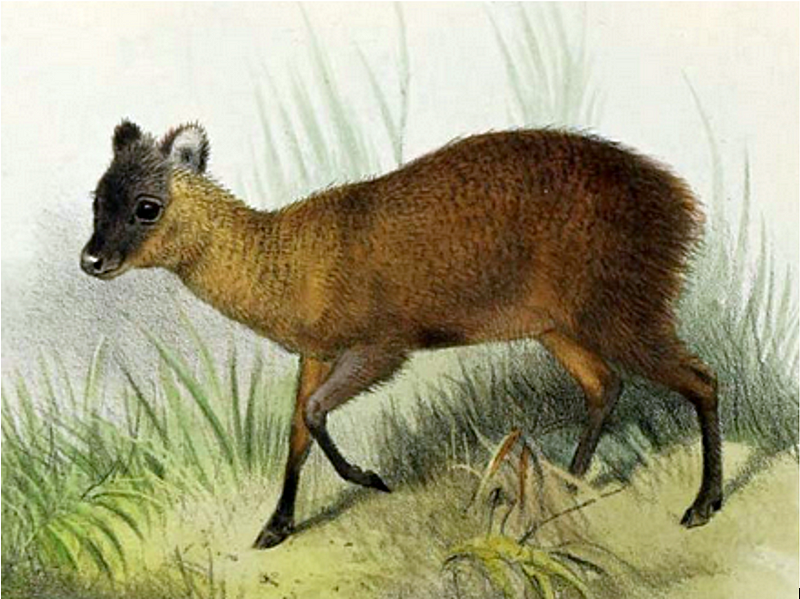
Illustration by Richard Lydekker

Today’s New York Times Spelling Bee letters:
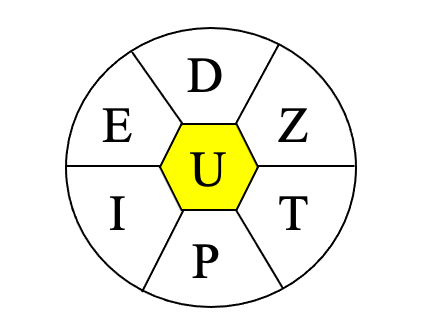
Art: Iva Reztok

D, E, I, P, T, Z, and center U (all words must include U)

Merriam-Webster says…
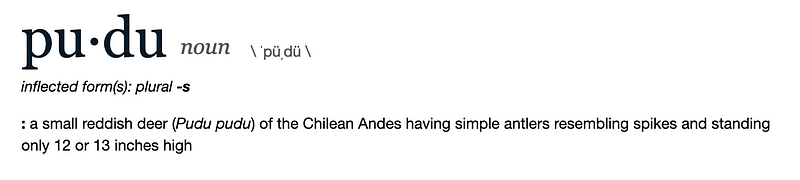
Credit: merriam-webster.com

Silly little dictionary! Don’t you know that pudu can’t possibly be a word if the New York Times says it ain’t?

For further fascinating facts, check out the Spelling Bee Master.

What’s your favorite dord* from today’s puzzle?

My Two Cents

In Spanish the word pudu carries an accent mark on the second “u”: pudú. Could that be the reason the New York Times refused to include this word in today’s Spelling Bee? Or could it be another instance of discrimination against smaller versions of regular animals, like with oribi five days ago?

As an interesting aside, that accent mark over the u (´) is called a tilde in Spanish. That word is also used to refer to the squiggly line placed over the “n” in Spanish (ñ) to create the \nʸ\ sound. Like in señor, which is pronounced senyor, with the “n” and “y” said quickly one after the other: se-nyor.

In English, however, tilde refers only to the squiggly line and not the diagonal accent mark. That squiggly line is used in logic to symbolizes negation, and in math to indicate the geometric relation “is similar to” as well as “an approximate value”.

The devil made me do it

The word pudu comes from the Spanish pudú, from the Mapuche (indigenous peoples of Chile and Argentina) word… püdü. So, simply the same word that switched diacritical marks and then lost them completely.

The genus Pudu was erected by John Edward Gray, which is not as dirty as it sounds when you realize that erecting in taxonomy means “setting up a category”. John Edward, or JEG, as he was known to no one ever, didn’t set foot in Chile, Argentina, Venezuela, or Colombia, where the two species of pudu roam. But he did work at the British Museum for fifty years, during which he wrote nearly 500 papers, including many descriptions of newly-discovered species that were being presented to the museum by collectors from around the world.

Pudu are “New World” deer and, as such, belong to the subfamily Capreolinae of the actual deer family Cervidae. What distinguishes New World deer from Old World deer has to do with a bone or two in their ankles or feet, something that I’m sure fascinates taxonomists, but me… not so much.

Now, even though the pudu’s subfamily is known as the New World deer, it includes members such as the reindeer and moose, both of which live in Europe and Asia, or the “Old World”. You think that’s confusing? One of the New World Deer is the gray brocket, also known as the… brown brocket.
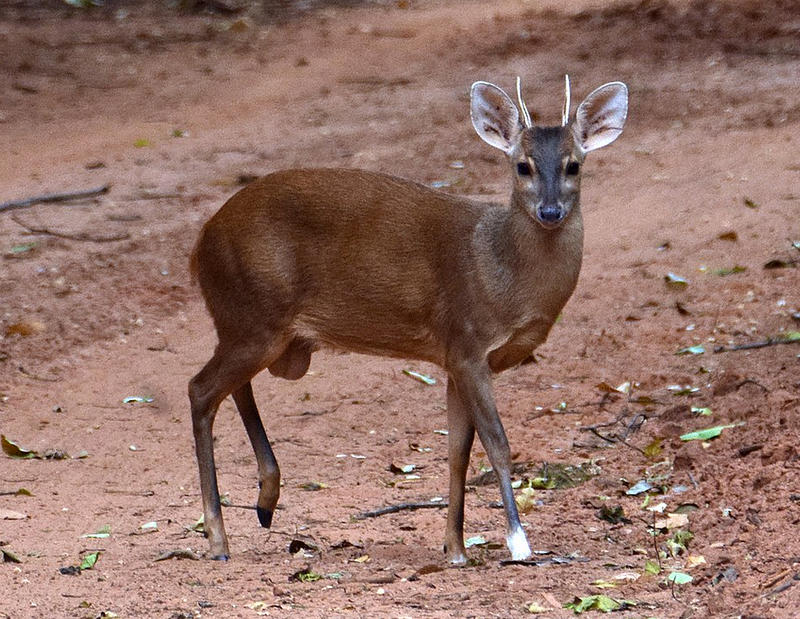
Photo by Miguelrangeljr

Gray or brown? What color do you see? Maybe we can turn this deer into the next “White & Gold/Blue & Black dress” viral hit!

As I mentioned before, there are two types of pudus. The southern pudu has the boring scientific name of Pudu puda and is the bigger of the two (35 to 45 cm [14 to 18 in] tall at the shoulder and 6.4 to 13.4 kg [14 to 30 lb] in weight). It also likes to pose majestically for photos:
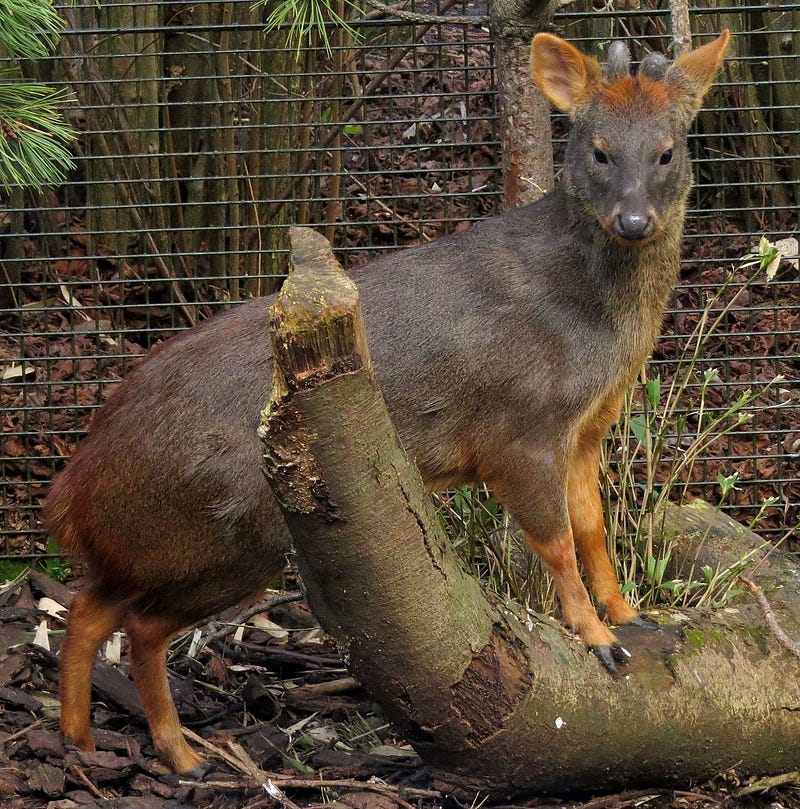
Photo by D. Gordon E. Robertson

Meanwhile, the poor tiniest of deer, the northern pudu, seems to throw you a look that says, “Oh, great, yet another tourist looking to take a picture of me. Woo-hoo!”.
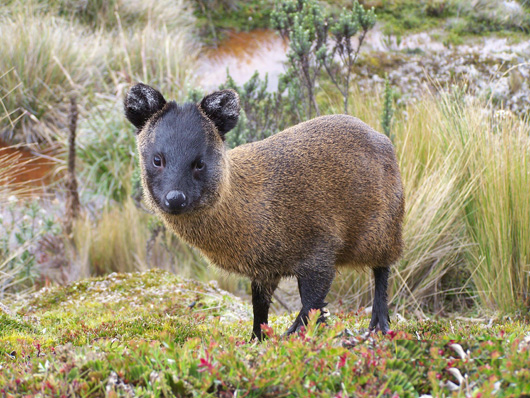
Photo by Eider Joselito Chaves Chaves

Oh, and for some reason the above animal was designated as Pudu mephistophiles by scientists. Yeah, you read that right. Mephistopheles. As in, the devil.

Maybe pudus were bedeviling zoologists because they are solitary, shy animals, very secretive about their habits in the wild. This is what the 1911 Encyclopedia Britannica had to say about them:

“Skull and metacarpals generally as in Mazama; size very small; hair coarse and brittle; antlers in the form of short, simple spikes; cannon-bones very short; tail very short or wanting; no whorls in the hair of the face; face-gland moderately large, and gland-pit deep and oval; tarsal and metatarsal glands wanting; ectocuneiform bone of tarsus united with the naviculocuboid. South America.”

And this is what the current Britannica explains, more than one hundred years later:

“Two species of the tiniest deer, the pudu (genus Pudu), standing only 30 cm (12 inches) at the shoulder, live far apart in the central Andes and southern Chile.”

It seems zoologists’ knowledge about this animal actually decreases as time goes on.

Wikipedia does have an entry about these tiniest of deer, but because of Wikipedia’s ill-deserved reputation and the supposed lack of knowledge regarding pudus, the entire article may have been made up. They have provided the wonderful pictures I’ve used in my column today, so I shouldn’t complain. Here’s another one:
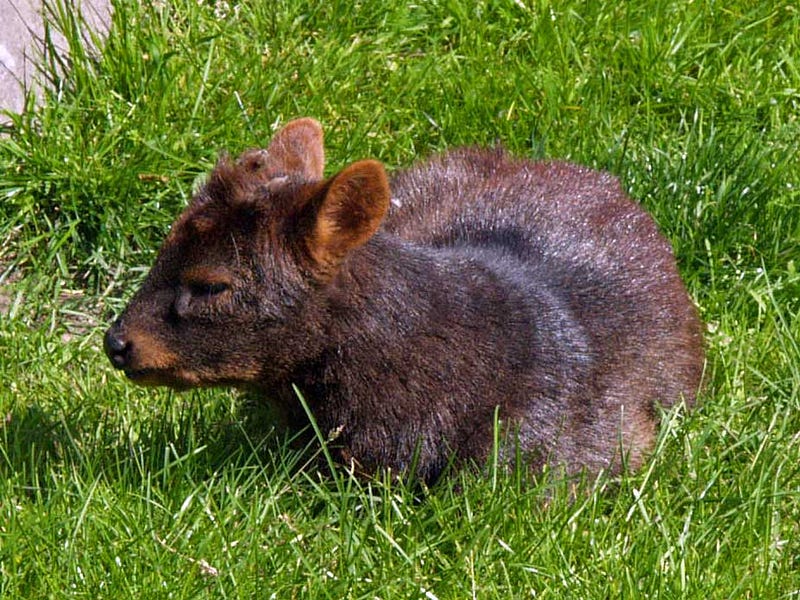
Photo by Andrzej Barabasz (Chepry)

The above was described as a “small pudu”, a phrase which I’ve officially submitted to the Department of Redundancies Department.

Other Pudus

I found a few other pudus, but obviously they can’t be included in today’s Spelling Bee list of words because they all begin with a capital “P”, being the proper nouns that they are.

  • The Pudu River (Chinese: 普渡河; pinyin: Pǔdù Hé) is a major river in Yunnan Province in southwest China. There are a couple of theories related to the river’s name. One claims Pudu (普渡) is a slogan from Buddhism Classics that means “helping people get out of sorrows and troubles”. The other theory says “Pudu” may refer to “a ferry ran by Pu’s family”. Hmmm…
  • Pudu is a census town in Dakshina Kannada district in the Indian state of Karnataka. And because it’s a census town, we would be remiss if we didn’t mention the results of the latest census: in 2001 Pudu had a population of 12,409.
  • Pudu (Chinese: 富都, alt. 半山芭) is a ward of Kuala Lumpur located along a road named Pudu. It has a bus station named… Pudu, a market named…Pudu, and it used to have a prison named… Pudu.

Well, okay, those were probably not as interesting — or cute–- as the pudus with a lowercase “p”. And here’s another picture to prove just how cute pudus are:
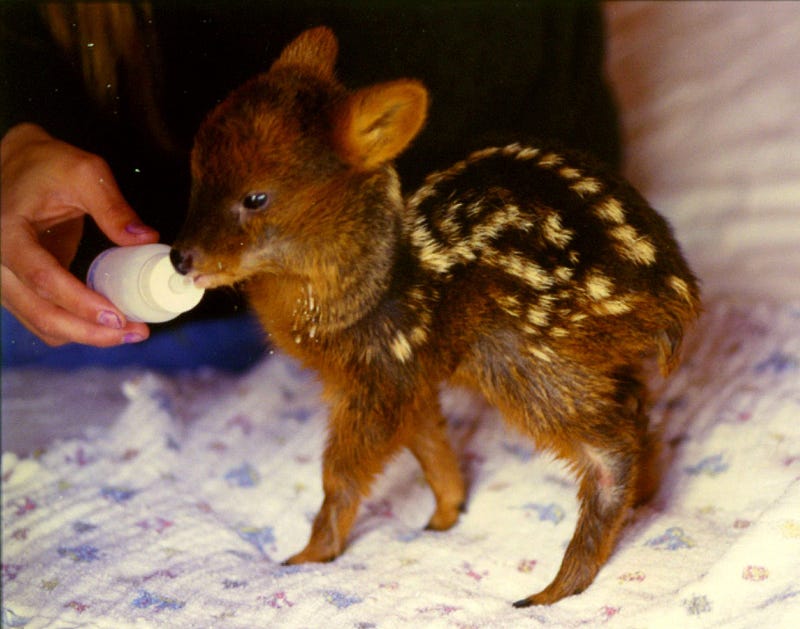
Photo by Rodrigo Fernández

Despite all this cuteness, the aloof pudu could not catch the attention of the aloof editors of the Spelling Bee, who decreed that this word is a dord.*

You can check out my previous entry on another dord* here:

*What the heck is a dord, you ask? Here’s the answer:

Spelling Bee
Language
Animals
South America
Science
Recommended from ReadMedium