
Oribi
Not an irregular plural, yet still rejected by the Spelling Bee
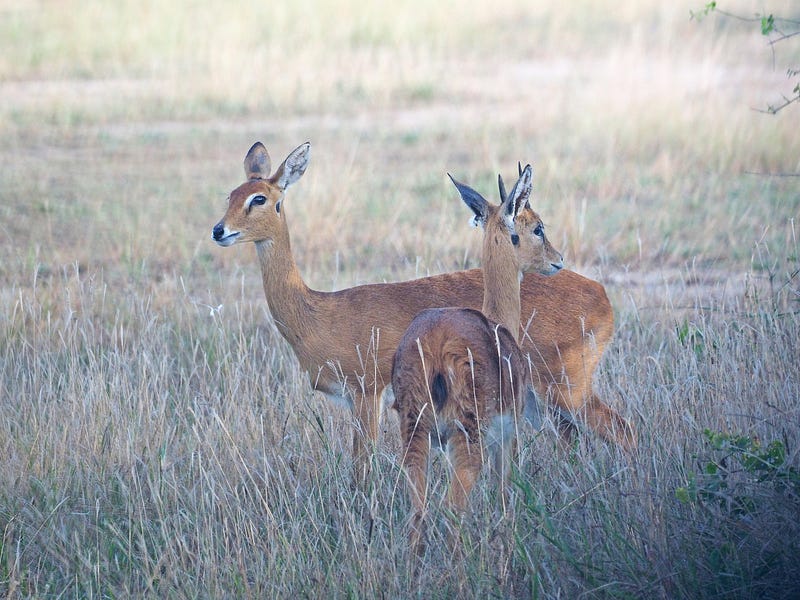
Today’s New York Times Spelling Bee letters:
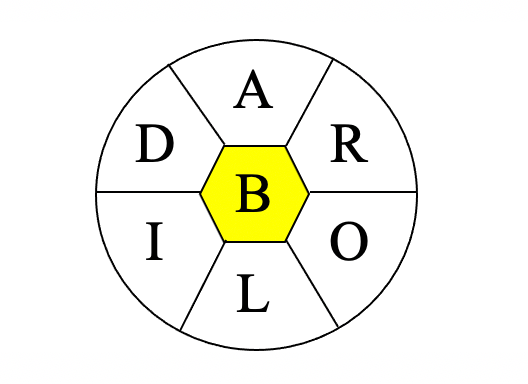
A, D, I, L, O, R, and center B (all words must include B)
Merriam-Webster says…
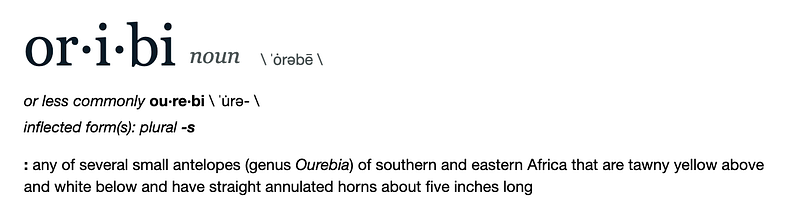
Silly little dictionary! Don’t you know that oribi can’t possibly be a word if the New York Times says it ain’t?
For further fascinating facts, check out the Spelling Bee Master.
What’s your favorite dord* from today’s puzzle?
My Two Cents
I tease and kid the New York Times and the Spelling Bee in this column. Exaggeration forms part of that, like when I implied in this article’s subtitle that the Spelling Bee does not like irregular plurals. I’ve seen radii (plural of radius) accepted as a word, and I think croci (plural of crocus) makes an appearance every so often, too. Or is it cocci (plural of coccus)? Or both? Well, octopi (plural of octopus) has. I’m sure of it!
In any case, oribi is not an irregular plural. And the plural of oribi — in case you were wondering — is the very regular oribis.
Dwarf antelope
According to the Encyclopedia Britannica, the oribi (Ourebia ourebi) is the only dwarf antelope. Fortunately, it has not been forbidden from contacting other antelopes by scientists, as they did with the dwarf planet Pluto.
The common name oribi comes from the Afrikaans word oribi, which probably derived from the Hottentot arab.
This ruminant that measures less than 30 inches (75 cm) at the shoulder and weighs less than an overstuffed vacation suitcase was first described in 1783 by Eberhard August Wilhelm von Zimmermann, a German geographer, zoologist, and believer in very long names.
The oribi has a slightly raised back, long neck and limbs, and a yellowish-brown coat with white underparts and rump. Males are usually smaller than females and have horns.
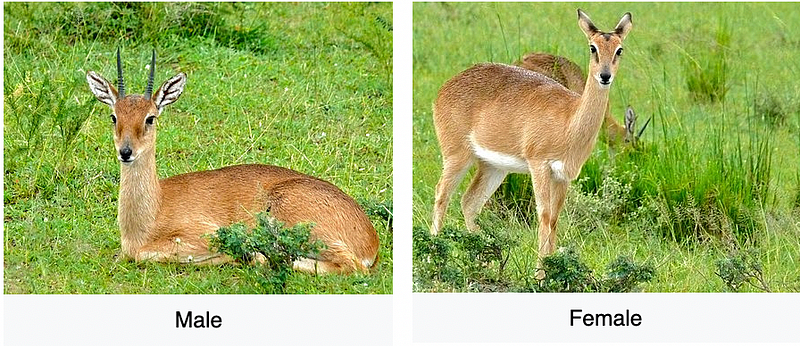
The oribi has been classified as Least Concern by the International Union for Conservation of Nature (IUCN), which I guess means not many scientists give a crap about this dwarf antelope. Not surprising, since that’s the same attitude they display towards the dwarf planet Pluto.
I mean, look how cute this young dwarf antelope is!
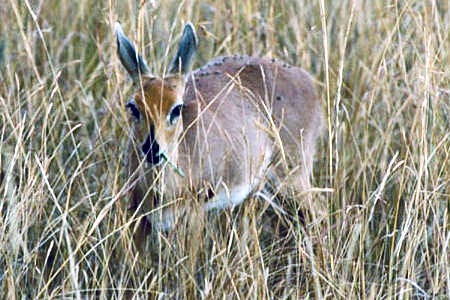
How can they not care?
One of the interesting, yet stinky, facts about oribis is that they form dung middens. These are also known as dung hills, poopie piles, scat stacks… well, you get the idea. Dung middens are piles of crap that some mammals return to and build upon. I’m not kidding. These mountains of mierda serve as territory markers. One of the best-known “dung middener” is the rhino.
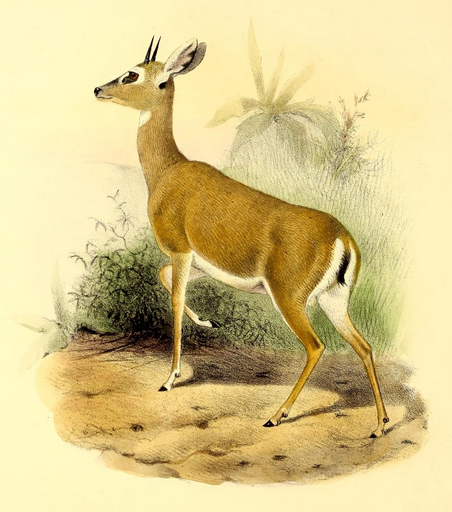
You know who cared about oribis? Philip Sclater. Look at this beautiful illustration he did in 1894 or thereabouts:
The Britannica’s current entry on oribis is much more extensive than it was in the 1911 edition:
ORIBI, or Ourebi, the local name of a small South African antelope (Oribia scoparia), standing about 24 in. at the shoulder, and characterized by the presence of a bare glandular spot below the ear, the upright horns of the bucks, which are ringed for a short distance above the face, and the tufted bushy tail, of which the terminal two-thirds are black. The name is extended to include the other members of the same genus, such as the Abyssinian, O. montana; the Gambian, O. nigricandata; the British East African, O. haggardi; and the Mozambique, O. petersi.
That’s it. One paragraph, fewer than 100 words. (Clearly they didn’t care either about the dwarf antelopes in 1911.)
Notice anything interesting, though? The species nomenclature changed from scoparia to ourebi. Also, the fact that the 1911 edition lists other members of the same genus, presumably implying they are species.
But today the Ourebia ourebi is considered to be the sole member of its genus.
Which brings us to…
Go forth and subdivide
In the complicated and complex world of biological classification, subspecies refers to two or more types of one species that have distinct physical characteristics. Unlike The Highlander, there cannot be only one.
For example, the leopard is classified as Panthera pardus, while the African leopard is called Panthera pardus pardus. The Indian leopard is Panthera pardus fusca, the Javan leopard is Panthera pardus melas, and so on.
You may have noticed a pattern. First, the scientific name now has three elements instead of just two (the usual genus followed by species). Secondly, the nominotypical subspecies — that is, the one that got described first — is the one in which the species name is repeated. So, in the leopard’s case, the African subspecies is the nominotypical one, as pardus is repeated: Panthera pardus pardus.
Since our friend with the long name (let’s just call him Zimmermann to save time and effort; hmmm, that didn’t work out too well; oh, anyway…) was the first to describe the oribi, the original subspecies is known as Ourebia ourebi ourebi, or O. o. ourebi. So when your coworker writes in an automated email reply that they are OOO, they may just be saying they’ve gone out to check on some dwarf antelopes frolicking about.

Clearly your coworker cares more about oribis than most scientists do.
Now, of the eight extant subspecies of oribi, Colin Groves and Peter Grubb identified O. o. hastata, O. o. montana, O. o. ourebi, and O. o. quadriscopa as independent species in 2011.
I, for one, trust these humble, short-named zoologists.
But I can’t seem to trust the editors of the Spelling Bee, who, like many scientists, are least concerned about dwarf antelopes… which is why they decided that oribi is a dord.*
You can check out my previous entry on another dord* here:
*What the heck is a dord, you ask? Here’s the answer:


