
Kraal
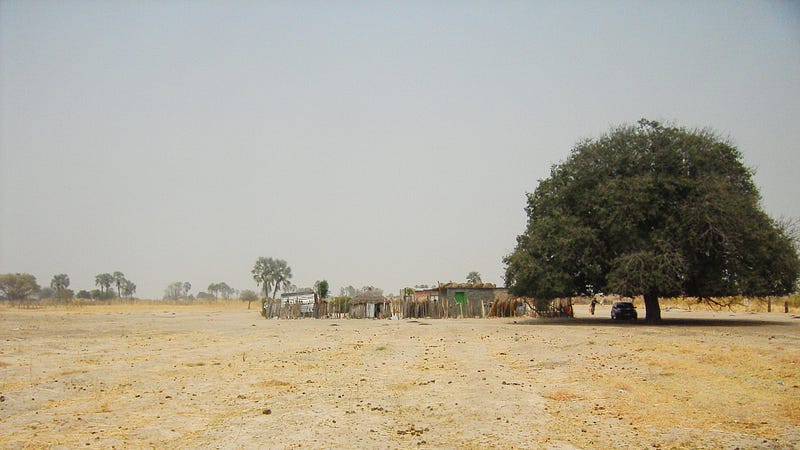
It might take a village to convince the Spelling Bee this is a word
Today’s New York Times Spelling Bee letters:
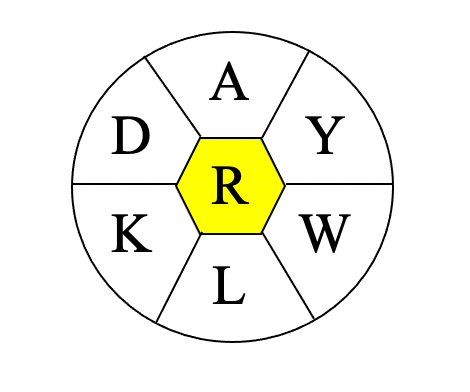
A, D, K, L, W, Y, and center R (all words must include R)
Merriam-Webster says…
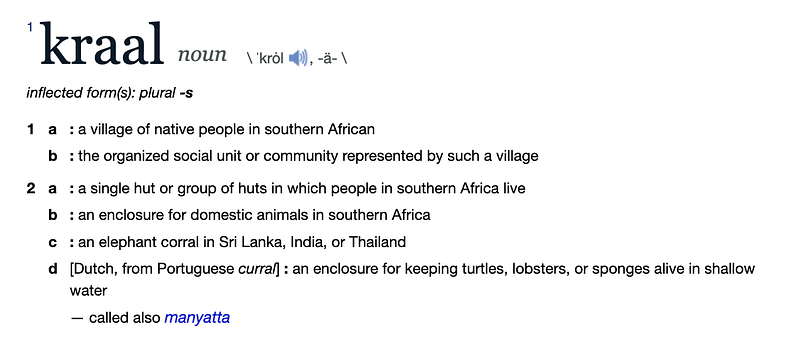
Silly little dictionary! Don’t you know that kraal can’t possibly be a word if the New York Times says it ain’t?
For further fascinating facts, check out the Spelling Bee Master.
What’s your favorite dord* from today’s puzzle?
My Two Cents
Our friends at Merriam-Webster explain that the word kraal is borrowed directly from Afrikaans. Although it’s not completely clear, the prevailing theory is that the Afrikaner word may have come from the Portuguese curral, meaning “ a pen for cattle” or “an enclosure”, possibly from the Vulgar Latin currale meaning “an enclosure for carts”.
In English, the word corral, which has the same meaning as definition 2b (an enclosure for domestic animals) was borrowed from Spanish. But the Spanish corral and Portuguese curral are cognates. It’s interesting that both words — corral and kraal — entered the English language separately.
Why did today’s Spelling Bee reject kraal from its list of words? Is it obscure? Possibly. Is it offensive? You may not think so, but read on.
The not-so-OK-corral
The dictionary claims the first known use of kraal for definition 1a (a village of native people in southern African) was in 1731. However, it seems German teacher, ethnologist, and explorer Peter Kolbe may have written about kraals as early as 1705, when he was appointed as the first official astronomer in South Africa. You can see him below, astronomizing.
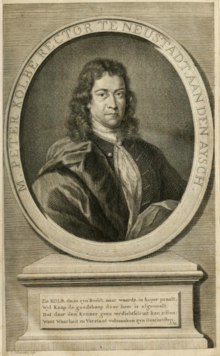
He was sent to the Cape of Good Hope where, aside from astronomizing, he compiled a list of the Cape’s animals, which he published in Amsterdam in 1719 under the title Naauwkeurige beschryving van de Kaap de Goede Hoop, which roughly translates as “I astronomized the heck out of the Cape of Good Hope”.
Since at the time South Africa was under Dutch rule, and had previously had Portuguese settlements, it makes sense that the word curral + Dutch accent brought about the word kraal.
Now, a colonist using the term “corral” to describe either the local village or the community living there (as in definition 1), well… it smacks of racism, doesn’t it? Or at least an extremely prejudiced comparison of the natives to animals. Obviously, this is not surprising, considering it was the 17th century.
Here is a 19th-century illustration of a kraal near Bulawayo, in Zimbabwe.
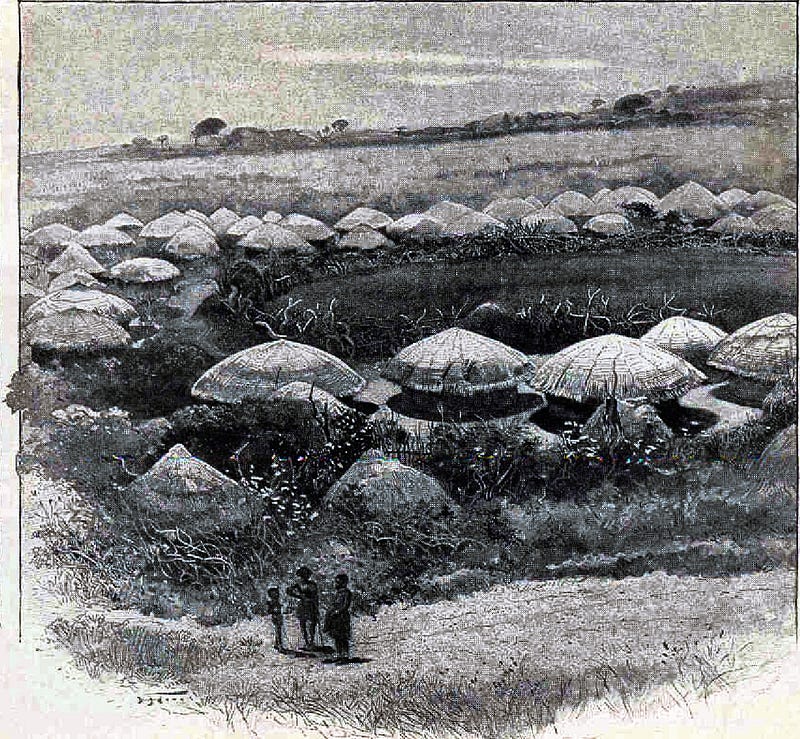
As you can deduce, Unk Nown, the artist who both drew Peter Kolbe’s portrait and the above artwork, lived a long, long time.
The above illustration shows a group of huts but no enclosure, which matches definition 2a.
This print, also from the 19th century, purportedly shows a Zulu kraal. But this time it was a different artist. And there appears to be an enclosure.
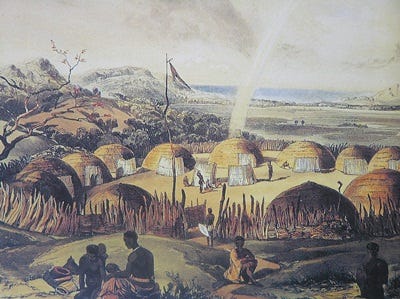
The Encyclopedia Britannica explains this about kraals:
The term has been more broadly used to describe the way of life associated with the kraal that is found among some African, especially South African, peoples. Among certain peoples of KwaZulu/Natal, for example, the kraal consists of a number of huts arranged in a circle around a cattle corral. Polygyny is common, and each wife has her own hut within the kraal. The head of the kraal may have custody of the property attached to the houses of his several wives. The term has also been used to describe the encampments of the pastoral Masai of East Africa. The household may consist of an elderly father, his wives, and his married sons. This group migrates as a unit. During seasonal migrations, small, temporary kraals are built; there are also more permanent settlements. Women are responsible for the construction and maintenance of the kraal, and here too each wife has her own hut.
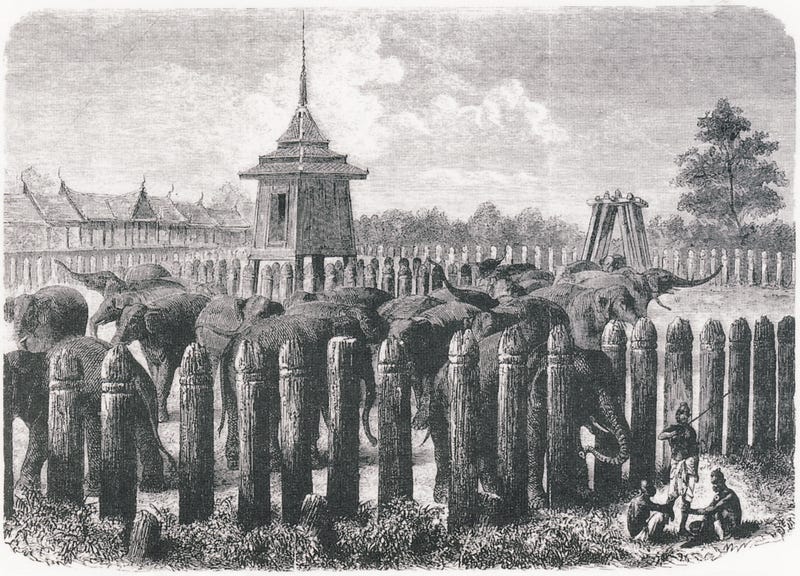
As far as the elephant enclosure mentioned in definition 3c, here is a picture, so that I don’t have to use a thousand words:
Subtract an “a”, add an “l”… and what do you get?
Legendary Canadian jazz pianist and singer Diana Krall, that’s what.
She’s got an amazing contralto voice, has won three Grammy Awards and eight Juno (Canadian Grammy?) Awards, has sold more than 15 million albums worldwide, has earned nine gold, three platinum, and seven multi-platinum albums, married Elvis Costello at Elton John’s estate (!), has produced an album by Barbra Streisand, and has a plaza named after her in Nanaimo, Canada (where she was born).
Oh, and she’s a heck of a jazz pianist and singer. Here she is covering Billy Joel’s “Just the Way You Are”.
Well, clearly Krall and kraal have nothing to do with each other. And clearly Krall is a proper noun and cannot be on the Spelling Bee’s list of words. But kraal? Who knows why the editors of the Spelling Bee decided that kraal is a dord.*
You can check out my previous entry on another dord* here:
*What the heck is a dord, you ask? Here’s the answer: