
Codec
You probably use this every day, but the Spelling Bee still thinks it’s a dord!*
Today’s New York Times Spelling Bee letters:
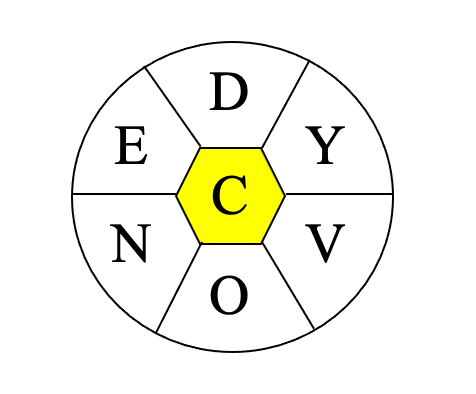
D, E, N, O, V, Y, and center C (all words must include C)
Merriam-Webster says…
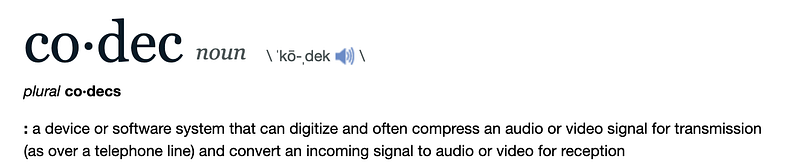
Silly little dictionary! Don’t you know that codec can’t possibly be a word if the New York Times says it ain’t?
For further fascinating facts, check out the Spelling Bee Master.
What’s your favorite dord* from today’s puzzle?
My Two Cents
Today’s daily dord*, codec, is a portmanteau. Portmanteaus are word combos created in one of the three following ways:
- two entire words (commonly known as compounds): fire + fighter = firefighter
- all of one word and part of another: book + (auto)mobile = bookmobile
- parts of two words: smoke + fog = smog
Codec belongs to that last category, being a portmanteau of coder-decoder.
Essentially, that’s what a codec does. Codes. Then decodes. Today the coding part may include digitization and compression to allow ease of transmission or storage. The decoding portion reverses the process.
Hello, I’m a Mac... And I’m a PC
Whether you prefer Bill Gates or Steve Jobs (what a choice, huh!), you have to admit these commercials, which ran from 2006 to 2009, were pretty funny… before they ended up getting on everyone’s nerves.
Back then, and especially before then, Macs and PCs were not very compatible. Especially when it came to sharing audio and video files. And that’s because Apple has historically offered terrible support for codecs not developed by Apple itself. The rise of the iPod and the iPhone helped changed that, possibly in the same way that MS Office’s dominance overtook Apple’s Pages, Numbers, and KeyNote apps.
Young readers may not remember VLC, but that was a magical, life-saving software that was free and easy to download. I mean, it still is, but I don’t people are as dependent on it as they used to be.

The app logo was a safety cone with orange and white stripes; having it on your computer meant you could play almost any audio and video file thrown at you. That was because VLC supports a bunch of codecs.
Codecs were first used around the middle of the 20th century as devices that transformed analog signals into digital formats. This method was known as pulse-code modulation, and became the standard form of digital audio in computers, CDs, and other digital audio applications.
In the U.S., the Emergency Alert System that replaced the famous Emergency Broadcast System in 1997 uses a type of codec.
The rise and fall and semi-rise of a music pirate
Surely you’ve heard of the term MP3. Well, that’s a codec. Probably the best-known, the one that has become as widespread as the music it helps store, send, and play. According to the Encyclopedia Britannica:
With the rise and fall of the music-trading site Napster, the term MP3 entered common parlance to become one of the most widely recognized codecs. By eliminating sounds not normally heard by the human ear, MP3 (an abbreviation of MPEG-1 Audio Level-3) reduces music files to less than one-tenth of the space that they would normally consume on an audio CD. It allows music to be quickly sent over the Internet, and it also helped bring questions of copyright on the Internet to a head.
Napster was founded by Shawn Fanning and Sean Parker and operated as a peer-to-peer file sharing service (mostly for music) between 1999 and 2001. Because it was based on the user-friendly MP3 and was easy to navigate, it eventually had more than 80 million free registered users.
80 million users! We’re talking before Facebook, Twitter, Instagram, etc. This was still the infancy of the web. In today’s dollars, that’s the equivalent of at least a billion subscribers. Okay, I made that last part up with very liberal and fuzzy math, but it does sound convincing, doesn’t it?
Napster helped music enthusiasts not only download popular hits of the time, but also older songs that were becoming harder to obtain in digital formats. The online piracy site was so popular in college dorms that many colleges blocked access to the website even before the copyright violation lawsuit.

In 2000, the heavy metal band Metallica found out its single “I Disappear” was being aired on several radio stations across the U.S. Normally this would have been fine… except Metallica had not yet released this song from the Mission Impossible 2 soundtrack.
It turned out that Napster had leaked “I Disappear”. Metallica was shocked to discover their entire music catalog was available for free on the website. They promptly sued. A month later Dr. Dre filed a similar lawsuit. Then several record labels piled on their fancy and expensive corporate lawyers.
Napster lost, appealed, and lost again. Technically speaking, Napster could have survived if it had been able to keep track and restrict access to any and all files that were a direct infringement of copyright. With 80 million users, seemingly there was no way such a small company could do that.
However, Napster was able to develop a technology that blocked the transfer of 99.4% of infringing files. This, according to the courts, was not enough. Copyright infringement had to be taken down to 0 somehow. It was clear, then, that the issue was not so much the infringement itself as the file sharing Napster was doing.
Napster shut down that file-sharing service in July 2001. A few months later the owners agreed to pay millions to the copyright owners they had pirated from. The only way to do this was for Napster to charge its users. It tried and failed miserably. Turns out people didn’t want to pay to use something online. Shocking!
Napster tried to sell its assets to German media firm Bertelsmann in 2002, but after filing for bankruptcy as part of the agreement, the sale was blocked and Napster's assets were liquidated. During the bankruptcy auction, American software company Roxio bought the brand name and logos. Roxio then changed the name of their music service from Pressplay to Napster 2.0.
In 2008 Napster was bought for around $121 million by electronics retailer Best Buy, which was looking to get into the subscription-based entertainment market. Three years later Best Buy was unloading Napster to Rhapsody, at the time the largest on-demand music service in the U.S.A. Today Rhapsody provides this service to the iHeartRadio app.
In August of last year, Napster was sold for $70 million to MelodyVR, a London-based company that specializes in virtual reality concerts. As of today, you can still find the Napster app in your iPhone or Android store.
CNN best summed up Napster’s role in the digital entertainment world in this quote from a November 30, 2011, article, calling the company “the music-industry scourge that blazed a trail that led to modern digital music services.”
That sounds about right.
You can thank Napster for making the term MP3 a household name. You’ve been using and talking about that codec forever, even if you didn’t actually know what a codec was, or even that MP3 is a codec.
Surely the New York Times knows what a codec is, though. Every time they include an audio or video file in their online paper they have to make use of one. Which is why it makes absolutely no sense for the editors of the Spelling Bee to claim that codec is a dord.*
You can check out my previous entry on another dord* here:
*What the heck is a dord, you ask? Here’s the answer: