
Chainman
So many definitions for a word that doesn’t even exist!
Today’s New York Times Spelling Bee letters:
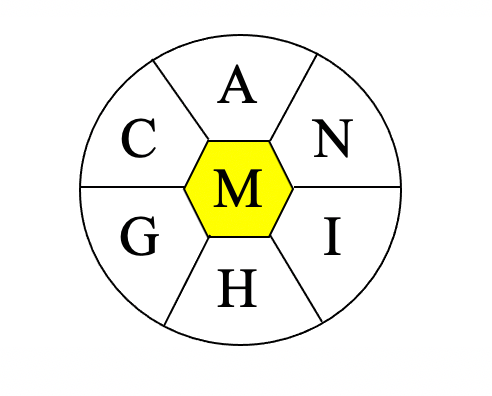
A, C, G, H, I, N, and center M (all words must include M)
Merriam-Webster says…
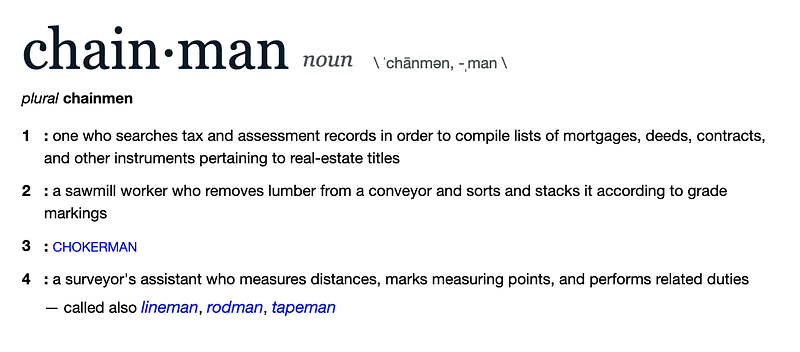
Silly little dictionary! Don’t you know that chainman can’t possibly be a word if the New York Times says it ain’t?
For further fascinating facts, check out the Spelling Bee Master.
What’s your favorite dord* from today’s puzzle?
My Two Cents
The word chainman is a compound, or compound word. The dictionary defines that as “a word consisting of components that are words”. Typical examples are rowboat, firefighter, outrun, and airtight. Even the short word into is a compound (in + to). High school is also given as an example, and so is devil-may-care.
The Spelling Bee rules make it clear that compound words separated by a space or joined by a hyphen are not accepted. Which is fine, except that what constitutes a hyphenated word varies a lot when it comes to the Spelling Bee. For example, in today’s game the word mahimahi is accepted, although the dictionary favors the hyphenated version: mahi-mahi. I have seen cases in which the opposite happens; that is, the dictionary’s preferred spelling is non-hyphenated yet the Spelling Bee rejects the word. (Right now I can’t think of an example, but if I find one I’ll edit this paragraph. If you know of one, please let me know in the comments.)
In today’s game the word gagman has also been rejected.
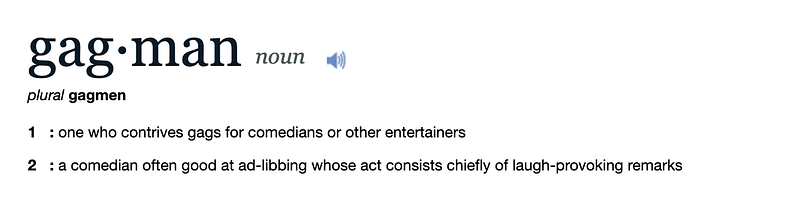
Why? Why is hangman accepted today, but not chainman and gagman? Being that these two are compounds, wouldn’t it make sense to include these words and give some joy to those Bee players who might type them just to see if by chance they are accepted. It’s not like they’re made-up words like, say, cigman or nagman.
Sigh…
Searchman
I had never heard of the term chainman relating to the first definition given by the dictionary: “one who searches tax and assessment records in order to compile lists of mortgages, deeds, contracts, and other instruments pertaining to real-estate titles.”
I did find lots of “chairmans” when searching real estate companies, deeds, taxes, etc., etc., etc… but not a chainman.
The closest I got was with the real estate term “chain-free property”, used more commonly in the UK than in the U.S. This refers to a property in which the seller does not need to buy their own property after they’ve sold theirs. This could be because the homeowner already moved into their new house or because the property being sold is not their primary residence. This also happens when a property is owned by a bank or a professional investor.
What’s the advantage of buying a “chain-free property”? Well, because the deal is not dependent on the owner needing to purchase another property in order to sell this one, the sale won’t be canceled for that reason. This is especially risky when there is a long “property chain” of several owners both buying and selling. In that case, the failure of one owner to buy a new property (and therefore not needing the one they’re selling) means the entire chain can be broken and several other buyers and sellers might be affected.
Sawman
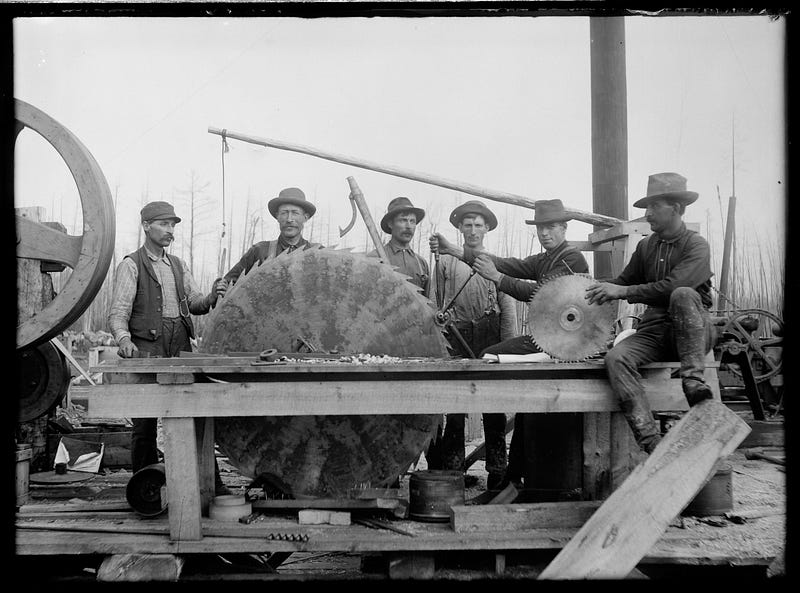
A chainman is also defined as “a sawmill worker who removes lumber from a conveyor and sorts and stacks it according to grade markings.” Also known as lumber mills, sawmills are places where logs are brought in and chopped, cut, sliced, and diced into lumber. But not pureed.
Here are some sawmill workers posing with their saw blades.
And here are some logs sorted and stacked. The photo was accidentally cut in half by one of the saws above, then reattached.
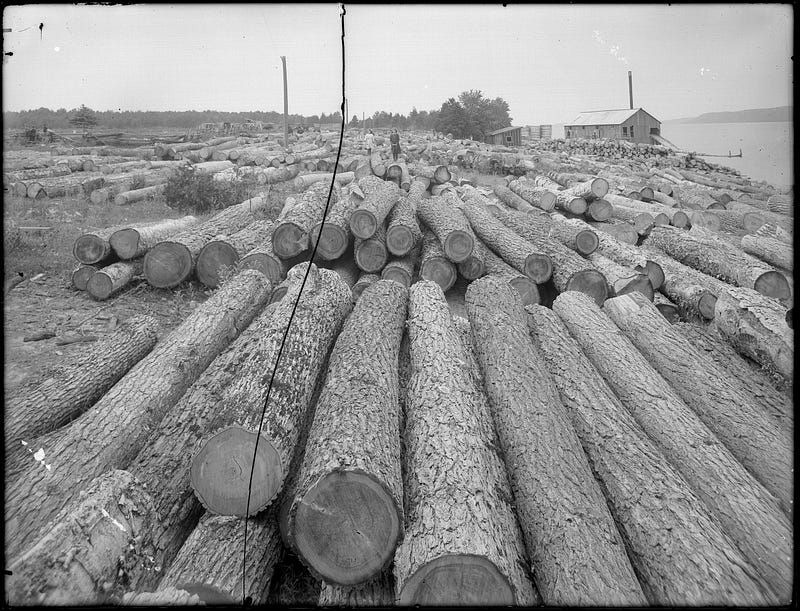
But the above stacks weren’t prepared by the chainman. How do I know this? Because chainmen are specialists. They deal exclusively with lumber coming off the conveyor belt, not logs ready to be loaded onto the conveyor. So who stacked the logs in the picture? That, my dear reader, might be a mystery as impossible to solve as Stonehenge.
Chokerman
The third definition of chainman was given simply as chokerman. I thought maybe it was a jeweler who specialized in short, tight necklaces:

But it turns out chokerman is also a logging term. That’s the guy who puts chokers around the logs before they are hauled off. Something like this, I guess…
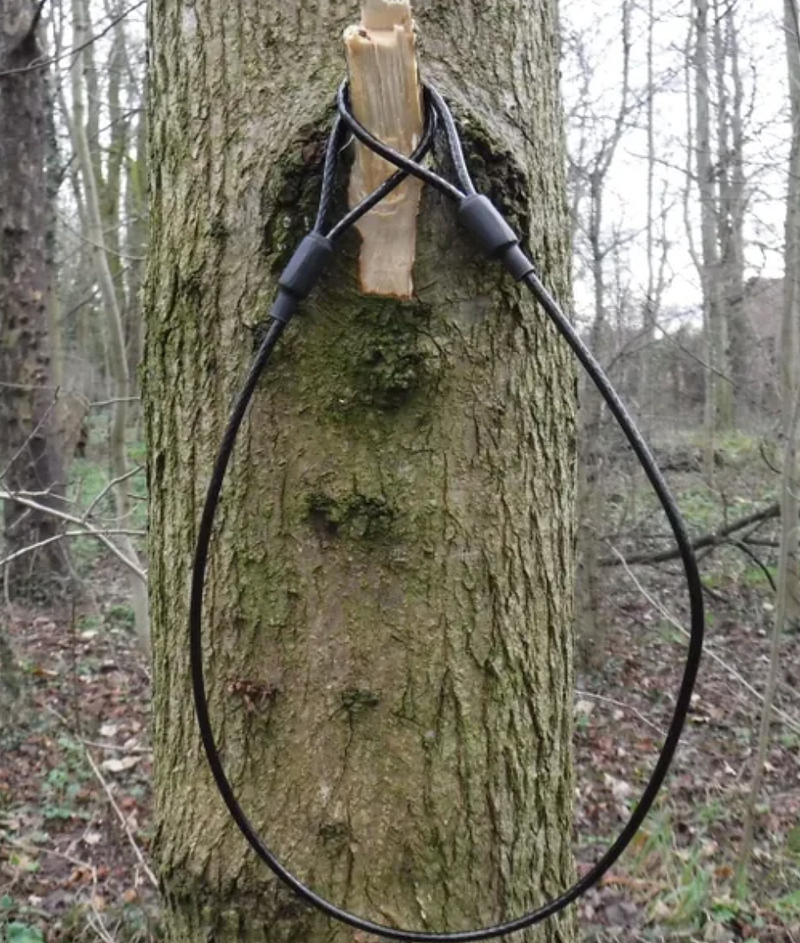
Except whoever put this choker chain on the log was a very impatient chainman. He couldn’t even wait for the tree to be chopped down!
Rodman
No, not the best rebounder I’ve ever seen in the history of the NBA:

In this case, a rodman, or chainman, refers to the surveyor’s assistants who move the far end of a chain under their boss’s direction. Land surveying is the arty science — or scientific art, I forget which — of figuring out the three-dimensional position points and area of any part of the Earth’s surface.
Surely you’ve happened upon a person doing this on the street at some point in your life.

No, they’re not incompetent peeping toms. They are surveyors using one or more of several surveying instruments:
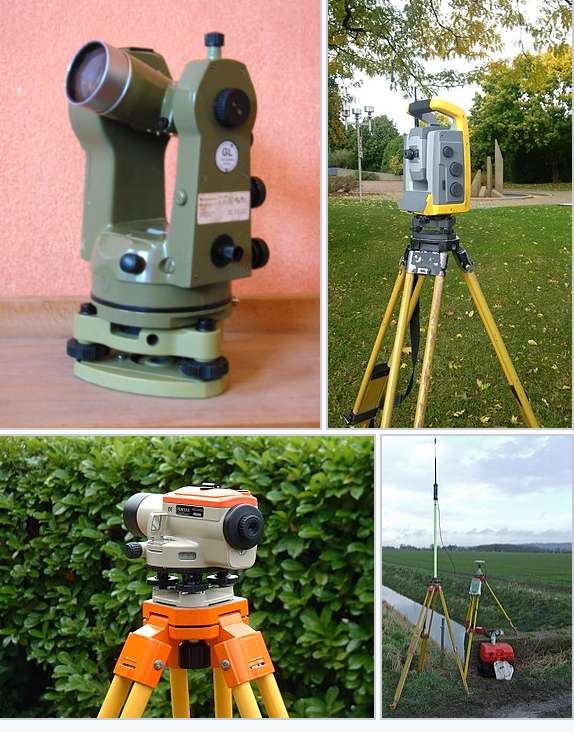
Clockwise from upper left: optical theodolite, robotic total station, RTK GPS base station, optical level.
Now, the above is mostly modern equipment. Except for the theodolite, used for measuring horizontal and vertical angles. Its invention is credited to Jesse Ramsden, who had a huge ego and in 1787 called his new product the “great theodolite”, even before the Yelp reviews were in. How cheeky of him!
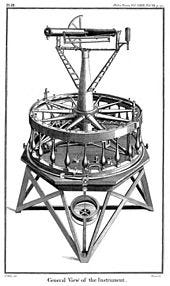
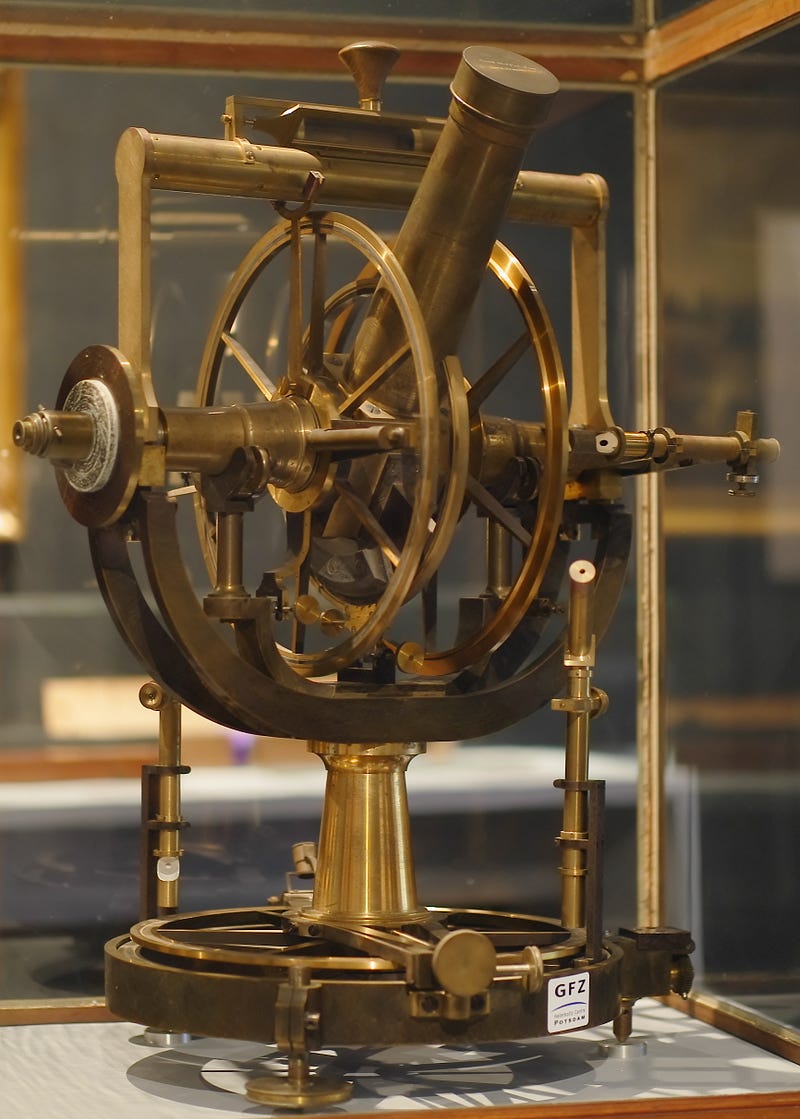
The photo at the top of today’s article is of a theodolite built in 1851.
Back to the chainman, or chainwoman, as the case may be. Here is an all-female surveying crew from Idaho:
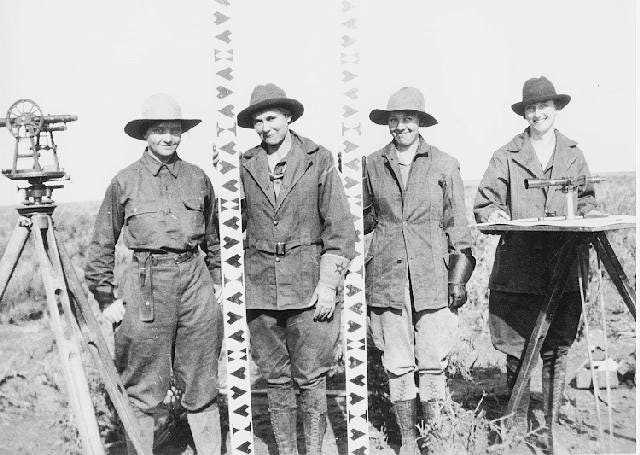
One of the above probably yanked Gunter’s chain. No, this is not a crass double entendre. Get your mind out of the gutter.
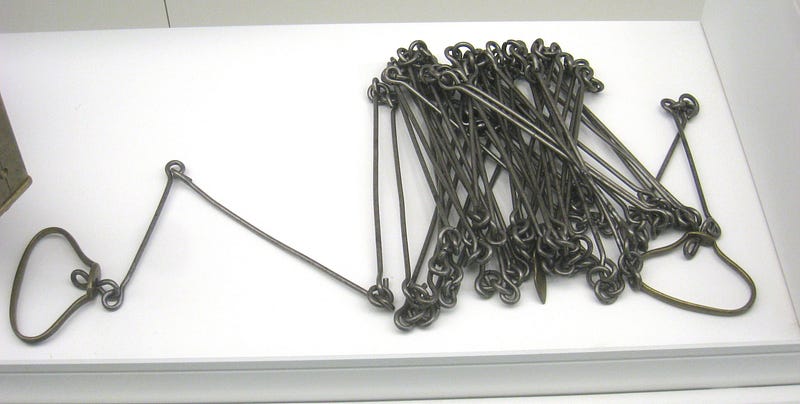
In 1620 English clergyman and math whiz Edmund Gunter introduced to the world the measuring chains named after him. The 100-link instrument became a standard and later came across the pond to America. In fact, the Public Land Survey System still uses the chain unit because their database is hundreds of years old and no one seems to want to go to the trouble of updating thousands upon thousands of records to customary units or — gasp! — metric.
The actual unit named “chain” of 100 links measures a modernly inconvenient 66 feet grouped into 10 links marked by tags. Thus, one link is 7.92 inches, a quarter chain (25 links) is 16 feet 6 inches, also known as a rod or pole.
There appears to be a 10-link tag in the middle of the right half of the photo below, towards the bottom part.
According to the Santiago Canyon College, a survey chainman is expected to perform the following duties:
…holds level rod or distance meter reflector at designated points to assist in determining elevation and laying out stakes for map making, construction, land and other surveys; calls out reading or writes station number and reading in notebook; marks points of measurement with elevation, station or other identifying mark; measures distance between survey points, using surveyors tapes or electronic distance measuring equipment; marks measuring points with keel (marking crayon), paint, sticks, scratches, tacks, stakes or monuments; places stakes at designated points and drives them into ground, sometimes at specific elevation, using sledge hammers; cuts and clears brush and trees from line of survey using brush book, knife, ax or other cutting tools; obtains data pertaining to angles, elevations, control points and contours used for construction, map making, or other purposes; compiles notes, sketches and records of data obtained and work performed; directs work of subordinate members of survey crew; performs other duties relating to survey work as directed by the CHIEF OF PARTY.
All this hard work is rewarded at about 70 grand a year, according to Zippia. However, according to Comparably, the U.S average salary for a chainman is $30,117, with a median salary of $27,950. Although they do specify that the top 75% make close to 50 grand.
I report, you decide… if you want to become a chainperson.
If you do, please let the New York Times know about all the valuable work you’re doing. Then maybe the editors of the Spelling Bee will take chainman off the list of dords.*
You can check out my previous entry on another dord* here:
*What the heck is a dord, you ask? Here’s the answer: