
Mammality
The ethereal quality of belonging to the breast-feeding class
Today’s New York Times Spelling Bee letters:
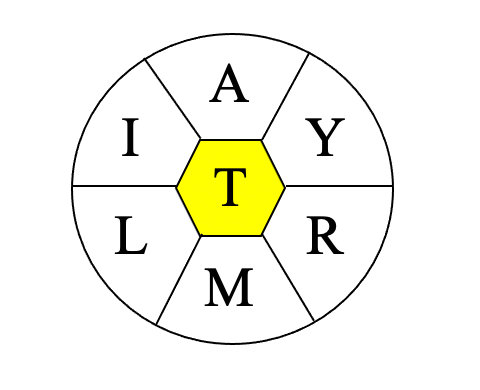
A, I, L, M, R, Y, and center T (all words must include T)
Merriam-Webster says…
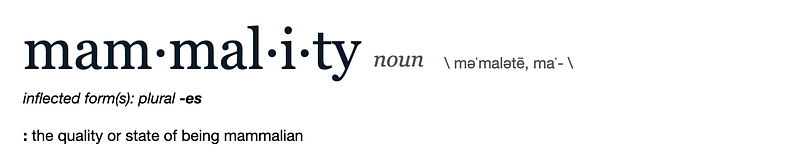
Silly little dictionary! Don’t you know that mammality can’t possibly be a word if the New York Times says it ain’t?
For further fascinating facts, check out the Spelling Bee Master.
What’s your favorite dord* from today’s puzzle?
My Two Cents
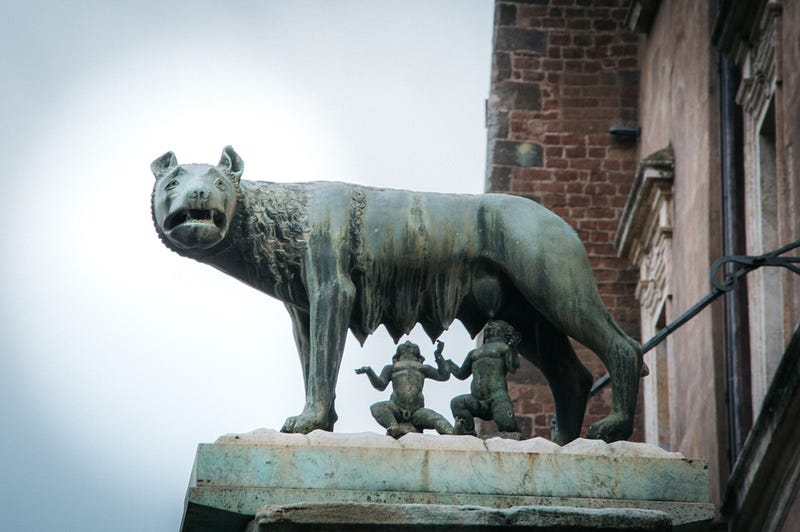
That poor she-wolf in the photo looks like she’s in agony. She’s suckling the twins Romulus and Remus. Perhaps she knows that Romulus will go on to kill his brother in a silly dispute over which hill to found the city of Rome.
(As an aside — and since this is, in theory, a column about words — the term suckle means both the action of the one breastfeeding as well as the one being breastfed.)
In Roman mythology, Romulus and Remus were the sons of Rhea Silvia, a vestal virgin and the daughter of former king Numitor. Rhea Silvia conceived the twins she was visited by the god Mars in a sacred grove dedicated to him. Amulius, now the current king after kicking his brother Numitor off the throne, saw the two babies as a threat and ordered them killed.
Abandoned to die, they saved by the god Tiberinus, suckled by the famous she-wolf, and eventually adopted by a shepherd.
That image of the twins nursing from the wolf has become one of Rome’s best-known symbols, along with the Colosseum, of course, and the Trevi Fountain in which Anita Ekberg and Marcello Mastroianni took a dip in Fellini’s La Dolce Vita.
Here is another version of the statue of the she-wolf. She doesn’t look too happy here, either.
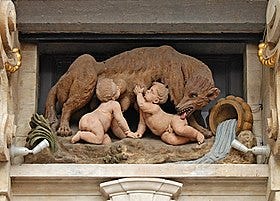
United we suckle
Swedish botanist Carl Linnaeus is credited with formalizing the binomial nomenclature, or “two-name system” for naming species of living things. He decided to use the New Latin term mammalia as the class name for all warm-blooded vertebrates that feed their young with milk secreted by their… mammary glands. Since the Latin word mamma means “breast”, this made udder sense. Sorry! That dad joke just slipped in by surprise.
Breast or udders are a distinguishing feature of all mammals, but certainly not the only one. Most mammals also tend to have the following things in common:
- a neocortex (a region of the brain involved in higher-order functions)
- fur or hair (except for Olympic swimmers and yours truly, who is bald)
- three middle ear bones
That’s it. There is a lot of variation otherwise. Some mammals have four legs, others only two. Seamus Levine from Family Guy has four wooden pegs but is still otherwise a mammal. (He is also the only Irish Jewish pirate in the history of the world.)
Some mammals live on land, others in the sea. Some can fly, like the bat, and some can even go into space, like Jeff Bezos. Some mammals carry their young in the womb while others, like the platypus, lay eggs.
So, to quote Hugh Hefner’s famous words that I just made up for this article: “Breasts. That’s what unites us all.”
According to the Encyclopedia Britannica, there are “more than 5,500 species of living mammals, arranged in about 125 families and as many as 27–29 orders (familial and ordinal groupings sometimes vary among authorities).”
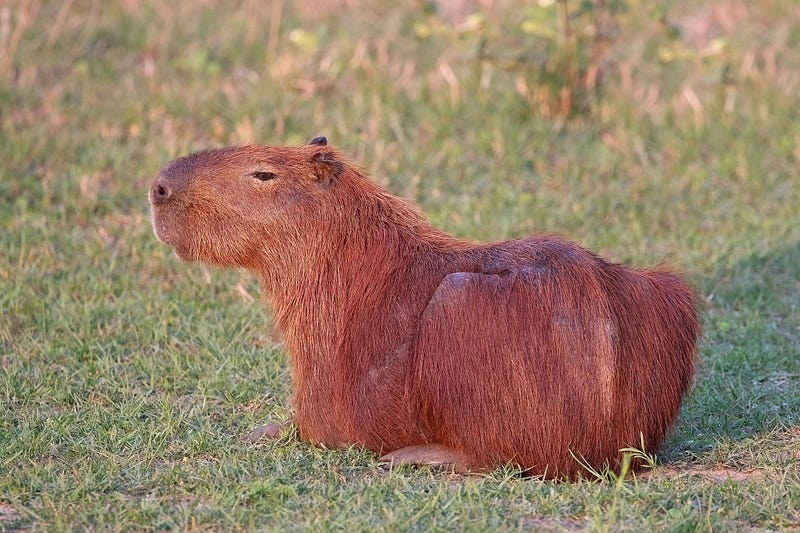
Do you know which is the most common Order, or “category” of mammals populating the Earth? Rats! More specifically, the Order Rodentia, which includes not only rats, mice, and beavers, but also porcupines and capybaras (my favorites). Here is a capybara:
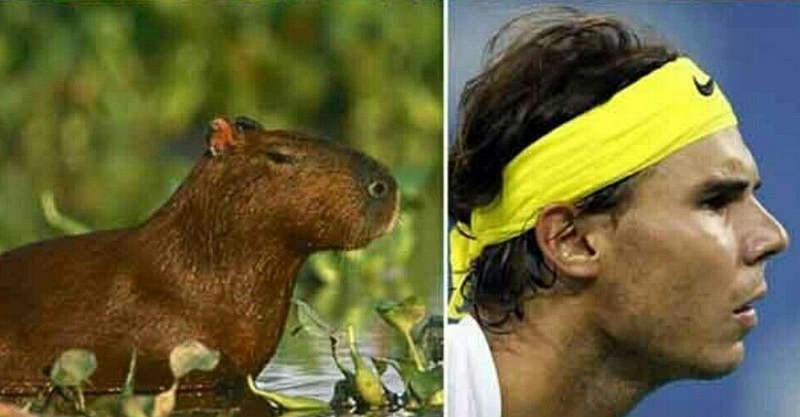
In Spain the capybara is also known as the Rafael Nadal, for obvious reasons:
Do you know who is not included in the Order Rodentia? Rabbits and hares. Despite the fact that they have large front teeth that they use to gnaw at things, they belong to the Order Lagomorpha.
Homo sapiens, or humans, belong to the Order of Primates, which comes in at a measly fourth place as the category with the most species of mammals. That’s okay, though. At least we beat the Carnivora, which includes cats, dogs, bears, raccoons, and even seals.
That udder feeling of belonging
Sorry… another dad joke. They keep slipping through my fingers today.
Do you feel connected somehow to other mammals because we can all feed from our mothers’ breasts — although some of us may prefer baby formula? Do you feel that shared bond coursing through your veins every time you use your neocortex to make a stupid decision? Does your hairy self help you accept the responsibility of being somehow related to all other furry creatures great and small? Those three middle ear bones, do they make it easier for you to hear and understand your fellow mammals?
If you said yes to any or all of the above, you have–-at some point in your life — experience mammality.
And that, my dear readers, proves the point that the editors of the Spelling Bee should not have decided that the word mammality is a dord.*
You can check out my previous entry on another dord* here:
*What the heck is a dord, you ask? Here’s the answer: