
Rata
The man… the myth… the tree?
Today’s New York Times Spelling Bee letters:
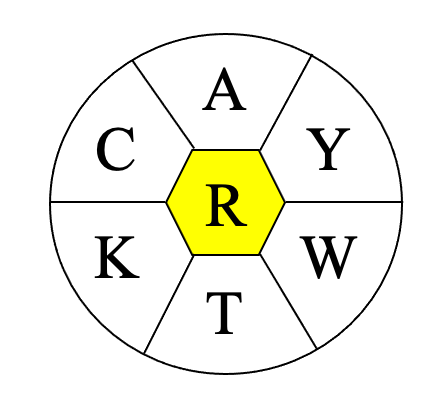
A, C, K, T, W, Y, and center R (all words must include R)
Merriam-Webster says…
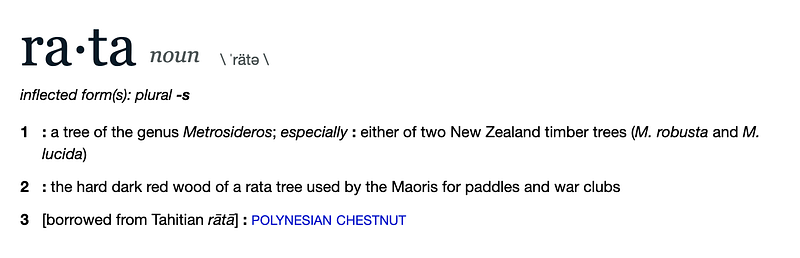
Silly little dictionary! Don’t you know that rata can’t possibly be a word if the New York Times says it ain’t?
For further fascinating facts, check out the Spelling Bee Master.
What’s your favorite dord* from today’s puzzle?
My Two Cents
One of the things I like best about writing this column is how it helps me learn and discover new things on a daily basis. When researching a word I sometimes start going off on tangents that can take me far away from where I started. And then it’s interesting to go back and connect the steps and realize how the connection between different things came about.
Like today. I discovered there is an extinct species of plant from New Zealand called Adams mistletoe (Trilepidea adamsii, previously known as Loranthus adamsii ). When one thinks of extinction, it’s usually all about animals; but plants can get offed, too. In this case, one of the factors was the introduction of the Australian brushtail possum.
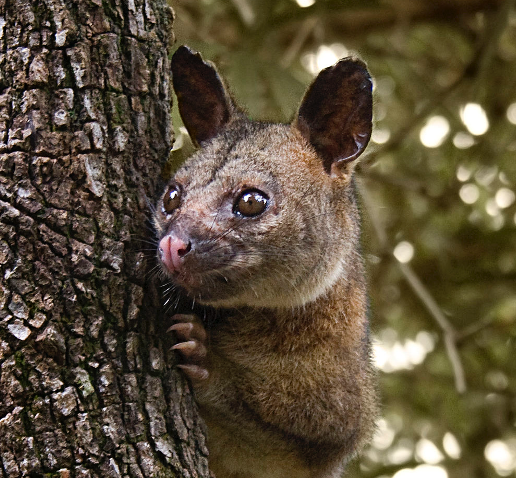
Yeah, don’t be fooled by that charming smile. That little critter is a plant murderer!
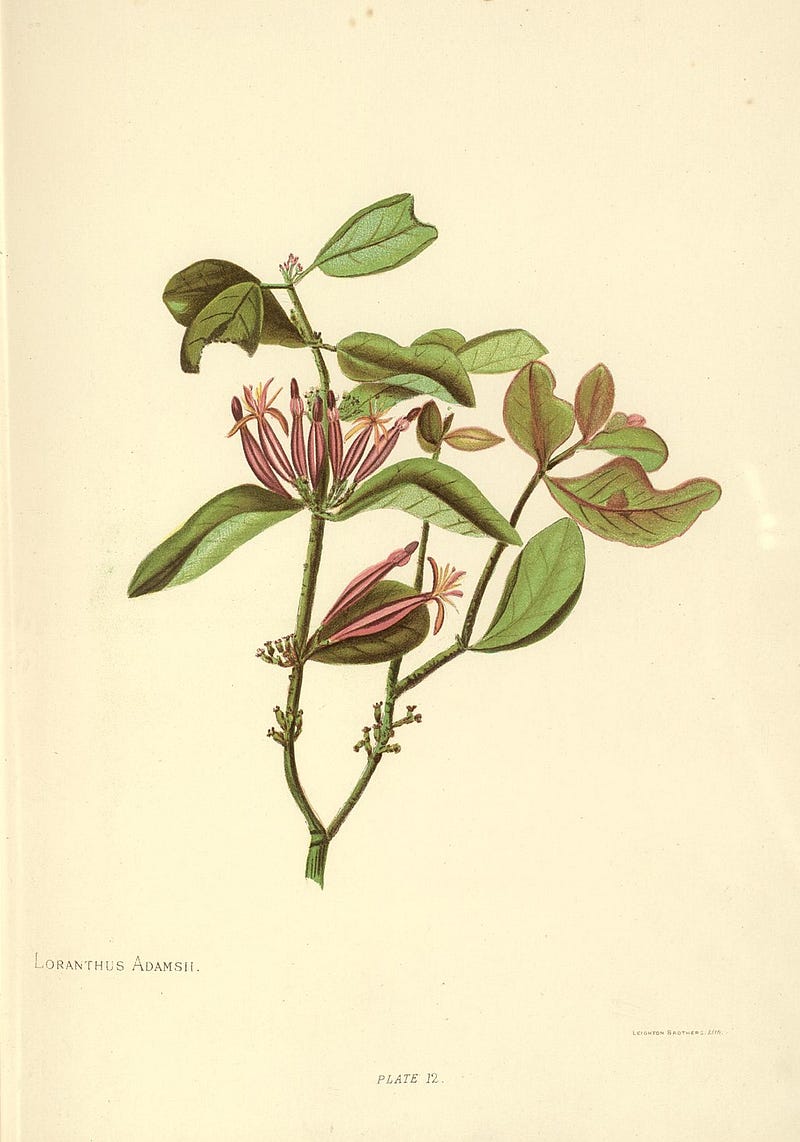
The drawing at the top of today’s article is an illustration of Adams mistletoe done by Georgina Burne Hetley, a New Zealand artist and writer born in England. She published her book The Native Flora of New Zealand in 1888, barely ten years before she passed away at age 66.
Thanks to Hetley, there is a record of what Adams mistletoe looked like before it became extinct. And that record graces the top of today’s article.
Among many other plants, Hetley also illustrated this one, the Metrosideros albiflora, also known as large white rātā.
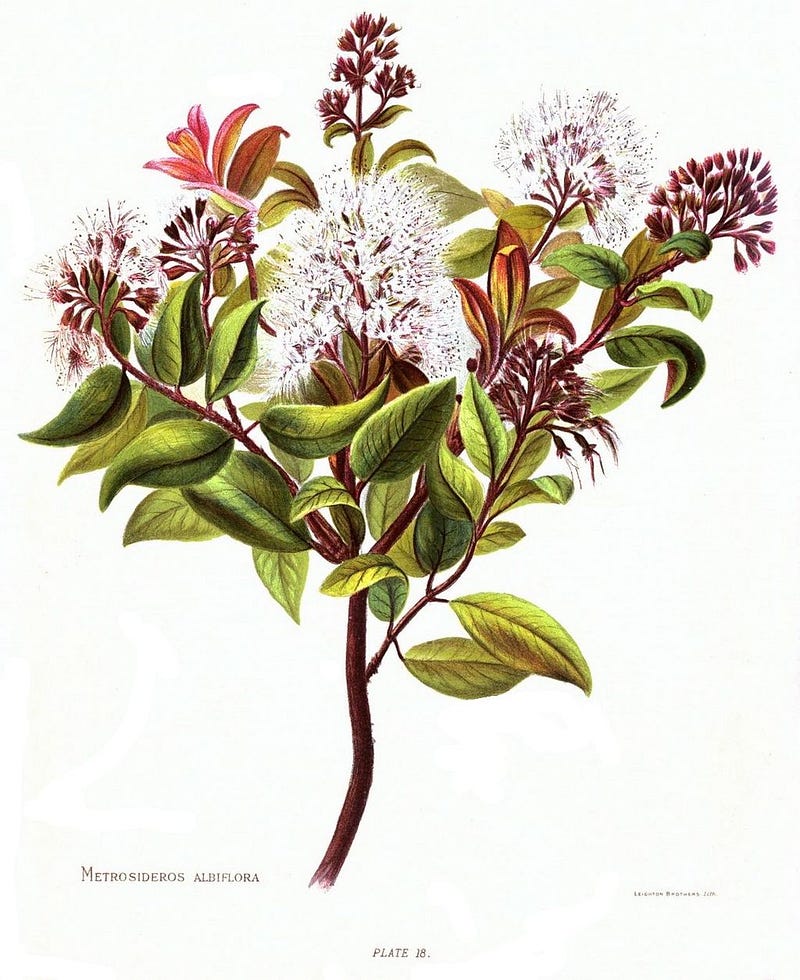
This forest vine is part of a Genus of shrubs, vines, and trees found commonly in New Zealand. Which brings us to…
Tall tree
The northern rātā, or rata for the purposes of our column, is a tall and robust tree, as its species name, Metrosideros robusta, indicates. It can grow to more than 80 feet (24 meters and change)… as long as it begins its life as a semi-parasite.
Wait, say what?
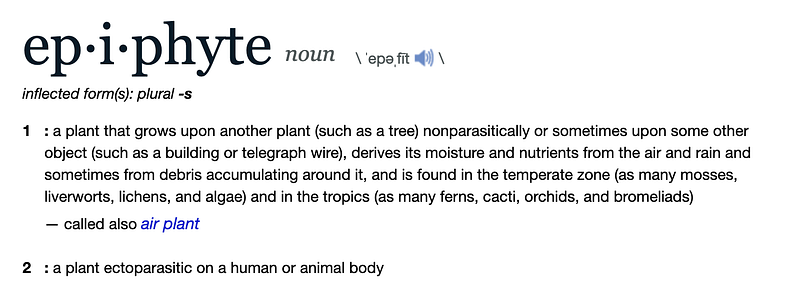
Well, turns out ratas are hemiepiphytes, or plants that spend part of their life cycle as epiphytes. I realize that’s not very helpful if you don’t know what an epiphyte is, which I didn’t. So I did everyone a favor by looking it up.
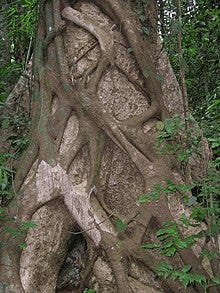
Epiphytes can grow on tree trunks or in their canopies. They are much less harmful than hemiepiphytes, because these start growing on trees until their own roots reach the ground. Then they may kill the host tree, as the strangler fig does. Here is one that was caught by the cops.
Northern ratas don’t actually strangle their host tree (the large evergreen coniferous rimu), but they do form a massive, hollow pseudotrunk composed of fused roots. When the northern rata does not have a chance to begin like as a semi-parasite, it will grow on the ground but end up with a normal and much shorter trunk.
Here is a rata doing what it does best: towering over every other plant in a New Zealand forest.
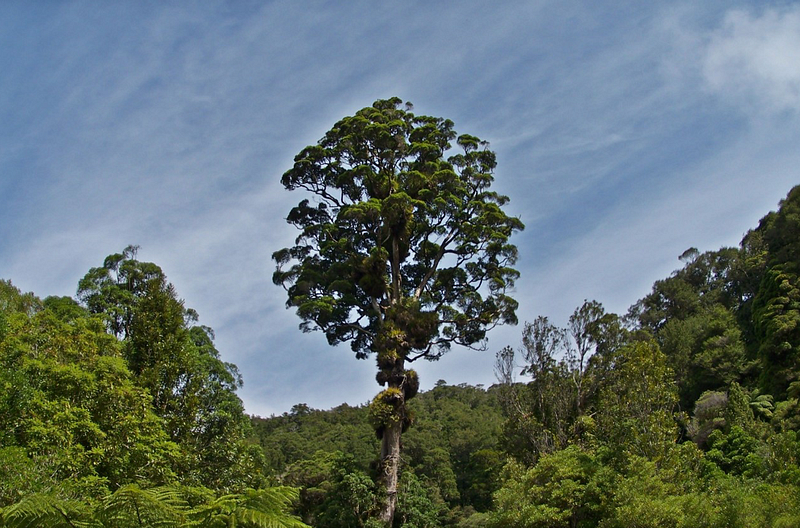
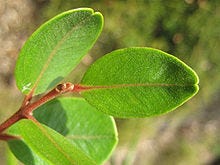
Aside from its massive height, the northern rata has distinctive small, leathery, dark green leaves with have a notch at the tip.
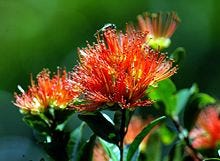
The flowers are interesting looking.
The northern rata suffers from the same problem as Adams mistletoe did: possums. These animals can cause extensive damage to the rata by eating its leaves, buds, flowers, and young shoots. Some trees can die quickly, within two years.
Oh, well. Live by the sword, die by possum, as they say.
Tall tale
Rata with a capital “R” is the name of a folk here in Maori, Tahitian, and Tuamoto mythology.
Here is a story summary of the Maori version, courtesy of Careers.govt.nz.
A young man named Rata decides to build a waka to help his people sail across the sea to the Fish of Māui, because their village is constantly battered by storms. He finds the tallest, straightest tree in the forest for the waka, but forgets to offer prayers to Tāne, the god of the forest, before cutting the tree down. The children of Tāne are outraged and decide to teach him a lesson.
When Rata returns for the tree the next day, it is standing upright. He is puzzled, but again chops down the tree — and again returns to find the tree is upright. So he cuts down the tree a third time. He then returns at night to watch what happens, and sees all the insects and birds putting the tree back together. Rata asks, “What do you think you are doing?” They tell him he has disrespected Tāne by not offering prayers.
Rata is ashamed of his actions and asks for forgiveness. The children of Tāne decide not to punish Rata, because he is trying to help his village, and the next day carry the gift of a hollowed-out waka to Rata’s village. Rata then becomes a respected leader in the community.
Careers.govt.nz is “responsible for supporting New Zealanders to have the skills, knowledge and training opportunities for lifelong success.” So perhaps they want to encourage someone to become a mythical hero.
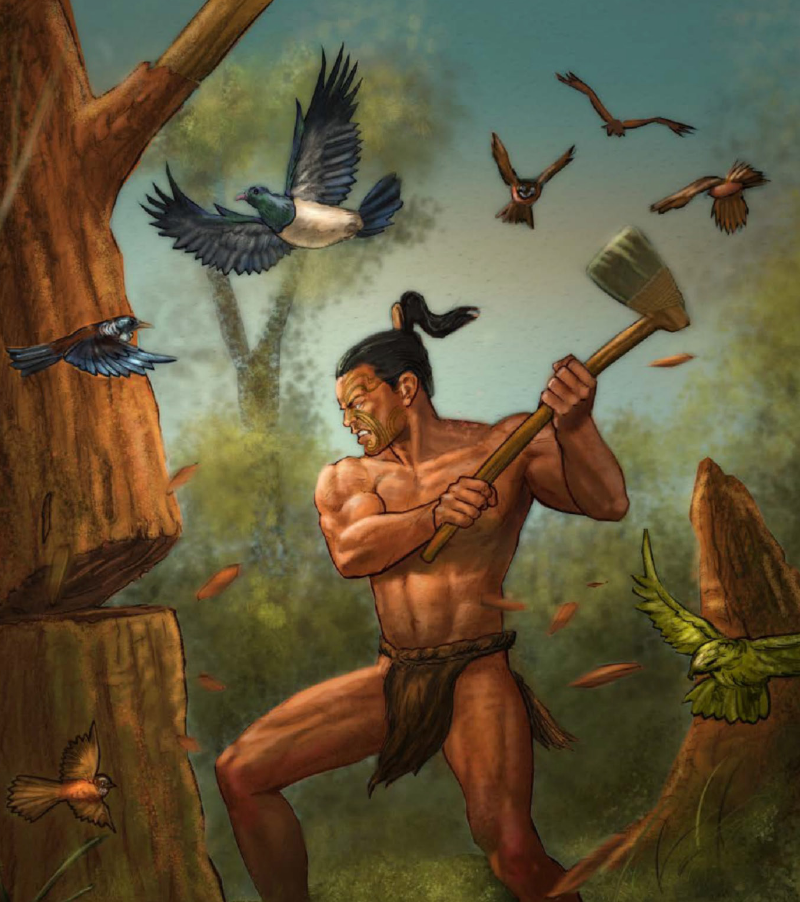
Hey, it worked for Marvel, didn’t it?
Although Rata the hero cannot be on the Spelling Bee list of words because it’s a proper noun, rata the tree should be. And yet, the editors of the Spelling Bee still decided that rata is a dord.*
You can check out my previous entry on another dord* here:
*What the heck is a dord, you ask? Here’s the answer: