
Prophetic Yeats — The Second Coming
Latter Day Barbarians at Civilization’s Gates
Could anyone have predicted, have seen (in the Nietzschean sense) the general catastrophic decline, the slide toward despotic anarchy, that currently threatens global civilization? I suppose not.
Like Karl Popper, I am not an historicist. Just to be clear, like Popper, I see historicism as the faulty theory that history develops inexorably and necessarily according to knowable laws toward a determinate end. Popper believes that this view is the principal theoretical presupposition underlying most forms of authoritarianism and totalitarianism, and that historicism is founded on mistaken assumptions regarding scientific law and prediction. Popper’s logical construction is:
A. The growth of human knowledge is a causal factor in human history. B. No society can scientifically predict its own future states of knowledge. ∴ There can be no predictive science of human history.
Predictive historicism is most likely so much bunk. But even though theoretical models abound suggesting that something like this could happen, predicting our current dilemma based on the past was and is not possible. But, even given this, one of the human brain’s most enigmatic powers is its ability to — in hindsight — see the present in the past, to interpret something in the past as somehow foretelling the present. So in this spirit, I wish to examine “The Second Coming,” a powerful, disturbing, and, yes, even interpretively prophetic poem by William Butler Yeats.
Setting the stage for this important poem, World War I and its horrific slaughter had, in 1918, recently ended, as had the Irish Easter Rising in 1916, and the Russian Revolution in 1917. It was an age of war and revolution and the global mood was grim, so it’s no surprise that the tone of Yeats’s poem is somber.
Here is the full text of his 1921 poem, written in a very rough iambic pentameter, but so loose and varied that it falls into free verse.
The Second Coming
Turning and turning in the widening gyre The falcon cannot hear the falconer; Things fall apart; the centre cannot hold; Mere anarchy is loosed upon the world, The blood-dimmed tide is loosed, and everywhere The ceremony of innocence is drowned; The best lack all conviction, while the worst Are full of passionate intensity.
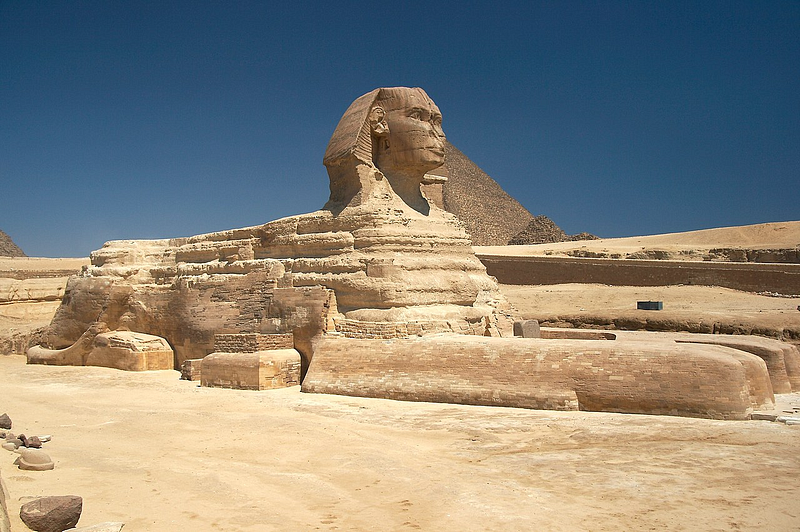
Surely some revelation is at hand; Surely the Second Coming is at hand. The Second Coming! Hardly are those words out When a vast image out of Spiritus Mundi Troubles my sight: somewhere in sands of the desert A shape with lion body and the head of a man, A gaze blank and pitiless as the sun, Is moving its slow thighs, while all about it Reel shadows of the indignant desert birds. The darkness drops again; but now I know That twenty centuries of stony sleep Were vexed to nightmare by a rocking cradle, And what rough beast, its hour come round at last, Slouches towards Bethlehem to be born?
In the opening couplet we find a falcon wheeling above, in an ever-widening spiral or gyre. The bird has flown beyond the range of the falconer’s voice; communication is not possible.
‘Gyre’ is an important word and concept for Yeats; it appears in many of his poems. To better appreciate its use, we must first understand that mysticism exerted an inexorable force on Yeats. He danced around it, darting ever-closer to the mysterious agencies that constitute its event horizon. He was devoted to the occult; so much so that he spent considerable time and effort in the writing of A Vision, a prose work that developed his mystical worldview. While it never attained wide acceptance by his reading public, A Vision’s influence on his poetry was nevertheless enormous. Key to his occult treatise was the notion that opposing forces are at work in history — the ancient and the modern — and these are represented by gyres, one spiraling outward, the other inward. The two forces operated in an approximate balance, producing the Spiritus Mundi, the world’s spiritual core. But in the poem we find that, “The falcon cannot hear the falconer,” the two gyres are far out of sync and are not working well together.
As we see in the next line, the consequence of this imbalance is dire: “the centre cannot hold.” The result? Anarchy, a “blood dimmed tide” that drowns innocence.
Even worse, the closing couplet of the first stanza decries that those who are supposed to stem this tide “lack all conviction,” perhaps not persuaded that the problem is severe, or too weak to take effective action. What’s more, on the other side, those who are responsible for the chaos are energized; the forces of darkness are “full of passionate intensity.”
The second stanza’s opening couplet concludes that, by virtue of all of the above, “Surely the Second Coming is at hand.” The Christian symbology — the reference to the second coming of Christ — is inescapable, complete with its Revelation that promises salvation for the good and eternal damnation for the sinners. But Yeats was not a Christian, so immediately, in a tour de force of thwarting expectations, the poet invokes not Christ, but a vision of the Spiritus Mundi, as a Sphinx-like apparition “somewhere in sands of the desert,” rumbling into motion, disturbing a host of startled desert birds.
Yeats declaims that his vision fades, saying, “The darkness drops again,” but not before he has become aware that the spirit of all of humanity, its gyres operating in turbulent-but-nonetheless-operative harmony, has, after “twenty centuries of stony sleep,” been disturbed, “vexed to nightmare by a rocking cradle.” The sayings are “let sleeping dogs lie,” and “don’t rock the cradle when the baby’s quiet.” But this folk wisdom has been ignored.
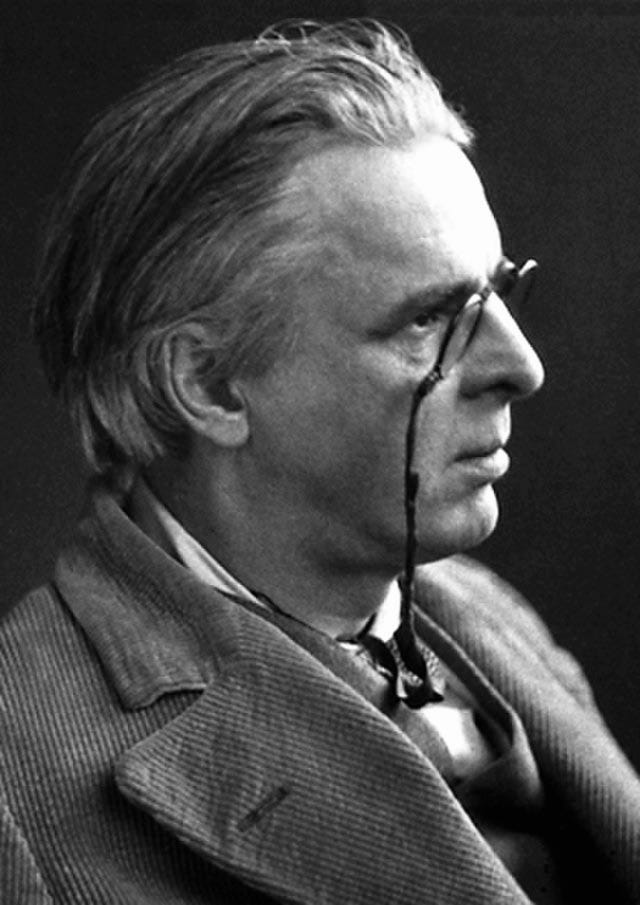
In one of his most disturbing and dark poetic closings, Yeats asks, “And what rough beast, its hour come round at last, / Slouches towards Bethlehem to be born?” Will the Spiritus Mundi be reborn as some new dark and barbaric form, in some new anti-Bethlehem, emanating from some new Stygian spiritual center?
Despite my opening determination to not treat history as having predictive powers, the poem begs a comparison with events of the early twenty-first century. The center is indeed falling apart, and opposing viewpoints are inescapably further and further asunder and seem irreconcilable. Anarchy and bloodshed are rampant, and the innocence of democratic rule and the progression toward a peaceful, prosperous world is in tatters, if not in ruin. The “good and noble” who were supposed to protect us from all this are flailing and fumbling, and the deniers and excluders are ascendant.
Is a revelation at hand? Is the world spirit that only a short while ago seemed to be moving toward equanimity and dignity now indeed on the verge of a great change, lurching instead toward subjection and debasement? Is there “some rough beast” at this very moment slouching toward Bethlehem, its hour of birth having arrived? Is this beast personified in the form of one of the many would-be autocrats that crowd the world’s stage. Or is the beast more ethereal, an ideology like authoritarianism and capitalism-run-amok, a scourge on humanity that rapaciously feeds on the weak and ignorant while it prospers from greed and exploitation?
I fear the answers to these speculations cannot be found in the teachings of history, or in the poetry of Yeats or any other. History, poetry, literature, drama, art, music, these practices, as sublime as they are, only have the power to posit more questions. Perhaps there is no “answer.” Perhaps the way out is the same as the way in — an endlessly branching process of self discovery. We have learned that there are many dead ends and unfruitful paths, but perhaps not all are such. We should continue to have hope — that great comforter in danger — that some paths may lead us back to the light.
I am indebted to the following sources; please read them further.
Karl L. Popper, The Open Society and Its Enemies, Volume I, The Spell of Plato & Volume II, Hegel and Marx, Routledge, London, 1945
W. B. Yeats, The Collected Poems of W. B. Yeats, The Macmillan Company, Toronto, 1956
W. B. Yeats, The Autobiography of William Butler Yeats, Macmillan Publishing Co., New York, 1965.
Peter Ure, W. B. Yeats, Grove Press, New York, 1964.
John Unterecker. A Reader’s Guide to William Butler Yeats, Farrar, Straus and Giroux, New York, 1959.
Humphrey Carpenter, A Serious Character: The Life of Ezra Pound, Bantam Doubleday Dell Publishing, New York, 1988.
Elder Olson, An Outline of Poetic Theory, The Ronald Press Company, New York, 1949.
R. P. Blackmur, The Later Poetry of W. B. Yeats, The Ronald Press Company, New York, 1949.


