
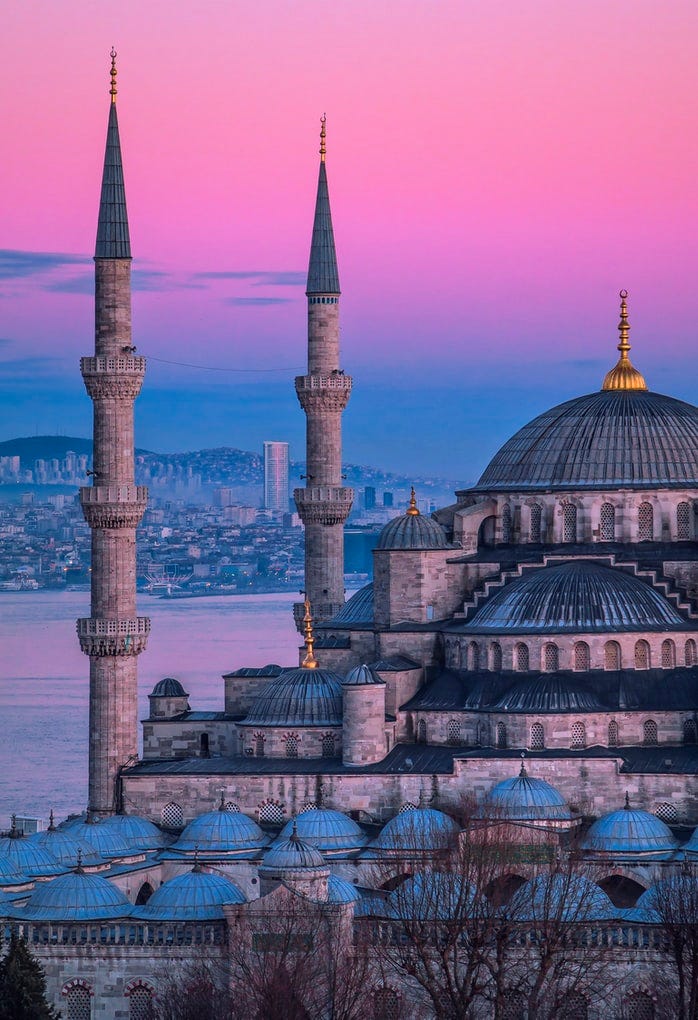
Yeats Confronts Mortality
Sailing to Byzantium
William Butler Yeats was awarded theNobel Prize for Literature at a ceremony in Stockholm on November 14, 1923. As this honor would imply, his life and work were widely acclaimed by the western world; yet, unlike most Nobel laureates whose awards represent the culmination of a life’s work, Yeats’s best work was still to come.
His collection, The Tower, of 1928 is frequently selected as containing his best late-life poems, arguably the greatest of his career. The tone of this collection is poignant; Yeats himself writes that he was “astonished at its bitterness . . . yet the bitterness gave the book its power and it is the best book I have written.” The volume consists of thirty poems, some of which had been previously published, which were mostly written between 1920 and 1927, a period of great achievement, a veritable winter blossoming. (It should be noted that The Tower is only part of a call-and-response, completed by his following collection, The Winding Stair. The two books present carefully opposing points of view.)
In 1922 Yeats had been called to serve in the Senate of the Irish Free State, a perilous and dangerous position. He took his duties as senator seriously, and was active in the business of the new Ireland. In the midst of the Irish Civil War, guards were hired to protect him, and when bullets were fired through his windows, he and his wife sought refuge at his tower — Thoor Ballylee — in Galway. In his poem, “The Stare’s Nest by the Window,” he vividly captures the tense mood:
We are closed in, and the key is turned On our uncertainty; somewhere A man is killed, or a house burned. Yet no clear fact to be discerned.
It is against this background that his late-life flourishing took place. An explanation for his renaissance can perhaps be traced to his (and his wife’s) belief in mysticism and the occult. Within days of his marriage to Georgina Hyde Lees (he called her George) in 1917, when she was 25 and he was 52, she had begun automatic writing. Yeats was obsessed with the messages that her writing produced, in part because the material resembled some of his earlier thoughts and writings, in which he had developed a mystical quasi-religious/philosophical system. In the several years which followed, George’s automatic writing helped solidify what he called “a new framework and new patterns.” Devoted to the occult, Yeats believed that he was receiving, through his wife, an other-worldly message: “we have come to give you metaphors for poetry.”
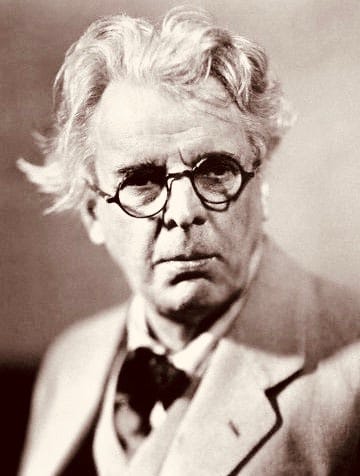
Brimming with self-confidence, magnificent poetry poured forth, and Yeats pushed himself to exhaustion. Predictably, in 1927 his health broke down, but not before his power of expression had reached a new level, exemplified by a uniquely mature tone.
“Sailing to Byzantium,” written in this tumultuous year, perhaps best expresses the new worldview of late-life Yeats. Wishing to escape the anger and violence that he describes in “The Second Coming,” Yeats seeks to sail away. The poem directly confronts mortality, and contrasts sensual youth with spiritual maturity, a topic that had been on his mind for some time. Evidence of his preoccupation can be found in his Autobiography, where Yeats describes the emotions that flood him while sitting on the stage in Stockholm, examining his Nobel medal. “It shows a young man listening to a Muse, who stands young and beautiful with a great lyre in her hand, and I think as I examine it, ‘I was good-looking once like that young man, but my unpracticed verse was full of infirmity, my Muse old as it were: and now I am old and rheumatic, and nothing to look at, but my Muse is young’. . .”
The poem is complex, and is not an ‘easy’ read. Nonetheless it bears a stanza-by-stanza, line-by-line examination, for it reveals the powerful themes that permeate The Tower and characterize much of Yeats’s later work.
Sailing to Byzantium I That is no country for old men. The young In one another’s arms, birds in the trees, — Those dying generations — at their song, The salmon-falls, the mackerel-crowded seas, Fish, flesh, or fowl, commend all summer long Whatever is begotten, born, and dies. Caught in that sensual music all neglect Monuments of unageing intellect.
II An aged man is but a paltry thing, A tattered coat upon a stick, unless Soul clap its hands and sing, and louder sing For every tatter in its mortal dress, Nor is there singing school but studying Monuments of its own magnificence; And therefore I have sailed the seas and come To the holy city of Byzantium.
III O sages standing in God’s holy fire As in the gold mosaic of a wall, Come from the holy fire, perne in a gyre, And be the singing-masters of my soul. Consume my heart away; sick with desire And fastened to a dying animal It knows not what it is; and gather me Into the artifice of eternity.
IV Once out of nature I shall never take My bodily form from any natural thing, But such a form as Grecian goldsmiths make Of hammered gold and gold enamelling To keep a drowsy Emperor awake; Or set upon a golden bough to sing To lords and ladies of Byzantium Of what is past, or passing, or to come.
In quick summary, the poem describes an elderly man, who faces the problem of old age, death and regeneration. He can no longer enjoy the sensual joys of youth, and is denied participation in a world that belongs to the young. An old man, he is functionally no more than “a tattered coat upon a stick.” But the young too are missing something: completely subsumed by sensuality, they are ignorant of life’s deep spirituality. So the old are free from the whirlwinds of physical passion, their souls free to experience the realm of spirit. The more the old come to understand the sublimity of the soul, the more reason to be joyful. A deeper understanding of the soul’s grandeur can be gleaned from great works of art; but Yeats’s epiphany is that these are not mere artifacts, “monuments,” but themselves have souls. These works’ souls, however, are not “fastened to a dying animal,” as is the case with humans. So the old man wishes for the end of his mortal body, and the rebirth of his soul, placed in something other than mere flesh and bone; he wishes his soul to be reincarnated, embodied, in immortal and changeless art.
A look at the language reveals the depth and power of Yeats’s poetic genius, not to mention the power of poetry, for he is able to carry this profound and subtle message in 230 words.
The opening stanza decries, “That is no country for old men.” Not “this,” but “that.” With a single, carefully chosen word, the poet tells us that, in his mind, he has already left the world of violence and sensuality that is Ireland and is looking at it from afar, even though physically he had not yet made the move to Italy, where he would spend most of the rest of his life. But more than a geographic place, Byzantium is a state of mind. He continues, describing “those dying generations,” telling us that, “whatever is begotten, born, and dies” is doomed, to be “caught in that sensual music.”
The second stanza makes clear that, though he is “but a paltry thing,” he is still capable of spiritual life, and that his “soul can clap its hands and sing, and louder sing,” for he can still, maybe better, appreciate eternal mysteries that reside in monumental art. With this realization, he is able to leave the sensual behind, and enter “the holy city of Byzantium.”
The third stanza elevates his understanding of monuments of art to a much higher level, for he has come to realize that art itself is ensouled, and refers to these higher souls that make their homes in art as “sages standing in god’s holy fire.” He invokes them “to come from the holy fire, perne in a gyre,” and teach him, to “gather me / into the artifice of eternity,” and to take “my heart away: sick with desire / and fastened to a dying animal.”
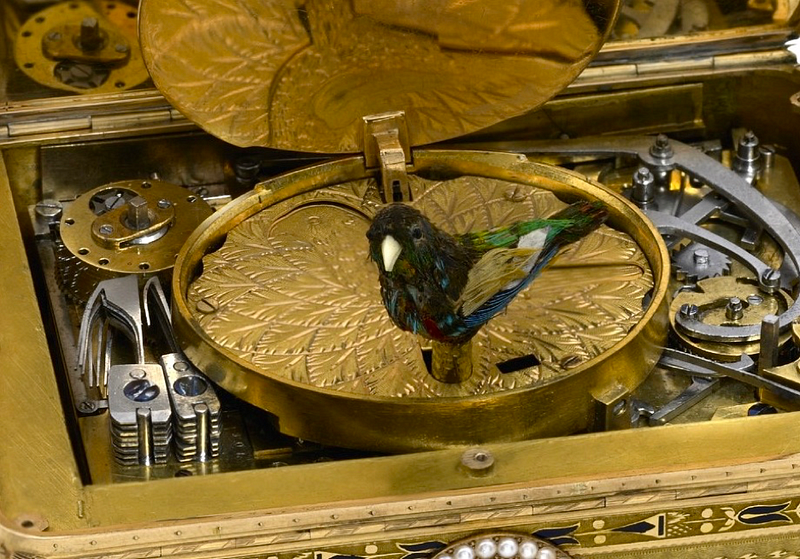
In the fourth stanza, he resolves: “I shall never take / my bodily form from any natural thing.” It would be better that his soul were placed in some work of art, like an exquisite mechanical bird “of hammered gold and gold enamelling” that is “set upon a golden bough to sing / to lords and ladies of Byzantium.”
Following from Elder Olson’s summary in An Outline of Poetic Theory, the poem develops thus: the first stanza rejects passion and sensuality; the second stanza accepts that art can also have soul; the third stanza rejects the imprisonment of the soul in a body that must die; and the fourth stanza accepts that ensoulment in an incorruptible art work is to be desired. There is an alternation: out of passion, into intellection, out of impermanence into permanence. Passion must be condemned before the intellect can be esteemed; the intellect must be invoked in order to understand that art can have soul; this in turn leads to the realization that the body may be dispensed with, and reincarnation of the soul in some changeless medium is possible.
And here is the soul’s proper country, Byzantium. As R. P. Blackmur states in The Later Poetry of W. B. Yeats, “Byzantium is for Yeats, so to speak, the heaven of the mind; there the soul dwells in eternal or miraculous form; there all things are possible because all things are known to the soul.”
I am indebted to the following sources; please read them further.
W. B. Yeats, The Collected Poems of W. B. Yeats, The Macmillan Company, Toronto, 1956
W. B. Yeats, The Autobiography of William Butler Yeats, Macmillan Publishing Co., New York, 1965.
Peter Ure, W. B. Yeats, Grove Press, New York, 1964.
John Unterecker. A Reader’s Guide to William Butler Yeats, Farrar, Straus and Giroux, New York, 1959.
Humphrey Carpenter, A Serious Character: The Life of Ezra Pound, Bantam Doubleday Dell Publishing, New York, 1988.
Elder Olson, An Outline of Poetic Theory, The Ronald Press Company, New York, 1949.
R. P. Blackmur, The Later Poetry of W. B. Yeats, The Ronald Press Company, New York, 1949.


