
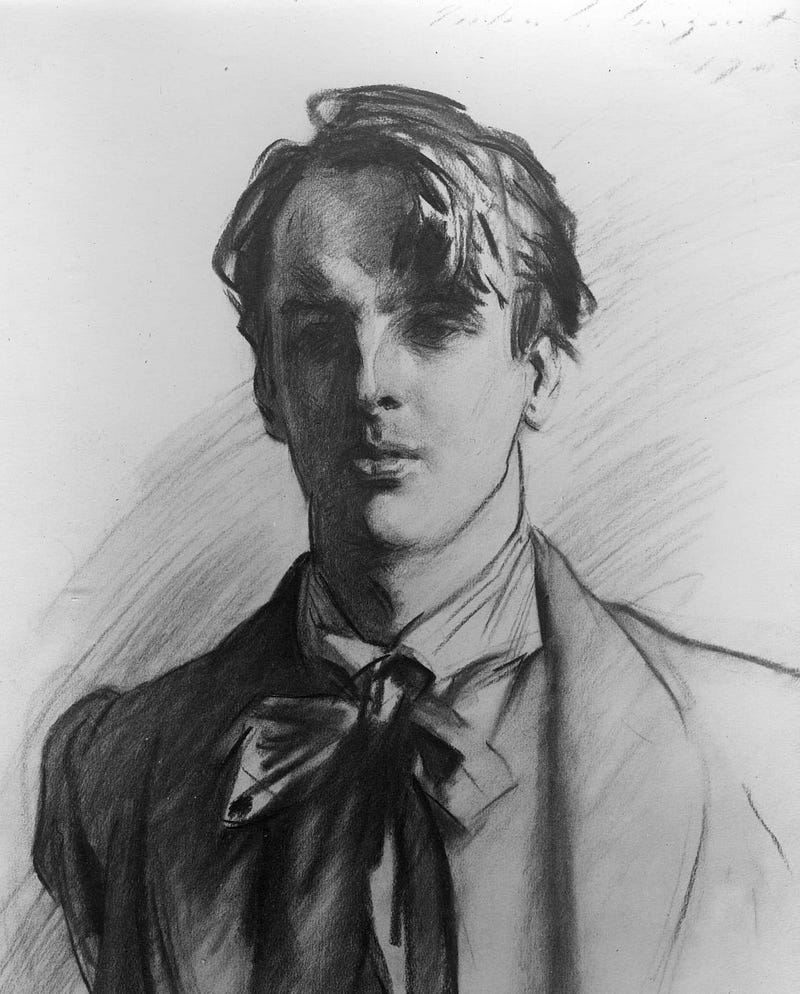
Yeats at Midlife
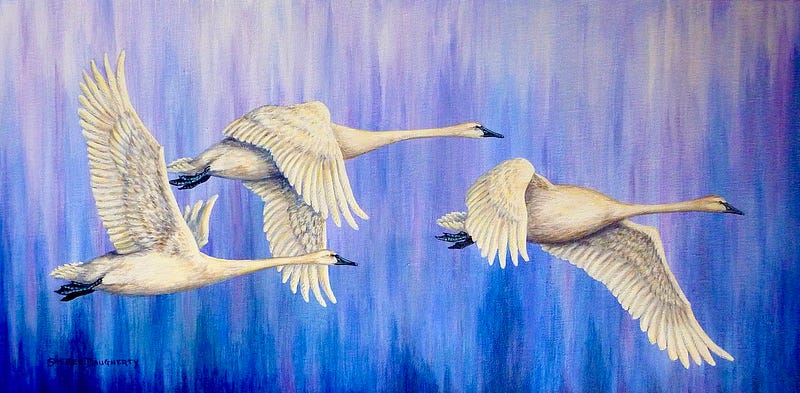
The Wild Swans at Coole
William Butler Yeats is, without a doubt, one of a handful of poets who can rightfully lay claim to greatness. Certainly among the 20th-century’s top poets, Yeats won the Nobel Prize for Literature in 1923, though some of his greatest work was written later. His poetry continually evolved during his life. His early works were Romantic, deeply informed by Irish folklore; his mature, later-life major works bore the Modernism stamp of the new century, but still maintained the originality and point-of-view that characterized his earlier work. In fact, he can lay claim to having bridged the gap between late nineteenth-century Romanticism and early 20th-century Modernism.
While often thought of as quintessentially Irish, Yeats belonged to the Protestant Ascendancy, the Anglo-Irish minority. His ancestors and neighbors, living in what is now Northern Ireland, for the most part considered themselves English people who happened to have been born in Ireland. This group of expatriates had dominated the economic, political, social, and cultural life of Ireland since at least the end of the 17th-century. But nonetheless, English roots and all, Yeats considered himself Irish, and proudly proclaimed his Irish nationality. In fact, Yeats celebrated his Irish-ness, and featured Irish legends and heroes in many of his poems and plays, especially his earlier works. But even though he felt himself to be Irish, in his heritage were the seeds of some conflict, and he was — in some circles — viewed as an elitist and somewhat of an interloper, his good Irish intentions notwithstanding. His commitment to Ireland was ultimately recognized, and, in his later years, he served two terms as a Senator of the Irish Free State.
As he embraced all things Irish, it was inevitable that he would encounter the Irish Republican movement and its many flamboyant and historic protagonists. One such Irish nationalist — Maude Gonne — would become a major influence in his life, a muse to Yeats, much like Beatrice was to Dante. She was striking in every way — tall, beautiful, confident, a woman of considerable social standing. Educated and raised in Paris, Gonne was the daughter of an army officer, and became one of the leading Irish Nationalists, outspoken and passionate about Irish politics.
They first met in 1889, and, after spending only nine days with her, Yeats fell madly in love. Maude was the inspiration for much of Yeats’s poetry in the years following their meeting, and she even starred in a play he had co-written with her in mind, “Cathleen Ni Houlihan.”
Over the years Yeats pursued her, even though she had declared their relationship to be platonic. Undeterred, Yeats proposed marriage in 1891, and three more times: in 1899, 1900, and 1901, but to no avail. Gonne rejected him, and went on to marry the Irish nationalist Major John MacBride, who was later executed in Dublin in 1916 for his part in the Easter Rising.
Maude Gonne was not the only woman to leave a mark; Yeats was also profoundly influenced by Isabella Augusta, Lady Gregory. Her home at Coole Park in County Galway was a meeting place for Irish literati. She was an Irish dramatist, folklorist and theatre manager, though she is mainly remembered for her work in creating and promoting the Irish Literary Revival. With Yeats and Edward Martyn, she co-founded the Irish Literary Theatre and the Abbey Theatre, and wrote works for both companies. Like Yeats, she was a member of the Protestant, Anglo-Irish minority; also like him she turned against the British, instead espousing Irish cultural and political nationalism.
Over the years, Yeats was to spend many summers at Coole Park: his first sojourn there took place in the summer of 1897. During that time, his work with Lady Gregory was productive, and the theatrical and other literary works that they created and promoted were significant to the utmost. But, as the years wore on, Yeats’s worldview evolved, partly due to his association with Ezra Pound, who he first met in 1909, but didn’t get to know well till 1912. Ultimately, Yeats became quite friendly with that iconoclast of Modernism; Pound served as Yeats’s secretary and the two lived together for three winters (1913–1916) at Stone Cottage near the village of Coleman’s Hatch in Sussex. Pound tells of how he remembered sitting in the second floor of the cottage and hearing Yeats chant his poetry in the room below — the chimney carried the Irish poet’s voice up to Pound, who was working on his Cantos, above. Pound’s Modernist influence on Yeats is apparent, especially in Yeats’s image-rich late-life masterpiece, The Tower. What’s more, Pound and Yeats joined forces to promote and encourage another up-and-coming young Modernist Irish writer, James Joyce.
The years from about this time onward were chaotic. The “terrible beauty” of the Easter Rising of 1916 had occurred, with its shocking execution — by the British — of the movement’s ringleaders, one of whom was Major John MacBride, Maude Gonne’s husband. During this galvanizing period Yeats once again proposed to Maude, and was finally rejected. In his desperation and confusion Yeats asked Gonne’s half-his-age daughter, Iseult, to marry him; but she also turned him down. Yeats married another woman Georgie Hyde-Lees within a month of his double rejection, but his heart was always with Maud Gonne. Despite this, and the fact that Yeats was 25 years older than his new wife, they enjoyed a happy marriage and had two children. “George,” as she called herself, persuaded Yeats to join the Golden Dawn, a mystical society, and together the two explored automatic writing and all things extra-worldly. Yeats, who was a fervent believer in the occult, even went on to write what would become his mystical manifesto, A Vision.
During this time things at Coole Park were also in disarray. Lady Gregory had fallen ill; the future of her estate at Coole Park was in jeopardy; and, in what was a devastating blow, Lady Gregory’s son, Robert, was killed in action, inspiring two of Yeats’s finest poems, “An Irish Airman Foresees His Death,” and “In Memory Of Major Robert Gregory.”
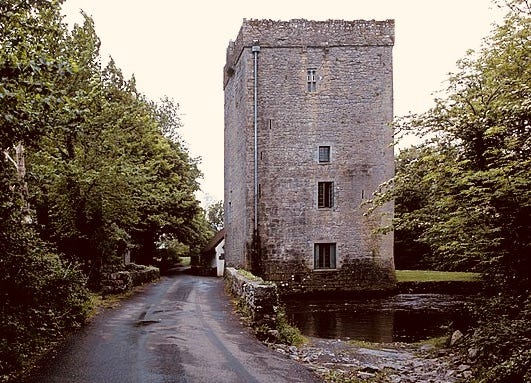
Also during this tumultuous period, Yeats had purchased Thoor Ballylee, the Norman castle-tower not far from Coole Park, and which would become his home, his poetic center, and one of the most substantial symbols of The Tower and much of his later work.
Even more disconcerting to Yeats, he felt that he was getting old, that his best days were past. It is against this background that the poem, “The Wild Swans at Coole,” was written.
The Wild Swans at Coole
The trees are in their autumn beauty, The woodland paths are dry, Under the October twilight the water Mirrors a still sky; Upon the brimming water among the stones Are nine-and-fifty swans.
The nineteenth autumn has come upon me Since I first made my count; I saw, before I had well finished, All suddenly mount And scatter wheeling in great broken rings Upon their clamorous wings.
I have looked upon those brilliant creatures, And now my heart is sore. All’s changed since I, hearing at twilight, The first time on this shore, The bell-beat of their wings above my head, Trod with a lighter tread.
Unwearied still, lover by lover, They paddle in the cold Companionable streams or climb the air; Their hearts have not grown old; Passion or conquest, wander where they will, Attend upon them still.
But now they drift on the still water, Mysterious, beautiful; Among what rushes will they build, By what lake’s edge or pool Delight men’s eyes when I awake some day To find they have flown away?
Written between 1916 and early 1917, when the poet was 51, the poem was first published in the June 1917 issue of the Little Review, and was the title poem in the Yeats’s 1917 and 1919 collections The Wild Swans at Coole. Formally, the poem is in five, six-line, roughly iambic stanzas, with the first and third lines in tetrameter, the second, fourth, and sixth lines in trimeter, and the fifth line in pentameter. The stress pattern in each stanza is 434353, and the rhyme scheme in each is ABCBDD.
The poem’s first stanza — almost Wordsworthian — calls to mind Yeats’s earlier poetry’s search for permanence in an idealized nature. The day-to-day cares of ordinary life are absent. The stillness of the sky — heaven itself — is mirrored in the water’s earthly semblance. The scene is set, the water and the sky reflecting a perfect unity, a cosmos inhabited by “nine-and-fifty swans.”
But, in the second stanza this idyllic scene is interrupted, overwritten by the poet’s voice, which carries through — in diminuendo — to the poem’s end. For the poet, time is fleeting, hurrying by, in marked contrast to the serene eternity of the “autumn beauty.” Yeats realizes that he is in the autumn of his life, a time to calculate what, if anything, he has accomplished. He asks himself: Is beauty possible, in a mutable world, seemingly hurtling by, out of control? How can he, a mere mortal, living only for a few brief moments in time, make something eternal a part of himself?
The third stanza continues to raise the issue of fleeting impermanence. “All’s changed . . .,” writes the poet. Does anything persist? At his first encounter, the birds mounted to the sky, scarcely before he finished counting them. Nineteen years later they still resist the mechanistic logic imposed on them by “counting.” What’s more, in the fourth stanza, the swans are “Unwearied still, lover by lover, / They paddle in the cold / Companionable streams or climb the air; / Their hearts have not grown old.” Unlike Yeats, their offers of love have not been repeatedly rejected; like him, fire still burns in their hearts.
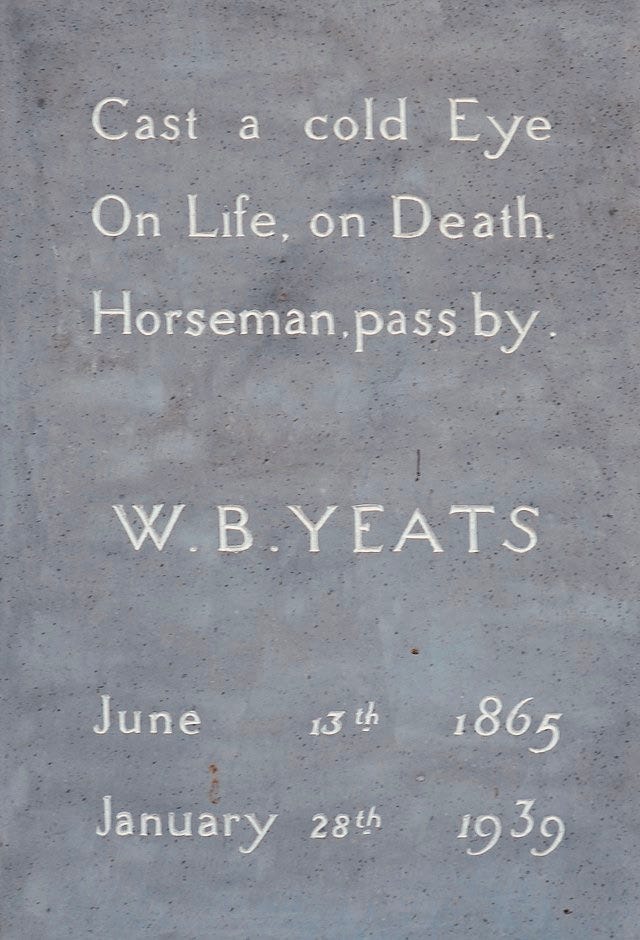
By the final stanza, the poet’s voice has become distant, impersonal, almost absent. But the poet, and the poem, reach resolution. In the end, Yeats realizes that his days too will come to an end, his swans will fly away. Yet, in this poem, their image — and by extension, his experiences — will persist. Art, especially poetic art, lives at the intersection of the human and the divine. To the mystically-minded Yeats, life and death are transients, like shadows flitting across the face of eternity. Art alone endures.
For Yeats, the swans themselves provide the key to connecting life’s flux to the eternal. Though existing in time, like the poet, they have gone beyond time, and have ascended to everlasting Beauty. Yeats reveals his epiphany: Beauty doesn’t somehow exist attached to the eternal as a separate entity. Beauty, like Truth, emerges fully formed into being when the eternal and the temporal come together, when they interact. We do not merely admire eternity; we create it by contemplating the eternal, and, persisting, like the swans at Coole, in fellowship, facing an unknown future.
I am indebted to the following sources; please read them further.
W. B. Yeats, The Collected Poems of W. B. Yeats, The Macmillan Company, Toronto, 1956
W. B. Yeats, The Autobiography of William Butler Yeats, Macmillan Publishing Co., New York, 1965.
Peter Ure, W. B. Yeats, Grove Press, New York, 1964.
John Unterecker. A Reader’s Guide to William Butler Yeats, Farrar, Straus and Giroux, New York, 1959.
Humphrey Carpenter, A Serious Character: The Life of Ezra Pound, Bantam Doubleday Dell Publishing, New York, 1988.


