Nifty Ontology
Proof of the Moon
And me
I was chatting with my two little buddies the other day — talking a little of this, a little of that. At one point, one of them looked up and said, “Stephanie, do you think we really landed on the moon?”
This took me by surprise. I’d never thought about it before. I’d always just assumed we’d landed on the moon. The first landing happened when I was four and my mom and I watched it on TV together.
I looked from one buddy to the other. They looked back at me with gravity. This created a nagging feeling in me. We might think kids don’t know about consequential things, but this isn’t true. How much do I know about Roblox, for example? Not one thing. Those two know everything about Roblox. My point is, even though these two child friends of mine aren’t aerospace engineers, they know things.
After the three of us parted company, I went straight to the internet, where you can find information on anything from whichever angle sounds super cool to you in an unbelievable sort of way. I scrolled and clicked and scanned and got sidetracked, then got back on track — and there it was. We had NOT gone to the moon. It had all been a hoax — the American flag con, the whole shebang.
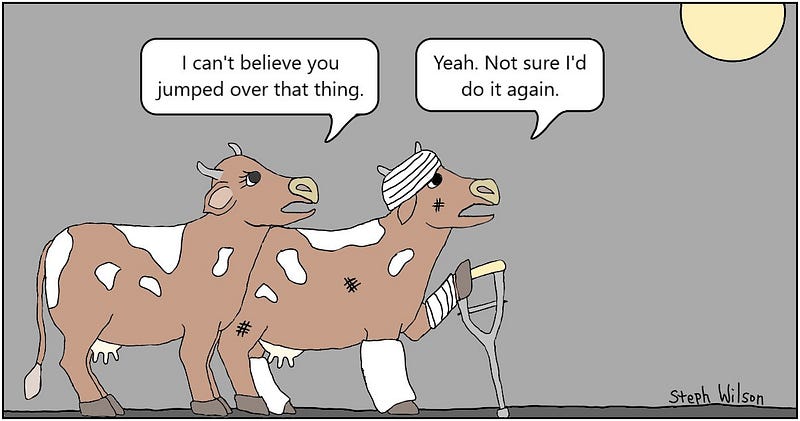
Holy Cow — who apparently didn’t jump over the moon either — we never landed on the moon?
Really?
Apparently.
This gave me pause. If we hadn’t gone to the moon, how could we even be sure the moon existed? This was a harrowing thought. I’ve always loved the moon. Had I been loving a complete fabrication? There was no solid proof now since — apparently — we’d never touched it with our gloved astronautic hands, nor stood on it with our booted astronautic feet.
Then a far worse thought crept into my brain, like an evil slug on a sinister mission.
Did I exist?
Oh, I can’t describe the feeling I had at that moment. It was as if the last domino of my own personal civilization was teetering precariously. If this beautiful poem of a moon that I’ve loved with all my heart is a fake, what does that say about anything or anybody? Is this all just a cruel joke? What do we truly know for certain about what’s real and what’s not?
These were such horrible allergic thoughts.
I sneeze at you, Philosophy, and your demonic slugs.
I was crushed, because the one thing I’ve always wanted to be since I was a baby was real. I couldn’t imagine being anything else. The seriousness of the situation lit a grim and weighty flame under my potentially unreal bottom to go forth with courage and seek the truth.
Rocket science
You could call it a moon landing on myself to verify me — foot and flagpole tested. If I found that I existed, there might be hope yet for the moon. Not to be a jerk, and it’s good to be positive, and we must let bygones be bygones, but it sure would have been nice if NASA had done its job long ago and landed on the moon. What a hassle.
The first thing I’ll say about trying to determine your whereabouts in the scheme of reality — it’s rocket science.
The first thing I did was pinch myself. Why not test methods tried in the past? First, I pinched my nose, but that got me nowhere. I couldn’t detect a change in olfaction. This could be from Covid, or it could be from non-existence. I moved on.
I pinched my butt. That’s something folks do a lot, especially to elicit a response. If I responded, it stood to reason I was real and my birth wasn’t a sensational deceit. I pinched and squeezed. I grabbed and patted. I think I felt something, but it was hard to say. Lately, I’ve been sitting all day producing this highly meaningful writing, so my butt’s gone numb. This factor might have interfered with the test. I moved on.
What if I could see myself in some evidence-based way? Good idea! I ran over to the wall mirror and stood in front of it. I moved out of view of the mirror, then slowly inched my head back into view. I smiled, then frowned. I stuck my tongue out. I pushed up the tip of my nose to make a pig snout.
But seriously, was this really me? Are mirrors just working for the tricksters? I decided to seek other feedback than just my own, or the mirror’s, which I now found to be questionable. This is when things really got depressing.
I walked into the kitchen where my boys and husband were discussing physics, chemistry, and AI. They all seemed verifiable. I heard their overly loud chatter. I saw them make a mess of my kitchen. I smelled their food cooking.
Then I tried to verify me. I walked right past each of them and stood not a few feet away. Did one of them notice? Not a one. This was telling, and not the result I wanted. I went further. I spoke up and asked a question. What happened? Not a thing.
Not good
It had to be considered I might not be real. I did not want this to be true. I’m a self-scientist, which means I do my own science on my own terms using my own parameters and synthesizing my own conclusions. Self-science is about believing what catches your eye. Right then, my existential deniability was catching my eye.
I walked out of the kitchen disappointed in my self-testing, but I knew I had one last angle from which to approach this problem. The flagpole test.
I would need a smaller flagpole than the one you see in the photos of the prank Apollo 11 mission — something I could plant on my body to claim its realness.
I’m a scaredy cat when it comes to bodily pain, so I made a concession and fashioned one out of a straight pin. I cut out a teeny rectangle of paper and drew a teensier American flag on it. I taped it to the top of the pin, and then took a deep breath to prepare myself for the final moment of my own moon landing. I’d be Armstrong-Aldrin raising the flag on my own lunar existence.
I waffled for a moment, vacillated between wanting to know the truth and not wanting to stick a pin in my toe. Truth won.
I squeezed my eyes shut and poked the giant callus on the side of my big toe with the American flag.
“OOOOUUUCCCHHHH!!!!”
Then out of nowhere shot my family from the kitchen.
“What happened??!! Are you okay?!!” they screamed.
My eyes popped open. I looked at them, then looked at my toe. The American flag had hardly pierced the callus, but the pain was real. My family was hovering over me looking at me.
You know what this meant?
I existed.
Folks, it was one small step for me, but a giant step for mankind. Why? Because all of you might exist now, too.
I have friends who work for NASA, whose science experiments are shot up to the ISS in rockets, who spend their careers trying to solve all those vexing astro problems. I have no way to verify whether they’re doing what they say they’re doing, but I don’t worry. There’s no doubt in my mind they’re using straight pins in their research. You can’t imagine the peace of mind this gives me in such an unverifiable world.
Thank you, Andrew Rodin, for editing this. You’re so supportive! :-)