GOLD STANDARD
FOOD: A DIY Clinical Study
From the semi-methodical sciences
Trigger Warning: This article describes a scientific methodology that could lead you to believe I’m more creative than you. I’m likely not, but after this study, I’m probably hungrier.
BACKGROUND
I follow a low FODMAP diet. It’s to help with gut issues. FODMAP stands for Fermentable Oligosaccharides Disaccharides Monosaccharides And Polyols. That’s a mouthful, and it sure would be if you had all of them in your mouth at once, but the idea is to test each food separately to see if it bothers you.
It’s a process of elimination — what bothers you, what doesn’t. It’s best to eat what doesn’t bother you. Some folks get confused. Food is confusing!
Some food you should eat, some you shouldn’t. What does edible mean? Am I eating right now? Because it feels like something is happening in my mouth while my mind is in a terror with Stranger Things on TV.
Further, is food just a ruse for bad actors? Here, put this in your mouth at this swanky table for two while we launder money in the back for Al-Qaeda. See what I mean? Food can be bad.
No, that’s silly. Food isn’t bad. It’s sustaining, artful, and communal. Yet, even if it isn’t bad, it sure needs a solution, because it’s one big conundrum. Due to my success with the FODMAP diet, I theorized that a process of elimination could be successfully applied across the population. There was only one way to find out — test it.
Now, I’m no fancy food scientist. I’m no doctorate of the gut biota. I’m not even a good cook. Instead, what I can do is DIY, as I’m an accomplished DIYer. By leveraging this expertise, I designed and implemented a study on what food might be.
METHODS
Research Strategy
I used a randomized double-blind placebo-controlled study because this title had a nice ring to it, and the word ‘blind’ doesn’t have any bearing on taste to my knowledge. The test foods were carefully chosen by flipping through an antique dictionary blindfolded and sticking my finger on potential foods. This took quite some time, as I’d point to words like “gargantuan” or “tremor” which you can’t eat. Eventually, I relented and allowed some test foods into the study that aren’t relevant, but my time is relevant. I did not have all day for this detail crap.
Eligibility Criteria
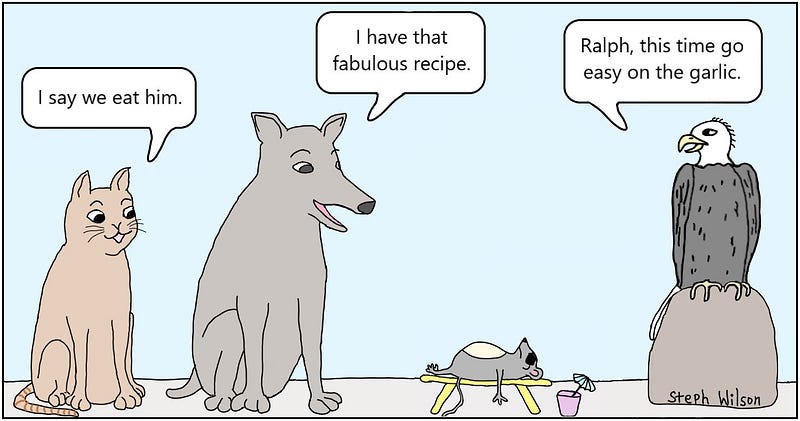
Study subjects needed to be able to eat the test foods with minimal trouble or complaint, as I wasn’t going to babysit anyone. I chose myself, Kitten, Mocha, Gus, and my husband. Kitten is my cat. Mocha is the Brittany Spaniel across the street. Gus is the Golden Doodle next door. My husband is the guy whose frying pans I clean. These four have historically eaten anything put in front of them.
Preliminary Discussion
I gathered my cohort and explained the study parameters.
“We’re doing a randomized double-blind placebo-controlled test. This is the gold standard. Does anyone know what that means?” The dogs stood there with eyes that looked both dumb and inviting. Kitten wasn’t paying attention at all. My husband smirked because his background is real science as opposed to DIY.
“Stephanie,” my husband offered unnecessarily, “nothing about this is gold or standard.”
“Anyway,” I said, “This means you will eat what I give you, no questions asked. It also means what you eat might help you or it might not.”
“What does that mean?” asked Mocha.
“It means it might be healthy, or it might kill you.”
The four-legged snapped to attention. I chuckled.
“Just kidding.”
Administration of Test
The study took one week. The cohort met as a group twice a day for meals. Each member received one food type per day, blindly selected from a box. Observations of the effect of each meal were recorded at 24 and 48 hours. A follow-up interview was conducted at two weeks to discover any residual effects — or fatality, in case.
“Just where do you expect this ‘gold standard’ to be published?” my husband asked on Day 1.
“In the Journal of Food Isms.”
“I can’t decide if that’s funny or absurd,” he said.
“We’re about to begin, honey. Can you sit down with the others?”
My husband plopped down reluctantly on a patio chair next to the rest of the cohort.
RESULTS
The study showed some foods to be well received by the cohort, while others were rejected outright. There was wide variation.
For example, vodka. Largely, the cohort rejected this food, with Mocha the only one who repeatedly accepted it. He displayed common symptoms associated with vodka, and these persisted past 24 hours, which was noteworthy as well as entertaining. He barked like a car motor that won’t turn over. Also, he wouldn’t turn over, let alone walk. Residual GI issues were moderate.
Dead mice appealed to 10% of the group and were vociferously rejected by another 10% [my husband]. The remainder sniffed at it and walked away. The moment I was receptive to eating it in the hypothetical, I dry heaved and walked away, too. For the cohort member who ingested the dead mouse — actually, five mice — no symptoms were noted. This food correlated with a significant positive effect on this study subject.
Ice cream was the winner across the cohort — with group members licking clean the containers. Unfortunately, my husband went and bought more of this test food, then shared it with the cohort when he thought I wasn’t looking. I had to scratch this food from my results.
Fabric softener dryer sheets. Due to the confusion in the public over detergent pods’ nutritional value, I thought it important to test other potential edibles in the laundry room. The cohort spent considerable time determining whether this food was a food. Study subjects pushed the sheets around on the ground, looked underneath them, sniffed at them, and tentatively stuck their tongues on them. No one in the cohort tried to ingest. Further study is needed on remaining items in the laundry room to be able to say with certainty whether this room has food.
Pan-seared salmon was expected to agree with the gut across the cohort, and it did. Eating time was extremely quick. No GI issues were noted. The cohort complained the portions were too small, or “shrimpy”.
Conversely, the group had trouble with live fish bait. Except for the human members of the group — who refused to even touch the bait — study subjects showed disturbed gastrointestinal symptoms before 24 hours. One member regurgitated some of the bait, which was still wiggling upon expulsion. The two canines followed the bait that wriggled off down the driveway with great interest.
Lucky Charms cereal had high agreeability with the study author’s husband and the Golden Doodle, both of whom begged for additional meal portions from the researcher — which was not given. No GI trouble was noted.
Sand. I tested sand because folks will spit it out when it lands in the mouth. To determine why this is, I included this food in the study. I also randomly landed on ‘sand’ in the dictionary. Sand proved to be a detriment to the cohort’s teeth and was an irritant to the roof of the mouth. This might be why everyone spit it out quickly and well perturbed.
CONCLUSION
My findings did not answer the initial question of what we should be eating. Instead, they gave insight into what cues us to food. My observations showed that we believe food is what sits on a plate, in a bowl, on the ground, but mostly in your neighbor’s bowl. Primarily, we believe food is what the rest of the social unit is inhaling. Further study is needed to determine why we trust these food indicators. My study showed ice cream is a universal food, and sand is not.
Thank you, BOFace, for editing this. You da best.
If you’re not a member of Medium yet, check it out: