
Pro-Israel Groups Tried to Get Me Fired
Instead, they taught me the value of free speech
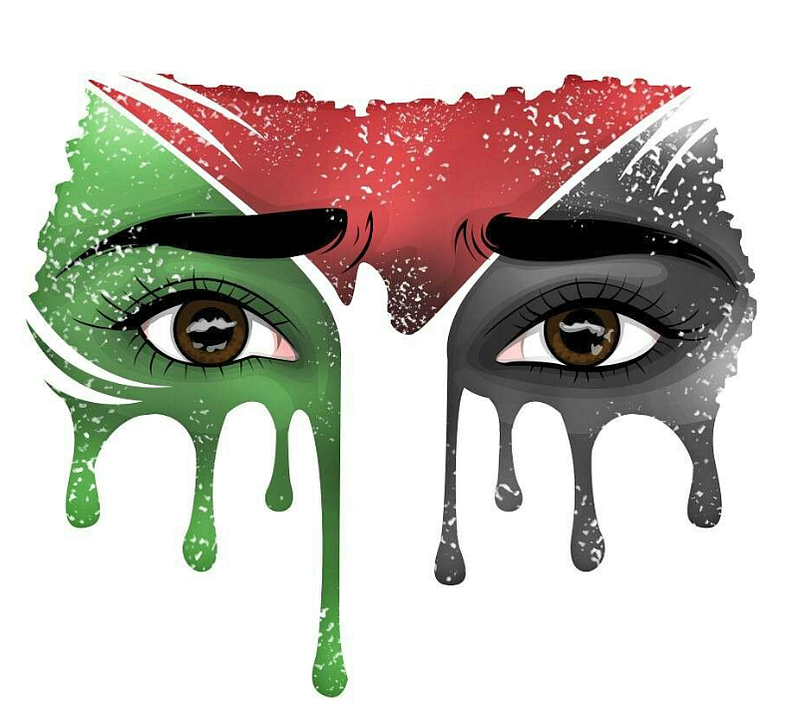
February 2017 marked a turning point in the history of Palestinian activism within the UK. During this tumultuous month, Palestinians and pro-Palestine activists were overwhelmed by an unprecedented flurry of event cancellations and attacks on their right to protest against the occupation. February 2017 also marked a turning point in my own involvement with Palestine and free speech. I had arrived in the UK in the summer of 2015 to begin teaching at the University of Bristol.
My peripatetic academic career had carried me from Damascus to Berlin and finally to Palestine and Israel. From 2010 to 2011, I commuted between Palestine and Israel several times a week. I lived in Bethlehem in the West Bank, across from the apartheid wall, along which I walked on my way to the Van Leer Institute, where I was a postdoctoral fellow.
The Van Leer Institute is centrally located in the historic Talbiyya district of West Jerusalem. In another era, thirteen years before the founding of the state of Israel in 1948, Palestinian American critic Edward Said was born in this neighborhood. His cousin abandoned the family home in 1948, just after it fell to the Zionist paramilitary Haganah, cutting Said’s ties to his homeland forever.
Now, many decades later, the Van Leer Institute has played a pivotal role in debates around definitions of antisemitism. In 2020, it served as the virtual and physical venue for the drafting of the Jerusalem Declaration on Antisemitism (JDA) and hosted many events to support its dissemination, as a way of countering the much more insidious IHRA definition. The association is not accidental. The Van Leer Institute is perhaps the most progressive institution in the Israeli scholarly landscape. Yet it too is embedded into the infrastructure of settler colonialism.

Although the Van Leer Institute was located just a few kilometers from where I lived in Bethlehem, the commute took several hours. Every morning when I had to travel into Jerusalem, I waited in line with restless and sleep-deprived Palestinian workers at the infamous Checkpoint 300.
While standing in line, I would often observe the preferential treatment that I, as a foreigner, experienced from the Israel Defence Forces (IDF) — now rightly called the Israel Occupation Forces by many — soldiers guarding the checkpoint. The contrast between their treatment of me and natives of Palestine was impossible to ignore. Israeli soldiers allowed me and other foreign passport holders to pass quickly through the metal detectors behind which Palestinian workers often had to stand for hours on end, causing them to be late for work and to lose out on vital income.
Double standards were everywhere on display. The metal barricades behind which we waited had separate rows for foreigners and Palestinians. Different policies are applied to each row. During certain hours, only foreigners could stand in line. It should not be hard to guess which rows required the longest wait.
Rarely had I seen discrimination so blatantly on display. I documented these scenes in a few stanzas I wrote at the time:
Workers greet the dawn
behind the bars of Checkpoint 300,
waiting to build settlers’ homes
with stolen limestone.
I called this poem “Stolen Limestone,” referring to the alabaster facades of the many buildings that gleamed across the hills of Bethlehem and the neighboring town of Beit Jala on my way to Jerusalem. These buildings were constructed by badly remunerated Palestinian laborers, who had to stand in line for hours at checkpoints just to reach the buses that would take them to work.
“Stolen Limestone” dwells on my complicity within the apartheid system that was developing at the time of my residence in Bethlehem and which has become even more entrenched in the years since my departure.
Living in Occupied Palestine
Although I had witnessed the carnage of war firsthand, the daily insults and humiliations of Palestinians that I witnessed in the occupied territories made me sick.
I wanted to see Palestine — and to live there — firsthand. A five-year fellowship in Jerusalem would make it possible for me to live in Palestine, specifically in nearby Bethlehem in the West Bank, just a few kilometers away.
A friend of mine had recently returned from Bethlehem, and she arranged for an apartment where I could stay. It was potentially a life-changing opportunity to live in Palestine for the long term. I was sympathetic to the boycott, but I also felt that I could best contribute to these issues by witnessing the occupation firsthand and by living it — even if only temporarily.
When it awarded me the fellowship, the Van Leer Institute had no idea that I was planning to live outside Israel and commute into Jerusalem. By the time I arrived in Jerusalem and told them that I would be living in Palestine, it was too late for them to refuse my request. Unlike Israelis, I was legally permitted to reside in the occupied territories. Unlike Palestinians, I could enter Jerusalem without seeking special permission.
These frequent commutes through congested checkpoints and the exposure to two radically different geographies that abutted each other led me to view the occupation in an entirely different way. This firsthand experience of the occupation intensified and justified my support for the boycott. Until I arrived in Palestine, my support had been based on secondhand information.
For too long, I had both observed and inhabited the bubble in which Israelis live while their Palestinian neighbors experience infinitely greater levels of economic deprivation, unemployment, and violence due to Israeli policies and prejudices.
I lived just blocks from the wall that was being constructed by Israel on a security pretext, even though it ran directly through Palestinian territory. Homes had been cut in two by this stone edifice. Commemorative plaques were erected over the rubble. A few years after I left Bethlehem, these bisecting walls would be memorialized in the Walled Off Hotel, an edifice initially set up by England-based street artist Banksy as a temporary exhibition, eventually becoming a permanent fixture of the occupation. I witnessed heavily armed IDF patrols in the streets, filling Palestinians with fear.
I could no longer justify living in — and receiving a livelihood from — this corrupt and discriminatory system. Although I had witnessed the carnage of war firsthand — I had visited Grozny soon after the city was flattened by Russian airstrikes in 2004 — the daily insults and humiliations of Palestinians that I witnessed in the occupied territories made me sick. I decided to end my fellowship for the sake of my own sanity.
Beyond Antisemitism, a polemic
Fear of being accused of antisemitism makes it difficult to speak out, and it is why so many of us who witness anti-Palestinian discrimination — Israelis and non-Israelis alike — keep silent.
It was during this time that I wrote a short polemic called “Beyond Antisemitism.” I was furious at myself — among others — for not being able to stop the abuses of history that had normalized the silencing of Palestinian voices. I sent it to the radical left-wing magazine Counterpunch. I received a response within hours from the journalist and editor, Alexander Cockburn. Cockburn liked it and said that he would feature it in the print edition.
“Beyond Antisemitism” argued that the long history of antisemitism and of the Holocaust forms the background against which Palestinian lives have been sacrificed since the creation of the state of Israel. I discovered this dynamic embedded in the everyday life of Israelis while commuting between my office in Israel and my Palestinian home.
The amnesia in which Israelis live reminded me greatly of my own education in the United States. The genocide of indigenous Americans was thoroughly suppressed in our school curriculums, and slavery was a delicate topic that our teachers avoided discussing directly. The traumas of Jewish history, and the understandable fear that this history might someday repeat itself, had similarly led to distortions and suppressions of the past.
Traumatic memories and the fear of their repetition haunted my conversations with Israelis. These fears fill the airwaves of Israeli radio and shape the cultural memory of the Israeli people. The Israeli state does everything it can to keep the focus on the historical trauma of the Jews.
Yet as Isaac Deutscher insisted in 1967, even when Israel’s leaders “over-exploit Auschwitz and Treblinka . . . we should not allow even invocations of Auschwitz to blackmail us into supporting the wrong cause.” “Beyond Antisemitism” was a polemic against the forced silences imposed by twentieth-century traumas, which deflect attention away from the occupation of Palestinian lands and the dispossession of the Palestinian people.
After a year of residing on the border between Israel and the West Bank, I was certain that there was no justification for the discriminatory checkpoints and segregated bus system, or the arcane system of passes and regulations that greatly restrict Palestinians’ access to employment and keep them in poverty.
While the collateral damage that these memories and fears cause for Palestinians was not forbidden from being discussed in Israeli public spaces, it was treated as secondary, as an afterthought to the more important themes of Jewish history. Meanwhile, alibis for and justifications of the occupation became increasingly untenable.
As Deutscher insisted, even invocations of Auschwitz do not legitimate oppression. Even the Jews’ long history of antisemitism — in which Palestinians were not directly implicated, yet which nonetheless shape the horizons of their political existence — is no excuse. That is why, I argued in 2011, we needed to move “beyond antisemitism.”
Soon after completing the article, I resigned from my fellowship and left Israel, never to return. Having vented my rage, I did not give that brief article further thought. It was a polemic, not a work of scholarship: a work of its time, and of my indignation, first and foremost at myself. Writing it was an act of self-denunciation, an attempt to clarify for myself what it really meant to cross checkpoints using the special lines designated for foreigners, and to witness racism and discrimination against the Palestinian population while biting my tongue.
Having purged my anger, I moved on to other things. I took up another fellowship at Central European University, then located in Budapest.
Finally, four years after composing that brief polemic, I moved to the UK to take up a position at the University of Bristol in southwest England, where I taught a standard fare of courses in modern languages: Translation Theory, Fourth Year Dissertation Seminar, Postcolonial Theory.
An unexpected visit from the past
Two years into my position at Bristol, I received a call in my office from the head of school. This was a rare occasion: indeed, she had never called me directly before. She asked me to meet her in her office as soon as I possibly could. She informed me that a student had discovered my 2011 article online, on the Social Science Research Network, a repository where I uploaded my work.
Among my hundreds of scholarly articles, the short polemic that I had called “Beyond Antisemitism” touched a nerve for the student, who identified as a Zionist. The head of school told me that the university had been informed that the student was planning to publish an anonymous letter in the student newspaper, Epigram, denouncing my article — and me — as antisemitic. The university administration had been informed of this by the newspaper editor. The administration hoped that the story would be quickly buried under other news and would not be picked up by the national media.
Back in 2017, accusations of antisemitism linked to Israel-critical speech were still relatively unusual in the UK. They have since become routine. We, however, were operating in uncharted territory.
Hopes that the controversy would soon pass were misplaced. A few weeks later, a reporter at The Telegraph who had made her reputation on clickbait stories accusing various academics of antisemitism, featured the student’s “discovery” of my article in a piece that bore the headline: “Bristol University Investigates Claims of Anti-Semitism after Lecturer Claims that Jews Should Stop ‘Privileging’ the Holocaust.” One thing I learned from this experience is that, when it comes to reporting, headlines often matter more than substance.
I was sitting in my university office when the phone rang. The reporter, Camilla Turner, asked if I had any comment about “Beyond Antisemitism,” which had been the subject of an anonymous letter in the student newspaper. I requested that she give me a day to respond. She refused, saying that the article was to be posted that evening.
So I conferred with the same friend who had found me a place to live in Bethlehem. Together, we combed through the writings of Edward Said, who had long been a guiding light for me, in search of words that could represent what I learned and saw while living in Palestine. My first port of call was Said’s classic essay “Zionism from the Standpoint of Its Victims” (1979).
Although the quote I provided to Turner was butchered, at least the core part of Said’s message made it into print. “Denying claims of anti-Semitism Dr Gould quoted Edward W. Said,” Turner wrote, and then went on to quote me quoting Said: “To oppose Zionism in Palestine has never meant, and does not now mean, being anti-Semitic.”
A tempest followed. In The Telegraph article about me, Conservative MP and newly appointed special envoy for post-Holocaust issues Eric Pickles accused me of Holocaust denial. He went so far as to claim that the author of “Beyond Antisemitism” should “consider her position” at the university, which was a polite British way of saying I should either resign or be fired.
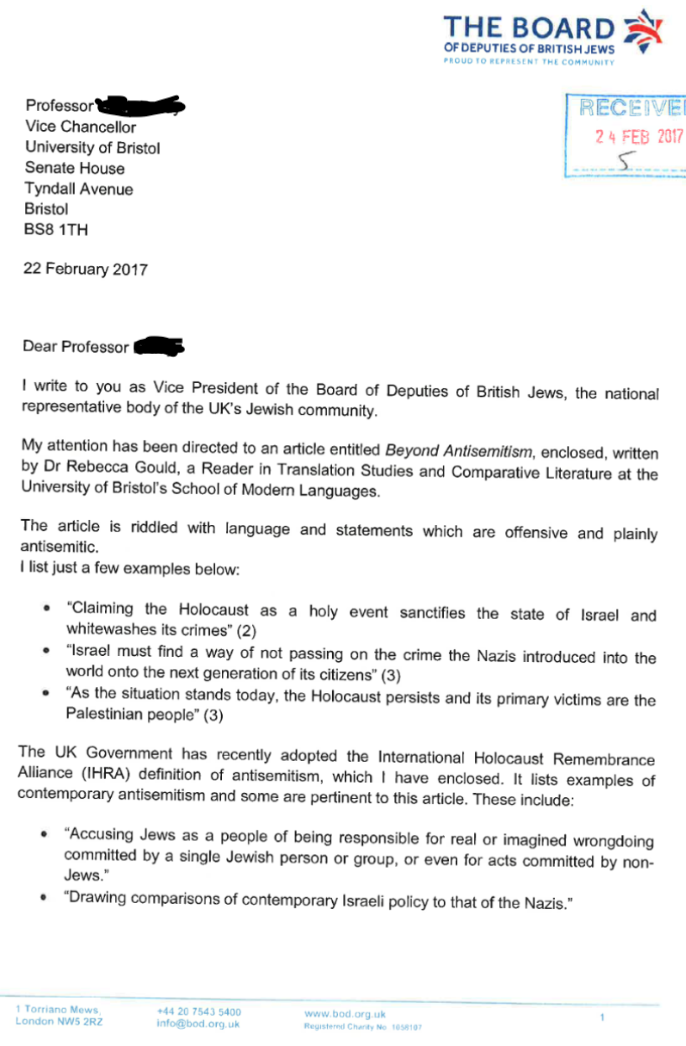
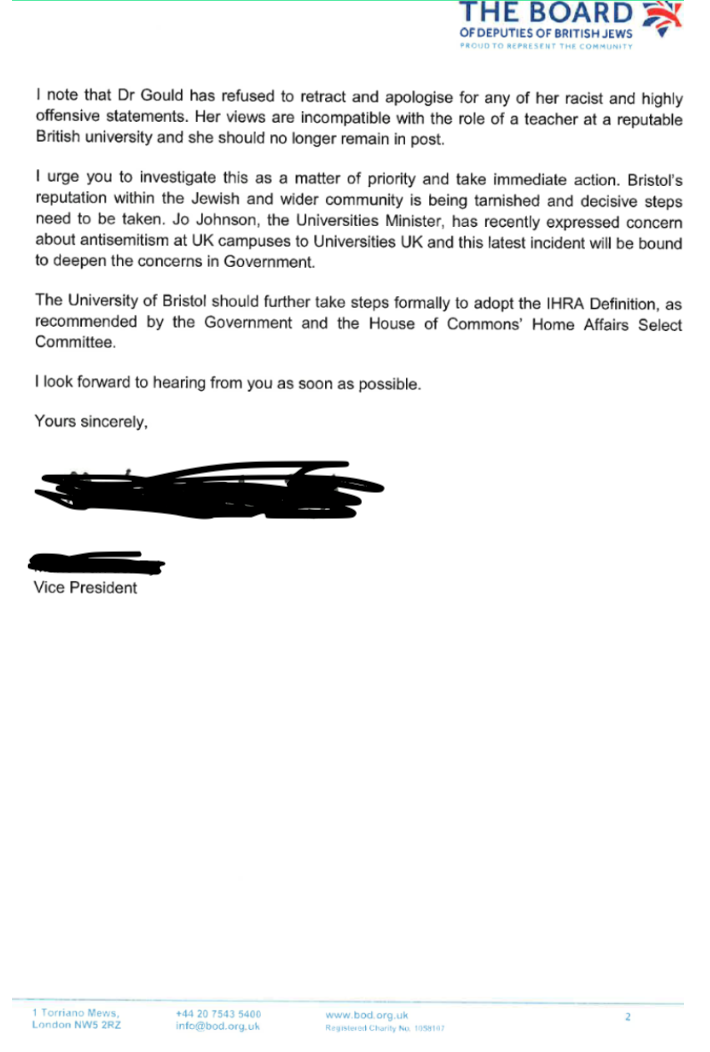
Even more astonishing, Pickles described my article as “one of the worst cases of Holocaust denial” that he had seen in recent years. The Board of Deputies of British Jews joined the chorus. The Board of Deputies wrote to the vice chancellor about me, claiming in a letter concealed from me by the university for many years, that my views were “incompatible with the role of a teacher at a reputable British university,” and insisting that I “should no longer remain in post.”
This letter was withheld from me for several years and I was not permitted to see it until I did a subject access request after leaving the university. After years of suppression, I am especially pleased to be able to publish it now.
The Board of Jewish Deputies before Zionism
Ironically, one hundred years earlier, in a radically different era, this same Board of Deputies that now called for my dismissal had been among the signatories to express concerns about the British government’s increasing support for Zionism.
In a controversial letter to the Times dated May 24, 1917, the Board of Deputies, together with the Anglo-Jewish Association, objected to the “Zionist theory, which regards all the Jewish communities of the world as constituting one homeless nationality, incapable of complete social and political identification with the nations among whom they dwelt.”
The signatories worried about the implications of conceiving of all Jews as members of a single “homeless nationality,” since this in itself might create “a political centre and an always available homeland in Palestine,” protesting “strongly and earnestly” against this theory. That letter from 1917 was to mark the end of the Board of Deputies’ acceptance of anti-Zionism as a legitimate position for Jews.
By 2017, the Board of Deputies had completely shed its past skepticism toward the Zionist project and wholeheartedly embraced a nationalist conception of the Jewish people, even lobbying for the dismissal of those who did not agree with them.
Refusing to compromise
What I witnessed while living in Palestine and commuting into Israel was no illusion, and my words were not fiction. I had to stand by them.
It was only a few weeks later that the identity of the student who had accused me of antisemitism was revealed in an interview he gave to the Huffington Post. The way in which he turned himself into the hero of the fiasco suggested something about his motivations from the beginning. In the interview, he said he did not want to see me fired. He speculated that I had only represented Israel in such a negative way because I had never before encountered a Zionist Jew like him. He expressed satisfaction at having played a role in my enlightenment.
I had worked in Israel for a year, and the article in question was written while I was living in Palestine, yet the student seemed oblivious or indifferent to these crucial facts. In this respect, his reaction correlated with that of nearly every other UK observer.
While the student was busy claiming the limelight for what he perceived as his heroic defense of academic freedom, no one asked for my perspective on these events. Media commentators showed little interest in learning about the Palestinians who were most severely silenced by the crackdown on Israel-critical dissent.
Time and again, reporters presented me with simplistic questions:
Would I retract my article?
Would I accept the right of the state of Israel to exist?
Would I acknowledge the legitimacy of Zionism?
In fact, there was nothing for me to retract. What I witnessed while living in Palestine and commuting to Israel was no illusion, and my words were not fiction. I had to stand by them.
What I learned about free speech
After a six month inquiry, the University of Bristol exonerated me. By that time, I had already found a better job at another university. I resigned without hesitation, and went on to become a scholar of free speech and academic freedom. I have even won grants on this topic. My research has benefitted significantly from the fact that I now know first hand want it means to be denied this vital human right.
This experience taught me to stand by my convictions, no matter how intense the pressure to force me to compromise or to retract my statements. I knew what I had seen. I had written accurately and with care about what was taking place before my very eyes in an apartheid state.
Assuming that we speak with conviction and after reflection, it is harmful to our selves and to our cause to back away from principled statements when pressured to for political ends. I am grateful that I did not give in.
In the end, I managed to weather the storm of being accused of antisemitism and to emerge with my life transformed yet still whole. The experience was not easy, and I would not wish it on anyone, but I am grateful that it gave me a direction in life.
For my writings on free speech and Palestinian liberation, see this list
For my writings on antisemitism and its weaponization, see this list
You can also join my Substack to be the first to get updates about my reading and writing: Textual Materialism | Rebecca Ruth Gould | Substack